How much does a collection agency charge? Usually a contingency fee — a percentage of what it actually collects, taken from the payment before the balance reaches the lender — and rarely one percentage. The same account carries a different rate at primary, secondary and tertiary placement, and a single contract can hold different rates for paid-in-full settlements, instalment plans, accounts the borrower pays the lender directly and accounts that go to suit. That is why the headline rate a lender negotiates tells it so little about the month’s cost, and why Botminds’ Collection Agency Management ties every line of every remittance file to a posted payment and to the fee rate the contract actually sets for that account on that date.
The worked figures below come from a fictional sample lender — Bellmere Bank, six invented agencies and one September remittance file — as the solution shows them. The bank, the agencies and the people are sample data; the public benchmark later in the page is real and linked.
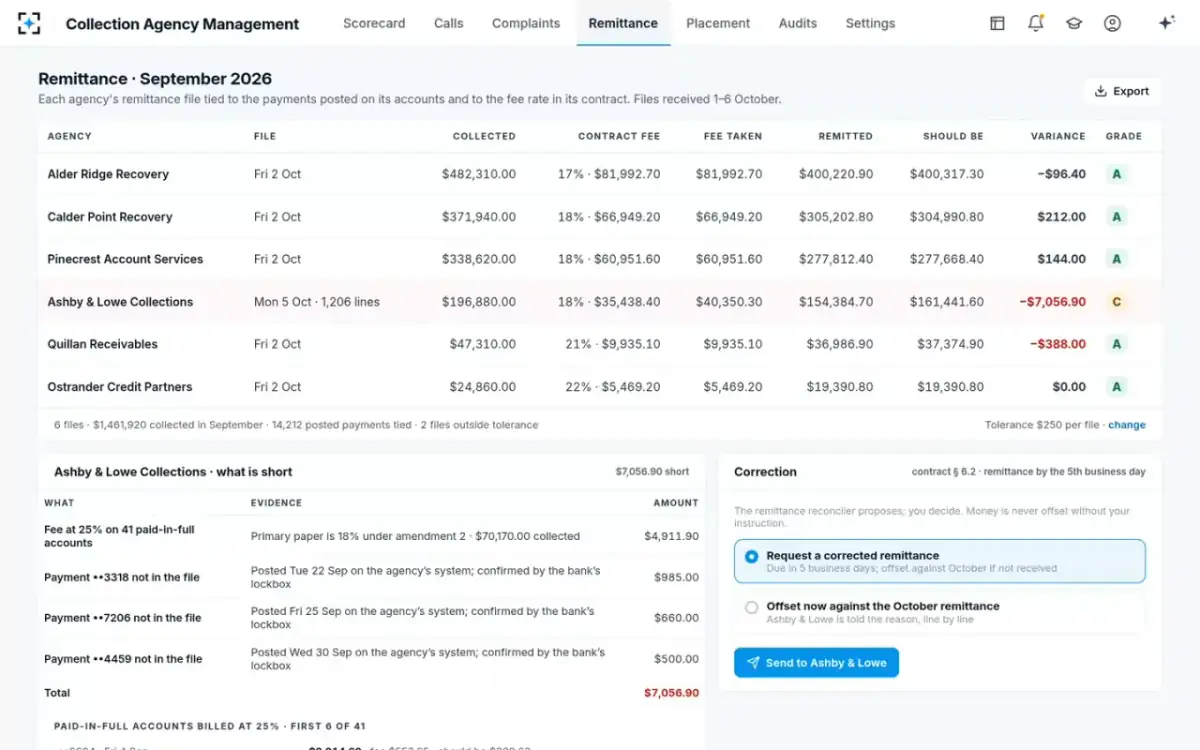
One agency’s September file, after it was reconciled line by line
$7,057
short across the file, against a $250-per-file tolerance
41accounts
paid in full and billed at the 25% secondary rate instead of the 18% the amendment set
3payments
posted on the agency’s system and confirmed by the lockbox, but absent from the file
How much does a collection agency charge?
The structure is simple and the arithmetic is not. An agency is paid a contingency fee: it keeps a percentage of what it collects and remits the rest, so it earns nothing on an account it never resolves. What the lender is really agreeing to is a fee schedule with several axes — the age of the paper, whether it is the first agency to work the account, how the money arrives, and what the agency had to spend to get it.
Three things move the percentage in every contract worth reading. The first is placement stage: older paper that one agency has already failed to collect is worth less, so the next agency charges more. The second is the balance band: small balances cost nearly as much to work as large ones, so some schedules price them separately. The third is the route the money took — a payment the agency negotiated, an instalment plan it set up and services, a settlement at less than the full balance, and a payment the borrower sent straight to the lender are often four different fee events.
There is no honest public average for commercial contingency rates. The figures that circulate come from vendor and trade surveys rather than from a regulator or a peer-reviewed study, and a lender that benchmarks its panel against them is benchmarking against an advertisement. What exists publicly is a statutory ceiling in one well-documented programme, and the arithmetic of net back — which is the comparison that actually matters.
What percentage do collection agencies take, and why the number moves
The percentage is taken from the gross payment, not from the balance, and that is the first thing to get straight when reading a proposal. On a $1,000 payment at an 18% rate, the agency keeps $180 and remits $820. On a half-balance settlement of $500 at the same rate it keeps $90 and remits $410, so a lender that measures an agency on gross collections has not yet measured anything it can bank.
What reaches the lender from $1,000 collected, at the six contracted rates on one panel
That comparison is the useful one, and it cuts against the instinct to negotiate hard and then stop looking. Five percentage points separate the cheapest agency on the sample panel from the dearest. Seven separated the rate that was billed on 41 accounts in September from the rate the contract set — $70 on every $1,000, or $4,911.90 on the $70,170 those accounts paid. A year of negotiation can be undone by one schedule applied to the wrong placement stage.
Primary, secondary and tertiary: the same account at three prices
Charged-off accounts are usually worked in waves. Primary placement is the first agency to see the account after charge-off, when contact data is freshest and the chance of payment highest. If it is not resolved within the agreed working period, the lender recalls it and places it again — secondary placement — and then possibly a third time. Each wave gets a lower-yielding population, and each is priced accordingly.
Three practical consequences follow, and all three are places money goes missing.
First, the same account number can be billed at two rates within one year, and which rate applies depends on when the payment arrived and which placement was live at that moment. Second, an amendment that changes a rate has an effective date, and payments either side of it are billed differently; a file that applies the new rate to everything, or the old rate to everything, will be wrong in one direction. Third, an account that returns to the lender and is placed again with the same agency is not automatically back at the primary rate — that is a contract question, and it is worth answering in writing before it is worth arguing about.
In the sample file, exactly this went wrong: 41 accounts from the primary pool were paid in full and billed at the 25% secondary rate rather than the 18% rate that amendment 2 set for primary paid-in-full accounts. Nothing about the collection work was wrong. The fee schedule applied was simply the wrong one.
How do collection agencies get paid — the remittance file, line by line
Payment to the agency is not an invoice the lender approves; in many arrangements the agency nets its fee out of the money as it remits — on the sample panel, under a contract clause requiring the file by the fifth business day of the following month. That is the single most important structural fact about agency fees, because it reverses the usual control. The lender is not approving a payment before it leaves; it is checking, after the fact, that the amount withheld was the amount owed.
A remittance file therefore has to be reconciled in three directions at once. Each line must match a payment the lender can see on its own side — posted to the account, or arriving through the lockbox. Each fee must match the contract rate in force for that account, at that placement stage, on that payment date. And the file as a whole must account for every payment the lender knows about: a payment that exists in the lender’s records and not in the file is as much a variance as a wrong rate.
That third direction is the one spreadsheets miss, because it requires looking for something that is absent. In the sample September file three payments totalling $2,145 — $985, $660 and $500 — were posted on the agency’s own system and confirmed by the bank’s lockbox, and simply did not appear. Across the panel that month, six files covering $1,461,920 of collections were tied to 14,212 posted payments, and two of the six fell outside tolerance. A check that only tests the lines present can never find them.
Every remittance line tied to a posted payment and the contract fee
Net back: the only number worth comparing between agencies
Net back is what actually reaches the lender from a placement, after fees and any pass-through costs, measured against the balance placed. It is the figure a finance partner can use, and it is the only one that survives a difference in fee structure between two agencies.
Net back on a placement, term by term
Gross collected
Payments on the placed cohort in the window
Taken from the lender’s own posted payments and lockbox, not from the agency’s total.
The lender’s payment records
Contingency fee
Each payment × the rate in force for that account on that date
Rate by placement stage, payment type and any amendment effective on the payment date.
The contract and its amendments
Pass-through costs
Court costs, media, skip-tracing and anything else the contract allows
Often small on agency placements and material on suit placements.
The contract’s cost schedule
Net back
(Gross collected − fee − costs) ÷ balance placed
Comparable between agencies only when the cohorts are comparable too.
The recoveries manager
Two cautions come with the formula. It must be measured on a cohort, not on a month: the money arriving in September came from accounts placed over many months, so dividing September’s net by September’s placements compares two different things. And it only compares agencies fairly when the cohorts are alike — same vintage, same balance bands, same states, same contact data. Why that is harder than it sounds, and the five checks worth running before publishing any ranking, is the subject of measuring agencies on the same paper.
The fee terms that cause most of the disputes
Fee disputes between a lender and its agencies tend to start in one of six places, and five of them are written into the contract at the start.
Where fee disputes come from, and the clause that settles each one
| The term | What goes wrong | What the contract should say |
|---|---|---|
| Amendment effective dates | A new rate is applied to payments that arrived before it took effect, or the old rate survives past it. | The effective date, and whether the rate attaches to the payment date or to the placement date. |
| Paid in full against instalments | A settlement in instalments is billed at the full-payment rate, or each instalment carries a set-up fee nobody priced. | The fee event: per payment received, and whether an arrangement changes the rate. |
| Direct pays | The borrower pays the lender directly and the agency claims the fee — or never learns of the payment and keeps calling. | Whether a direct payment during placement is commissionable, for how long after placement, and how fast it must be notified. |
| Recalled accounts | A payment arrives after recall on an arrangement the agency set up, and both sides think they are owed. | The tail: whether the agency earns on payments after recall, and for how many days. |
| Pass-through costs | Court costs, media or skip-tracing charges appear in the file without authority. | A closed list of recoverable costs, an approval threshold, and whether costs are netted or invoiced. |
| Tolerance and correction | A small variance is written off each month, and the same cause runs for a year. | A per-file tolerance, a deadline for a corrected file, and the right to offset the next remittance. |
The last row is the one that quietly costs the most. A tolerance exists so that a team does not chase pennies, but a tolerance without a trend check turns a recurring cause into an annual subscription: twelve variances of $240 is $2,880 nobody ever looked at. The useful rule is that a variance under tolerance is still recorded and still attributed to a cause, even when no money is claimed back.
A public benchmark: what the federal government pays to collect its own debt
One contingency arrangement is written in statute and can be checked by anyone. Congress requires the Internal Revenue Service to use private agencies for certain inactive tax debts — “The law requires the IRS to use private agencies to collect certain outstanding, inactive tax debts” (IRS, Private debt collection) — and the Internal Revenue Code caps what may be retained out of what those agencies collect. The Secretary may retain and use “an amount not in excess of 25 percent of the amount collected under any qualified tax collection contract for the costs of services performed under such contract”, and a further amount not exceeding 25 percent to fund a special compliance personnel programme (26 U.S.C. § 6306(e)).
Read it for what it is. It is a statutory ceiling on retention in one federal programme, not a market rate for consumer charge-off paper, and the debt, the data and the collection powers behind it are nothing like a bank’s. What makes it useful to a lender is that it is a public, dated, checkable number in a field where the rates that circulate come from vendor and trade surveys. If a proposal sits far above a quarter of collections for primary placement of recent charge-offs, that is a question worth asking out loud.
Checking a month’s fees without taking anyone’s word for them
The prudential agencies describe what monitoring is for in terms that fit a remittance file exactly. In their joint guidance, ongoing monitoring lets a bank confirm that a third party’s controls hold up and that it can meet its contractual obligations, escalate significant problems such as repeat audit findings or compliance lapses, and respond to them once found (Interagency Guidance on Third-Party Relationships, June 2023). A fee reconciliation is the plainest possible test of the first of those three.
In practice the check has four steps, and none of them requires trusting the agency’s totals. Start from the lender’s own money: every payment posted to a placed account and every item in the lockbox for the month. Match each to a line in the file, and list what has no match in either direction. Recompute every fee from the contract and its amendments, using the placement stage and payment type for that account on that date. Then price the difference, attribute it to a cause, and decide — request a corrected file, or offset the next remittance.
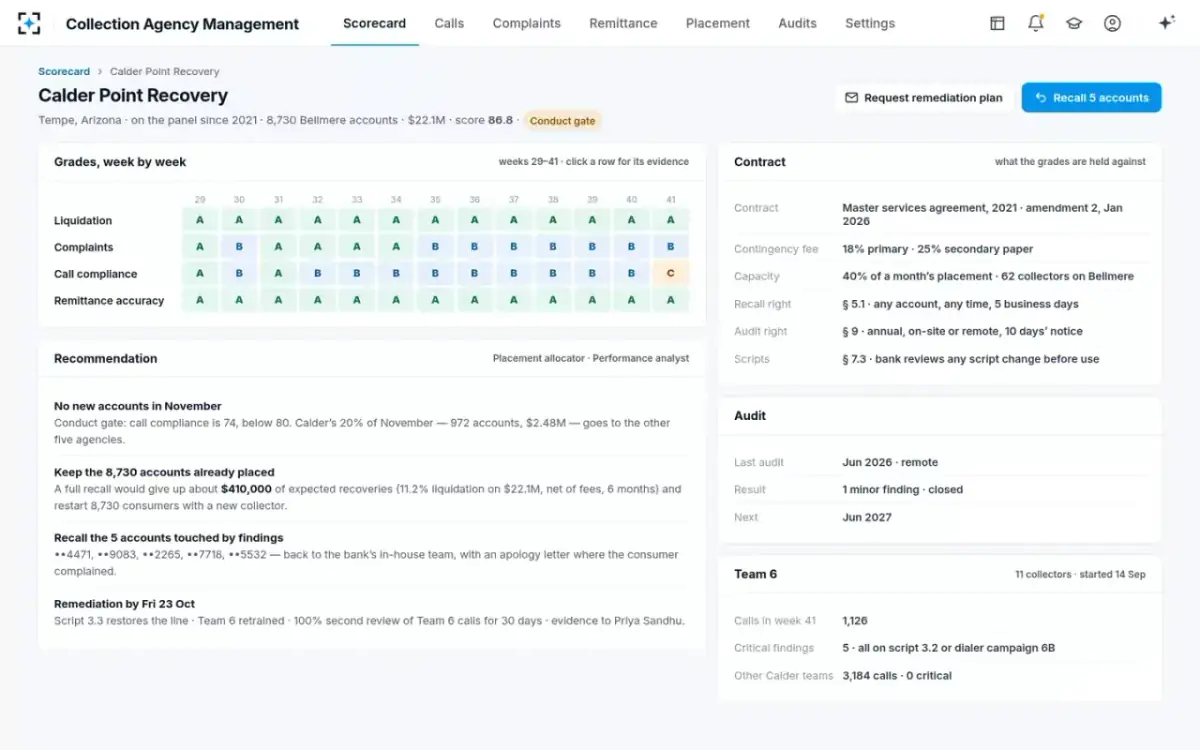
What makes this tractable at six agencies and tens of thousands of accounts is that it is arithmetic, done the same way every month, over evidence that already exists. In the solution it runs with the weekly grading: the reconciler ties the files to posted payments and the contract fee, explains each variance, and proposes a correction for a person to send. It never moves money, and remittance accuracy is one of the four measures each agency is graded on, so a repeat cause shows up as a falling grade rather than as a surprise at the annual audit. The diligence that should have priced the fee schedule in the first place is in how to choose a collection agency, and what the line between the lender’s own collectors and an outside agency actually is sits in first-party versus third-party collections.
What the agency reported, and what the bank could prove, on one September file
The agency’s file as received: $70,170 collected across 41 accounts
The same month from the bank’s own records: Agrees: all 41 matched to posted payments
The agency’s file as received: 25%, the secondary schedule
The same month from the bank’s own records: 18% under amendment 2 for primary paid-in-full accounts
The agency’s file as received: $17,542.50
The same month from the bank’s own records: $12,630.60 — a difference of $4,911.90
The agency’s file as received: Every line reconciled to an account
The same month from the bank’s own records: Three payments of $2,145 confirmed by the lockbox and absent from the file
The agency’s file as received: $52,627.50 on these accounts
The same month from the bank’s own records: $57,539.40 at the contract rate, before the missing payments
The agency’s file as received: Not raised
The same month from the bank’s own records: $7,056.90 short against a $250-per-file tolerance
The agency profile where the fee question meets the performance question
An agency’s rate is a schedule, its invoice is a deduction, and the number that matters is what arrives. To see a month of remittance files tied line by line to posted payments, start from Collection Agency Management.
Questions people ask
What is a contingency fee in collections?
A fee calculated as a percentage of the money the agency actually collects, rather than a charge for time or for the accounts placed. The agency usually nets it out of each payment before remitting the balance, so the lender never approves an invoice; it verifies a deduction after the fact. Because the fee follows collections, an agency earns nothing on accounts it cannot resolve — which is why fee schedules rise for older, harder paper.
How much does a collection agency cost if it collects nothing?
On a pure contingency arrangement, nothing in fees — but not nothing in cost. The lender still pays for the placement file, the data it supplies, the oversight it owes, and the opportunity cost of accounts sitting with an agency that is not working them. That is why a panel is managed on net back by cohort rather than on rate, and why capacity caps and placement shares matter as much as the percentage.
What is the difference between primary and secondary placement rates?
Primary placement is the first agency to work an account after charge-off, on the freshest contact data and with the best chance of payment, so it carries the lowest rate. Secondary placement is the same account after the first agency has returned it, on a population that has already resisted collection, so the rate is higher. The practical trap is not the difference itself but applying the wrong one: a payment is billed at whichever schedule the account was under on the date the money arrived.
How do you check a collection agency’s remittance?
Reconcile in both directions against your own records, not against the agency’s totals. Match every line to a payment posted on your side or confirmed by the lockbox; recompute every fee from the contract, the placement stage and the amendment in force on the payment date; and then list the payments you can see that the file does not contain. The last of those finds errors the first two never will.
What is net back in collections?
What reaches the lender from a placement after the agency’s fee and any pass-through costs, measured against the balance placed. It is the only fee-structure-independent way to compare two agencies, and it has to be measured on a placement cohort over a stated window rather than on a calendar month, because the money arriving this month came from accounts placed over many.
When should you pay a flat fee instead of a contingency?
When the work is not collection. Contingency aligns the agency with recovery, which is what you want on a pool of charged-off accounts; it aligns badly with tasks whose value does not depend on money arriving — data cleansing, skip-tracing a batch, locating an estate, or a one-off portfolio review. Paying for those by the item or by the hour keeps the contingency rate clean and stops a collection rate silently funding non-collection work.