Change control in regulatory affairs is the seat that answers one question about a manufacturing or quality change: does it need a filing, in which country, of what kind, and when will that agency approve it. The change itself is raised and justified elsewhere — at the plant, in quality — but the regulatory answer can only come from the people who hold the approved dossiers and each country's classification rules, and everything downstream waits on it. That is the uncomfortable shape of the work: four or five other roles are blocked by one assessment, and the assessment is mostly reading. CMC Change Impact Assessment, Botminds' agentic solution for post-approval changes, exists to take the reading off that one desk and leave the deciding on it.
The five people on this page are fictional characters in the solution's sample data, at an invented company, Northwind Bio, making an invented antibody, Veltrimab. The regulations, and the industry figures, are real and linked where they appear.
What is change control in regulatory affairs?
It is the regulatory half of a change control: the assessment of what a proposed manufacturing or quality change obliges the company to tell, or ask, each regulator that approved the product. The quality system owns the change; regulatory affairs owns the consequence of it for the marketing authorisation.
The distinction matters because the two halves have different thresholds. Quality assurance asks whether the change is justified, validated and safe, and can clear it on that basis. Regulatory CMC asks a narrower and more literal question — is the thing that is changing written into an approved dossier, and what does that country's rule book call a change to it — and can reach "a filing is needed" on a change quality considers trivial, or "nothing to file" on one quality treated as major. Neither answer is a comment on the other.
Regulatory CMC also carries a duty the plant cannot discharge. In the United States, before distributing a biological product made using a change, the applicant must "assess the effects of the change and demonstrate through appropriate validation and/or other clinical and/or nonclinical laboratory studies the lack of adverse effect of the change on the identity, strength, quality, purity, or potency of the product" (21 CFR 601.12(a)(2)). The studies are the plant's and quality's work. Holding the obligation, and knowing which markets it applies in, is regulatory's.
The five seats a single change control passes through
Most companies run post-approval change through the same five roles, whatever the titles say. One raises the change, one assesses it, one approves the assessment, several file it, and one plans supply around it. Each is waiting on the one before.
One change control, five seats: what each week holds, and what each seat keeps
Today
Raises the change control with the technical facts and a planned implementation date, then waits — often without knowing which market is holding the date up.
With agents
Sees the runway for her own change and a go-live date the approvals actually support, with the market that sets it named.
Still theirs: The technical justification and the validation plan
Today
Assesses four to six new change controls a week; each one means opening twenty-one dossiers and twenty-one classification guidelines before a single market can be called.
With agents
Opens a matrix already proposed and cited, decides the markets that need her call, sets the go-live date and signs.
Still theirs: Every decision, every changed category and the signature
Today
Second-approves the heavy assessments and owns the rule books, usually with no view of why one market is slower than the rest.
With agents
Reads a memo with every market's category and rule cited, and approves rule-book versions before the classifier may use them.
Still theirs: The second approval, and what counts as an approved rule book
Today
Chases the category, the rule and the document list for each local submission, often re-deriving work the global team already did.
With agents
Gets one filing task per market with the category, the rule and the documents needed, and can see why the category was proposed.
Still theirs: The local submission, and the agency relationship behind it
Today
Needs to know which markets may take material made with the change, and from when — and finds out late.
With agents
Reads the filing plan: first approvals, the share of volume over time, and the markets that must never receive the new material.
Still theirs: The allocation, and the restriction that keeps it honest
The order is fixed, and only one hand-off in it is reversible. If the plant's change description is thin, regulatory asks and waits. If the assessment is wrong, every filing task built from it is wrong, and some of them will already have been submitted. That asymmetry is why the assessment seat is where companies put their most experienced people, and why the queue in front of it is the thing worth measuring.
The change owner: raises it, and needs a date to plan against
The change owner is usually a plant or technical-services person with a reason and a deadline: a second filter supplier so a single-source risk goes away, a duplicate line so capacity arrives before a launch, a method replaced because an instrument is end-of-life. They write the change control for the quality system, with the description, the justification and the risk assessment — and they put a planned implementation date on it, because the project behind the change needs one.
That date is almost always set before anybody has looked at the approvals. In the sample company, the change owner at Plant 5 — Cork planned to switch to the second sterilising-grade filter supplier in April 2027. The assessment put the realistic date at September 2027 for twenty of twenty-one markets, with one market following later still. The plan was not careless; it simply could not see the longest runway, because nobody had drawn it yet.
What the change owner needs back is not a classification. It is a date, with the market that sets it named, so the project can be re-planned once rather than slipped three times.
Regulatory CMC: the only seat that can say a filing is needed
This is the seat the whole chain turns on. The regulatory CMC lead takes the change control and produces the assessment: every registration the change touches, the category proposed for each market with the rule it rests on, the expected approval dates, and the markets not affected with their supply restrictions. In the sample company that is four to six new change controls a week, each across twenty-one markets and three presentations.
Two things make the seat hard to delegate. First, the answer is market-specific in a way that does not generalise: the same duplicate drug-substance line is classified one way in Japan, another in the European Union and another again in Canada, and a lead who has learned one agency's habits cannot infer the others. Second, the answer is evidential. A category is only as good as the registered text behind it, which is why a serious assessment quotes the dossier rather than summarising it.
What this seat does not own is the change itself. It cannot declare a change technically justified, it cannot validate it, and it cannot decide a plant's project. It owns one sentence per market, and the signature under them.
The head of regulatory CMC: rule books, and the second approval
Above the lead sits a seat that owns two things most organisations under-specify. The first is the rule books: which version of each country's classification the team is allowed to apply, approved by a named person and dated. Without that, two leads assessing similar changes in the same month can reach different answers for good reasons, and nobody can reconstruct which rule was in force when.
The second is the second approval. In the sample configuration, when five or more markets need prior approval, the head of regulatory CMC approves the assessment after the lead has signed it. The threshold is a setting, not a habit — three, five or eight markets are all defensible — and the point of writing it down is that the heavy assessments get a second reader by rule rather than by whoever happens to be available.
In the solution, a rule watcher checks the agencies weekly and re-checks open assessments when a classification changes, but a new rule-book version cannot be used by the classifier until this seat has approved it. That is the right order: a rule change is a decision about what the company believes, not a data refresh.
The affiliate: one filing task, one country's rule
The affiliate regulatory team turns a decided market into a submission. Their question is narrow and practical — what category, under what rule, with what documents, by when — and their frustration is usually that they have to ask for it. When the global assessment arrives as a memo and a mail thread, each affiliate re-derives the parts that concern them, and five affiliates re-derive five times.
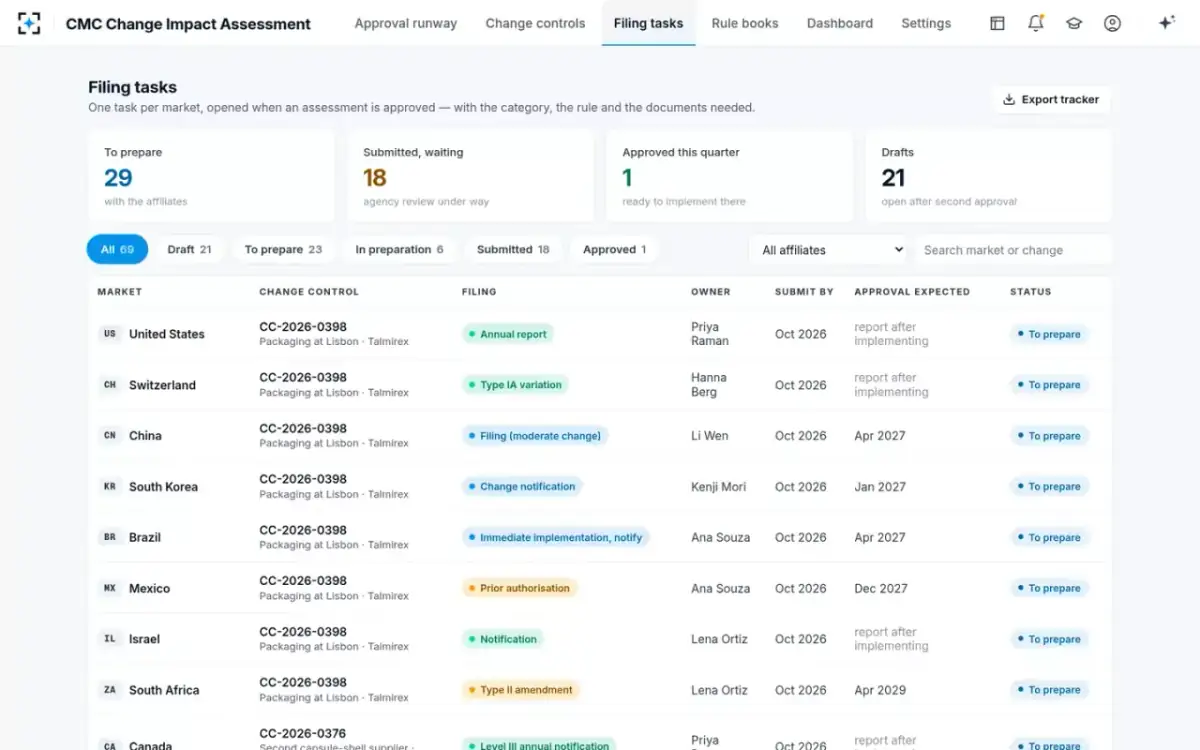
The fix is structural rather than clever: when an assessment is approved, open one task per market carrying the category, the rule entry, the documents needed, the submit-by month and the expected approval, owned by the named affiliate. In the sample tracker that is a single list — twenty-nine tasks to prepare with the affiliates and eighteen submitted and waiting on an agency — rather than a question each time.
Affiliates are also where the company's global answer meets a local procedure that the global answer does not cover. Where an agency asks for a certificate of pharmaceutical product, proof of approval in a reference market or a locally formatted dossier, the sequence and the paperwork are local even when the category is not. Until agencies routinely rely on each other's assessments, the affiliate's local knowledge is the thing that keeps a global assessment honest, and a proposal they can see the reasoning behind is one they can argue with.
One filing task per market in CMC Change Impact Assessment, with the affiliate who owns it
Supply planning: which markets may receive the new material
The fifth seat is the one most often left off the diagram, and the one that turns a filing error into a recall. A change that is approved in nineteen markets and not in two does not simply wait; it creates two kinds of material and a rule about where each may go.
Supply planning needs three things from the assessment, and none of them is the category. It needs the date each market can take the new material, the markets that must never take it because they register a different site or supplier, and the share of volume covered at each point in time, so it can see whether running two processes for six months is worth it.
This is why "not affected" is the most dangerous phrase in an assessment. In the sample case, two markets register a different drug-substance site, so no filing is needed for them — and precisely because no filing is needed, nothing downstream would otherwise stop material from the new line reaching them. A market marked not affected always gets a supply restriction alongside, which is a rule the solution enforces rather than a note someone remembers to write.
Who waits on whom, and where the queue forms
Drawn as a chain, the work is short. Drawn with its waiting, it is not.
From a change control in the quality system to a filing task in each market, in CMC Change Impact Assessment
A person decides
Change ownerRaises the change control with the description, justification and risk assessment, and a planned implementation date.
Agent
Change readerStates the product, presentations, sites, change type and the registered elements it may touch, quoting the change control for every statement.
Never: decide whether the change is regulatory relevant
Agent
Registration finder and dossier matcherLists every active registration by presentation and country, then quotes the approved text each one holds for the element that changes.
Never: drop a market quietly, or paraphrase registered text
Agent
Rule classifierProposes each market's category from that country's approved rule book and past agency advice, with the entry cited, a confidence and the alternative considered.
Never: decide a market below the confidence floor the team sets
A person decides
Regulatory CMC leadDecides each market, gives a reason for any changed category, sets the go-live date and signs the assessment.
A person decides
Head of regulatory CMCAdds the second approval when the threshold is met — in the sample settings, five or more markets needing prior approval.
A person decides
Affiliates, and supply planningWork one filing task per market from the approved assessment; supply planning allocates batches against the approval dates and the restrictions.
The queue forms at one point. Four to six change controls a week, at roughly six and a half hours of assessment each by hand, is about four days of a five-day week before anything else — inspections, submissions in flight, agency questions, the rule changes that have to be read. Everything else in the chain is fast and intermittent; this step is slow and continuous, so it is the step that sets the date.
A week on one regulatory CMC desk, by hand: five change controls across 21 markets
- Registrations0.5 d
- Opening dossiers1.4 d
- Rule books and past advice1.1 d
- Affiliates0.5 d
- Plans and memos0.6 d
- Everything else the seat owns0.9 d
The scale behind that week is not unusual. A study of prior-approval post-approval changes at eighteen large pharmaceutical companies found that "On average, each company had about 2,700 PAC submissions approved per year" (Vinther and colleagues, Therapeutic Innovation & Regulatory Science, 2024). Every one of those submissions started as a change control that somebody had to assess, market by market, before it could be written.
Who signs a regulatory impact assessment?
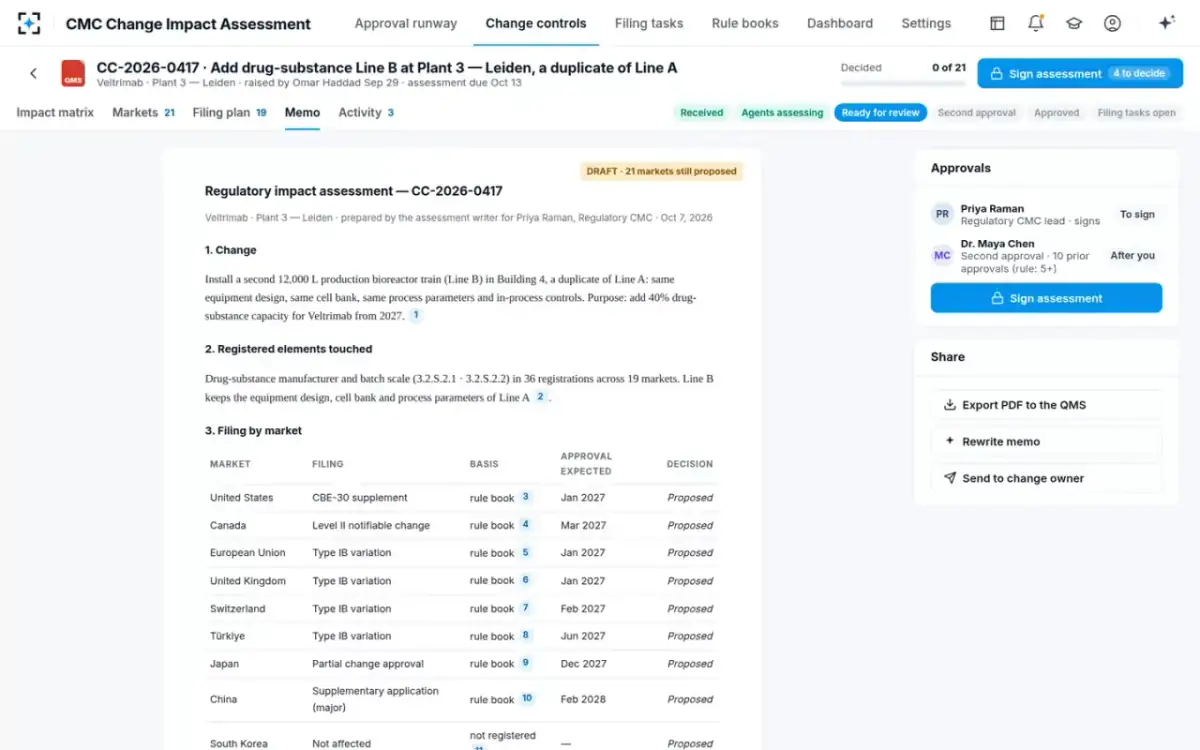
The regulatory CMC lead signs, with an electronic signature and its meaning recorded, and a second approver signs above a threshold the company sets. That is the simple answer. The useful one is about what the signature covers: not "this change is safe", which quality has already said, but "these are the filings this change needs, in these markets, on this basis" — a statement about twenty-one countries' approved text, made on a particular day against particular rule-book versions.
Three rules keep that statement meaningful. Only decided markets go into a signed memo, so a draft cannot be mistaken for a decision. A changed category needs a reason, kept verbatim in the memo and the audit trail, so a later reader can see where the signer disagreed with the proposal. And a bulk confirmation of the clear markets is never automatic: in the sample settings it covers proposals at or above 80% confidence, and the lead presses it, under her own name.
The approvals the assessment needs, and the two names under them
What the regulations themselves require of the team
Very little of the seat structure above is in a regulation; most of it is practice. One piece is not. ICH Q10 is explicit that a proposed change is not one function's business:
"Proposed changes should be evaluated by expert teams contributing the appropriate expertise and knowledge from relevant areas (e.g., Pharmaceutical Development, Manufacturing, Quality, Regulatory Affairs and Medical), to ensure the change is technically justified."
ICH Q10, Pharmaceutical Quality System, section 3.2.3(c)
Read carefully, that sentence does two things. It names regulatory affairs as a contributor to the technical evaluation, not merely a recipient of its result — which is the argument for involving the assessment seat before the change control is final, not after. And it says "expert teams", which is a staffing statement: a company whose post-approval change work rests on one person's memory of twenty-one agencies is not meeting it, however experienced that person is.
The second regulatory constraint on the team is timing, and it is subtler. In the European Union, for a quality change, "This interpretation allows companies to manufacture conformance batches and generate any needed stability studies to support a type-IAIN variation before making an immediate notification because the change will not be made in their own quality system until these data are available" (EMA, Type-IA variations: questions and answers). In other words the date the company changes its own quality system is the date that counts — which means the plant, quality and regulatory have to agree what "implemented" means before anyone commits to a schedule. The clocks that follow from it are set out in the guide to Type IA implementation dates.
Everything else is organisational design, and the measure of whether it is working is simple: how long a change control sits before anybody has read it, and how many markets a lead decides with a cited rule in front of her rather than from memory. The assessment itself, step by step, is where those hours are spent, and CMC Change Impact Assessment is what the sample company runs them in.
Questions people ask
Who decides if a manufacturing change needs a filing?
Regulatory CMC, market by market. Quality assurance decides whether the change may be made at all; regulatory CMC decides what each agency must be told or asked first, by checking whether the changed element is registered in that country and what its classification calls a change to it. Many companies add a second approver above a threshold they set; the sample settings use five or more prior-approval markets.
What is the difference between regulatory CMC and quality assurance here?
Different questions and different evidence. Quality assurance evaluates the change against the process, the validation and the risk assessment. Regulatory CMC evaluates it against approved dossiers and classification guidelines in every market. A change can be trivial to one and reportable to the other, which is why both assessments sit in the same change control and neither overrides the other.
Who files a variation in each country?
Usually the local affiliate or the regional regulatory team, working from the approved global assessment. They need four things from it: the category, the rule it rests on, the documents the local procedure requires and the submit-by date. Where a country has no equivalent category, the affiliate is also the person who negotiates the local answer with the agency.
How many change controls does a CMC lead assess a week?
In the sample company, four to six, each across twenty-one markets and three presentations. There is no published benchmark, and the honest comparison is internal: count the change controls arriving each week, the hours spent per assessment, and the share of those hours spent retrieving registrations, dossier text and rules rather than deciding anything.
What does regulatory affairs need from a change control before it can assess it?
The change described in terms that can be matched to a dossier: which product and presentations, which sites and lines, what exactly is changing and what is staying the same, the comparability or validation evidence planned, and the implementation date the plant wants. Vague descriptions do not slow the filing by a day; they slow it by a round trip.
Can one person own post-approval change for a whole portfolio?
Own it, yes; do it alone, no. ICH Q10 expects proposed changes to be evaluated by expert teams drawing on development, manufacturing, quality, regulatory and medical knowledge. One seat can hold the decision and the signature, but the reading behind twenty-one markets, and the local knowledge in each of them, is not a single-person job at any serious portfolio size.