Type II variation timelines are published per agency, and the published number is almost never the number that matters. In the European Union a major variation gets an opinion within 60 days, extendable to 90, with the clock stopped while the company answers questions. In the United States a 30-day supplement lets distribution begin a month after receipt. Both are real. Neither tells a plant when it can switch over, because the change is the same change in every country and the switch-over date is set by the slowest market, which published research puts years, not months, after the first approval.
That gap between the fastest clock and the last approval is what CMC Change Impact Assessment is built to make visible before a date is promised. It reads the change control, finds every registration it touches, proposes each country's category with the rule cited, and then draws one bar per market from target submission to expected approval — with the basis for every date shown, so the longest runway is a number someone can argue with rather than a surprise eighteen months later.
The product, company and dates in the worked examples here are fictional sample data running in the solution. The published clocks and the measured figures are linked to the regulations and research they come from.
How long does a Type II variation take?
In the centralised European procedure, the legal answer is sixty days: "The Agency shall issue an opinion on the valid application referred to in paragraph 1 within 60 days following its receipt." That sentence is the one every timetable quotes, and on its own it is misleading in three directions at once.
It is a floor, not a promise. The same article lets the Agency extend the period to 90 days for the variations listed in Annex V or for certain groupings, and lets it shorten the period where the matter is urgent. It is also suspendable: within the sixty days the Agency may ask the holder for supplementary information, and "The procedure shall be suspended until such time as the supplementary information has been provided." A variation that draws one request for information and takes six weeks to answer it has spent six weeks that no published timetable shows. And it is only the opinion — for a centralised product the Commission decision that follows is a further step.
So the honest answer to how long a Type II variation takes is: sixty days of agency assessment, plus however long the company takes to answer questions, plus the decision, and that is one market. On the sample assessment, the same change in the same week is also a Japanese partial change approval of about a year, a Chinese supplementary application of about fourteen months, and in two markets nothing at all. A timetable for one agency answers a question nobody is really asking.
The EU clock: 60 days, extendable to 90, and what stops it
Three mechanics decide what the European sixty days actually buys. The first is validation: the clock starts on receipt of a valid application, so a package that fails validation has not started. The second is the extension to ninety days, which applies to the variation types listed in the Regulation's own annex and to groupings — in practice, the larger quality changes most likely to arise from a manufacturing project. The third is the suspension, which is the one that moves real dates most.
A clock-stop is not a failure. It is the normal shape of an assessment of a substantial quality change, and the length of the stop is largely in the company's hands: the question list arrives, and the answer takes as long as the data takes. Planning a European go-live on sixty days from submission assumes an assessment with no questions. Planning it on a single round of questions answered inside a month is a defensible estimate, and it should be written down as an estimate with that assumption attached — which is exactly what a date with its basis shown is for.
The US clock: how long does a CBE-30 take to be cleared, and a PAS to be reviewed?
A CBE-30 is not cleared at all in the sense people mean. For biologics, "Pending approval of the supplement by FDA … distribution of the product made using the change may begin not less than 30 days after receipt of the supplement by FDA." Nothing arrives to say yes. What can arrive, inside those thirty days, is a letter saying the change actually requires prior approval, or that information required in the supplement is missing — and then the applicant may not distribute until FDA determines that compliance is achieved.
The tail is longer than the thirty days as well. FDA retains the power to act after distribution has begun: "If the agency disapproves the supplemental application, it may order the manufacturer to cease distribution of the products made with the manufacturing change." A plant that treats day 31 as the end of the matter has mistaken permission to ship for a closed review.
For a prior-approval supplement the regulation sets no review period at all; the applicant must simply obtain approval before distributing. That is why a US date on a filing plan is an estimate from the company's own history rather than a quotation from a rule, and why it should say so. The choice between the two categories, and what it does to the date, is worked through in the comparison of CBE-30 and prior approval.
What other agencies publish: WHO's suggested review times
Most agencies publish something, and WHO offers the reference point many of them were built against. Its guidance for biotherapeutic products sets suggested review timelines by reporting category: a major quality change on a prior-approval supplement at three to six months, a moderate quality change at one to three months, with minor changes and changes with no impact requiring notification or nothing at all. The guidance is explicit about why: "the review time frames for major changes should be longer than those for moderate changes", and the suggested times are examples drawn from the experience of several agencies, starting when the supplement has been accepted as complete.
What each clock says, and what it leaves out
| Where | The published clock | What it does not cover |
|---|---|---|
| European Union, major variation of type II | 60 days for the Agency opinion, extendable to 90 days for the variations listed in the Regulation’s annex and for groupings. | Validation before the clock starts, the suspension while questions are answered, and the Commission decision after the opinion. |
| United States, 30-day supplement for biologics | Distribution may begin not less than 30 days after FDA receives the supplement. | A letter inside the 30 days re-classifying the change or calling the package incomplete; FDA may later order distribution to cease. |
| United States, prior-approval supplement | No review period is set in the regulation; approval is required before distribution. | Everything. A date here is the company’s own estimate from its approval history. |
| WHO suggested review timelines | 3–6 months for a major quality change, 1–3 months for a moderate one. | Guidance to agencies, not a commitment by any of them; the clock starts only once the supplement is accepted as complete. |
| The other hundred-odd agencies | Local timetables, where they are published at all. | Whether the timetable is met. In the measured data, more than half of changes took over six months in 33 countries. |
What the measured data shows: how 156 agencies actually performed
The largest published measurement of the problem pooled prior-approval changes from eighteen global pharmaceutical companies across three years and 156 countries. The year-by-year totals barely move — 47,285 changes approved in 2019, 50,552 in 2020, 48,713 in 2021 — and neither does the share that overran six months, which sat at 29%, 27% and 27%. Stability is the finding: this is not a backlog clearing, it is how the system runs.
The distribution across countries is the part a filing plan has to respect. In 33 of the 156 countries, more than half of the changes submitted took longer than six months to approve. In four countries, more than three-quarters did. Exactly one agency approved every change put to it inside six months. The authors' summary of the consequence is blunt: a company running a product in many markets must manage several versions of it at once, and "It is rare that any PAC is approved globally in less than 6 months."
The spread a global change actually meets
33of 156
countries where more than half of changes took over six months to approve
~2years
for one change to be approved in the majority of countries, in vaccine supply chains
4+years
for the outliers in the same analysis
1of 156
agencies that approved every change put to it within six months
A single PAC approval can take around 2 years to get approvals in the majority of countries; however some outliers can take up to 4 years or more.
Dellepiane, Pagliusi, Akut and colleagues, Vaccine: X, 2020
The longest runway sets the date, not the average
An average approval time is the wrong statistic for this decision, and it is the one most filing plans report. A change cannot be implemented in a market that has not approved it, so the date on which one process can replace another everywhere is the date of the last approval — the maximum, not the mean. Averages fall when a tail of slow markets is diluted by a crowd of fast ones, which is precisely the shape of the measured data.
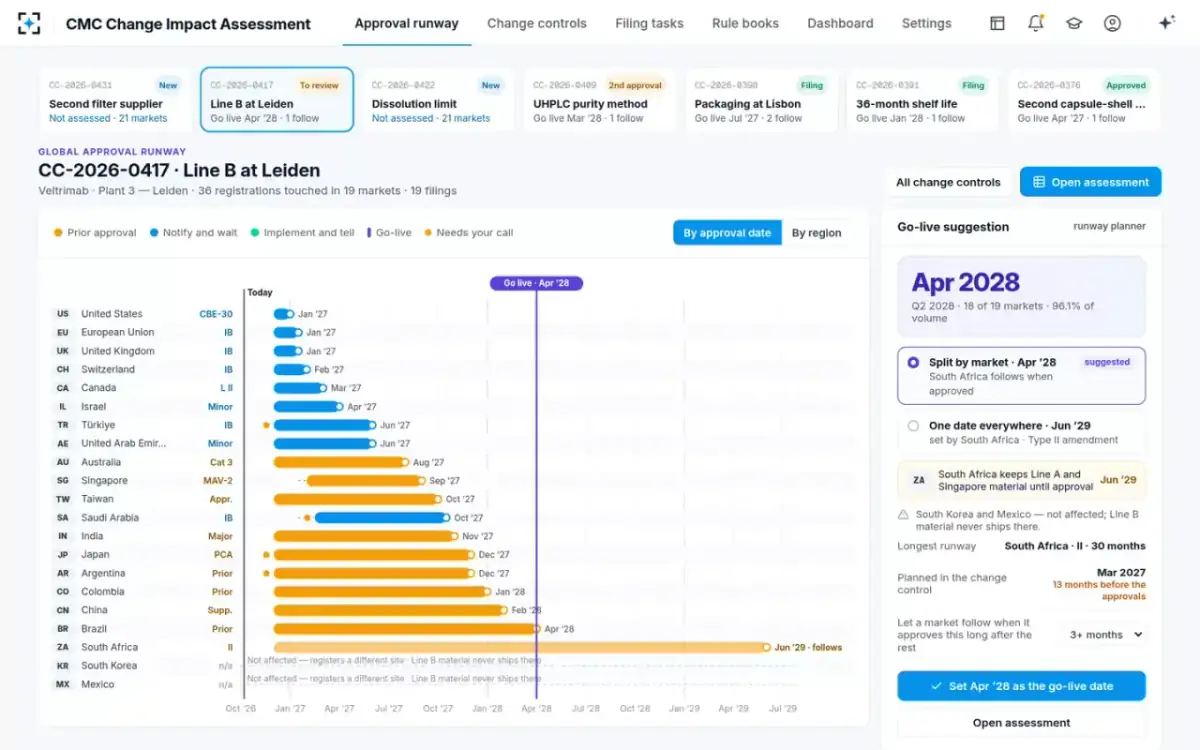
In the sample assessment the effect is stark. For the new drug-substance line, first approvals land in January 2027, ninety per cent of volume is covered by February 2028, and South Africa's amendment — the longest runway at about thirty months — lands in June 2029. Two and a half years separate the first market from the last, and the average across the nineteen filings is nowhere near either end.
One change, nineteen filings, and the runway that sets the date
Every market's submission and approval on one plan, with its basis
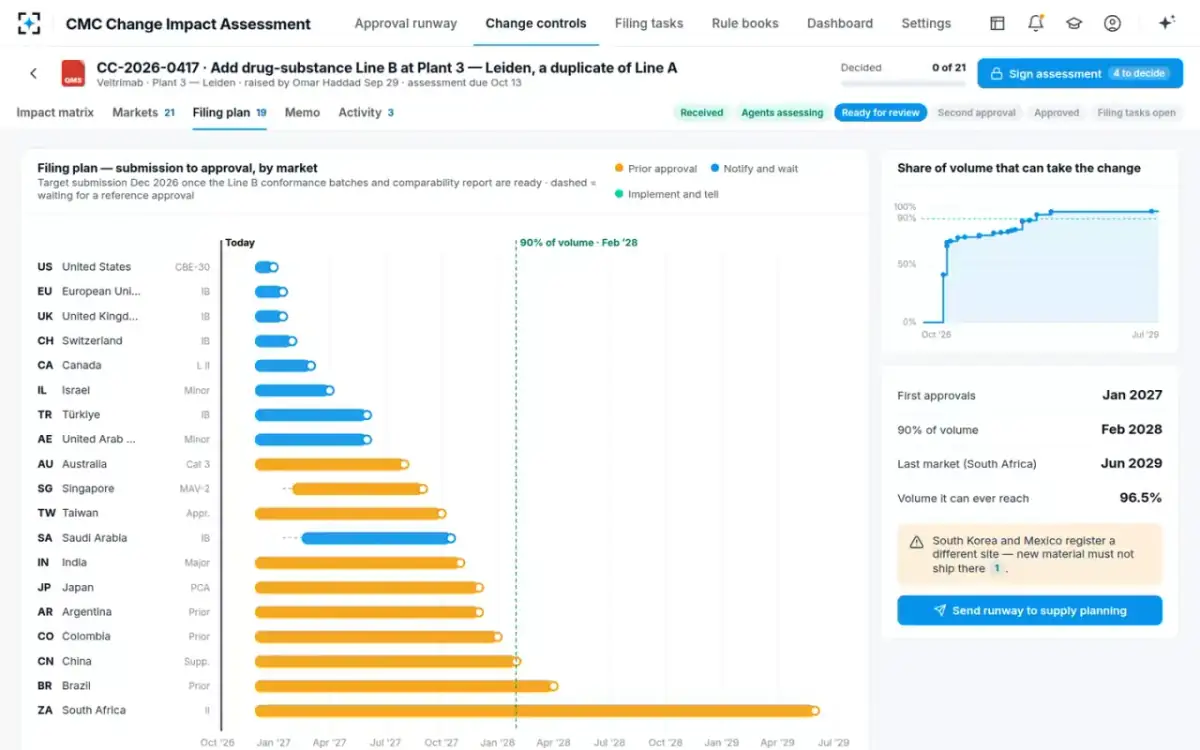
The two markets missing from that chart are missing on purpose: their registrations name a different drug-substance site, so they have no runway and a supply restriction instead. Why a market with no filing still needs a decision is the other half of a drug-substance change.
Two plans for the same change, drawn to scale
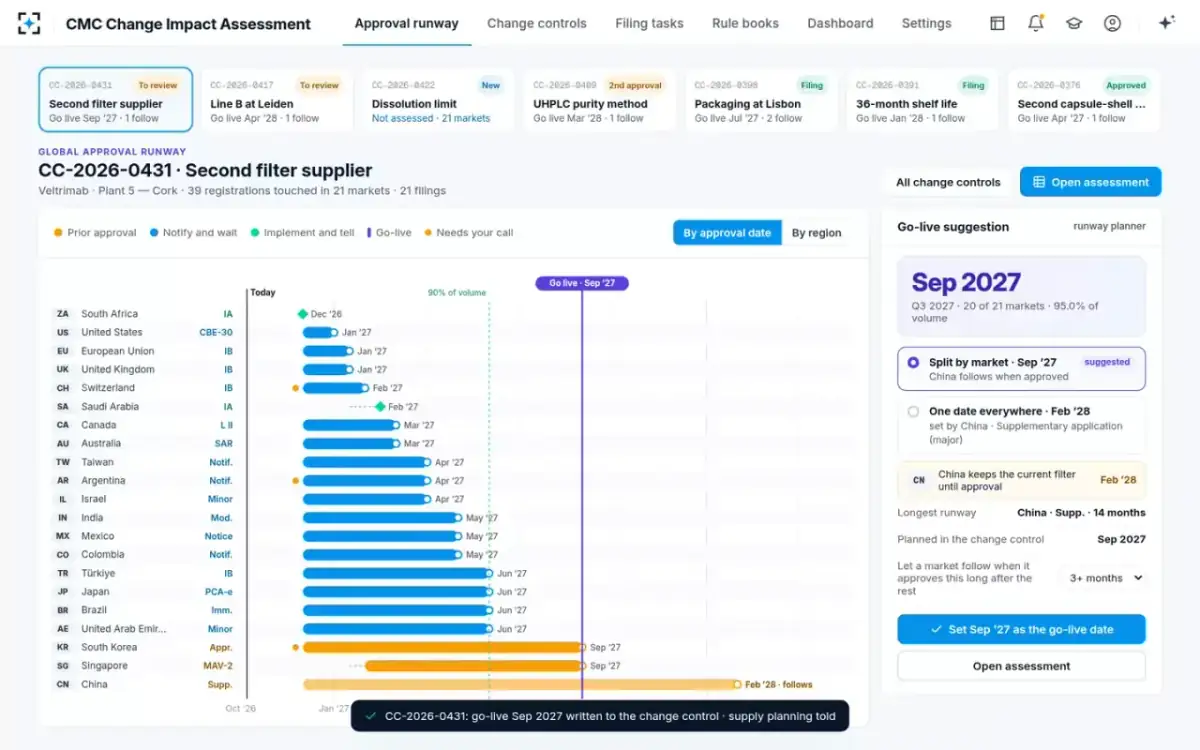
Put the two plans side by side in months and the trade is easier to argue about than to describe. Both lanes below are the sample filter-supplier change, from the same assessment and the same target submission; the only difference is whether the plant waits for the last market.
Split go-live against one date everywhere, on the sample filter change
- Assessment and submissionsto Dec 2026
- Twenty of twenty-one markets approvedlive Sep 2027
- China keeps the current filter until approvedto Feb 2028
- Assessment and submissionsto Dec 2026
- Waiting for the last approvallive Feb 2028
One date everywhere, or a split that lets a late market follow
Once the runway is visible, there are only two honest plans, and the choice is a business decision rather than a regulatory one. One date everywhere means waiting for the last approval: a single process, a single stock, nothing to allocate, and a go-live that is years out. A split go-live means switching where the change is approved and letting the late markets keep the current process until theirs arrives: the benefit lands early, and the price is a period of running both.
One date everywhere against a split go-live, on the same change
One date everywhere: When the last market approves. On the sample filter change that is February 2028, five months after the rest of the world is ready.
Split: the late market follows: When the main group is approved — September 2027 for twenty of twenty-one markets, 95.0% of volume.
One date everywhere: One process throughout, then one process after. Nothing to allocate.
Split: the late market follows: Both processes for the length of the gap, with batches matched to the markets that have approved each one.
One date everywhere: In the delay: the change is usually there to improve robustness or secure supply, and none of that lands until the last agency acts.
Split: the late market follows: In allocation: a batch sent to a market that has not approved the change is an unapproved change in that market.
One date everywhere: The benefit of the change, multiplied by the months it waits.
Split: the late market follows: Two validated processes, two released stocks, and the inventory to cover the late market.
One date everywhere: Nothing to explain: every market is on the same version.
Split: the late market follows: A written restriction per market with the registration it came from, and a date each one may switch.
The date the plant planned, and the date the approvals support
What waiting costs: two processes, two stocks, and a shortage risk
The cost of a long runway is usually described as delay, which understates it. While approvals arrive market by market, the plant validates and runs both processes, quality control releases both, the warehouse holds both, and every shipment is matched against a registration. The 18-company study gives the clearest measure of where that ends: one author describes a single year in which 83 batches of one vaccine product were made to 55 different variations.
There is a supply argument underneath the operational one. Post-approval changes exist largely to make manufacturing more robust and more reliable, and the same study notes that the 2019 FDA drug shortages report attributed 62% of US drug shortages between 2013 and 2017 to manufacturing quality issues. A system in which the fix takes years to reach every market is a system that keeps the weakness in place while the improvement waits in a queue.
Why does a single change take years to be approved everywhere?
Not because any one agency is slow. It takes years because the change is reviewed from scratch in every country, under a different classification, in a different format, with different supporting data, and often in a required sequence. The 18-company dataset shows where that ends: in the 33 countries where most changes overran six months, some took "up to more than 5 years" to be approved.
Sequencing compounds it. Some agencies act as reference markets: approval by the reference agency is required before the same change can even be submitted to the agencies that rely on it. In the sample assessment two such rules are configured as plain sentences — Saudi Arabia files after the EU decision, Singapore after the EU and the US — and they push those runways out by the length of the decision they wait on, before any local review begins. The arithmetic is additive, and it is invisible in a list of per-agency timetables.
Reliance: the lever with the most promise
The approach with the most published work behind it is reliance — a national agency relying on the assessment of a recognised reference agency rather than repeating it. A pilot run with the support of the European Medicines Agency and WHO took a major drug-substance process change for a monoclonal antibody, submitted the same package used in the EU to every participant, shared the European assessment report and questions, and set a target of global approval in 6.5 months. "Globally 48 NRAs have agreed to join the pilot."
Set that against the measured baseline — rare for any change to clear globally in under six months, two years to reach most countries, and more than five years in some — and the ambition is a step change rather than an improvement. It is also, for now, a pilot on one product whose approval outcomes had not yet been published when it was reported, so a filing plan written today still has to be built on what agencies do, not on what a pilot targets. What software can honestly change is when the runway is known: the sample assessment reaches a signed proposal in a design target of 38 minutes from a new change control, against most of a day by hand. It does not make any agency faster, and no tool should claim to.
Open change controls, and one bar per market from submission to approval
Putting a date on a filing plan you can defend
A defensible date has four parts. It names the market that sets it, so the conversation is about South Africa rather than about regulatory being slow. It shows the basis for each estimate — the company's own approval history for that agency and category, the sequencing rules applied, the assumptions about questions. It states which plan it is, one date everywhere or a split, and what the split costs. And it is owned by a person: in the solution the planner suggests and the regulatory CMC lead sets the date, with both the suggestion and the choice recorded.
The failure mode it replaces is familiar. A change control carries an implementation date set by the plant before the assessment exists — April 2027 on the sample filter change — and the approvals turn out to support September. Discovering that in month two costs a conversation. Discovering it in month fourteen costs a shutdown slot, a validation plan and a supply forecast. To see the runway, the sequencing rules and the go-live suggestion on one change, start from CMC Change Impact Assessment.
Questions people ask
What is the Type II variation timetable?
For the centralised European procedure, the Regulation sets an opinion within 60 days of a valid application, extendable to 90 days for the variation types listed in its annex and for certain groupings, and suspended while the holder answers a request for supplementary information. A Commission decision follows the opinion. National and mutual-recognition procedures publish their own timetables, and the monthly submission calendar decides which start date a given package can catch.
How long does a post approval change take to be approved in every country?
Longer than any single agency's timetable implies. Pooled data from 18 companies across 156 countries found it rare for a change to be approved globally in less than six months, with more than half of changes overrunning six months in 33 countries. An analysis of vaccine changes put typical global approval at around two years, with outliers beyond four, and in some countries individual changes took more than five years.
Which market usually takes the longest to approve a variation?
There is no universal answer, which is why the question has to be asked per product. It depends on where the product is registered, how each agency classifies that specific change, and whether any sequencing rule makes one market wait for another. In the sample assessment the longest runway is South Africa at about thirty months for a drug-substance line, and China at about fourteen months for a filter supplier change — two different markets for two changes in the same product.
Can you implement a change in some markets and not others?
Yes, and for a global product it is often the only way to get the benefit this decade. The requirement is that every batch is matched to a market that has approved the version in it, which means a written restriction per late market, an allocation rule the supply planner actually holds, and a date on which each one may switch. The alternative is to wait for the last approval and run one version throughout.
What stops the clock on a variation assessment?
In the European procedure, a request for supplementary information: the procedure is suspended until the holder provides it, so the length of the stop is mostly the company's. Validation sits before the clock rather than stopping it — an invalid application has not started one. In the United States a 30-day supplement can be halted inside its thirty days by a letter saying the change needs prior approval or that required information is missing.
Does regulatory reliance shorten approval times?
It is the approach with the most published work behind it, and it is not yet the normal case for post-approval changes. In a pilot supported by the European Medicines Agency and WHO, 48 national agencies agreed to rely on the European assessment of one major manufacturing change, with a target of global approval in 6.5 months against a baseline measured in years. Until reliance is routine, a filing plan should be built on what each agency does today.