The best AI for regulatory affairs, for anyone whose week is spent on post-approval changes, is whichever tool can take a change control it has never seen and come back with a category per market, the registered text it relied on, and a date. That is a narrow and demanding definition, and it is deliberate: almost everything sold into this department retrieves documents, drafts text or answers questions about guidance, while the work that fills the week is deciding — country by country, against a rule, with a name against the decision.
Retrieval and drafting are genuinely useful. They are also not the same product, and the shortlist goes wrong when all three are evaluated with the same demonstration. The six tests below are written to be run on your own closed change controls, because neither FDA nor EMA validates or approves a tool, and nothing in either agency's published position relieves the holder of responsibility for what is filed.
Where this page shows what a tool can look like, the examples come from Botminds' CMC Change Impact Assessment running on its fictional sample company and product. The regulations and the agency papers are linked where they are used.
What should AI for regulatory affairs actually do?
Start from the shape of the regulatory system rather than from the technology. ICH Q12 describes a regime in which agencies are "encouraged to utilise a system that incorporates risk-based regulatory processes for (a) requesting prior approval from the regulatory authority, (b) notifying the regulatory authority, or (c) simply recording CMC changes". Three tiers, assigned per change and per market, each with its own data requirements and timeframe. The job is sorting changes into tiers in every country where a product is registered, and defending the sort.
That tells you what to automate and what not to. The mechanical parts are reading, finding, matching and looking up — the parts that consume the day and that a person does no better for having done them a thousand times. The judgement parts are the markets where the registered text is ambiguous, where the rule book does not cover the change, and where a prior agency position cuts across the obvious answer. A tool that takes the first and leaves the second is useful. A tool that takes both has taken something it cannot be accountable for.
Search, assistant, agent: three products sold under one name
The clearest way to tell the three apart is to hand each the same input — a new change control, with no further instruction — and look at what comes back.
One change control, three kinds of product, three outputs
| What it is | What you give it | What comes back | What is left for you |
|---|---|---|---|
| A search tool over guidance and dossiers | A query you have already formulated | Passages ranked by relevance, from documents you asked about | Working out which markets are in scope, reading each dossier, classifying every one, and writing it down |
| An assistant or chat over your documents | A question, and usually the context you paste in | A fluent answer, sometimes with citations, about the question as you framed it | Verifying every citation, repeating the exercise per market, and taking responsibility for the framing |
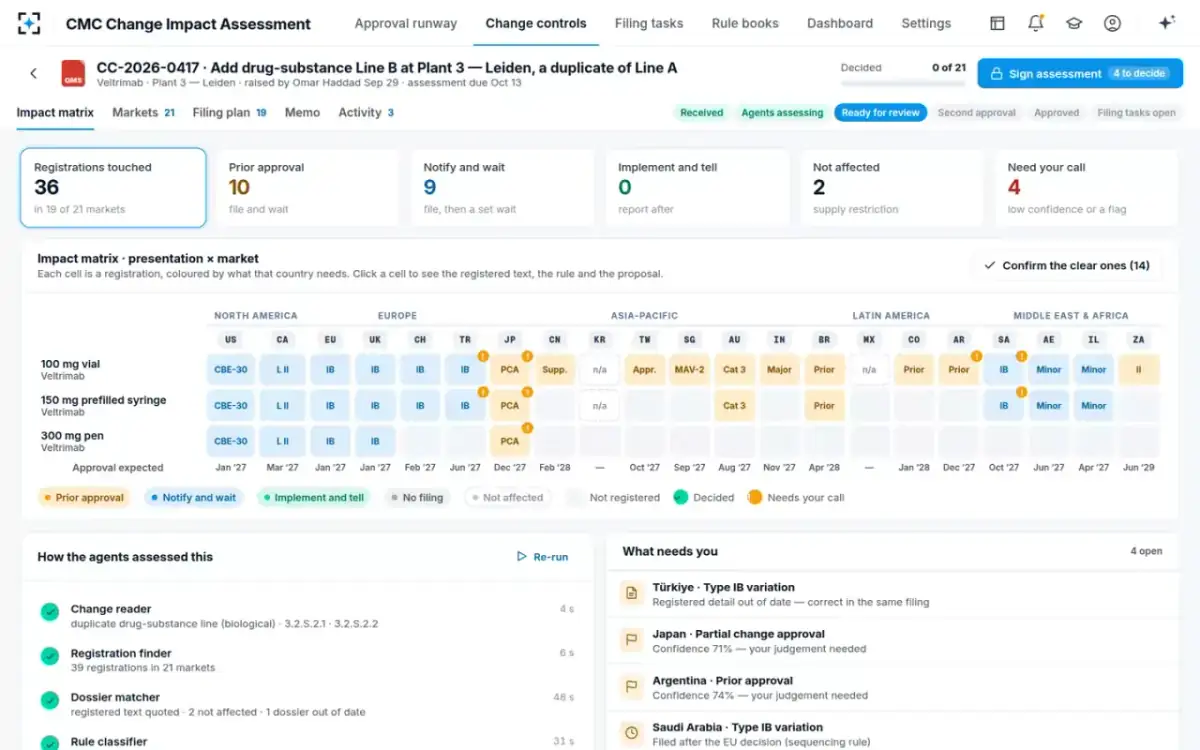
| An agentic assessment | The change control itself, from the quality system | A category proposed per market with the registered text quoted, the rule entry cited, a confidence, the alternative rejected and a date with its basis | Deciding the markets it flagged, giving a reason for anything you change, setting the implementation date and signing |
The distinction is not about model quality. It is about where the question is formulated. In the first two rows a person decides what to ask, which market to look at next, and when the list is complete — and that is most of the skill and most of the time. A tool that waits to be asked has left the hard part where it was.
The six jobs a CMC change assessment is made of
Break the work down and there are six, in order, each owing a specific output and each with something it must not do. The names below are one product's names and not an industry standard; what matters is the job, the output it owes, and the refusal attached to it.
Six jobs, the output each owes, and the thing each must refuse
- Read the change: what changed, where, and which registered elements it may touch
Owes the product, presentations, sites, change type and the dossier sections in scope, quoting the change record for every statement. Must refuse to guess an unclear change type — it asks the change owner instead — and must leave relevance to the lead.
- Find every registration, by product, presentation and country
Owes the complete list, including registrations under renewal, with agency, licence number and the registered drug-substance and drug-product sites. Must refuse to drop a market because it looks unaffected: it marks it and says why.
- Match the dossier: what each country actually approved about the step that changed
Owes the exact registered text, quoted from that country’s approved section or local approval, and a flag where the dossier disagrees with the approved change history. Must refuse to paraphrase.
- Classify against the country rule book and any past agency advice
Owes a proposed category with the rule entry cited, a confidence and the alternative it considered. Must refuse to decide: below the confidence floor the market goes to a person first.
- Plan the runway: submission and approval dates per market
Owes a date per market with its basis shown — approval history, category, sequencing rules — and a go-live suggestion. Must refuse to set the implementation date.
- Write the assessment and open the filing work
Owes the memo in the company template from the decided markets, and one filing task per market with category, rule and documents. Must refuse to put a still-proposed market into a signed memo.
Each step as it runs on a change control the tool has not seen before
Test 1 — does it read the change control, or wait to be told what changed?
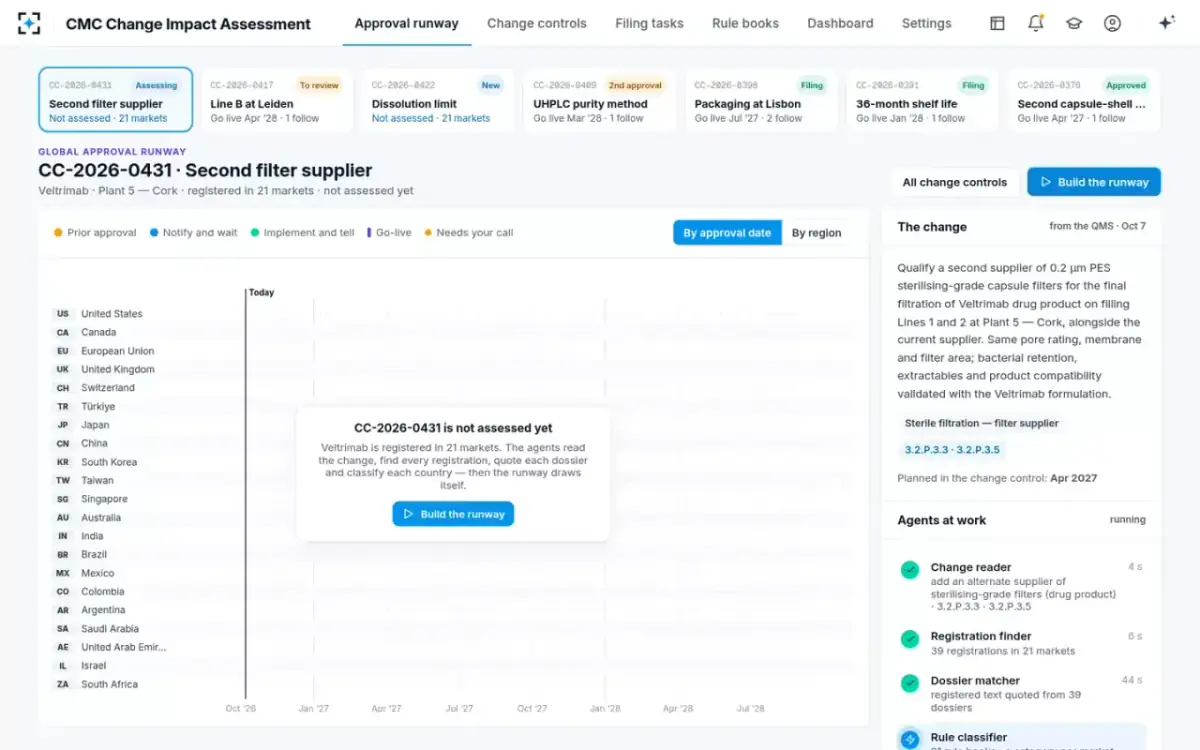
Give it the change control and nothing else. A tool that needs you to say "this is a sterilising filter change affecting 3.2.P.3.3 and 3.2.P.3.5" has asked you to do the first job and will do the rest on your framing. A tool that reads the description, the justification and the risk assessment and comes back with the product, the presentations, the sites and the dossier sections — quoting the change record for each — has done it.
Watch what it does with an ambiguous change, because that is the honest half of the test. The right behaviour is a question to the change owner, not a confident reading. In the sample solution the change reader asks when the change type is unclear, and it lists what the change touches while leaving regulatory relevance to the lead. A tool that never asks anything is not more capable; it is less careful.
Test 2 — does it find every registration, including the unaffected ones?
Run it on a product you know has an awkward market — one registered under a local name, one mid-renewal, one that names a different manufacturing site — and count what comes back. The completeness of the list is the ceiling on everything downstream, and the failure is almost never a market the tool could not find. It is a market the tool found and discarded as irrelevant.
Those discarded rows are the ones that cause harm, because a market whose registration does not include what changed needs no filing and must never receive the changed material. The output you want is an explicit "not affected, and here is the registered text naming the other site, and therefore a supply restriction". Why that row is a supply instruction rather than a blank is worked through in the drug-substance walk-through.
Test 3 — does it quote the registered text, or paraphrase it?
Ask for the evidence behind one proposal and look at what arrives. A quotation from the approved dossier section can be checked against the dossier in a minute. A summary cannot be checked at all, and a summary that is subtly wrong produces a category that is confidently wrong.
This is also the test with the clearest agency opinion behind it. EMA's reflection paper on artificial intelligence warns that generative language models tend to produce output that is plausible but wrong or incomplete, and asks for quality review mechanisms so that model-generated text is factually and syntactically correct before it goes for regulatory review. Quotation is the cheapest such mechanism there is: it moves the reviewer's job from judging a claim to comparing two strings.
The same paper makes the applicant or holder responsible for the fitness of every model, dataset and pipeline it uses, judged against legal, scientific and regulatory standards — and notes that those standards can in places be stricter than ordinary data-science practice, which is the warning teams used to general-purpose software tend to miss.
Test 4 — does it cite the rule-book entry behind each proposal?
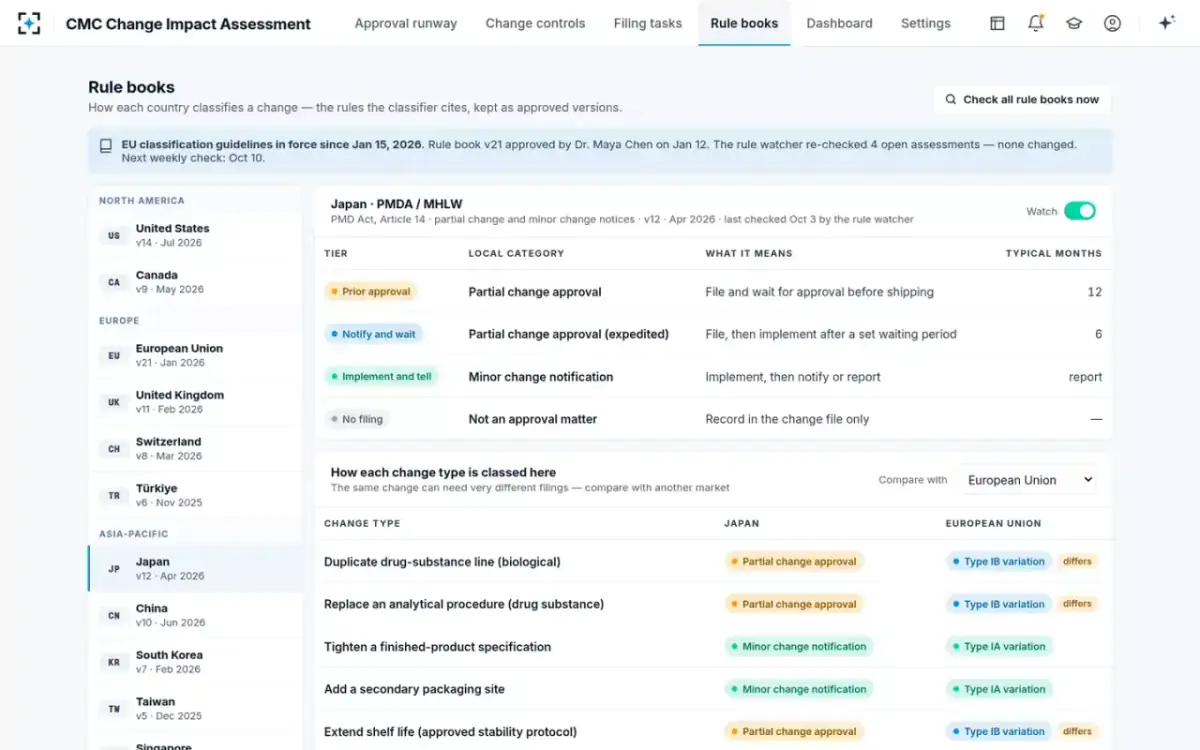
A category with no rule behind it is an opinion. Ask which entry, in which rule book, at which version, produced the answer — and then ask who approved that version and when it was last checked against the agency's current guidance. Classification rules move: the European classification guidelines were re-issued with a new chapter structure for applications from January 2026, and national rule books change without announcement.
There is also the case no rule book covers. European law provides for it: a holder may ask for a recommendation on the classification of an unforeseen variation, and "The recommendations shall be consistent with the guidelines referred to in Article 4(1). It shall be delivered within 60 days following receipt of the request". A tool that quietly invents a category for an unclassified change has skipped a route the regulation puts there on purpose. The behaviour you want is a flag and a named alternative — which is what a low confidence is for.
Rule books as approved, numbered versions, one per agency
Test 5 — does it produce dates, and show their basis?
A filing plan without dates is a list. Ask the tool when each market will approve, and then ask how it knows. The acceptable answers are narrow: the company's own approval history for that agency and that category, the published clock where one exists, and the sequencing rules that make one market wait for another. The unacceptable answer is a number with nothing behind it.
Ask too what it will not claim. No tool makes an agency faster, and any suggestion that software shortens a review is a claim about the regulator rather than about the product. What changes is when the runway is known: in the sample solution the design target is 38 minutes from a new change control to a signed proposal, against most of a working day by hand. The approval dates themselves are exactly as long as they were. How those dates are estimated, and why the longest one sets the go-live, is set out in the guide to variation timelines.
Test 6 — what will it refuse to do?
Ask for the refusals in writing, and treat a vague answer as the answer. The three that matter in this work are filing, editing and dating: a tool should not submit anything to an agency, should not edit a dossier, and should not set the implementation date, because each of those is an act the marketing authorisation holder is accountable for through a named person.
A fourth refusal is subtler and worth asking about: will it decline to answer? A classifier that produces a confident category for every market in every situation has no mechanism for doubt, and doubt is the most valuable output in this job. In the sample solution anything below 75% confidence goes to a person before it is shown as a clear proposal — Japan sits at 71% and is flagged — while bulk confirmation only ever offers proposals at or above the separate 80% threshold the lead set, and is never automatic.
Is AI allowed in regulatory affairs? What FDA and EMA say
Neither agency approves or validates tools, and neither forbids their use. What both have published is an expectation about how you use them. EMA's reflection paper is addressed to holders and manufacturers directly: anyone deploying AI or machine learning is expected to identify and manage its risks systematically, from early development until the system is retired, with early regulatory interaction advised where the use could affect a product's benefit-risk balance.
FDA's draft guidance on AI for regulatory decision-making draws its own boundary, and it is one buyers should read carefully before quoting it either way. It covers AI used to produce information supporting decisions on safety, effectiveness or quality — and it states plainly what it leaves out: AI used in drug discovery, and AI used for operational efficiencies — internal workflows, resource allocation, drafting or writing a regulatory submission — that do not affect patient safety, drug quality or the reliability of nonclinical or clinical study results. A tool that proposes filing categories for a person to decide sits closer to that second group than to the first, which means its seven-step credibility framework is not a certificate you can be handed.
A demonstration on the vendor's data against a replay on yours
The demonstration: A change control chosen because it shows the product well.
The replay on closed change controls: Ten to twenty of your own closed changes, including one that went wrong and one with a market that needed no filing.
The demonstration: A clean sample set, complete by construction.
The replay on closed change controls: Your real list, with the local product names, the mid-renewal markets and the gaps you already suspect.
The demonstration: Indexed and tidy.
The replay on closed change controls: Your archive, where some sections are scans and some disagree with today’s process.
The demonstration: Whether the output is well presented.
The replay on closed change controls: Whether the reasoning matches what your team recorded, and which of your six data sets is the weak one.
The demonstration: A second meeting.
The replay on closed change controls: Nothing, if you do it before you buy. A filing plan built on a bad list, if you do not.
Who is responsible if an AI model gets a classification wrong?
The marketing authorisation holder, through the person who signed. No published position from either agency shifts responsibility to a supplier, and none is likely to: the filing is made by the holder, the category is asserted by the holder, and the consequences of under-classification fall on the holder's product. That is why the design question is not how accurate the model is but where the signature sits.
In practice this makes three features load-bearing rather than cosmetic. A named person decides each market and signs with an electronic signature carrying its meaning. A changed category requires a reason, kept verbatim, in the memo and on the audit trail. And a second approval is required when the stakes rise — in the sample solution, when five or more markets need prior approval, the head of regulatory CMC signs as well. What a defensible proposal has to carry, item by item, is set out in the guide to systems of record.
Which job hands to which person, and what the person still decides
Today
Assesses four to six change controls a week: twenty-one dossiers and twenty-one rule books opened by hand for each, most of a day per change.
With agents
Opens a matrix already proposed and cited, and spends the time on the markets that were flagged.
Still theirs: Decides every market, gives a reason for any category changed, sets the go-live date and signs.
Today
Adds the second approval when enough markets need prior approval, usually without seeing the reasoning behind each one.
With agents
Reads a memo in which every market carries its registered text and its rule entry.
Still theirs: Approves each rule-book version before the classifier may use it, and signs the second approval.
Today
Raises the change and sets an implementation date before any assessment exists.
With agents
Sees the runway for the change and a date the approvals actually support.
Still theirs: Owns the change itself, and answers when the change type is unclear.
Today
Asks repeatedly for the category, the rule and the documents for one market.
With agents
Receives one filing task per market with the category, the rule and the documents named.
Still theirs: Prepares and makes the local submission, and holds the local agency relationship.
Today
Finds out which markets can take new material by asking.
With agents
Gets the runway and the restrictions from the filing plan.
Still theirs: Allocates batches, and owns the consequence of sending one to the wrong market.
Questions to ask a vendor, and the answers that should worry you
Six questions, each with a bad answer worth recognising. Ask them before the demonstration is designed, because the demonstration will be designed around whatever you have told them you care about.
Six questions, and the answers that should end the conversation
| Ask | A good answer sounds like | An answer that should worry you |
|---|---|---|
| What is the input — a question, or the change control? | The change control itself, read from the quality system, with the output quoting it. | "You tell it what changed and it does the rest." |
| Show me a market where it was unsure. | A flagged market with a confidence, the alternative considered, and the person it went to. | Every market confident. No mechanism for doubt is not a feature. |
| Where did this registered text come from? | A quotation from that country’s approved section, with the document and the section named. | A paraphrase, or a general statement about the product. |
| Which rule entry, at which version, produced this category? | A numbered, approved version with the approver named and the date it was last checked. | "It knows the regulations." Regulations have versions; knowledge does not. |
| How did it get this date? | Our approval history for that agency and category, plus the sequencing rules, shown per date. | A number with no basis, or a claim that the tool shortens agency review. |
| What will it refuse to do? | Not file with an agency, not edit a dossier, not set the implementation date, not decide below the confidence floor. | Anything framed as fully automatic, or a claim that a regulator has approved or validated the tool. |
The output to judge: every registration, proposed, cited and traceable
What a shortlist looks like when the tests are applied
Run the six tests and most of a long list resolves itself quickly. Search tools fail test one, because they wait for a question. Assistants usually fail tests three and four together: fluent, sometimes cited, but reasoning you cannot reconstruct and rules you cannot version. What survives is a short list of tools that take a change control as input and produce an evidenced proposal per market as output — and those should then be judged entirely on a replay of your own closed changes, not on a demonstration.
The last thing to agree before you buy is the boundary, written down: what the tool does, what it refuses, who signs, and which thresholds a named person owns. If that document is hard to produce, the tool has not drawn the line yet, and you will be the one who discovers where it falls. To see six jobs, their limits and a signed assessment on one change control, start from CMC Change Impact Assessment.
Questions people ask
Can AI classify a variation?
It can propose a classification, and the distinction is the whole of the matter. A proposal that quotes the registered text, cites the rule entry and version, states a confidence and names the alternative it rejected is something a regulatory professional can accept, amend or reverse in a minute. An unexplained category is not faster to check than doing the work; it is slower, because the checker has to start again.
Should AI quote or summarise registered text?
Quote. The claim a classification rests on is the exact wording of what a country approved about the step that is changing, and a summary removes the only thing a reviewer can verify. EMA's reflection paper on AI warns that generative models produce plausible but erroneous or incomplete output and asks for review mechanisms before text goes for regulatory review; quoting is the simplest of those mechanisms.
Do you have to validate an AI model used in regulatory affairs?
Neither agency issues approvals for tools, so there is nothing to be handed. What EMA expects is that holders and manufacturers deploying such systems consider and systematically manage the relevant risks from early development through to decommissioning, with early regulatory interaction where a product's benefit-risk balance could be affected. FDA's draft guidance sets out a risk-based credibility framework but explicitly excludes uses that are operational efficiencies not affecting patient safety, drug quality or study reliability — so for this use the evidence you hold is your own qualification work and your audit trail.
How do you test a regulatory AI tool before buying it?
Replay it on change controls you have already closed. Pick ten to twenty with a spread of categories, include one where the original assessment turned out wrong and one with a market that needed no filing, and compare market by market against the reasoning your team recorded at the time. You will learn as much about the state of your registrations and dossiers as about the tool, and both are things to know before a live assessment.
What should AI in regulatory affairs refuse to do?
File with an agency, edit an approved dossier, set an implementation date, and decide a market it is not confident about. The first three are acts the marketing authorisation holder is accountable for through a named signatory; the fourth is the difference between a tool that surfaces judgement calls and one that hides them. Ask for the refusals in writing before the evaluation starts.
Who is responsible if an AI model gets a classification wrong?
The holder, through the person who signed the assessment. No published agency position transfers that to a supplier. In practice this makes three things load-bearing: a named decider per market with an electronic signature carrying its meaning, a verbatim reason wherever a proposed category was changed, and a second approval when enough markets need prior approval.