Established conditions, in ICH Q12, are the parts of an approved application that are binding: change one and you owe the agency a submission. Everything else in the dossier is supportive information, which you may change under the quality system alone. That single distinction decides most of the work in post-approval change, because the first question of any assessment is not "how big is this change" but "does this country's approved text register the thing that is changing at all" — a lookup, in named sections, against words somebody filed years ago. CMC Change Impact Assessment, Botminds' agentic solution for post-approval CMC changes, does that lookup registration by registration and quotes what it finds, so the category proposed for each market rests on text rather than recollection.
The worked examples come from the solution's fictional sample data — Northwind Bio, its antibody Veltrimab, and the dossier extracts shown on its screens are all invented. Every regulation and guideline quoted is real and linked where it appears.
What are established conditions under ICH Q12?
ICH Q12 defines them in two sentences, and they are worth reading as one rule and one consequence.
"ECs are legally binding information considered necessary to assure product quality. As a consequence, any change to ECs necessitates a submission to the regulatory authority."
ICH guideline Q12 (EMA/CHMP/ICH/804273/2017), section 3.2.1
The rule is "legally binding information considered necessary to assure product quality". The consequence is that a change to it always produces a submission — not necessarily a prior approval, but always something told to the agency. The guideline is equally clear about the other half of a dossier: all regulatory dossiers contain a combination of established conditions and supportive information, and supportive information "is not considered to be ECs but is provided to share with regulators the development and manufacturing information at an appropriate level of detail".
Where Q12 adds something genuinely new is in asking companies to say which is which. An applicant may identify the elements it considers established conditions, with the rationale in the relevant parts of the dossier, and may propose the reporting category for changing each one. Q12 is explicit that, unless a regional requirement says otherwise, identifying them for a given product is not mandatory — which is why the practical answer to "what is registered?" still varies by market and by how the dossier was written.
Why "is it registered?" is the question that decides everything else
Consider what the alternatives cost. If the changed element is registered, you owe a submission in that market and the only remaining question is which category. If it is not registered, you owe nothing — but you may owe a supply restriction, because material made with the change must not reach a market whose approval describes something else. The two branches lead to completely different work, and you cannot pick the branch without opening the dossier.
That is why a well-run assessment front-loads retrieval. On the sample drug-substance change — a duplicate production line added at one site — thirty-six of the company's thirty-nine live registrations held text that the change touched, and three did not, because two markets register a different drug-substance site entirely.
Thirty-nine registrations, one change: the lookup that splits them
Veltrimab, 39 registrations in 21 markets, against one drug-substance line change
- Registers the changed element — a filing is owed · 92%
- Does not — a supply restriction instead · 8%
The eight per cent is the half of the answer that gets lost. "Not affected" reads like nothing to do, and it is the opposite: it is the only outcome that produces an obligation nobody will be reminded of, because no filing task exists to carry it. In the solution a market whose registration does not include what changes is always marked not affected and given a supply note, which is a rule rather than a habit.
The lookup in CMC Change Impact Assessment: four moves from a changed element to a filing or a restriction
Agent
Name the elementTurns the change control into a dossier element: which site, which unit operation, which supplier, which specification — with the CTD sections that would hold it.
Never: guess at a change type; it asks the change owner when the description is ambiguous
Agent
Find the section that would register itFor each country's approved dossier, opens the sections that hold that kind of element, including local approval documents where the market does not use the CTD.
Never: assume one market's structure describes another's
Agent
Quote what it saysCopies the registered text verbatim and marks registrations whose text does not include the thing that changes.
Never: paraphrase; a summary cannot be checked against the approval
Agent
Decide: filing, or restrictionWhere the element is registered, passes the market to classification with the quoted text attached. Where it is not, marks the market not affected and raises the supply restriction.
Never: drop a market from the assessment because it looks unaffected
A person decides
Regulatory CMC leadReads the quoted text beside each proposal and decides the market; a changed conclusion carries a reason.
Where the registered elements live: the Module 3 sections to open
Q12 publishes a general list of which CTD sections contain established conditions and which contain supportive information. It is the closest thing to a map, and reading it is the fastest way to understand why two apparently similar changes get different answers.
ICH Q12's general list: which Module 3 sections hold established conditions
| CTD section | What Q12 lists for it | What that means for a change |
|---|---|---|
| 3.2.S.1.1 / 3.2.S.1.2 Nomenclature, structure | Drug substance name, structure. | Binding, and rarely changed; a change here is a different product conversation. |
| 3.2.S.1.3 General properties | Supportive information. | Characterisation detail. Changing how it is described does not by itself create a filing. |
| 3.2.S.2.1 Manufacturer(s) | Drug substance manufacturing site(s), including testing. | Adding, moving or dropping a drug-substance site or testing laboratory is a change to an established condition almost everywhere. |
| 3.2.S.2.2 Description of manufacturing process | Individual unit operations and their sequence, with inputs and outputs identified under Q12 chapter 3. | The heart of it. A step added, reordered or re-scaled is binding; the level of parameter detail that is binding depends on how the dossier was written. |
| 3.2.S.2.3 Control of materials | Starting material specifications, critical raw material controls, source of biological materials, cell bank generation and control. | A new raw material supplier may or may not touch it; a new cell bank certainly does. |
| 3.2.S.2.5 / 3.2.P.3.5 Process validation and evaluation | Supportive information. | Q12 treats the validation package itself as supportive — but a national approval may still register a detail stated there, so the general list is not a substitute for the country's own text. |
| 3.2.P.3.1 Manufacturer(s), drug product | Drug product manufacturing sites, including testing, packaging and device assembly. | A new filling line at an approved site and a new site are different questions; both start here. |
| 3.2.P.3.3 Description of manufacturing process, drug product | Individual unit operations and their sequence. | Where a sterilising filtration step, a filling operation or a hold step is registered. |
| 3.2.P.3.4 Controls of critical steps and intermediates | Specifications for critical steps and intermediates, including storage conditions. | Relaxing one is a change to a binding limit; tightening one is usually still a change, in a lower category. |
3.2.S.2.1 and 3.2.S.2.2: the drug substance site, and its process
These two sections carry most drug-substance change controls between them, and they behave differently. Section 3.2.S.2.1 is a list of facts — who manufactures and tests, where, and with what responsibility — so a change to it is binary and easy to detect: a site is on the list or it is not.
Section 3.2.S.2.2 is prose, and prose is where companies create obligations for themselves. ICH M4Q is blunt about its status: the process description in 3.2.S.2.2 is the applicant's commitment to how the drug substance will be made. A commitment written at the level of unit operations and their sequence binds the company to the sequence. A commitment that also names a vessel volume, a building or a line count binds the company to those too — and a plant change that would otherwise be invisible to the dossier becomes a variation in every market whose text contains the detail.
That is exactly what happened on the sample change. Adding a second production line at the approved site touched 3.2.S.2.1 and 3.2.S.2.2 in thirty-six registrations, because the capacity and site description are registered; in Japan it mattered more, for a reason the next sections cover.
3.2.P.3.3 and 3.2.P.3.5: the drug product process, and its validation
On the drug product side the same pair repeats with a sharper edge. Section 3.2.P.3.3 registers the unit operations and their sequence; M4Q expects the narrative description to identify process parameters such as time, temperature or pH at each step, with numeric ranges where relevant. Section 3.2.P.3.5 holds the validation studies for critical steps — ICH Q12's general list calls that supportive information.
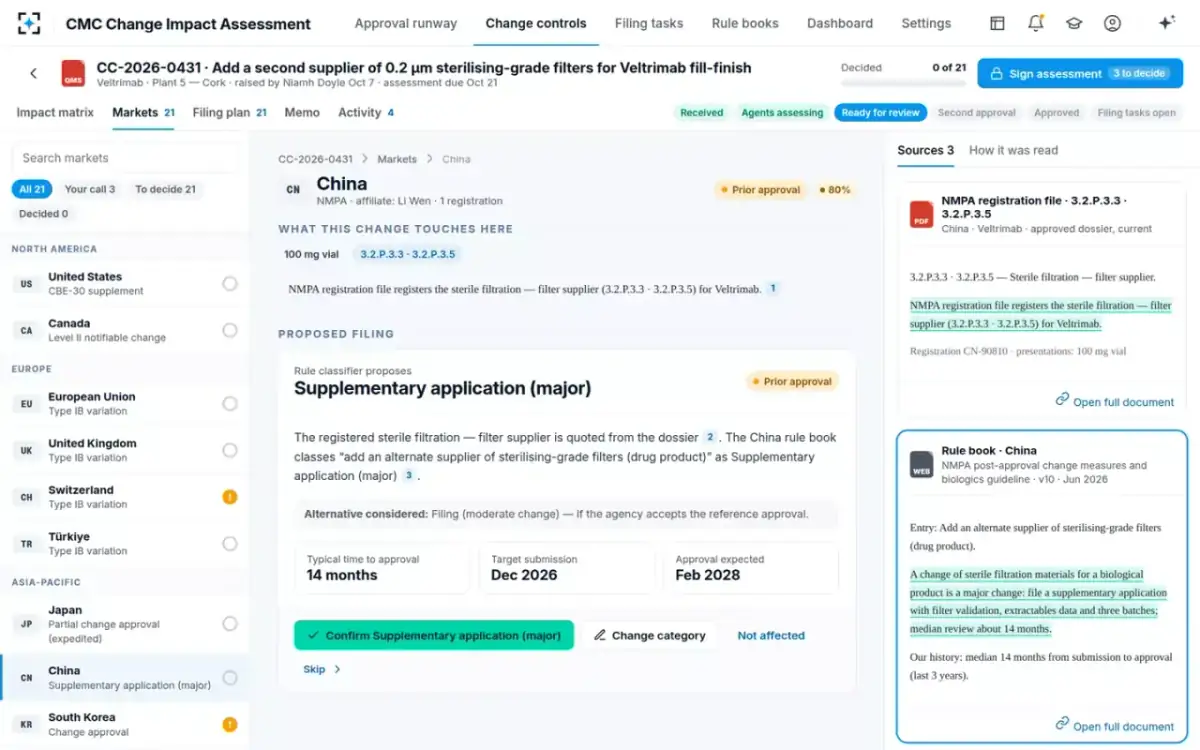
In practice the line is not where the general list puts it, and a global assessment has to allow for that. On the sample filter-supplier change, the Chinese registration file registers the sterile filtration filter supplier at 3.2.P.3.3 and 3.2.P.3.5, which makes a second supplier of the same filter a change to registered text in that market even though the pore rating, membrane and filter area are unchanged. The United States answer for the same change comes from a published table rather than from the dossier, and lands in a lower category — the test that decides which US supplement you file is worked through separately.
CMC Change Impact Assessment quotes the registered text beside the proposal that rests on it
Japan writes it differently: approval matters, declared in advance
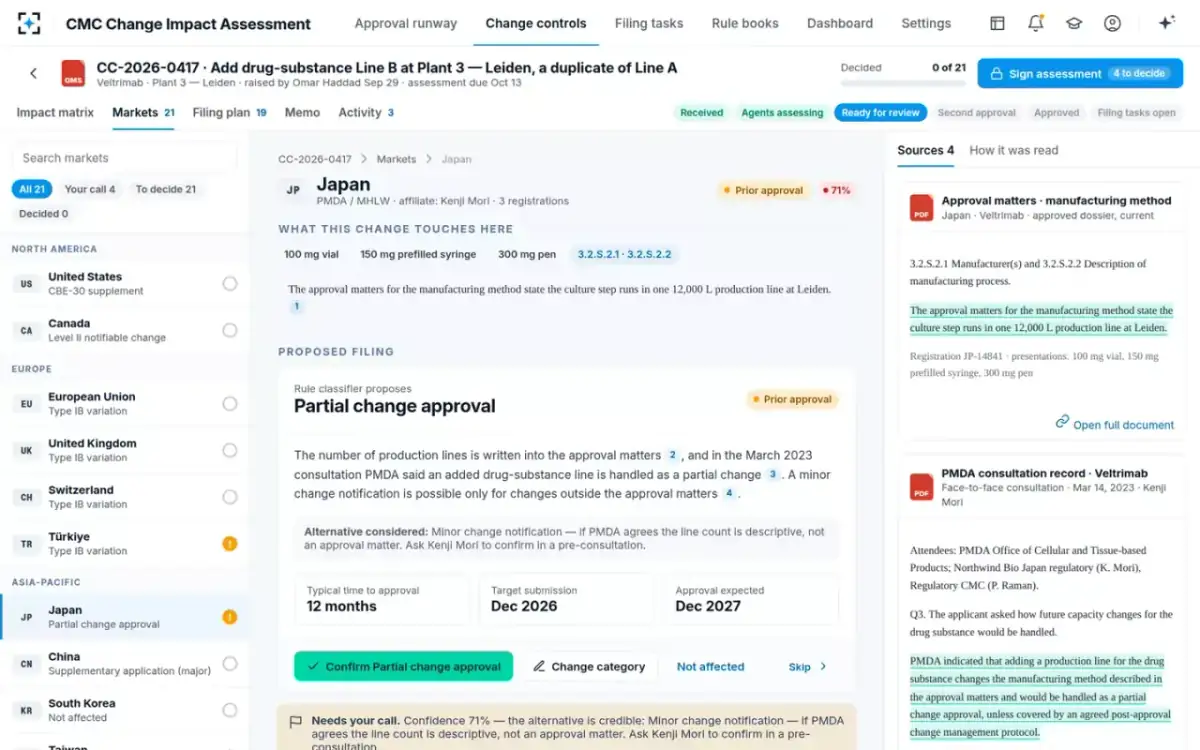
Japan reached the same problem more than a decade before Q12 and solved it the other way round. Rather than inferring what is binding from the dossier, the applicant declares it in the application form. The 2005 notification that set this out tells the applicant to use the description examples and "personally distinguish and establish in advance the matters to be addressed in a partial change approval application, and the matters to be addressed in the notification of minor changes" (MHLW, PFSB/ELD Notification No. 0210001, section 1(2), tentative translation).
Two consequences follow for anyone assessing a change. First, in Japan the question "is it registered?" has a documentary answer: open the approval matters and look. Second, the answer was decided by the company itself at approval time, so a line count or a vessel volume written into the approval matters is binding because somebody chose to put it there.
The same drug-substance line change, two ways of deciding what is binding
United States: The regulations set a risk-based paradigm for reporting changes; FDA guidance then describes a broad set of post-approval changes and the category each should be reported in.
Japan: The applicant distinguishes, in advance and in the application form, which matters need a partial change approval and which may go in a minor change notification.
United States: The regulation, then the applicable change tables in guidance for that product type.
Japan: The approved application form for that product — the approval matters themselves.
United States: The agency, in rules and guidance that apply to everyone.
Japan: The company, at approval, within the agency's description guidelines — and then the agency, in approving the form.
United States: Only matters if the regulations or guidance treat that element as reportable.
Japan: Becomes an approval matter, so changing it needs a partial change approval rather than a notification.
United States: A duplicated line at an approved facility with unchanged parameters fits a published row and lands below prior approval.
Japan: The line count sits inside the approval matters, so the proposal is a partial change approval — with a minor change notification named as the alternative if the agency agrees the count is descriptive.
One market's registered text, the rule it meets, and the alternative the proposal names
What is supportive information, and why it still reaches the agency
Supportive information is everything in the dossier that is not an established condition: development history, characterisation, justification, validation reports, the reasoning behind a specification. It is filed, assessed and used — it is simply not binding in the sense that changing it obliges a submission.
Three cautions keep that from becoming a loophole. First, Q12 is careful to separate supportive information from post-approval commitments: stability commitments and similar undertakings are managed under regional rules whatever their label. Second, supportive information is still part of the approved application, so it has to be kept accurate and it is read at inspection. Third, and most practically, whether a given sentence is supportive depends on the market, which is why the general list is a hypothesis and the country's own approved text is the evidence.
Established condition, or supportive information? The test, and what each status costs
Established condition
Legally binding information considered necessary to assure product quality.
- Any change to it needs a submission to that authority.
- The reporting category depends on the risk the change carries.
- It is what the assessment must quote, market by market.
- Writing extra detail into one creates extra obligations.
Supportive information
Provided to share development and manufacturing information at an appropriate level of detail; not binding in itself.
- Changing it does not by itself oblige a submission.
- It is still filed, still assessed, and still read at inspection.
- Whether a sentence is supportive can differ between markets.
- Post-approval commitments are managed separately, whatever they look like.
Does proposing established conditions change what you must file?
In the United States, not by itself. FDA's draft guidance on implementing ICH Q12 is explicit that "Proposing elements to be considered ECs that may differ from those FDA typically considers to be ECs based on the risk-based paradigm set forth in the regulations and the recommendations contained in guidance is voluntary", and that if specific elements are not proposed, the established conditions are the ones FDA typically considers to be established conditions under that paradigm. The guidance remains a draft, so a company treating explicit identification as a settled US requirement is ahead of the text.
The underlying obligation is older and broader than Q12's vocabulary. For an NDA, "the applicant must notify FDA about each change in each condition established in an approved NDA beyond the variations already provided for in the NDA" (21 CFR 314.70(a)(1)(i)). "Each condition established" is the phrase Q12's term echoes; what Q12 adds is a structured way to say in advance which conditions those are, and to argue for a lower reporting category where product understanding supports one.
The honest summary for an assessment team is this: proposing established conditions is a way to make the answer predictable and sometimes cheaper, in the markets that accept the proposal. It does not change what is binding today in a product that was approved without one, and in a twenty-one-market portfolio the dossiers approved without one are nearly all of them.
The dossier that no longer describes the plant
Two drifts happen to long-lived products, and established conditions make both expensive.
The first is over-description. A dossier written with more detail than the law required — a vessel volume, a building number, an equipment brand — turns those details into things that have to be varied. The cost appears years later, when a change that touches nothing the regulator cares about still needs a submission in eleven markets because eleven dossiers happen to mention the detail. Q12's identification approach exists partly to let companies draw that line deliberately at approval rather than by accident.
The second is divergence. An approved change gets carried into some markets' texts and not others; a renewal re-states a detail imprecisely; a local translation fixes a number that was a range. The registered text then disagrees with the company's own change history, and the only place that shows up is an assessment that compares the two. In the sample solution the dossier matcher flags registrations that disagree with the approved change history — on the sample drug-substance change it found one, in a single market, where the registered detail was out of date and could be corrected inside the same filing.
Neither drift is fixed by assessing against the plant. The obligation is measured against what is registered, so the discrepancy has to be raised as its own finding with an owner, which is how the assessment itself handles it, step by step.
The PLCM document: a register of what is registered
Q12's last tool is the one that makes the rest usable. The Product Lifecycle Management document is a summary, filed in the application, that lists the established conditions, the reporting category for changing each one, any post-approval change management protocols and any post-approval CMC commitments, with references to where the justification sits elsewhere in the dossier. Q12 suggests a tabular format and puts the document in CTD module 3.2.R.
For an assessment team the attraction is obvious: instead of inferring what is binding from prose written years earlier, you read a list somebody agreed with the agency. The caveats are equally obvious. It only exists where it was filed; it has to be updated with each submission that changes an established condition; and it is one market's answer, so a portfolio still needs the country-by-country lookup for everything approved without one.
Which is the shape of the whole problem. "What is registered?" has a clean answer in theory and twenty-one documentary answers in practice, and until every market holds a maintained list, the only defensible method is to open each country's approved text and quote it. That is the step the agents in CMC Change Impact Assessment take off the desk — and the one thing they are not allowed to do is paraphrase it.
Questions people ask
What counts as an established condition?
Information in the approved application that is legally binding because it is considered necessary to assure product quality — typically the manufacturing sites, the unit operations and their sequence, the critical controls and specifications, and the analytical procedures behind them. ICH Q12 publishes a general list by CTD section, but what is binding for a given product in a given market is what that agency approved.
Which CTD sections hold the established conditions?
Mostly 3.2.S.2 and 3.2.P.3 for manufacture, plus the specification and analytical-procedure sections for drug substance and drug product and, for biological products, the cell bank and raw-material control sections. ICH Q12's Appendix 1 marks several sections as supportive information, including the process validation sections 3.2.S.2.5 and 3.2.P.3.5.
Does a change to supportive information need a submission?
Not by itself. Supportive information is not binding in the way an established condition is, so it can be managed under the quality system. Two cautions: a national approval may register, as binding, a detail that the general list treats as supportive; and post-approval commitments are handled under regional rules whatever they are filed beside.
How does Japan define what is registered?
By declaration in the application form. The applicant distinguishes in advance which matters require a partial change approval and which may be handled by a minor change notification, following the agency's description guidelines, and that declaration is approved with the application. The practical effect is that the question is answered by reading the approval matters rather than by interpreting the dossier.
What is a PLCM document?
The Product Lifecycle Management document: a summary filed in the application listing the established conditions, the reporting category for changing each, any change management protocols and any post-approval CMC commitments, with pointers to the justification elsewhere in the dossier. ICH Q12 recommends a tabular format and places it in module 3.2.R, updated with each submission that changes an established condition.
What happens if the dossier describes more than the law requires?
The extra detail becomes binding in that market. A vessel volume or a line count written into an approved process description has to be varied when it changes, even where the regulator would not have asked for it. That is the main argument for deciding deliberately, at approval, how much detail to register — and the main reason two markets can answer the same plant change differently.