A Type IA variation's implementation date is the day the marketing authorisation holder makes the change — and in the European Union it comes before the day the agency is told, not after. That is the whole of the "do and tell" procedure, and it is why the question "when can we implement?" has a different answer for a Type IA than for a Type IB or a Type II, where the notification or the application comes first. The complication worth knowing is that implementation does not mean what most plants assume: for a quality change it is the day the company changes its own quality system, not the day the first batch made with the change leaves the site. CMC Change Impact Assessment, Botminds' agentic solution for post-approval CMC changes, works those clocks market by market and turns them into one runway with a suggested go-live date.
The worked example runs on the solution's fictional sample data — an invented company, Northwind Bio, and an invented antibody, Veltrimab. The European rules, dates and figures are real and linked where they appear.
What is a Type IA variation implementation date?
It is the date the holder actually makes a minor variation of Type IA, and it is the date every other Type IA deadline is measured from. The regulation defines the category by its impact rather than its procedure: "'Minor variation of type IA' means a variation which has only a minimal impact, or no impact at all, on the quality, safety or efficacy of the medicinal product concerned" (Commission Regulation (EC) No 1234/2008, Article 2, consolidated text).
Because the impact is minimal, the European Union does not make the holder wait. The variation is implemented first and notified afterwards — immediately for the subcategory that requires immediate notification, and otherwise inside twelve months as part of an annual update. The implementation date is therefore the date that starts the notification clock, and the date a plant can put in its own plan without waiting for anyone.
The EU categories, and who waits for whom
There are four categories, and the only question that matters to a plant is which of them allows material made with the change to be released, and when.
The four EU variation categories, on the dates that bind a plant
| Category | What the holder does, and when | What the agency may do | If the deadline is missed |
|---|---|---|---|
| Type IA — minor, not requiring immediate notification | Implement, then notify. The notification is submitted within 12 months of implementation as a Type IA annual update — no earlier than 9 months and no later than 12 after the first implementation date in that update. | Review the notification after the fact, within 30 days of receiving it. | The dossier of record is out of step with the product. A variation refused within an annual update may be resubmitted on its own so that it still lands inside the 12-month reporting period. |
| Type IAIN — minor, requiring immediate notification | Implement, then notify immediately, so the agency's supervision of the product stays current. | The same post-hoc review; the point of the subcategory is timeliness, not approval. | Immediate means immediate: holding an IAIN for the annual update is a compliance finding, not a scheduling choice. |
| Type IB — minor, everything that is neither IA nor II nor an extension | Notify first, wait 30 days, then implement. The regulation makes silence favourable: if no unfavourable opinion arrives in 30 days the opinion is deemed favourable. | Send an unfavourable opinion inside the 30 days, with grounds; the holder then has 30 days to amend the notification. | Implementing before the window closes is implementing without the deemed favourable opinion the procedure rests on. |
| Type II — major | Apply, and wait for the opinion. The Agency issues its opinion within 60 days of receiving a valid application. | Reduce the 60 days for urgency, extend them to 90 for listed variations or certain groupings, or request supplementary information — which suspends the procedure. | There is no deadline to miss on the holder's side; the exposure is a plant that planned against 60 days and met a clock-stop. |
Read down the second column and the pattern is a staircase of trust. Type IA is implemented on the holder's own judgement; Type IB is implemented on the agency's silence; Type II is implemented on the agency's opinion. The categories are not degrees of paperwork, they are degrees of who carries the risk while the change takes effect.
Do and tell: a Type IA is implemented before it is notified
"Type IA/IAIN variations do not require prior approval before implementation ("Do and Tell" procedure)"
European Medicines Agency, Type-IA variations: questions and answers
The phrase is EMA's own, and it is worth preferring to the various in-house labels teams invent, because it is also what a European colleague will search for. Its practical effect is that a Type IA change has no regulatory waiting time in the European Union at all. Whatever is holding the change up — conformance batches, stability, a supplier qualification, an internal approval — is the company's own work, not the agency's queue.
That has two consequences for a global plan. First, the European Union is rarely the market that sets a go-live date when the change classifies as Type IA there; it drops out of the critical path. Second, a company that treats Type IA like every other filing, and waits anyway, is paying a delay that nobody asked for. On the sample filter-supplier change, two markets outside the European Union were classified in the solution's equivalent tier — implement, then report — and their bars on the runway start at once while most markets are still waiting.
IAIN against IA: immediate notification, or the annual update
The two subcategories differ only in when the notification is due, and the classification guideline says which changes fall in which. Type IA variations requiring immediate notification must be submitted to the competent authorities or the Agency immediately following implementation, so that supervision of the product stays current. Everything else is collected and submitted as a Type IA annual update.
Three practical details are easy to get wrong. A Type IA annual update is usually a grouping, but it can be a single variation if only one was implemented in the period. A super-grouping across several marketing authorisations of the same holder is possible where the variation is identical for all of them. And there are defined exceptions that allow an individual submission outside the annual update — among them a Type IA needed to mitigate a shortage with agreed regulatory flexibilities, a public-health concern that makes an immediate dossier update necessary, an update needed before a routine site inspection or a transfer of the authorisation, and a third country requiring proof of acceptance in the European Union. Each exception needs a justification in the application form.
The annual update window: no earlier than 9, no later than 12 months
The window is narrow at both ends, and the lower bound is the one that surprises people.
"The application should be submitted no earlier than 9 months and no later than 12 months after the first implementation date of the Type IA variation included in the 'Type IA annual update'."
European Medicines Agency, Type-IA variations: questions and answers
So the clock is anchored on one date: the first implementation date among the variations in the update. A holder that implements three Type IA changes in February, March and April is expected to submit the grouped update between the following November and January — nine to twelve months after the February date, not after the April one. Submitting in June, to be tidy, is as much outside the window as submitting in March of the following year.
The reason to care is bookkeeping that nobody enjoys doing by hand. Every Type IA implemented anywhere in the portfolio carries its own date, and those dates decide which update it belongs to. A company that tracks implementation dates in the change control system, rather than in the regulatory tracker, usually finds the two disagree — and it is the regulatory date that the window is measured from.
What "implementation" means for a quality change, and why it helps
Here is the definition that decides the dates, and it is not the one a plant would guess:
"For quality changes, 'implementation' is when the company makes the change in its own quality system."
European Medicines Agency, Type-IA variations: questions and answers
Not the day the change is approved internally in principle, not the day the equipment is installed, and not the day the first batch made with the change is released. The day the change is made in the quality system — the day the new procedure, specification or supplier becomes the controlled one.
EMA explains why the definition is drawn there, and the reasoning is in the holder's favour: it lets a company manufacture conformance batches and generate stability data in support of a variation before the notification is due, because the change has not been made in the quality system until those data exist. That is a real allowance. It means the evidence-gathering runs can happen without starting the notification clock, and the clock starts when the company commits.
For product information the test is different again: implementation is when the company internally approves the revised product information, which is then used in the next packaging run. A team that applies the quality-change definition to a labelling change will date it wrongly.
The vocabulary matters here too. Teams build internal labels for these tiers, and screens often read "implement and tell". The term the regulator uses, and the one a European colleague will type into a search box, is "do and tell" — and the guides, the rule books and the training are easier to keep straight when the internal word matches the regulator's.
Type IB: tell, wait 30 days, then do
A Type IB is the residual category: a variation which is neither a Type IA nor a Type II nor an extension. Its procedure is the mirror image of do and tell. EMA calls it "Tell, Wait and Do": the holder notifies before implementation, and on acknowledgement of a valid notification "the MAH must wait a period of 30 days to ensure that the notification is deemed acceptable by the relevant authority(ies) before implementing the change".
Do and tell against tell, wait and do: the same change, two procedures
Type IA / IAIN — do and tell: Implement the change, then notify the agency.
Type IB — tell, wait and do: Notify the agency, wait 30 days, then implement.
Type IA / IAIN — do and tell: The category itself: these variations do not require prior approval before implementation.
Type IB — tell, wait and do: The absence of an unfavourable opinion in the 30 days, which the regulation deems a favourable opinion.
Type IA / IAIN — do and tell: The notification: immediately for IAIN, or within the 9-to-12-month annual update window for IA.
Type IB — tell, wait and do: None on the holder — but implementing early forfeits the basis on which the change was made.
Type IA / IAIN — do and tell: The agency reviews after the fact; the change has already been made in the quality system.
Type IB — tell, wait and do: An unfavourable opinion with grounds; the holder has 30 days to submit an amended notification, failing which the notification is deemed rejected.
Type IA / IAIN — do and tell: The European Union drops off the critical path; the plant's own readiness sets the date.
Type IB — tell, wait and do: A month of regulatory time, which often still leaves the EU among the earlier markets.
Type II: the 60-day opinion, and what stops the clock
A major variation is the only one of the four where the holder genuinely waits for an answer. Under Article 16(2), the Agency has 60 days from receipt of a valid application to give its opinion, and the same article allows the period to be reduced for urgency or extended to 90 days for variations listed in Annex V and for certain groupings.
The number to plan against is not 60 days, though, and the reason is in the next paragraph. Within the assessment period the Agency may request supplementary information, and under Article 16(3) the procedure then stops until the holder has supplied it. A clock-stop is not an extension of a few days; it is a pause whose length is set by how quickly the holder can answer, and a question that needs new data can add months.
Two more facts shape the calendar. Validation comes first: the 60 days run from receipt of a valid application, so a validation issue moves the start. And the opinion is not the end — within 15 days of the final opinion the closing measures are taken, and where the variation affects the terms of the Commission decision, the decision itself is amended afterwards.
Can you implement a Type IB before the 30 days are up?
No. The 30 days are the period in which an unfavourable opinion may arrive, and the regulation's wording is what makes implementation lawful afterwards: "if within 30 days following the acknowledgement of receipt of a valid notification the Agency has not sent the holder an unfavourable opinion, its opinion shall be deemed favourable" (Article 15(2)). Implementing on day 20 is implementing without the deemed favourable opinion.
It also explains why a careful screen says "notify and wait" rather than "await approval" for a Type IB. Nothing is approved; the holder is waiting out a silence that the regulation converts into a favourable opinion. The distinction is more than semantic when the agency does respond — an unfavourable opinion starts a 30-day amendment period, and a notification the holder does not amend is deemed rejected.
What changed on 15 January 2026, and what to re-check
The European Commission's revised variations guidelines are the first substantial rewrite of the classification in years. EMA's announcement is precise about the date they bite: "The guidelines will apply to variation applications submitted by marketing authorisation holders to EMA from 15 January 2026" (EMA, 22 September 2025).
The wording matters for anyone maintaining a rule book. The guidelines apply to applications submitted from that date, which is not the same statement as a rule being in force from it — and for Type IA variations the two can come apart, because implementation precedes submission. EMA's own transitional guidance sets out how the annual update cycle restarts: the first Type IA variation implemented on or after 15 January 2026 starts a new cycle for the annual update, unless an exemption applies to it.
Three things are worth re-checking on open work. Whether a change classified before the date is still in the same category under the revised classification. Whether any Type IA variations implemented before 15 January 2026 are still sitting outside an annual update, since those are named as a case for individual submission. And whether the rule book your team applies is versioned at all — in the sample solution each country's classification is an approved version with a named approver and a date, and a rule watcher re-checks open assessments when a version changes, precisely so a change assessed in December is not quietly filed under a January rule.
How much of this the European Union actually handles: variation applications started in 2024
Two clocks on one change, and the date the plant gets
Put the categories on a calendar and the two-clock structure becomes obvious. A Type IA has an implementation date and, separately, a notification date up to twelve months later. A Type IAIN has the same implementation date and a notification date immediately after it. A Type IB has a notification date and an implementation date thirty days later. A Type II has an application date and an implementation date after the opinion — which is the only one of the four where the gap is set by the agency rather than by the holder.
Twelve months after the decision: when the change is in use, and when the agency has been told
- In use from day 0; the agency has not been told yet0–9 months
- Annual update submitted in this window9–12 months
- In use from day 0, and notified immediately after implementationimmediate
- Waiting30 days
- In use, on a deemed favourable opinionthen in use
- 60-day assessment60 days
- Suspensionclock-stop
- In use once the opinion is favourablethen in use
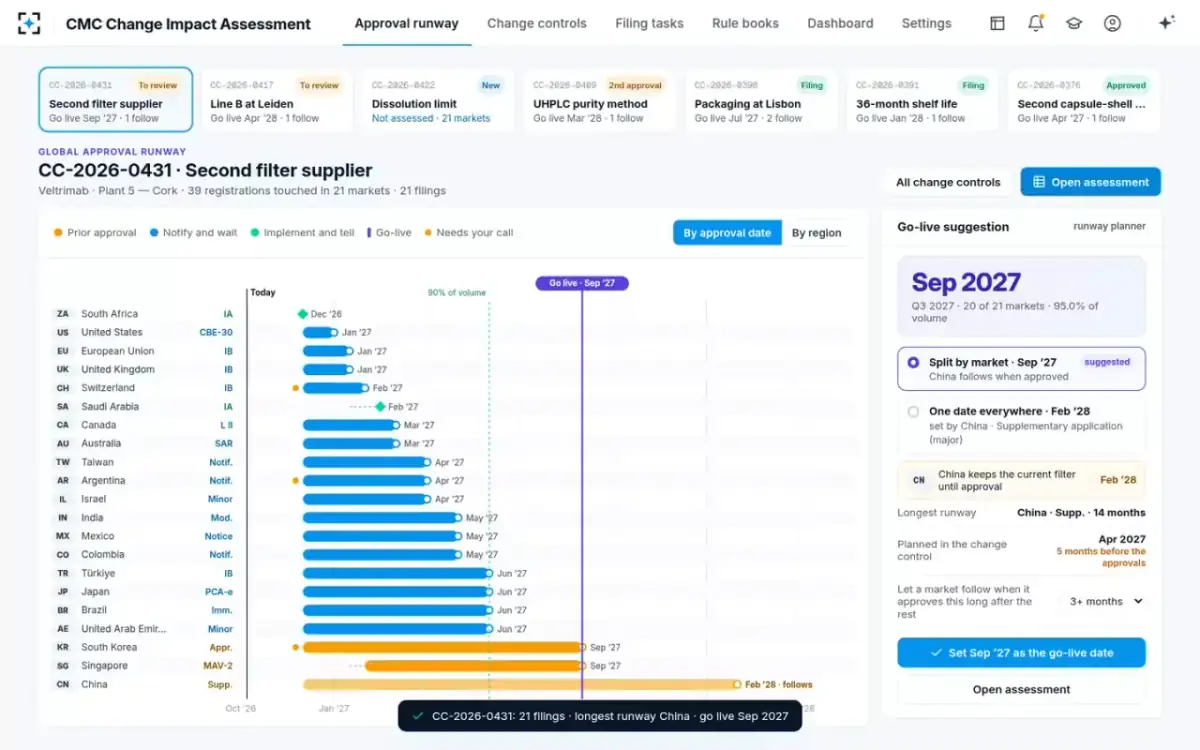
A plant does not want four clocks; it wants one date. That is what a runway is for: one bar per market from submission to expected approval, with the implementation rules of each category built into where the bar starts and ends, and a single suggested go-live date underneath.
Twenty-one markets on one change in CMC Change Impact Assessment, and the markets that need nobody's permission
Where the implementation date ends up
The date has to leave the regulatory system and land somewhere a plant and a supply planner can act on. On the sample change the planner suggested September 2027 — twenty of twenty-one markets, 95.0% of volume — with the last market keeping the current filter until its own approval in February 2028, against the April 2027 the change control had originally planned. The alternative, one date everywhere, would have been February 2028 for everybody.
Two rules keep that honest. The planner suggests and shows the basis for every date; the regulatory CMC lead sets the go-live date, and both the suggestion and the choice stay on the audit trail. And the date is written back to the change control and passed to supply planning, so the plant's plan and the regulatory plan are the same document rather than two.
The date chosen, written back to the change control by CMC Change Impact Assessment
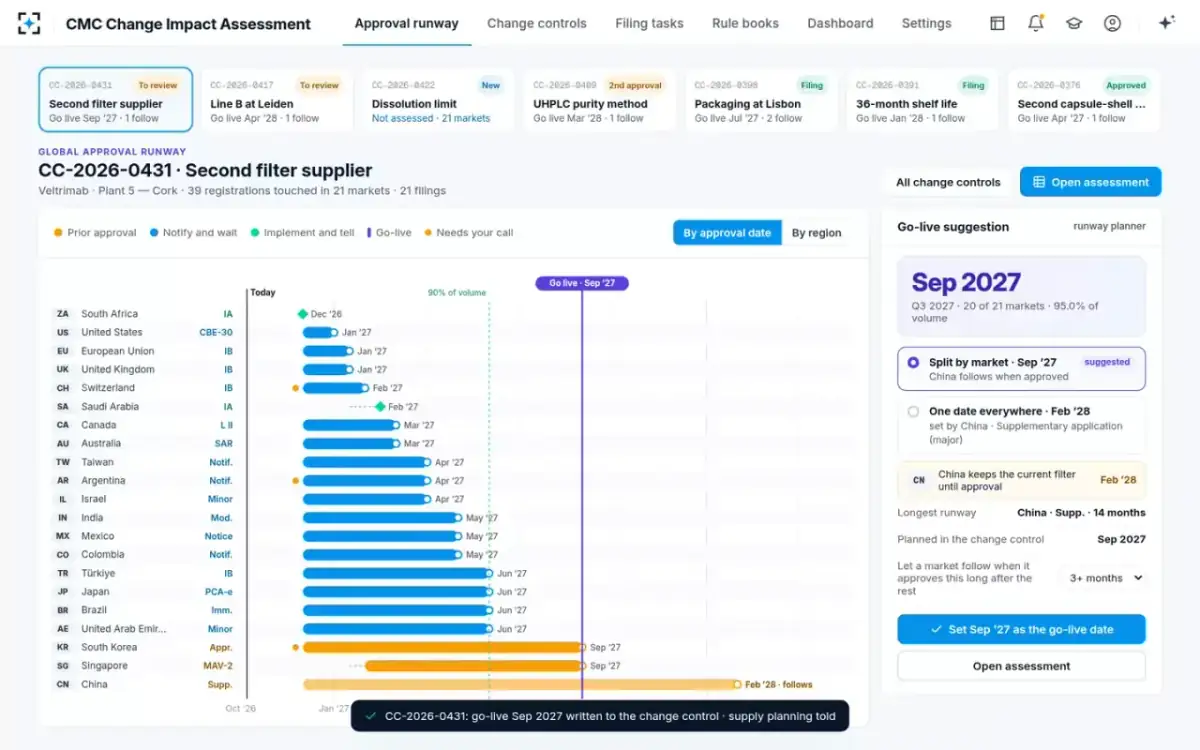
That is the difference between knowing the categories and being able to use them. The four European clocks are published and knowable; the work is applying them alongside twenty other markets' clocks to one change, and the assessment that produces them, step by step, is where that happens. The United States answer that usually runs alongside the European one has its own guide, and CMC Change Impact Assessment shows both on one runway.
Questions people ask
What does do and tell mean for a Type IA variation?
That the change is made before the agency is told. Type IA and IAIN variations do not require prior approval before implementation, so the holder implements, then notifies — immediately for an IAIN, or within the annual update window for an IA. It is the only one of the four EU categories where no regulatory waiting time stands between the decision and the change.
What is the difference between a Type IA and a Type IAIN variation?
Only when the notification is due. Both are minor variations with minimal or no impact, and both are implemented first. A Type IAIN must be notified immediately after implementation so that supervision of the product stays current; a plain Type IA is collected into a Type IA annual update. The classification guideline says which changes require immediate notification.
When does the 12 months for a Type IA start?
At the first implementation date among the variations in that annual update. The application should be submitted no earlier than nine months and no later than twelve months after it. Three variations implemented in February, March and April are therefore expected in a single update submitted between the following November and January.
What counts as implementing a quality change?
The day the company makes the change in its own quality system — not the day the equipment is installed or the first batch ships. EMA draws the line there deliberately: it lets a holder manufacture conformance batches and generate stability data in support of a variation before the notification is due. For product information, implementation is when the revised text is internally approved.
How long does a Type II variation opinion take?
The Agency issues its opinion within 60 days of a valid application, reducible for urgency and extendable to 90 days for listed variations and certain groupings. The period that actually elapses is often longer, because a request for supplementary information suspends the procedure until the holder answers. Plan against the 60 days plus the company's own history of clock-stops.
What changed in the EU variations guidelines in 2026?
The European Commission's revised variations guidelines apply to variation applications submitted to EMA from 15 January 2026. For Type IA variations, the first one implemented on or after that date starts a new annual update cycle unless an exemption applies, and Type IA variations implemented before it that are not yet in an update are a listed case for individual submission. Any classification used on open assessments is worth re-checking against the revised text.