A post-approval change to drug substance is any change to how the active ingredient is made, tested or released after the product is licensed — a new line, a new site, a new raw material, a wider hold time, a different release method — and it has to be answered separately in every country where the product is registered. The answer is not one category. On the sample product used on this page, the same new line is a 30-day supplement in the United States, a minor variation in the European Union, a partial change approval in Japan, and in two markets nothing at all, because their registrations name a different drug-substance site. Those last two are the ones most easily missed, because a filing list has no row for them.
Botminds' CMC Change Impact Assessment is built for that decision. Six agents read the change control, find every active registration by presentation and country, quote the registered text each one carries, apply that country's rule book with the entry cited, and draw a runway from submission to expected approval — and a market whose registration does not include what changed is never dropped from the list. It is marked not affected and given a supply restriction.
The worked example on this page is the one that runs in the solution: Northwind Bio's Veltrimab, a monoclonal antibody registered in 21 markets, and change control CC-2026-0417, which adds drug-substance Line B at Plant 3 in Leiden as a duplicate of Line A. The company, the product, the people and every figure describing them are fictional sample data. The published research and the rules are linked where they appear.
The measured size of the problem, across 18 companies and 156 countries
146,550
post-approval changes approved globally over three years, counted from 18 companies
156countries
whose agencies reviewed them, each on its own classification and clock
28%
of those changes took more than six months at the agency reviewing them
1of 156
agencies approved every change put to it inside six months
What counts as a post-approval change to drug substance?
A change counts when it touches something the registration states. That is the whole test, and it is why the question cannot be answered from the change control alone. The US rule for biologics puts the line at effect rather than at intent: a supplement is required for "any change in the product, production process, quality controls, equipment, facilities, or responsible personnel that has a substantial potential to have an adverse effect on the identity, strength, quality, purity, or potency of the product". A change with less potential than that still has to be reported, in a lower category.
For drug substance specifically, the changes that come up most often are a new or replaced manufacturing facility, a duplicate production line at an approved site, a new cell bank or a change in its qualification, a change in culture or purification conditions, a new supplier of a critical raw material, a new or widened in-process limit, a change to the release specification or its analytical method, and a longer hold or storage time. Each of those is written somewhere in Module 3 section 3.2.S, and each country's copy of 3.2.S is its own document.
Health Canada's table for biologics names the facility case in the plainest terms of any rule book: "Replacement or addition of a manufacturing facility for the bulk drug substance, or any intermediate of the drug substance", which is a supplement — prior approval — unless the listed conditions are met, in which case it drops to a notifiable change. The FDA's biologics guidance reaches the same place by a different route, listing "Addition or replacement of a manufacturing facility for production of Drug Substance, Drug Product or intermediates" under prior approval in its facilities table.
The reason two agencies that agree on the category still produce different answers for one company is that they are not reading the same dossier. What each country approved is what each country gets to judge.
Why the same molecule has a different registered site in every market
Registrations are filed market by market over years, and they freeze whatever the supply chain looked like at the time. A product launched in the United States from one plant and launched in Asia four years later from a second plant carries both facts, each in its own dossier, and nothing reconciles them afterwards. Add tech transfers, acquired products, local requirements for a regional fill site, and markets that approved a second site while others never had one filed, and a single molecule arrives at its tenth year with a different registered manufacturing footprint in a third of its countries.
That is ordinary, and it is legitimate. It also means the sentence "we are adding a drug-substance line at Leiden" has no fixed regulatory meaning until each registration has been opened. In the sample product, nineteen registrations name Plant 3 at Leiden as a drug-substance site. Two — South Korea and Mexico — name Plant 7 in Singapore and nothing else. For those two, a line at Leiden is not a minor change or an exempt change. It is not their change.
One drug-substance change, six of twenty-one registrations, and what each market gets
| Market | Registered drug-substance site | Touched? | Proposed filing | May it receive Line B material? |
|---|---|---|---|---|
| United States | Plant 3 — Leiden | Touched | Changes being effected in 30 days | Yes, 30 days after the supplement |
| European Union | Plant 3 — Leiden | Touched | Type IB variation | Yes, once the 30 days pass without objection |
| Japan | Plant 3 — Leiden | Touched | Partial change approval | Only after approval |
| South Africa | Plant 3 — Leiden | Touched | Type II amendment | Only after approval — the longest runway |
| South Korea | Plant 7 — Singapore | Not affected | No filing | Never — keep supplying from Singapore |
| Mexico | Plant 7 — Singapore | Not affected | No filing | Never — keep supplying from Singapore |
Finding every registration a change affects: product, presentation, country
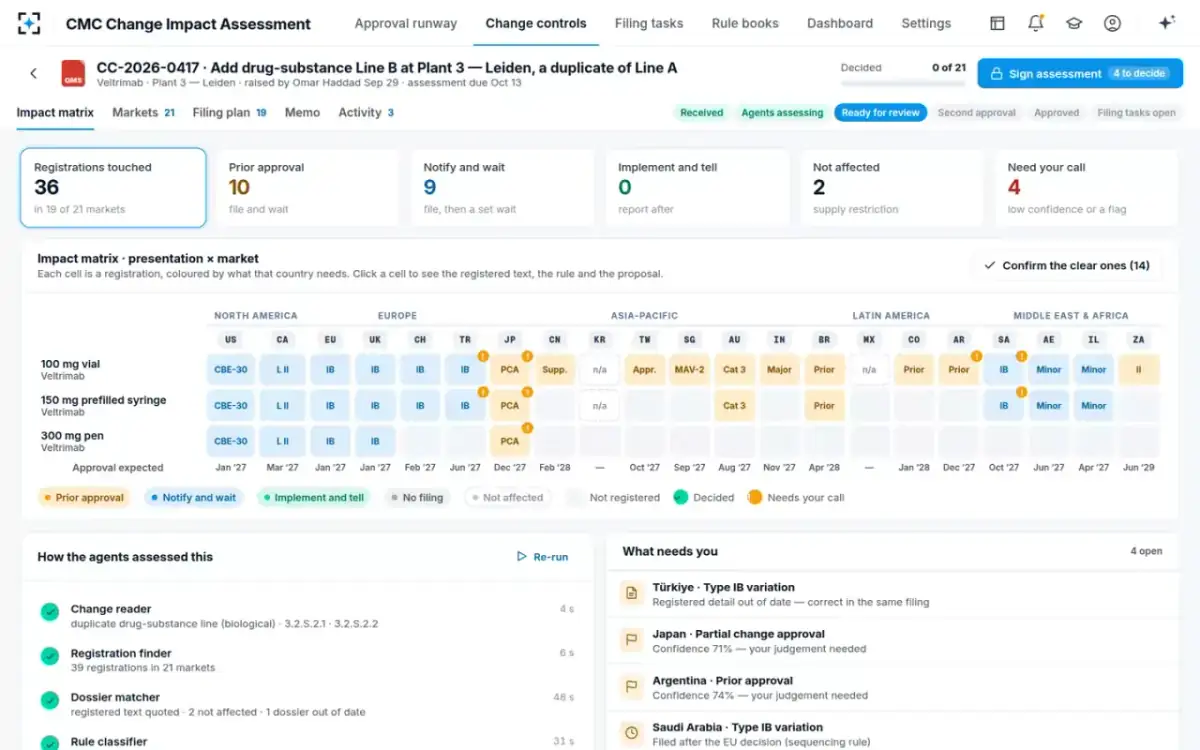
Before anything can be classified, the list has to be complete, and complete means three dimensions, not one. A product is registered by presentation as well as by country: the sample product is a 100 mg vial, a 150 mg prefilled syringe and a 300 mg pen, and not every market holds all three. Thirty-nine registrations sit behind twenty-one country names. A change that touches drug substance touches every presentation that uses it, so the count that matters is the registration count, not the country count.
Three traps eat registrations on the way to the list. The first is a registration under renewal, which some systems hide or park; it is still in force, and it still needs a filing. The second is a licence held by a local partner or an affiliate under a different product name, which a search on the global brand will miss. The third is the registration that looks irrelevant — a market that registers a different site — and which an analyst in a hurry deletes from the spreadsheet rather than marking.
How the assessment gets from a change control to a filing or a restriction
Agent
Change readerReads the change description, justification and risk assessment, and states the product, presentations, sites and the registered elements it may touch, with their dossier sections.
Never: Decides whether the change is regulatory relevant
Agent
Registration finderLists every active registration by presentation and country, including those under renewal, with the agency, the licence number and the registered drug-substance and drug-product sites.
Never: Drops a market because it looks unaffected
Agent
Dossier matcherOpens each country approved dossier section and quotes the exact registered text the change touches; marks the registrations that do not register what changes.
Never: Paraphrases registered text
Agent
Rule classifierApplies the approved rule book for each country and any past agency advice, and proposes a category with the rule entry cited, a confidence and the alternative it considered.
Never: Decides — below 75% confidence the market goes to a person first
A person decides
Regulatory CMC leadDecides every market, gives a reason for any category she changes, sets the go-live date and signs the assessment.
Never: Signs a memo with markets still only proposed
The markets a new line touches, and what each one calls it
For the sample change, nineteen registrations are touched and the proposals span four tiers. Ten markets need prior approval before any material from Line B may be distributed there. Nine notify and wait a fixed period. Two are not affected. Four of the nineteen are flagged for the lead's own judgement rather than confirmed, because the registered text is ambiguous, the dossier disagrees with the plant, or the rule book's confidence is below the floor.
The spread is not sloppiness by the agencies. A duplicate line at an already-approved facility is genuinely a different risk from a new facility, and rule books divide that risk differently. The US biologics guidance treats a duplicated process train at an approved site more lightly than a new facility; Japan's system asks whether the changed detail sits inside the approval matters, in which case it is a partial change approval and nothing less will do. The result is that the same engineering project is a four-week administrative act in one market and a twelve-month review in another.
Every registration, by presentation and market, coloured by what it needs
The market that is not affected — and the batch that must not go there
Here is the asymmetry at the centre of a drug-substance change. The markets that need a filing generate work and therefore get attention: a submission, a tracker row, an affiliate who chases it. The markets that need no filing generate nothing, so they fall off the page — and they are the only markets where a mistake reaches a patient without any agency ever seeing it.
South Korea and Mexico register Plant 7 in Singapore as the only drug-substance site for the sample product. Adding Line B at Leiden does not touch their registrations, so there is nothing to file, and no agency will ever write to the company about it. What those two registrations do say is that material made at Leiden is not approved for them. Together they are 3.5% of the product's volume. If a batch from the new line is allocated to either of them, the product has been supplied against a registration that does not cover it — an unapproved change, discovered at an inspection or at a market withdrawal, with no filing anywhere in the system to explain it.
Where twenty-one markets go: nineteen filings, two supply restrictions
Markets
- Prior approval before distribution — 10 · 47.6%
- Notify and wait — 9 · 42.9%
- Not affected, restricted — 2 · 9.5%
Volume
- Can take Line B material once approved — 96.5% · 96.5%
- 3.5% · 3.5%
Why not affected is a supply instruction, not a blank row
Treat "not affected" as a regulatory conclusion and you have answered half the question. The full conclusion has two halves: no filing is required, and this material may not be shipped here. The second half belongs to someone who does not read filing plans — the supply planner who allocates batches by market — and it has to reach them in a form they can act on.
That is why the solution writes a supply restriction for every not-affected market rather than leaving the cell empty, and why the dossier matcher is built so that a not-affected market always gets a supply note. The restriction carries the same citation as a filing: the registered text that names the other site, the registration it came from, and the date it was read. A planner who later asks why Mexico cannot take a Leiden batch gets the sentence from the Mexican registration, not a recollection.
The runway, with the markets that have no bar on it
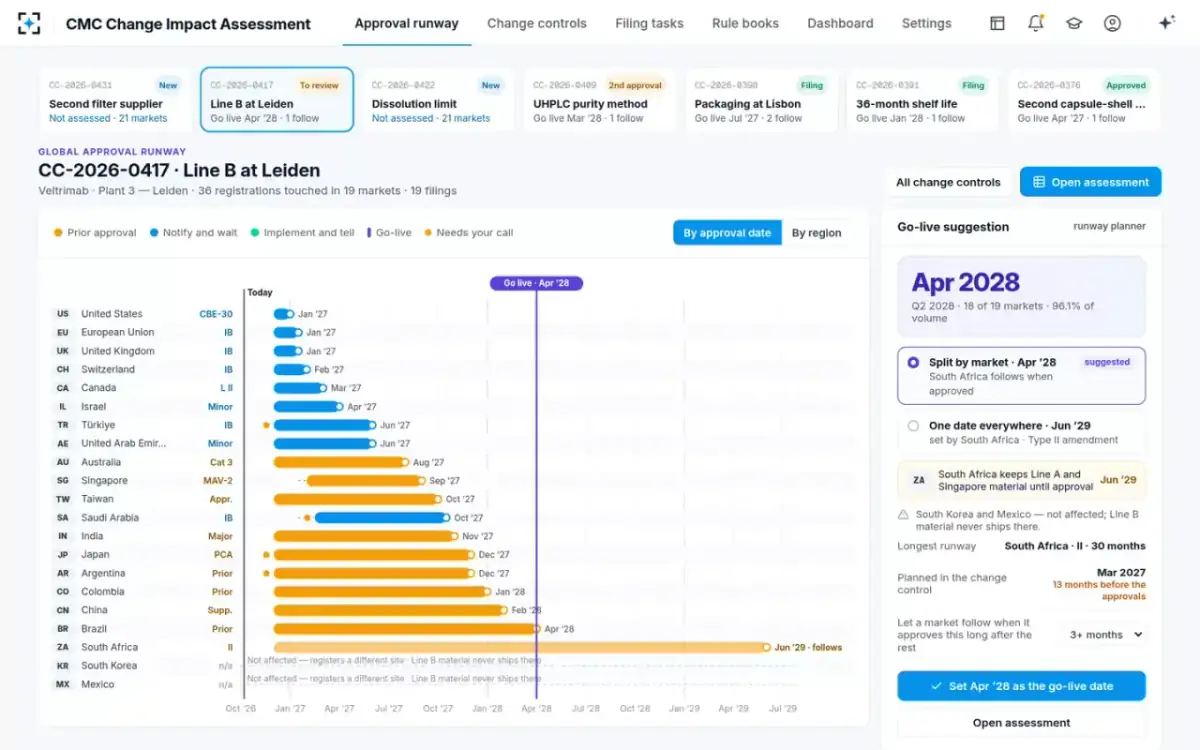
There is a second reason to keep the row. Not affected is a status that expires. If a later change brings Leiden into the Korean or Mexican registration — a site addition filed for another reason, a renewal that re-states the manufacturing section — the restriction has to lift, and a row that was deleted cannot be reconsidered. The data a defensible assessment has to carry includes the markets where the answer was no.
What a comparability exercise has to show for a biologic change
For a biologic, the filing category is downstream of the science. Before any market can be told what the change is, the company has to show that the molecule did not change with it. WHO defines the exercise as "the activities — including study design, conducting of studies and evaluation of data — that are designed to investigate whether a pre-change product and a post-change product are highly similar", and sets its size by risk: it can range from analytical testing alone, where a process change has no impact on any quality attribute, to a comprehensive exercise requiring nonclinical and clinical bridging studies.
The practical consequence for the filing plan is a date. The sample change's target submission is December 2026, not because the registrations take that long to assess — the assessment ran in minutes — but because the Line B conformance batches and the comparability report are the gating evidence, and the first submission cannot go without them. An impact assessment that produces a category per market and no date is only half a plan.
It is also where over-classification and under-classification both start. WHO's own appendix is explicit about the direction of travel: if any of the conditions listed for a change are not fulfilled, "the change is automatically considered to be at the next higher reporting category". A comparability package that is thinner than the rule book assumed does not keep the low category; it moves the change up a tier, in every market that uses that logic.
Running two processes at once, and what that costs
Because approvals arrive market by market, the old process and the new one overlap, and the length of that overlap is the real cost of the change. For the duration, the plant runs both; quality control releases both; the warehouse holds both; and every shipment has to be matched to a market that has approved the version in the box. The authors of the 18-company study put the problem at its sharpest with one of their own examples: in a single year, 83 batches of one vaccine product were produced according to 55 different variations.
One change, two supply chains, from the first approval to the last
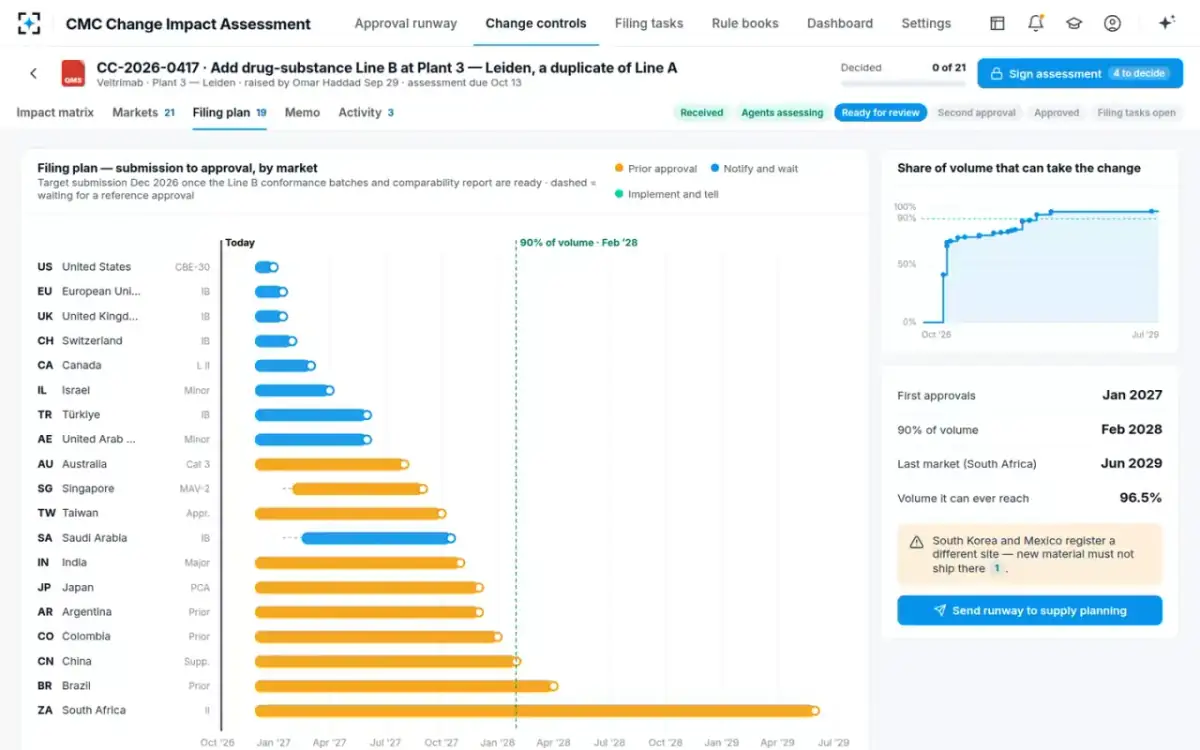
- Comparability and conformance batchesto Dec 2026
- First approvals, then up to 90% of volumeJan 2027 to Feb 2028
- The tail, to the last marketto Jun 2029
- Supplies every market until its approval arrivesboth lines released, stocked and allocated
- South Korea and Mexico: Singapore supply continues with no end dateindefinitely
The bottom lane is the part a filing plan usually omits. For the nineteen touched markets, dual running ends when the last of them approves. For the two not affected, it never ends: they keep taking Singapore material for as long as their registrations say Singapore. If the company's real intention was to retire Line A, that intention requires a second project — a site addition filed in Korea and Mexico — which nobody will raise unless the assessment said so out loud.
Can you ship product from a new line to a market that has not approved it?
No, and the three ways of getting it wrong are worth separating. In a prior-approval market, distribution of material made with the change is not permitted until the agency approves the supplement. In a 30-day market, the clock runs from receipt of the supplement, not from the day the change was made: material may be distributed only after the waiting period, and only if the agency has not objected. In a not-affected market, there is no clock at all, because the registration names another site — the material simply may not go.
The paperwork each market expects is similar, which is what makes the timing difference easy to miss. A US supplement must contain "(i) A detailed description of the proposed change; (ii) The product(s) involved; (iii) The manufacturing site(s) or area(s) affected; (iv) A description of the methods used and studies performed to evaluate the effect of the change", followed by the data from those studies and the validation protocols. The same package, re-assembled to local format, serves most of the nineteen. What differs is when the first box may leave the warehouse.
Before a batch from a new drug-substance line is allocated to a market
- The registration for that market and that presentation names the new site
Quoted from the approved dossier section, not from a registration summary table.
- The filing for that market has reached the state that permits distribution
Approved where approval is required; the waiting period elapsed where notification is required.
- The market is not on the not-affected list
A market whose registration names a different site needs no filing and may never receive the material.
- The comparability conclusion covers the presentation being shipped
A change assessed on drug substance still reaches every presentation that uses it.
- Any registered detail found out of date has been corrected or carried in the same filing
A dossier that disagrees with the plant is a finding in its own right, not a rounding error.
- The supply plan has the restriction, not just the filing plan
The person who allocates batches is not the person who files; the restriction has to reach them.
Renewals, rule changes and the registrations that move under you
An impact assessment is a photograph of a moving set. Between the day a change control is raised and the day the last market approves, registrations are renewed, local requirements are updated, and agencies change their classification rules. The sample assessment runs across years; the EU's variations classification guidelines changed in that window, and a classification settled under the old chapters has to be re-expressed under the new ones.
Two habits keep the assessment honest. The first is to treat a registration under renewal as live: it is in force, it is listed, and it gets a filing like any other. The second is to re-check open assessments when a rule book version changes rather than only new ones — in the solution, a rule watcher checks 21 agencies weekly and re-opens the affected proposals, with each rule book used only as a numbered version its approver signed off. The point is not that software notices; it is that a two-year filing plan built on a rule book nobody re-read is a plan built on last year's rules. How long each of those markets actually takes is the subject of the published and measured variation timelines.
Submission to approval by market, with the share of volume that may take the change
What this changes for the people who carry the change
The assessment is the same work it always was: open every registration, read the registered text, apply the country's rules, write down the consequence. What changes is how much of a week it takes and what the output can be checked against. By hand, a lead assessing four to six change controls a week spends most of a day on each, and the largest single block is opening dossiers to find the registered text. Each market's proposal here instead arrives with the dossier passage quoted, the rule entry cited, a confidence and the alternative the classifier rejected, so the lead's time goes to the four markets that need judgement rather than the fifteen that do not.
The decisions stay where they were. The agents never file with an agency, never edit a dossier and never set the implementation date; the regulatory CMC lead decides every market, gives a reason whenever she changes a proposed category, and signs — with a second approval from the head of regulatory CMC when five or more markets need prior approval. To see the matrix, the runway and the supply restrictions on one change, start from CMC Change Impact Assessment.
Questions people ask
Do you need a variation to add a drug substance manufacturing site?
In most markets that register the site, yes — and often at the highest tier. Health Canada lists replacement or addition of a manufacturing facility for the bulk drug substance as a supplement unless specific conditions are met, and FDA's biologics guidance places addition or replacement of a drug-substance manufacturing facility under prior approval. The exception is a market whose registration names a different site: there is no variation to file, and no material from the new site may be supplied there.
Does a duplicate production line need prior approval?
Not always, and that is why the distinction is worth making in the change control itself. A duplicated process train at an already-approved facility, with the same equipment design and process parameters, is treated more lightly than a new facility in several rule books — in the sample assessment it is proposed as a 30-day supplement in the United States at high confidence. Markets that write the number of production lines into what they approved, as Japan's approval matters can, treat the same duplicate as a change needing approval before implementation.
How do you find every registration a change affects?
By listing registrations rather than countries, by presentation, and by including those under renewal and those held under a local product name. Then open each one: the question is not whether the market sounds relevant but whether the changed element appears in that market's approved dossier section. The registrations most often lost are the ones that look unaffected, because they are deleted instead of marked.
How long can you run two manufacturing processes in parallel?
As long as the last market takes to approve, which published work puts in years rather than months for a global product. The cost is operational rather than regulatory: two validated processes, two released stocks, and allocation rules that match each market to the version it has approved. One of the authors of the 18-company study describes 83 batches of a single product made to 55 different variations in one year.
What documents does a drug substance site change need?
A description of the change and the sites affected, the comparability or validation studies and their data, updated dossier sections for 3.2.S, and whatever each market adds locally — a certificate, a local GMP document, a translated manufacturing section. The US rule for biologics lists the minimum directly: the proposed change, the products involved, the sites affected, the methods and studies used to evaluate the effect, the data, the validation protocols and a reference list.
What if a market registers a different drug substance site?
Then the change does not touch that registration, no filing is due, and the market must not receive material from the new site. Treat it as a supply instruction with a citation attached — the registered text naming the other site — and keep the row, because the status changes the moment a later filing adds the new site there.