Variation management software is meant to answer one question repeatedly and well: given this manufacturing or quality change, what has to be filed in each market, in which category, and when will each agency approve it. Every product in the category claims it. What separates them is not the claim but the inputs — a tool can only classify against a rule book you can produce and a dossier it can read, and most buying processes discover that months after the contract. This page is the requirement list written from the other end: the eight things a tool has to get right, the four data sets you have to bring, and the honest first step, which is a replay on changes you have already decided.
Nothing here names or ranks a product. Where it shows what a configured tool looks like, the examples come from Botminds' CMC Change Impact Assessment on its fictional sample company — six agents that read a change control, find every registration, quote each dossier, cite each country's rule and plan the approval runway, with a named person deciding and signing. The regulations and research are linked where they are used.
What does variation management software do?
In its narrow sense it manages the lifecycle of variation submissions: a record per planned variation, its category, its market, its documents, its submission and approval dates, and a tracker across the portfolio. That is a work-management tool, and it starts after the hard question has been answered by a person.
In the sense buyers usually mean it, the tool is also supposed to determine the category — to take a change and decide, market by market, what it is. That is a classification problem against local rules and local registered text, and it is a different engineering problem from tracking. When you evaluate, make sure you know which of the two is being demonstrated, because the tracker is the part that demonstrates well.
The volume is what makes the distinction expensive. Pooled data from eighteen global pharmaceutical companies put the average at roughly 2,700 approved prior-approval change submissions per company per year — and that is prior-approval changes alone. At that scale, a tracker saves administration and a classifier saves the work itself.
Three approaches, and what each one actually removes from the day
Most teams are running one of three things today, and each removes a different part of the week. Be precise about which part is actually consuming yours before choosing.
Spreadsheet, register module, agentic assessment: what each one does and does not do
| Approach | What it removes from the day | What it leaves exactly as it was | Where it breaks |
|---|---|---|---|
| A spreadsheet per change, built by the lead | Nothing. It records the answer after a person has worked it out. | Finding the registrations, reading every dossier, looking up every rule, estimating every date. | At portfolio scale, and at the first audit: the reasoning lives in a person’s memory and a cell comment. |
| A variation module inside the register | The tracking: one row per planned filing, with status, documents and dates visible across the portfolio. | The classification. Someone types in the category the tool then tracks. | When the typed category is wrong, the tool tracks the wrong filing efficiently. |
| An agentic assessment over the change control | The reading and the lookup: registrations found, dossiers quoted, rules applied, dates estimated with their basis. | The judgement. A named person decides each market, gives reasons for changes and signs. | When the dossiers cannot be read or the rule books do not exist. The data you bring is the ceiling. |
Where six and a half hours go on one change control today
The top two bars are the ones worth buying against. They are mechanical, they scale with the number of markets, and a person is no better at them on the hundredth change than on the first. The bottom two are judgement and accountability, and automating them is not an improvement.
RIM and variation management: where the register stops
A regulatory information management system holds what is approved where: product, presentation, country, licence number, status, history, commitments. A variation tool is supposed to hold what must now be filed. The boundary between them is the approved dossier — the registration says a market is approved, and only the dossier says what that market approved about the step you are changing.
In practice this means a variation tool that reads only the register is guessing, however good its rule engine is. It will classify the change you described rather than the change as that country's text describes the thing being changed, and it has no way to notice the market whose registration names a different site. The longer argument, with what a defensible proposal has to carry, is in the guide to systems of record.
The eight things the tool has to get right
Eight requirements, each with a test you can run on your own data rather than on a demonstration set. Take them to the evaluation as a scorecard.
Eight requirements, and the test that proves each one on your data
| Requirement | What good looks like | The test |
|---|---|---|
| 1. Reads the change control as its input | Takes the change from the quality system and states the product, presentations, sites and dossier sections it may touch, quoting the change record. | Hand it a change control with no briefing. Did it tell you what changed, or ask you? |
| 2. Finds every registration, including the unaffected | Lists registrations by product, presentation and country, including those under renewal, and marks the ones the change does not touch rather than deleting them. | Run a product with an awkward market. Count the rows against your own list, and look for the not-affected row. |
| 3. Quotes the registered text | The exact sentence from that country’s approved section or local approval, with the document and section named. | Pick one market and check the quotation against the dossier. A paraphrase fails. |
| 4. Cites a rule entry at a known version | The classification entry, the rule book, the version number, the approver and the date it was last checked. | Ask which version produced a category, and who signed that version off. |
| 5. Flags rather than guesses | A confidence per proposal, an alternative considered, and a threshold below which a market goes to a person before it is shown as clear. | Find a market where it was unsure. If there is not one in twenty changes, there is no mechanism for doubt. |
| 6. Produces dates with their basis | A date per market from your own approval history and your sequencing rules, each showing how it was derived. | Ask how one date was reached. "Experience" is not a basis; a history and a rule are. |
| 7. Keeps a person in the decision | A named decider per market, an electronic signature with its meaning, a verbatim reason for any category changed, and no automatic bulk confirmation. | Ask what happens with nobody logged in. Nothing should. |
| 8. Writes back where the work lives | The signed assessment and dates to the change record, and one filing task per market with category, rule, documents and target date. | Follow one approved assessment through to the affiliate’s task list. |
What you bring: four data sets, and what good enough means for each
No tool can classify against rules you cannot produce or dossiers it cannot read. The four data sets below are the real project, and they are worth assessing before a shortlist exists, because they decide both the timeline and which requirement will be the one that bites.
The four data sets you bring, and the minimum each must contain
- Registrations, by product, presentation and country
Minimum: every active registration with agency, licence number, status and the registered drug-substance and drug-product sites — including registrations under renewal and those under a local product name. Known gaps are workable; unknown gaps are not.
- Approved dossier sections and local approval documents
Minimum: the registered Module 3 sections, or the local approval document, retrievable per market and machine-readable. A section that exists only as a scan is a section the tool will quote badly or not at all.
- Country classification rule books, per agency
Minimum: one approved, numbered version per agency with a named approver. Most teams have this as expertise rather than as a document, which is why it is usually the long pole.
- A sample of closed change controls, with their decisions
Minimum: ten to twenty already assessed and closed, spanning categories, with at least one that went wrong and one with a market that needed no filing — and the reasoning your team recorded at the time.
The rule books nobody has: building and approving the first version
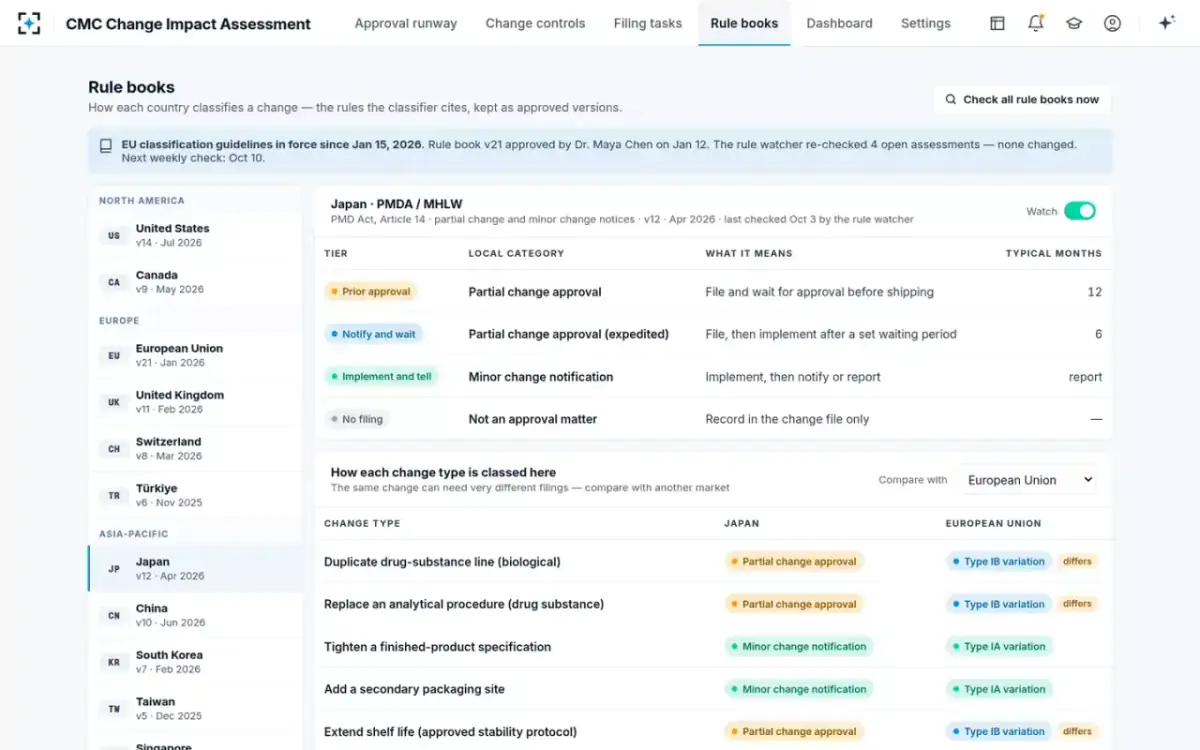
The third data set is the one that stops projects, because in most companies it does not exist as a document. Classification knowledge lives with three or four people, in precedent and in correspondence, and writing it down for twenty-one agencies is a real piece of work with a real approver at the end of it.
Two things make it finite. The first is that the rules are published: the European Regulation and its classification guidelines, FDA's guidance on reporting categories for the relevant product type, WHO's appendices for biotherapeutics, and each national agency's own document. FDA's biologics guidance states its purpose in those terms — it is "guidance intended to assist applicants and manufacturers of certain licensed biological products in determining which reporting category is appropriate for a change in chemistry, manufacturing, and controls (CMC) information to an approved biologics license application". A rule book is a structured transcription of documents like that, plus your own precedents.
The second is that the rules tell you what to do when they run out. European law gives a default: a variation that is not an extension and whose classification is undetermined after the rules are applied "shall by default be considered a minor variation of type IB". WHO places the same obligation on the manufacturer in a different form: where a change is not in its appendices and no consultation route is available, "manufacturers should determine the classification of the change on the basis of a change-specific risk assessment using the principles and examples provided in these WHO Guidelines". A rule book that encodes the defaults as well as the entries is one that still answers when the change is novel.
Scope the first version by volume, not by completeness. Write the rule books for the agencies that carry most of your filings, approve them, and run live on those; add the rest as changes reach them. Approval matters as much as content — in the sample solution the classifier may only use approved, numbered versions, each with its approver named, which is what makes a citation durable two years later.
Each country's categories held as an approved, numbered version
Scoring the replay: what agreement actually tells you
Run the tool cold on the closed change controls you set aside, then score it market by market against the decisions your own team recorded. The headline number is agreement, and the useful information is in the disagreements, which fall into three piles.
The first pile is the tool being wrong: it read the dossier badly, applied the wrong entry, or missed a prior agency position. That is a defect, and the question is whether the reasoning shown makes it findable in a minute. The second pile is your team having been wrong — a category your own review would now change — and these are the most valuable rows in the exercise, because they are free findings. The third pile is neither: the registered text was genuinely ambiguous, and the tool flagged it. A flagged market is a correct outcome, not a miss, and a scoring method that counts it as a failure will push you toward a tool with no doubt in it.
Score the data too. Every market the tool could not reach because the dossier section was missing, unreadable or unmatched is a row in your own backlog rather than a mark against the tool. Teams routinely learn more about the state of their archive from a replay than from any audit.
The first 90 days: what to measure, and what to ignore
Resist a dashboard of everything. Four numbers carry the programme, and the first one is the only one worth reporting upward.
The four numbers that carry the first 90 days
Cited coverage
markets proposed with a cited rule ÷ markets in scope
The one measure worth reporting. A market proposed without a rule entry and quoted registered text is not covered, however confident the category looks.
Regulatory CMC lead
Agreement on replay
markets where the proposal matched the recorded decision ÷ markets replayed
Counted with flagged markets as correct outcomes, not misses. Read the disagreements rather than the ratio.
Head of regulatory CMC
Time to a signed proposal
median time from a new change control to signature
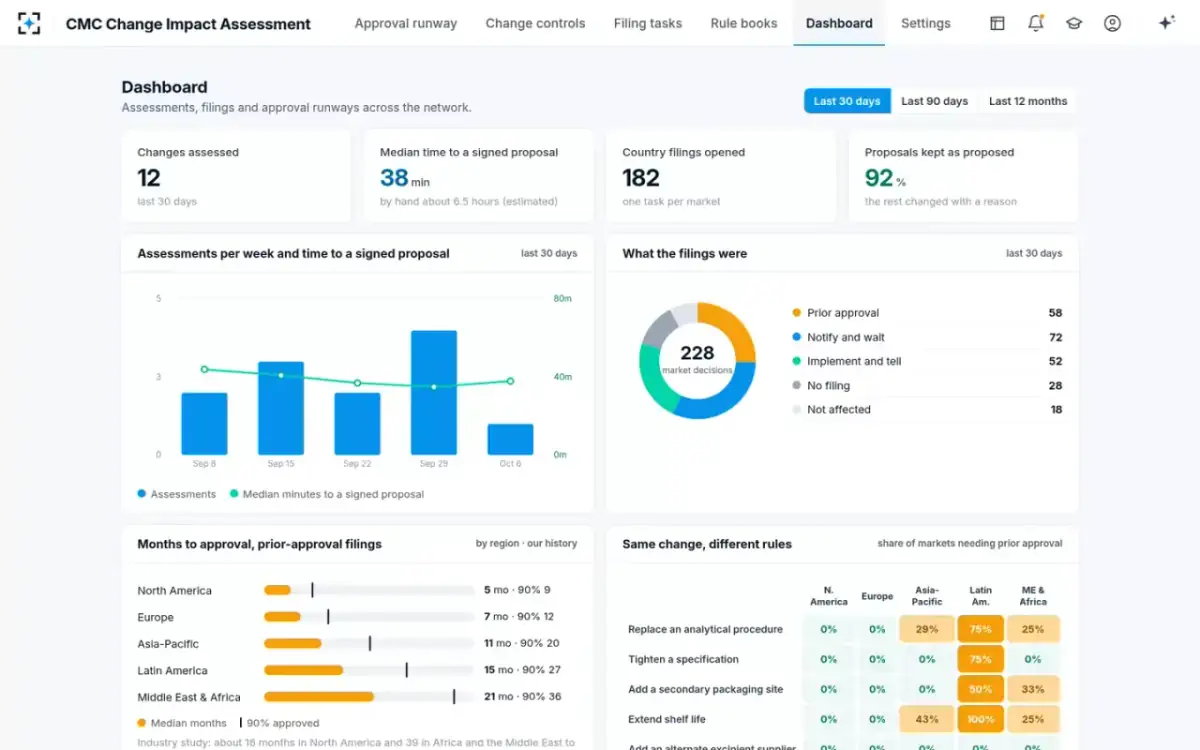
The sample solution’s design target is 38 minutes against about six and a half hours by hand. Measure your own; a target is not a result.
Regulatory CMC lead
Categories changed after signature
categories amended post-signature ÷ categories signed
The rework measure, and the one to watch upward. Every amendment should carry the verbatim reason that was recorded for it.
Head of regulatory CMC
A first 90 days that ends with one live assessment, not a launch
- Registrations and dossier sections assessed for completenesswhat is missing
- First rule books drafted for the highest-volume agenciesdrafted
- Rule-book versions approved and signed offapproved
- Replay on ten to twenty closed change controlsscored
- Thresholds, signers and sequencing rules configuredconfigured
- One live change control assessed in parallel with the manual routein parallel
- Compared, signed, and the measures agreedsigned
What you configure rather than code
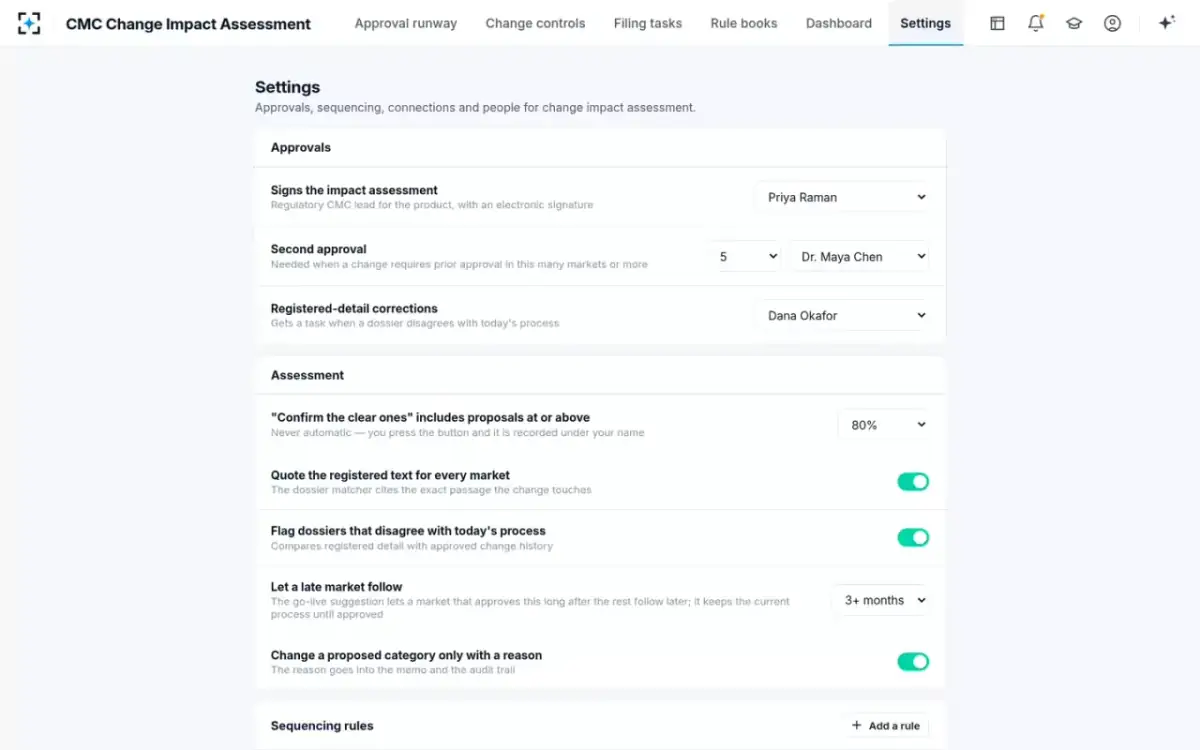
A tool that needs a change request to alter who signs will be out of date by the second reorganisation. The useful test is to ask which of your policies are settings and who may change them. In the sample solution the list is short and specific: who signs the impact assessment and with what signature; when a second approval is required, set at five or more markets needing prior approval; where registered-detail corrections are routed; the confidence at or above which a bulk confirmation may include a proposal, offered at 90%, 85% or 80% and never automatic; the gap after which a late market may follow instead of holding everyone, set at three months; whether registered text is quoted for every market; whether dossiers that disagree with today's process are flagged; and sequencing rules written as plain sentences such as Saudi Arabia filing after the European decision.
Every one of those is a policy a regulatory organisation already has, usually in a procedure nobody has reconciled with the tool. Writing them as settings makes them visible to an auditor and changeable by the person accountable for them, which is the test worth applying to any configuration screen you are shown.
The policies as settings: signer, second approver, thresholds, hold-back and sequencing
How do you keep rule books current when a regulation changes?
With a watcher, a version and a re-check of everything still open. The European change is the live example of why all three are needed: EMA announced the Commission's new Variations Guidelines in September 2025, and the practical effect for anyone maintaining a rule book was structural rather than cosmetic — the agency and CMDh's own webinar for holders lists "Change in the coding system from Chapter A, B, C, D to Chapter E, Q, C and M" among the changes. Every stored citation to a chapter letter had to be re-expressed.
Rule drift is not an exception to be handled when it happens; it is the normal condition of this work. EMA puts the obligation on holders in plain terms: "Medicine developers are required to take account of technical and scientific progress and continuously update the terms of their marketing authorisation to reflect the current understanding of the quality, safety and efficacy of a medicine." So the requirement on the tool is a watcher that checks the agencies on a schedule — weekly, for twenty-one agencies, in the sample solution — a new approved version when something moves, and an automatic re-check of open assessments rather than only new ones. An assessment signed eighteen months before its last approval has to survive the rules changing underneath it.
What the programme reports: mix, time and where rules diverge
What it will not do, and who still has to
Be explicit about the boundary before you buy, because it is the part that is never in a demonstration. A tool of this kind does not file with an agency, does not edit an approved dossier and does not set the implementation date. It does not negotiate a category with an assessor, answer a question from a reviewer, or decide whether a change is worth making. It does not make any agency faster, and a supplier who implies otherwise is describing the regulator rather than the product.
What it does is remove the reading and the lookup, and put the evidence behind every proposal so the judgement is quick and checkable. The remaining work is the work that was always the job: deciding the ambiguous markets, correcting registered details that have drifted, choosing between one go-live date and a split, and signing. Why the longest runway rather than the average decides that date is set out in the guide to variation timelines; the tests to run on an AI-branded tool specifically are in the six tests for regulatory AI. To see the requirement list answered on one change control, start from CMC Change Impact Assessment.
Questions people ask
Is variation management part of a RIM system?
Usually a module of one, and that module is normally a tracker: it holds a row per planned variation with its category, market, documents and dates. The category itself is typed in by a person, because determining it requires the approved dossier text and the country's classification rules rather than the register's own data. Ask any supplier plainly which of the two they are showing you.
What data do you need to automate variation classification?
Four things, and the third is usually the one that is missing. Registrations by product, presentation and country, including those under renewal; the approved dossier sections or local approval documents, readable per market; a classification rule book per agency, at an approved version with a named approver; and a sample of closed change controls with the reasoning recorded at the time, to test on. Past agency advice and three years of approval history make the dates and the edge cases much better.
How do you build a country rule book for variations?
Transcribe the published classification documents for that agency into structured entries, add your own precedents and any prior advice the agency has given on your products, encode what the rules say to do when a change is not listed, and have the head of regulatory CMC approve the result as a numbered version. Start with the agencies that carry most of your filings and add the rest as changes reach them; a rule book that covers your top markets and is approved beats one that covers everything and is not.
Can a spreadsheet handle global variation management?
It can record the answer, and that is all it does. The work it leaves untouched is the whole of the assessment — finding every registration, reading each country's registered text, applying each rule book, estimating the dates — which is where most of the hours go. It also fails at the first audit for a different reason: the reasoning behind each category is not in the file, so an assessment cannot be reconstructed by anyone who was not there.
How do you test a variation management tool before buying it?
Replay it on ten to twenty change controls you have already closed, cold, and compare market by market against the decisions your team recorded. Count a flagged market as a correct outcome rather than a miss, and read the disagreements in three piles: the tool was wrong, you were wrong, or the registered text was genuinely ambiguous. Expect to learn as much about your registrations and dossier archive as about the tool.
What will variation management software not do?
File with an agency, edit an approved dossier, set the implementation date, or decide a market it is not confident about. It will not shorten an agency's review either — what changes is when you know the plan, not how fast the regulator works. Everything on that list stays with a named person at the marketing authorisation holder, which is also where the accountability for the filing sits.