CBE-30 and PAS are two of the three ways the United States takes news of a manufacturing change to an approved product, and which one you file is decided by a single statutory test rather than by negotiation: does the change have a substantial, a moderate or a minimal potential to have an adverse effect on the identity, strength, quality, purity or potency of the product. Substantial means a prior approval supplement and no distribution until FDA approves; moderate means a supplement filed at least thirty days before you ship; minimal means a line in the annual report. The difficulty is not the test but its application, because the answer for a given change usually already exists in an FDA change table, and the cases that matter are the ones no table covers. CMC Change Impact Assessment, Botminds' agentic solution for post-approval CMC changes, proposes the United States category with the rule entry it rests on, the confidence, and the alternative it considered — for a person to accept or overturn.
The two worked changes on this page run on the solution's fictional sample data: Northwind Bio, a made-up company, and Veltrimab, a made-up antibody. The regulations and the FDA guidance tables are real, quoted and linked.
What is a CBE-30?
A CBE-30 is a supplement for a moderate change, labelled "Supplement—Changes Being Effected in 30 Days", that lets you distribute product made with the change thirty days after FDA receives it — unless FDA says otherwise inside those thirty days. The regulation puts it plainly: pending approval of the supplement, "distribution of the drug product made using the change may begin not less than 30 days after receipt of the supplement by FDA" (21 CFR 314.70(c)(4)).
Two things it is not. It is not an approval — the supplement is still under review when you ship, and FDA can still disapprove it and order you to stop distributing. And it is not a notification you may send after the fact: the thirty days run forward from receipt, so a CBE-30 is a date you have to plan backwards from, not a formality to file once the change is made.
The three categories, and the single test behind all of them
The regulation builds all three categories from one sentence, varying only the adjective. A supplement must be submitted for any change in the drug substance, drug product, production process, quality controls, equipment or facilities that has a substantial potential to have an adverse effect on identity, strength, quality, purity or potency; the same clause with moderate gives the CBE-30; the same clause with minimal gives the annual report.
One test, three thresholds: how the United States category is decided
Substantial potential
→ Prior approval supplement
"A supplement must be submitted for any change in the drug substance, drug product, production process, quality controls, equipment, or facilities that has a substantial potential to have an adverse effect on the identity, strength, quality, purity, or potency of the drug product as these factors may relate to the safety or effectiveness of the drug product."
21 CFR 314.70(b)(1)
Moderate potential
→ Supplement, 30 days before you ship
The same sentence, with "moderate" in place of "substantial". Distribution may begin not less than 30 days after FDA receives the supplement, unless FDA objects inside the window.
21 CFR 314.70(c)(1) and (c)(4)
Minimal potential
→ Annual report
The same sentence again, with "minimal". The change is documented in the next annual report, with a statement that its effects have been assessed, the sites involved, the date it was made and the data behind it.
21 CFR 314.70(d)(1) and (d)(3)
Notice what the test is not about. It says nothing about how large the change is in engineering terms, how much it costs, or how much work the validation took. A new building is minor if the registered process and its controls are untouched; a tightened in-process limit on a sterile filtration step can be major. The question is always the potential effect on the product's quality attributes as they relate to safety or effectiveness.
Prior approval supplement, CBE-30 and annual report on the three questions that matter
| The question | Prior approval supplement | Supplement, 30 days (CBE-30) | Annual report |
|---|---|---|---|
| When you may distribute | Only after FDA approves the supplement. | Not less than 30 days after FDA receives it, if FDA has not objected. | Immediately; the change is reported afterwards. |
| What you file | A detailed description of the change, the products and sites affected, the methods and studies used to evaluate it, the data, validation protocols and a reference list of relevant procedures. | The same information as a prior approval supplement, with a full explanation of the basis for the change and the date it is to be made. | A statement that the effects have been assessed, a full description of the change and sites, the date it was made, and data from the studies performed. |
| What FDA may still do | Approve, or ask for more and extend the review. No distribution meanwhile. | Inside 30 days, tell you the change needs prior approval, or that information is missing — and you must not distribute until that is resolved. A disapproved supplement can bring an order to cease distribution. | Review it at the annual report or at inspection, and disagree with the category. |
| Typical use | Changes that may affect sterility assurance, a new cell line or master cell bank, a new site for a step with real product impact. | Moderate equipment, scale or supplier changes that leave the approved parameters alone. | Equipment replaced with the same design and operating principle, compendial changes, an alternative analytical procedure that performs at least as well. |
Major changes: the prior approval supplement, and the listed examples
A prior approval supplement is the category where the company stops and waits. The regulations do not leave it entirely to judgement: both list examples, and the lists are a good guide to what the agency considers substantial. For a biological product they include changes in the virus or adventitious agent removal or inactivation methods, changes in the source material or cell line, the establishment of a new master cell bank or seed, and changes that may affect sterility assurance, such as a change in a sterilisation method or the addition, deletion or substitution of a step in an aseptic processing operation.
Read those together and a pattern appears: the listed major changes are the ones where the product's safety margin depends on the thing being changed, and where no amount of release testing would detect a failure. You cannot test sterility into a batch, which is why aseptic-process steps sit in this category almost by default.
What a supplement for a major change has to contain, under 21 CFR 601.12(b)(3)
- A detailed description of the proposed change
Specific enough that the reviewer can see exactly what is different, not a summary of intent.
- The product(s) involved
Every licence and presentation the change reaches, which is where multi-presentation products slip.
- The manufacturing site(s) or area(s) affected
Named, because the change is also an inspection fact.
- A description of the methods used and studies performed to evaluate the effect of the change
The comparability design, not only its conclusion.
- The data derived from such studies
The results themselves, so the reviewer can reach their own view.
- Relevant validation protocols and data
The protocol as well as the outcome, so the acceptance criteria are visible.
- A reference list of relevant standard operating procedures
Not the procedures themselves — the list that lets an inspector ask for them.
Moderate changes: CBE-30, and why the 30 days is not a grace period
The thirty days are a window in which FDA may stop you, not a waiting period after which you are safe. The regulation gives the agency two specific moves: "The applicant must not distribute the drug product made using the change if within 30 days following FDA's receipt of the supplement, FDA informs the applicant that either: (i) The change requires approval prior to distribution" — or that required information is missing (21 CFR 314.70(c)(5)).
Three planning consequences follow. First, the clock starts at receipt, so the submission date, not the implementation date, is the one to work backwards from. Second, silence is the normal outcome and is not an approval; the supplement remains under review, and a later disapproval can bring an order to cease distributing product made with the change. Third, a CBE-30 that is thin invites the second of those two moves — a request for missing information stops distribution as effectively as a re-categorisation.
Changes you may distribute on receipt: the CBE-0 list
Between the CBE-30 and the annual report sits a narrow category with no waiting at all. FDA may designate changes for which "the holder of an approved NDA may commence distribution of the drug product involved upon receipt by the agency of a supplement for the change" (21 CFR 314.70(c)(6)); the biologics equivalent is 21 CFR 601.12(c)(5), and a supplement in this category is labelled "Supplement—Changes Being Effected" with no number of days attached.
The list is short and conservative, and it is published in guidance rather than invented case by case. For certain biological products FDA names, among others, adding limits for production intermediates without a process change, a change in system suitability criteria without changing an approved analytical procedure, a change in the supplier of a disposable primary container with no change in construction material, and a reduction in shelf life where acceptance criteria are tightened or unchanged. The shape of the list is instructive: these are changes that can only make the control strategy tighter.
Minor changes: the annual report, and what it has to contain
The annual report is not a dustbin. Minimal-potential changes are documented in the next annual report, and the regulation specifies what each entry carries: a statement by the holder that the effects of the change have been assessed, a full description of the manufacturing and controls change including the sites involved, the date each change was implemented, and the data from the studies and tests performed to evaluate it.
That last requirement is the one teams under-build. An annual report entry that says only "equipment replaced, same design and operating principle" does not show that the effects were assessed; it asserts a conclusion. The examples the regulation itself lists — equipment replaced with the same design and operating principles, a compendial change, an extension of expiry based on full shelf-life data from an approved protocol, an alternative analytical procedure with equal or better assurance — all presuppose evidence that the equivalence holds.
Two worked rows: a duplicated process train, and a new filter supplier
Most real changes are answered by a published row rather than by reasoning from first principles. FDA's guidance for certain biological products contains tables of change descriptions against reporting categories, and both of the sample company's changes land in one.
Two sample changes in CMC Change Impact Assessment, and the FDA rows that answer them
| The change | The row that fits | Category | What would move it up |
|---|---|---|---|
| A duplicate drug-substance production line, same equipment design, cell bank, process parameters and in-process controls | "Addition of duplicated process train or process step(s) (e.g., bioreactor/fermenter, purification/inactivation) with no change in the process parameters specified in the approved license." | CBE-30 | Any change in the approved process parameters, or comparability data showing a difference in quality attributes — then it is a prior approval supplement. |
| A second supplier of the final sterilising-grade filter, same material, dimensions and sterilisation method | "Change to a final sterilization filter supplier with no change in material, dimensions or sterilization method." | CBE-30 | A different membrane material or filter dimensions: the same table puts "Change in a membrane material or dimensions of the final sterilization filter" at prior approval. |
Both rows reward reading the qualifier rather than the headline. "With no change in the process parameters specified in the approved license" is the whole of the first row: a duplicated train that runs at a different working volume is not the row's change. "With no change in material, dimensions or sterilization method" is the whole of the second: a filter with the same pore rating but a different membrane polymer crosses into the prior-approval column of the same table.
It is worth being precise about where each answer comes from. The regulation supplies the test — substantial, moderate or minimal — and the guidance supplies the row that places a specific change against it. On the sample duplicate-line change, the solution's own reasoning is of the same shape: Line B duplicates Line A at the approved facility with the same equipment design, cell bank and process parameters, so it is a CBE-30, and it would become a prior approval supplement only if comparability data showed a difference in quality attributes.
What happens if FDA disagrees inside the 30 days?
You stop. If FDA tells you within the window that the change requires approval before distribution, you may not distribute product made with the change until the supplement is approved; if FDA tells you information is missing, you may not distribute until the supplement has been amended to supply it. Either way the practical outcome is the same for the plant: the implementation date moves, and the material already made has to be held.
That is the argument for treating the United States category as a planning assumption with a named risk rather than as a fact. In the sample solution each market's proposal carries a confidence and the alternative considered, and anything below the configured floor is held for a person before it goes anywhere — so a borderline CBE-30 is visible as a borderline CBE-30 while the submission plan is still being written.
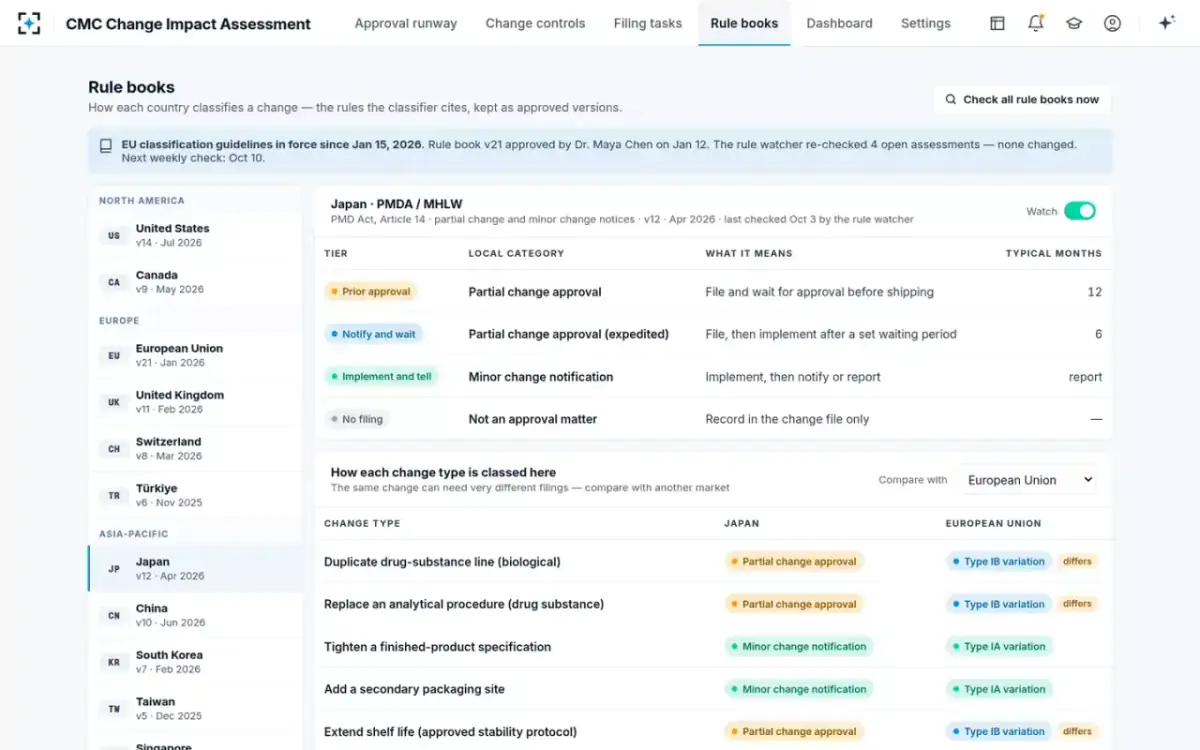
Each country's categories in CMC Change Impact Assessment, held as approved versions
Biologics are not drugs: 601.12 against 314.70
The two regulations are close enough that people quote them interchangeably and different enough that doing so causes mistakes. The test, the three categories and the thirty-day mechanism are the same. The listed examples, and some of the procedural detail, are not.
The same three categories, written twice: an approved NDA and a biologics licence
21 CFR 314.70 — approved NDA: Substantial, moderate or minimal potential for an adverse effect on identity, strength, quality, purity or potency of the drug product, as these factors may relate to safety or effectiveness.
21 CFR 601.12 — biologics licence: The same test, applied to the product, with the same five attributes.
21 CFR 314.70 — approved NDA: The applicant must notify FDA about each change in each condition established in an approved NDA beyond the variations already provided for in the NDA.
21 CFR 601.12 — biologics licence: The applicant must inform FDA about each change in the product, production process, quality controls, equipment, facilities, responsible personnel, or labeling established in the approved licence application.
21 CFR 314.70 — approved NDA: The NDA holder must assess the effects of the change before distributing a drug product made with a manufacturing change.
21 CFR 601.12 — biologics licence: The applicant must assess the effects and demonstrate, through validation and other studies, the lack of adverse effect on the product.
21 CFR 314.70 — approved NDA: Formulation and specification changes, equivalence studies, changes in drug-substance synthesis that may affect the impurity profile, container closure systems that control delivery, and specified biotechnology changes.
21 CFR 601.12 — biologics licence: Virus or adventitious agent removal or inactivation methods, source material or cell line, a new master cell bank or seed, and changes that may affect sterility assurance.
21 CFR 314.70 — approved NDA: The agency may designate a category of changes that may be distributed on receipt of the supplement, under 314.70(c)(6).
21 CFR 601.12 — biologics licence: The same mechanism sits at 601.12(c)(5), and the biologics guidance lists the changes FDA recommends be submitted that way.
21 CFR 314.70 — approved NDA: In the regulation, plus guidance such as the scale-up and post-approval change documents for specific dosage forms.
21 CFR 601.12 — biologics licence: In the regulation, plus the CMC changes guidance for certain biological products, whose tables answer most real cases row by row.
When a comparability protocol lowers the category
There is a legitimate way to make a future change cheaper, and it has to be bought in advance. An applicant may submit a protocol describing the specific tests, studies and acceptable limits that will demonstrate the lack of adverse effect for a named type of manufacturing change. "Any such protocols, or change to a protocol, shall be submitted as a supplement requiring approval from FDA prior to distribution of the product which, if approved, may justify a reduced reporting category for the particular change" (21 CFR 601.12(e)); 21 CFR 314.70(e) does the same for an NDA.
Three things are worth noting about the bargain. The protocol itself is a prior approval supplement, so the cost is paid up front. The reduction applies to the particular change type the protocol covers, not to a family of loosely similar ones. And the justification is explicit in the regulation: using the protocol reduces the potential risk of an adverse effect, which is why the category may fall — not because the paperwork has been pre-agreed.
For a company making the same kind of change repeatedly across a portfolio — a second supplier for a class of single-use components, say — that trade can be one of the most valuable regulatory investments available, because it converts a recurring prior approval into a recurring lower category.
Where the United States answer sits in a global assessment
Many global filing plans start with the United States, for two reasons: the category can usually be decided from published text and a published change table, and the US answer is often the anchor other markets are sequenced against. On the sample duplicate-line change the United States was one of the first approvals expected, in January 2027, while the slowest market on the same change ran well into 2028.
The United States column, beside the twenty others the same change has to satisfy
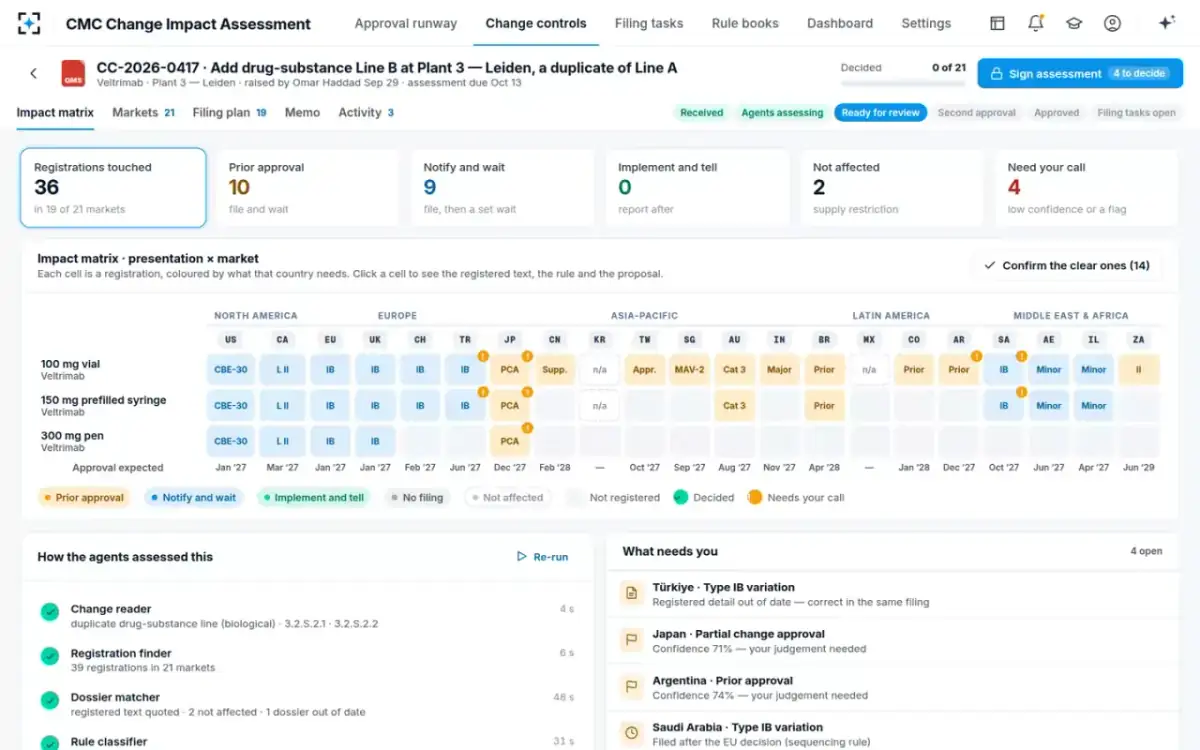
That is also why a US category that is wrong is expensive twice: once in the United States, and again in every market whose submission the company chose to sequence behind it. The guard is the same one that applies everywhere — the proposal cites the rule entry it rests on, names the alternative it rejected, and is confirmed by a person, not by a confidence score. The full assessment, step by step, puts the US answer beside the other twenty, and the European clocks that usually run alongside it are set out in their own guide. To see both on one change, start from CMC Change Impact Assessment.
Questions people ask
How is a CBE-30 different from a prior approval supplement?
When you may ship. A prior approval supplement must be approved before any product made with the change is distributed; a CBE-30 lets distribution begin thirty days after FDA receives the supplement, unless FDA objects inside the window. The underlying difference is the test: substantial potential for an adverse effect puts a change in the first category, moderate potential in the second.
Can you ship product 30 days after filing a CBE-30?
Yes, if FDA has not told you otherwise. The regulation permits distribution not less than thirty days after receipt of the supplement. If FDA informs you inside the window that the change needs prior approval, or that required information is missing, you must not distribute until that is resolved — and a supplement disapproved later can still bring an order to cease distribution.
What is a CBE-0 supplement?
A supplement for a change FDA has designated as one that may be distributed on receipt, labelled "Supplement—Changes Being Effected" with no waiting period. The mechanism is 21 CFR 314.70(c)(6) for an NDA and 601.12(c)(5) for a biologics licence, and the changes FDA recommends for it are listed in guidance — typically changes that only tighten the control strategy.
Is a filter supplier change a CBE-30?
For certain biological products, a change to a final sterilisation filter supplier with no change in material, dimensions or sterilisation method sits in the CBE-30 column of FDA's own table. Change the membrane material or the filter dimensions and the same table puts it at prior approval. The qualifier is doing all the work, so the assessment has to compare the two filters attribute by attribute, not supplier to supplier.
Which changes go in the annual report?
Those with minimal potential to affect the product's quality attributes: equipment replaced with the same design and operating principle, changes made to comply with an official compendium, an expiry extension from full shelf-life data under an approved protocol, an alternative analytical procedure with equal or better assurance. Each entry needs the description, sites, implementation date, supporting data and a statement that the effects were assessed.
How does a comparability protocol lower the reporting category?
By getting the evidence standard agreed in advance. The protocol is filed as a prior approval supplement setting out the tests, studies and acceptance limits for a named change type; once approved, it may justify a reduced reporting category for that change, because using it reduces the potential risk of an adverse effect. It is worth most where the same kind of change recurs across a portfolio.