A change control impact assessment, in a pharmaceutical company, is the regulatory answer to a manufacturing or quality change: which of the product's registrations the change touches, what filing each country needs, and when each agency will approve it. It is written by regulatory CMC against a change control raised in the quality system, and it is hard not because the science is difficult — a duplicate bioreactor train is not a difficult idea — but because the answer has to be found separately in every market the product is sold in, from the approved dossier of each one. CMC Change Impact Assessment is Botminds' agentic solution for that work: six agents read the change, find every registration, quote the registered text, apply each country's rule book with the entry cited, and draw the approval runway, for the regulatory CMC lead to decide and sign.
The worked example on this page is the fictional sample data the solution runs on: Northwind Bio, its monoclonal antibody Veltrimab, and the people who assess its changes are all invented. The regulations and the research figures are real and linked where they appear.
What is a change control impact assessment?
It is the part of a change control that answers a regulatory question rather than a technical one. The technical half asks whether the change is safe and justified; the regulatory half asks what the company owes each agency because of it, and when the change may therefore be made. ICH Q10 puts both inside one system and is explicit that the second question has to be asked: "Proposed changes should be evaluated relative to the marketing authorisation, including design space, where established, and/or current product and process understanding. There should be an assessment to determine whether a change to the regulatory filing is required under regional requirements" (ICH Q10, section 3.2.3(b)).
Two words in that sentence carry the work. Marketing authorisation means the approved dossier, not the current process description — and a product sold in twenty-one countries has twenty-one of them, which do not say the same thing. Regional requirements means each country's own classification rules, which can disagree about the same change: on the sample product used here, a duplicate drug-substance line is a supplement in the United States, a Type IB variation in the European Union and a partial change approval in Japan. Neither can be answered from memory, and that is why an assessment is a day's work rather than a judgement call.
The output is a memo. It names the change, lists the registered elements it touches, gives a table of markets with the filing proposed for each and the basis for it, and carries the signature of a named person. Everything downstream — the affiliates' submissions, supply planning's allocation, the plant's implementation date — waits on it.
What a regulatory impact assessment has to contain, from the four things ICH Q10 asks of a change system
Risk, proportionate
Quality risk management is used to evaluate the proposed change, and the effort put into the evaluation matches the risk. A duplicate line and a new shelf life do not deserve the same page count.
ICH Q10 3.2.3(a)
Measured against the authorisation
The change is evaluated against what is registered — including a design space where one exists — and the assessment says whether a filing is required in each region.
ICH Q10 3.2.3(b)
Assessed by the right functions
Named people from development, manufacturing, quality and regulatory affairs contribute, and the criteria the change will be judged against are set before it is made.
ICH Q10 3.2.3(c)
Checked after the event
Once implemented, the change is evaluated again to confirm it did what it was meant to and harmed nothing — which is why the assessment has to be findable a year later.
ICH Q10 3.2.3(d)
The four questions, in the order they have to be answered
Every regulatory impact assessment answers the same four questions, and the order is not a preference. You cannot classify a change in a market before you know the change touches something that market registers; you cannot know that before you have the registered text in front of you; and you cannot find the registered text before you know which registrations exist. Each answer is the next question's input.
The four questions, and who answers each in CMC Change Impact Assessment
Agent
1. What changed?Reads the change control — description, justification and risk assessment — and states the product, the presentations, the sites, the change type and the registered elements it may touch, with their CTD sections.
Never: decide that a change is not regulatory relevant; it lists what the change touches and asks the change owner when the type is unclear
Agent
2. Where is it registered?Lists every active registration of the product by presentation and country, including those under renewal, with the agency, the licence number and the registered drug-substance and drug-product sites.
Never: drop a market because it looks unaffected — it marks the market and says why
Agent
3. What does the dossier say?Opens each country's approved section and quotes the exact registered text the change touches, marking registrations that do not include what changes.
Never: paraphrase registered text, and never pass over a dossier that disagrees with the approved change history
Agent
4. What does this country call it?Applies that country's approved rule book and its past agency advice to propose a local category and tier, with the rule entry cited, a confidence and the alternative considered.
Never: decide: below 75% confidence the market goes to a person before anything else happens
A person decides
The regulatory CMC leadReads the proposals, decides each market, sets the go-live date and signs the assessment. A changed category needs a reason, which goes into the memo.
Read that way, the assessment has a shape worth noticing: three of the four questions are lookups. Question 1 reads a document the company wrote. Questions 2 and 3 read documents the company filed. Only question 4 involves applying a rule to facts, and even there the rule is written down in a classification guideline. The judgement that justifies a senior salary sits in the small number of markets where the rule book does not quite fit — and by hand, those markets get whatever attention is left after the lookups are done.
Step 1 — read the change control and name what it touches
The assessment starts with a change control that was written for a different audience. A plant's change record is written to satisfy quality: what is changing, why, what the risk assessment concluded, which validation will be run. It rarely says which lines of which dossier it disturbs, because the person writing it does not have twenty-one dossiers open.
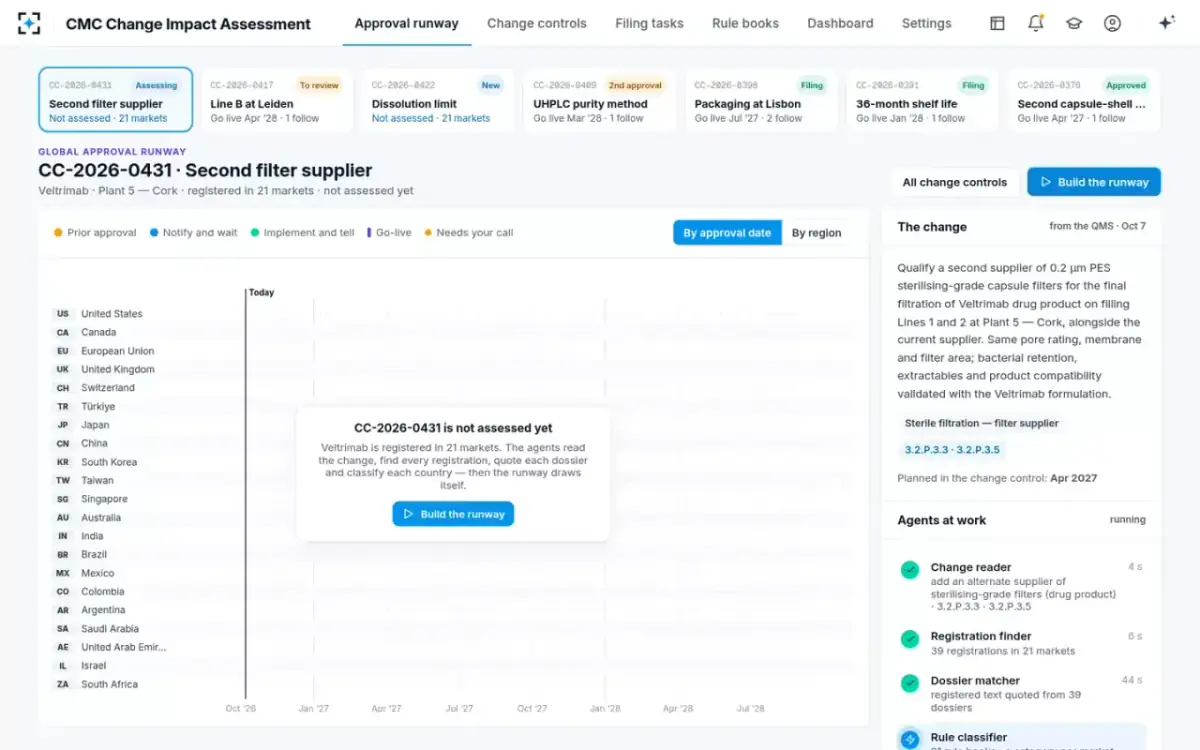
So the first job is translation. Take the sample change control CC-2026-0417, raised at Plant 3 — Leiden: install a second 12,000 L production bioreactor train, Line B, in Building 4, a duplicate of Line A with the same equipment design, the same cell bank, the same process parameters and in-process controls, to add 40% drug-substance capacity from 2027. Translated into dossier terms that is two registered elements — the drug-substance manufacturer and the batch scale, sections 3.2.S.2.1 and 3.2.S.2.2 — and nothing else. A change control that reads as a construction project turns out to touch two lines of text.
The translation has to be conservative, because the regulations are written broadly. For a biological product in the United States the applicant has to tell FDA about every change to anything the approved licence establishes — the product, the production process, quality controls, equipment, facilities, responsible personnel and labelling (21 CFR 601.12(a)(1)). Responsible personnel and facilities are in that list, which means a change control about an organisation chart or a building can be a reportable change. A first pass that only looks for process parameters will miss them.
CMC Change Impact Assessment reads a new change control before anyone opens a dossier
Step 2 — find every registration of the product, by presentation and country
A product is not registered once. Veltrimab is registered in 21 markets in three presentations — a 100 mg vial, a 150 mg prefilled syringe and a 300 mg pen — which is 39 live registrations, each approved on its own date against its own version of the dossier. The unit of the assessment is the registration, not the country and not the product.
Two failure modes live in this step. The first is missing a registration: a market in the middle of a renewal, a presentation launched late in one country, a licence held by a local partner. Changed material then ships to a country that never approved the change. The second is quieter and more common: dropping a market because it looks unaffected. On CC-2026-0417, two markets register a different drug-substance site, so Line B at Leiden does not touch them and no filing is needed — but that is only half the answer. The other half is a supply restriction, because material from the new line must never reach those two countries. An assessment that writes "not affected" and stops has created a supply problem instead of a filing one.
That is why the registration finder in the solution never drops a market quietly: every active registration is listed, and a market that does not register what changes is marked not affected and given a supply note. The supply planner who allocates batches by market is reading that column, not the filing table.
Step 3 — open each country's approved dossier and quote the registered text
This is the longest step and the one nobody can shorten by being clever, because the question is factual: does this country's approved dossier register the thing that is changing, and in what words? The words matter. ICH M4Q describes 3.2.S.2.1 as the place where "the name, address, and responsibility of each manufacturer, including contractors, and each proposed production site or facility involved in manufacturing and testing should be provided" — so a dossier that lists a site generically and one that names a building and a line number create different obligations from the same plant change.
The Module 3 sections a drug-substance or drug-product change usually opens
| CTD section | What it registers | A plant change that touches it |
|---|---|---|
| 3.2.S.2.1 Manufacturer(s) | The drug-substance manufacturing sites, including testing sites and contractors, with their responsibilities. | A new drug-substance line, a new site, a contract manufacturer added or dropped. |
| 3.2.S.2.2 Description of manufacturing process and process controls | The individual unit operations and their sequence, and the process controls applied at each of them. | A batch-scale change, a reordered step, a changed hold time or in-process control. |
| 3.2.P.3.3 Description of manufacturing process and process controls (drug product) | The unit operations and their sequence for the drug product, with the process parameters identified at each step. | A second sterilising-grade filter supplier, a new filling line, a changed filtration step. |
| 3.2.P.3.5 Process validation and/or evaluation | The validation studies for critical steps and assays, such as the sterilisation or aseptic filling validation. | A revalidation that changes what the approved dossier says was validated. |
The table is a starting map, not an answer. Which of those lines is binding is the question ICH Q12 answers with established conditions, and the answer differs by market: the same sterile filtration step is supportive detail in one dossier and a registered supplier name in another. The only safe method is to open the country's own approved text and quote it, which is what the dossier matcher does — it quotes and never paraphrases, and flags any dossier that disagrees with the approved change history.
Step 4 — apply each country's rule book and propose a category
Now the change meets the rules. Each agency publishes a classification: a list of change types with the category each falls into and what has to be filed. Applying one is mechanical when a row fits and a judgement call when none does, and the proportion of each is the thing teams underestimate.
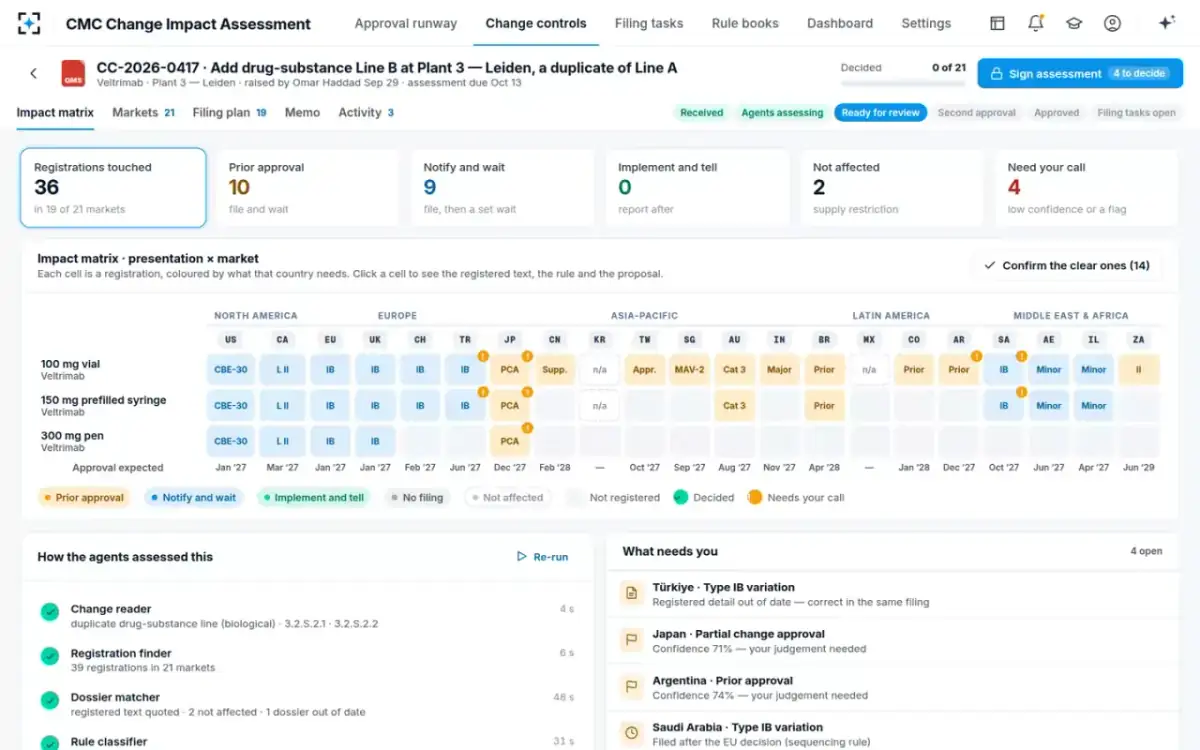
On CC-2026-0417 the solution's rule classifier proposed 19 filings across 19 markets: ten needing prior approval, nine to be filed and then waited out, two markets not affected with a supply restriction, and four flagged for the lead's own call. The four are the interesting ones. Japan was proposed as a partial change approval at 71% confidence, with the alternative — a minor change notification, if PMDA agrees the line count is descriptive rather than an approval matter — written out beside it, and a named affiliate asked to test it in a pre-consultation. A proposal that shows its own second-best answer is worth more to the person deciding than a confident one that does not.
Each market's proposal carries the rule entry it rests on, a confidence, and the alternative considered; below 75% confidence the market goes to a person before anything else. Those are settings, not habits. The United States answer on this change was a supplement filed thirty days before distribution rather than a prior approval supplement, and the European Union and United Kingdom were Type IB variations; the detail of each of those categories is worked through in its own guide.
Every registration, coloured by what its country needs, with the reading behind each cell
Step 5 — turn the categories into dates, and into one go-live date
A category is not a date. Prior approval in a market with a fourteen-month median review is a different fact from prior approval in one that answers in sixty days, and the plant cannot plan against either until somebody has added the submission date, the review time and the sequencing rules the company imposes on itself — filing Saudi Arabia only after the European decision, for instance, because the local procedure needs it.
Two go-live answers then exist, and they are genuinely different decisions. One date everywhere is simple, auditable and set by the slowest market. A split lets most markets go live early while a late market keeps the current process until its own approval arrives, which is cheaper but means running two processes and two supply chains for a while. On the sample filter-supplier change the split was worth taking: twenty of twenty-one markets at 95.0% of volume in September 2027, with China following in February 2028, against February 2028 for everyone if one date had been required. The European dates in that plan turn on what "implementation" means, which is not the same day the first batch ships.
In the solution the runway planner estimates those dates from three years of the company's own approval history and shows the basis for each one. It suggests; it never sets the implementation date. That belongs to the regulatory CMC lead, and the suggestion and the choice both stay on the audit trail.
What happens when the registered text no longer matches the plant
Sooner or later the assessment turns up a dossier that describes a process the plant no longer runs. An old change was filed in some markets and not others; a local renewal re-stated a detail incorrectly; an approved change was never carried into one country's text. On CC-2026-0417 one of the thirty-nine dossiers was out of date, in Türkiye, and the flag arrived in the same pass that proposed the filing.
The temptation is to assess the change against the process as it actually runs. That is the wrong baseline: the obligation is measured against what is registered, so an assessment written against the plant's reality will propose a filing that does not match the text the agency holds. The correct handling is to treat the discrepancy as a second finding with its own owner — often the registered detail is corrected inside the same filing, which costs nothing extra — and to say so in the memo rather than silently assessing against the right process and the wrong dossier.
It is also a reason to keep the comparison rather than the conclusion. In the solution, dossiers that disagree with the approved change history are flagged rather than reconciled, and corrections are routed to a named person under a setting, so a discrepancy becomes a task instead of an opinion inside one assessment.
Who signs the assessment, and when a second approval is needed
One person signs, and the signature is a statement about every market in the table. ICH Q10 expects the evaluation itself to be done by expert teams from the relevant functions — development, manufacturing, quality, regulatory affairs, medical — but the regulatory conclusion is owned by regulatory CMC, because nobody else can say what each country's text registers.
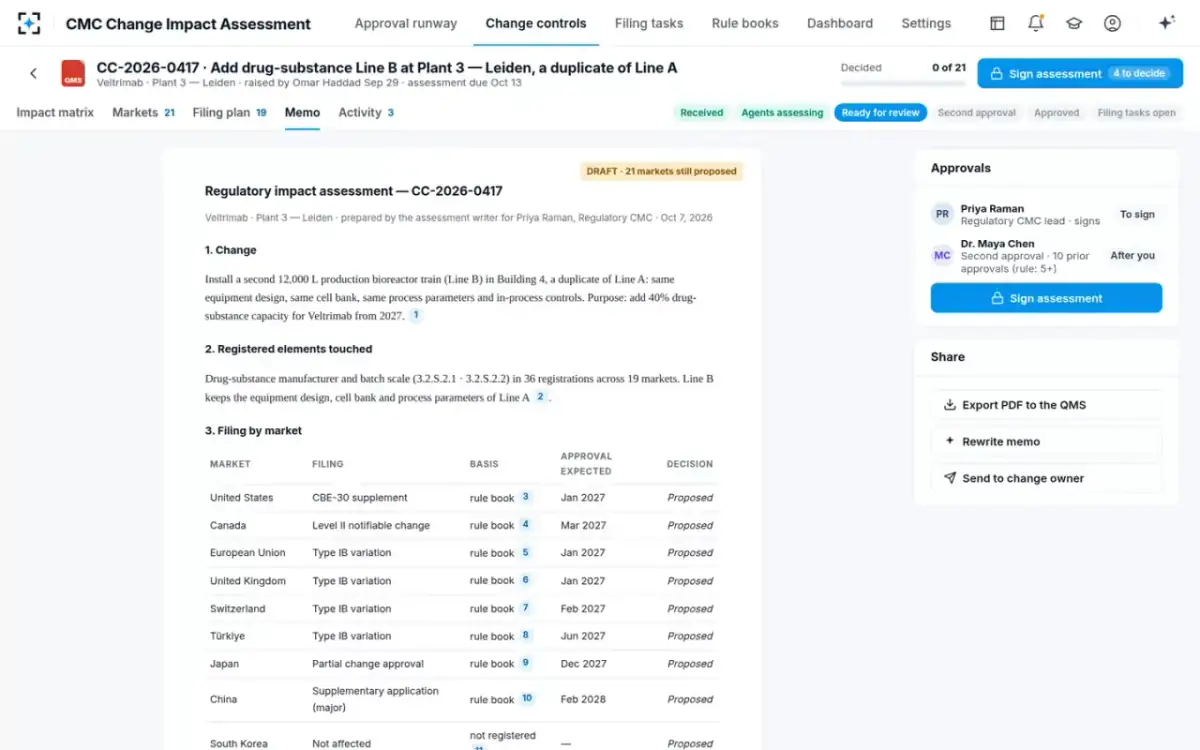
Most companies add a second approval above some threshold, and the threshold is worth setting deliberately. In the sample configuration the head of regulatory CMC adds a second approval whenever five or more markets need prior approval; on CC-2026-0417, with ten prior-approval markets, that second approval applied. The rest of the settings are of the same kind: who signs, who receives registered-detail corrections, the confidence at or above which a proposal may be confirmed in bulk, and how large a gap justifies letting a late market follow.
Two rules keep a signature meaningful. Only decided markets go into a signed memo — the sample memo carries a draft mark while any market is still proposed — and changing a proposed category requires a reason, which is kept verbatim in the memo and the audit trail. A memo that records which categories were changed, and why, is also the document that makes the after-the-fact evaluation ICH Q10 asks for possible a year later.
The assessment memo, drafted in the company template with every market's basis cited
How long does a change control impact assessment take?
By hand, on a product registered in twenty-one markets, about six and a half hours of a regulatory CMC lead's time per change control — and in the sample company four to six new change controls arrive each week, which is most of a working week before anything else is done. The split below is the solution's own estimate for that case, and the shape of it is the point: the two dossier-and-rule-book steps are more than half of the time, and the memo everyone waits for is half an hour at the end.
One change control across 21 markets, by hand: where six and a half hours go
- Registrations48 min
- Open each dossier134 min
- Look up each rule book106 min
- Ask affiliates48 min
- Plan29 min
- Memo29 min
Three quarters of the assessment is a lookup; the judgement is the last quarter
Where the 394 minutes go
- Registrations · 12%
- Registered text · 34%
- Rule books · 27%
- Affiliates · 12%
- Plan and memo · 15%
The scale behind that split is not specific to one company. An industry study of prior-approval post-approval changes across eighteen large pharmaceutical companies counted the scale: "The total number of PACs approved globally (146,550) was calculated by addition of data from all 18 companies over the 3 years" (Vinther and colleagues, Therapeutic Innovation & Regulatory Science, 2024). Every one of those submissions had an assessment behind it.
That is the case for automating the lookups and only the lookups. In the sample solution the six agents do steps one to four and hand the lead a matrix that is already proposed and cited; the design target is a median of 38 minutes from a new change control to a signed proposal, which is a design target, not a measured result. What does not move is the decision: the agents never file with an agency, never edit a dossier and never set the implementation date. To see the matrix, the memo and the runway on one change, start from CMC Change Impact Assessment.
Questions people ask
Does every change control need a regulatory impact assessment?
Every change control needs the question asked; not every one produces a filing. ICH Q10 expects all changes to be evaluated through the company's change management system, with an assessment to determine whether a change to the regulatory filing is required under regional requirements. The cheap discipline is to record the answer even when it is "nothing to file", because the next auditor's question is how you knew.
Who does the regulatory impact assessment of a change control?
Regulatory CMC, as part of an evaluation that ICH Q10 expects expert teams from development, manufacturing, quality, regulatory affairs and medical to contribute to. The change owner at the plant raises the change and supplies the facts; affiliates confirm local practice; but the conclusion that a filing is or is not needed in a given country belongs to the regulatory CMC seat, and so does the signature.
How do you know if a change needs a variation?
In three moves: find the registrations, check whether each one's approved text includes the thing that is changing, and look up that country's classification for the change type. If the dossier does not register it, there is usually nothing to file — but check the supply consequence. If it does, the country's rule book gives the category, and anything the rule book does not cover goes to a person, and often to the agency.
What should a regulatory impact assessment contain?
The change in dossier terms, the registered elements it touches with their CTD sections, every registration by presentation and country, the category proposed for each market with the rule entry it rests on, the expected approval date for each, the markets not affected and their supply restrictions, and the signature. Anything changed from an earlier draft should carry its reason.
What happens if the dossier does not match the current process?
Assess against the dossier, not the plant, and raise the mismatch as its own finding. The obligation is measured against what is registered, so a filing proposed against an unregistered reality will not match the text the agency holds. Where the correction is small it is usually folded into the same filing; where it is not, it needs its own owner and its own date.
How long does a change control impact assessment take?
On a product registered in twenty-one markets, roughly six to seven hours of a regulatory CMC lead's time by hand, most of it spent opening dossiers and classification guidelines. The elapsed time is longer, because the unclear markets wait on affiliate answers. The number worth tracking is not the total but the share spent on retrieval, because that is the share that can be moved.