Regulatory information management software is the system of record for registrations: which products are approved in which countries, under which licence numbers, in which presentations, with which renewal and commitment dates. It is the backbone of regulatory operations and nobody serious proposes running without one. What it cannot tell you is the thing a change control actually asks — given this change to this plant, what has to be filed where, in which category, and when will each agency approve it. That question is answered against the approved dossier and the country's rule book, neither of which a registration list contains.
The distinction matters most when the answer is challenged. An assessment is defensible when each market's conclusion carries the registered text it relied on, the rule entry behind it, the name of the person who decided and the reason for any category they changed. That is the standard this page argues for, and it is the standard CMC Change Impact Assessment is built to: six agents read the change, find every registration, quote each dossier, cite each rule book and plan the approval runway, and a named person decides and signs every market.
No product is named or compared here. The worked examples are the fictional sample company and product that run inside the solution, and the rules and guidance are linked where they are used.
What a regulatory information management system actually is
A regulatory information management system is a database of regulatory facts and the documents that evidence them, held so that one group can answer "what do we have, where" without opening a filing cabinet. In practice it holds product and substance definitions, a registration per product, presentation and country with its licence number and status, submission and approval history, commitments and renewal dates, health authority correspondence, and a document repository with the submitted sequences in it.
That is a register. Its job is to be accurate and complete about the past: what was submitted, what was approved, what is in force. Everything downstream — a renewal plan, a portfolio report, a filing tracker, an impact assessment — is built on it, which is why the quality bar for the register itself is higher than for anything built on top of it.
What RIM holds, and what it does not
The gap is not a criticism of these systems; it is a description of their scope. A registration record says that a product is approved in a country. It does not say what the approved dossier states about the step your plant is changing — and that sentence is the whole of the assessment.
A register of approvals against the inputs an assessment needs
What the register holds: Product, substance and presentation definitions, with licence numbers and status per country.
What the assessment has to read: The same list, plus the registrations under renewal and those held under a local product name, because each still needs a filing.
What the register holds: That the product is approved in the country, and when.
What the assessment has to read: What that country approved: the text of 3.2.S or 3.2.P, or the local approval document, for the step being changed.
What the register holds: Rarely anything. Classification lives in guidance documents, not in the register.
What the assessment has to read: That country’s classification rule book at a known version, plus any past advice the agency gave this product.
What the register holds: Nothing until a submission exists. The change control lives in the quality system.
What the assessment has to read: The change description, the sites and the registered elements it touches, read before any submission exists.
What the register holds: Dates of past submissions and approvals.
What the assessment has to read: An estimate per market for this change, with its basis shown, and the sequencing rules that make one market wait for another.
What the register holds: A list of registrations.
What the assessment has to read: A category per market, cited, with a named decider and a date.
Why a registration list is not an impact assessment
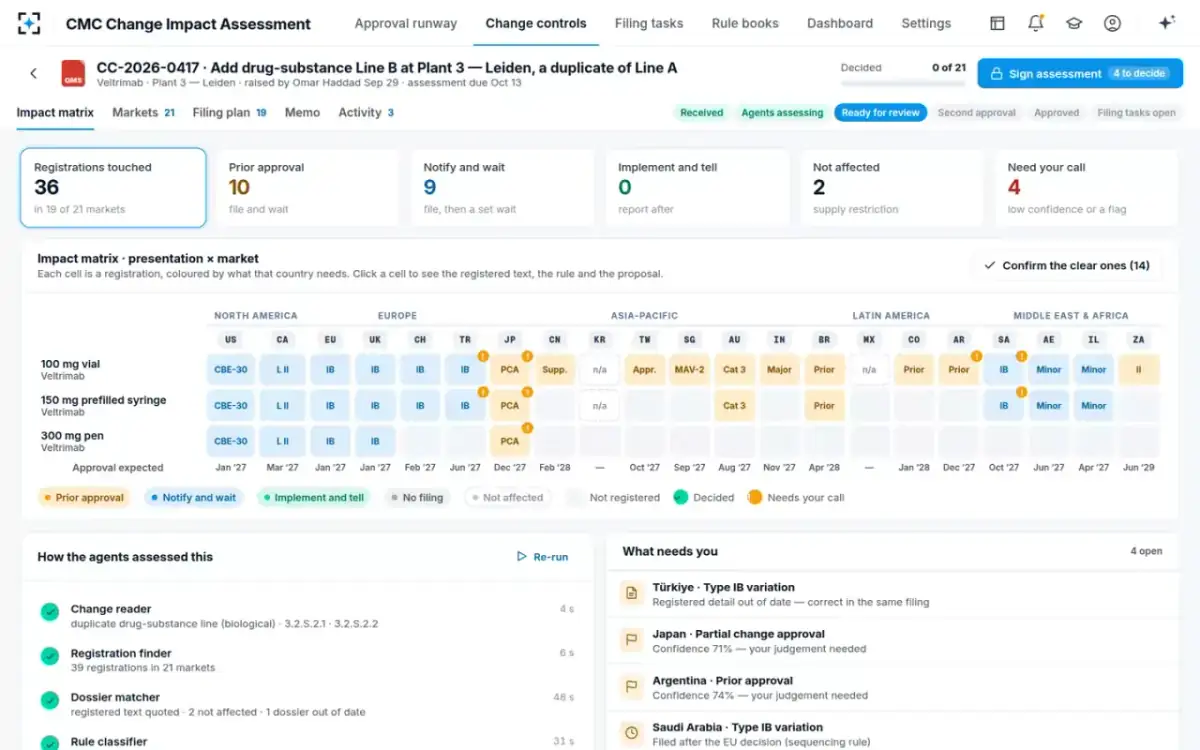
Take the simplest possible case: one change, twenty-one markets, a complete and accurate registration list. The list tells you twenty-one countries hold thirty-nine registrations. It cannot tell you that two of those registrations name a different drug-substance site, so the change does not touch them — or that one of the remaining nineteen describes the step in words that no longer match what the plant does.
Both facts are inside the approved dossier sections, which is why reading them is the largest single block of the work. ICH M4Q is explicit about what lives there for process validation: "Description, documentation, and results of the validation and/or evaluation studies should be provided for critical steps or critical assays used in the manufacturing process (e.g., validation of the sterilisation process or aseptic processing or filling)." A change to a sterilising filter lands in that text, in every country that has it, in whatever form that country approved.
So the assessment is a reading job before it is a classification job, and a tool that starts from a registration list has started one step too late. How to find every one of those registrations, including the ones that look irrelevant, is the subject of the drug-substance change walk-through.
The four things a proposal has to carry to be defensible
Defensible is not a feeling; it is a test. Hand a single market's proposal to someone who was not in the room — an inspector, a new lead, an auditor two years later — and ask them to reconstruct why that category was chosen. If they can do it from the proposal alone, it is defensible. Four items make that possible, and all four are missing from a filing list.
What each market's proposal has to carry before anyone signs it
- The registered text it relied on, quoted
The sentence from that country’s approved dossier section or local approval that describes the step being changed — not a summary of it.
- The rule entry behind the category, cited by version
Which classification entry in which rule book, at a version someone approved, produced this category.
- A named decider, and a reason for any category changed
Who decided this market, with an electronic signature and its meaning, and the reason in their words if they moved the category the tool proposed.
- The alternative considered, and the confidence
The category that was rejected and why, so a reviewer can see the judgement rather than only its result.
Quoted registered text, not a summary of it
Paraphrase is where assessments quietly go wrong. A summary that says "the drug substance site is registered" survives the week it is written and is useless a year later, because the question is never whether a site is registered — it is whether the specific attribute that changed appears in the registered description, and in what words.
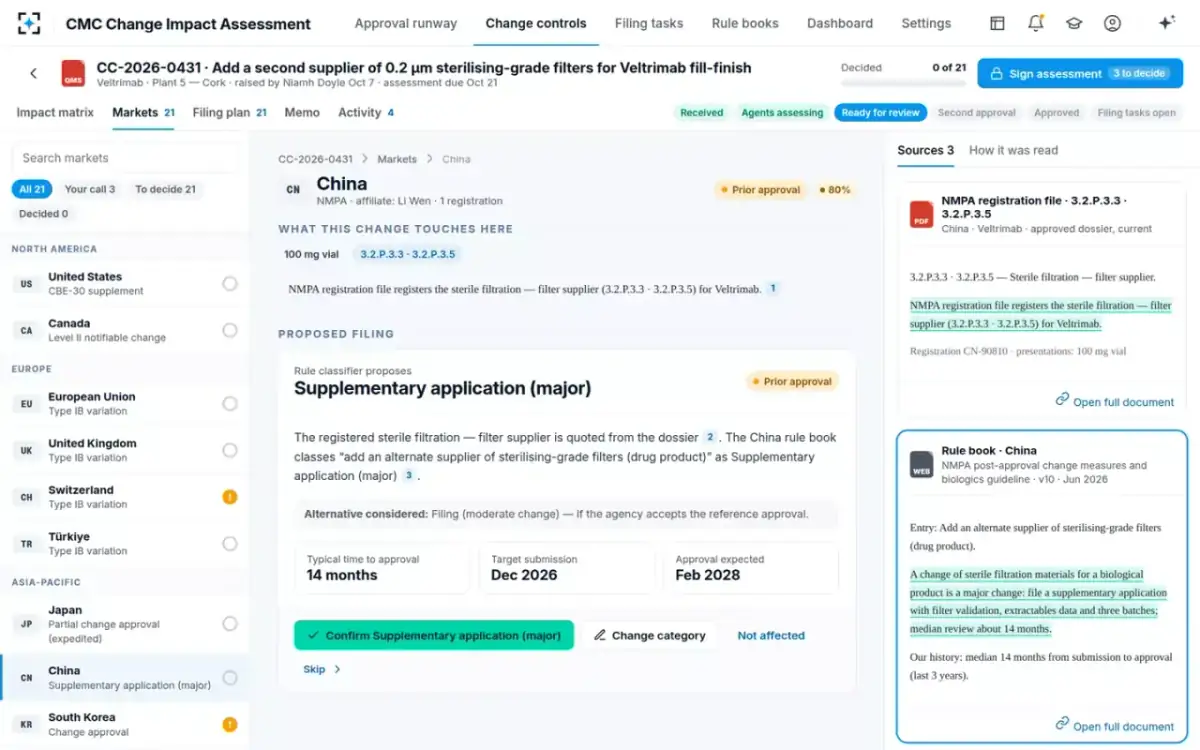
In the sample assessment, Japan turns on exactly that. The approval matters quoted from the Japanese registration state that the culture step runs in one 12,000 litre production line at the Leiden site. That sentence, quoted, is why a second line is proposed as a partial change approval rather than a minor change notification — and it is also why the proposal carries 71% confidence and goes to a person, because an agency could still treat the line count as descriptive rather than as an approved condition. Replace the quotation with "the manufacturing method is registered" and both the conclusion and the doubt disappear from the page.
A tool that paraphrases is therefore not slightly worse than one that quotes; it has removed the evidence. The setting that governs this in the solution is deliberately a switch the buyer owns — quote the registered text for every market, on or off — and the sensible answer is on.
One market, with the registered text and the rule quoted side by side
A cited rule entry, and the rule-book version it came from
Classification rules move. The European classification guidelines were rewritten, with their chapters renamed and renumbered, for applications submitted from 15 January 2026; national rule books are revised on their own schedules and often without fanfare. An assessment that cites "the EU guidelines" has cited a moving target, and a two-year filing plan built on it cannot be reconstructed later.
What makes a citation durable is a version with an owner. In the sample solution, each country's rule book is held as a numbered, approved version — the European one at v21, reflecting the classification guidelines in force from January 2026, approved by the head of regulatory CMC — and the classifier may only use approved versions. A rule watcher checks 21 agencies weekly and re-checks open assessments when a rule changes, so a proposal made under v20 is revisited rather than left to age.
ICH Q12 is the reason this matters beyond tidiness. It describes the regulatory system as one in which assessment and inspection work together: the guideline "outlines the complementary roles of regulatory assessment and inspection in the oversight of post-approval changes; and how communication between assessors and inspectors facilitates the use of the tools included herein." The category you filed under is visible to both, from two directions, years apart.
A named decider, and a reason for every changed category
Automation is not the risk; anonymity is. A proposal is a proposal, and a system that converts proposals into filings without a person in between has produced an assessment nobody owns. The useful design is the opposite: the tool does the reading and the lookup, and a named person decides each market and signs, with the signature carrying its meaning.
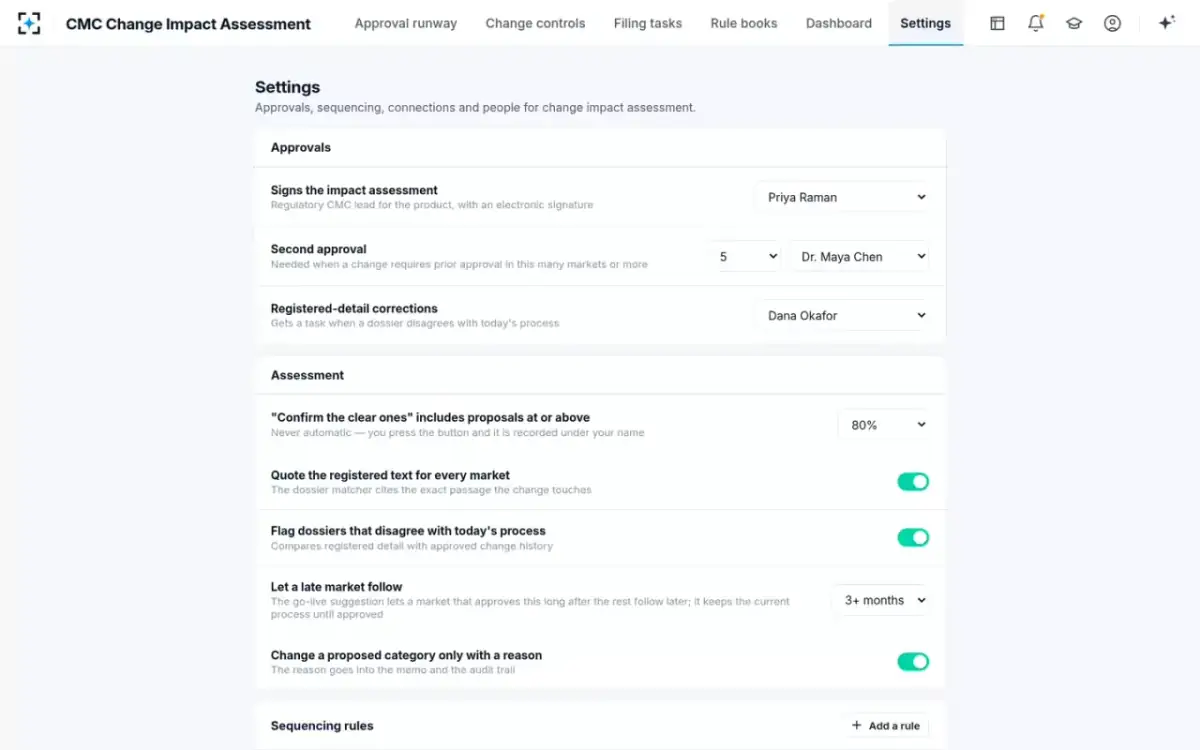
Two details turn that from a policy into something that survives an audit. The first is that changing a proposed category requires a reason, kept verbatim, which goes into the memo and the audit trail — so the places where a human overruled the rule book are the easiest part of the file to find rather than the hardest. The second is that bulk actions are never automatic: in the sample solution "Confirm the clear ones" is a button the lead presses, recorded under her name, and it only ever offers proposals at or above the confidence threshold she set.
Two numbers that are often confused, and what each one governs
75% · the flagging floor
Below this confidence, a market is not shown as a clear proposal at all: it goes to a person first, with the alternative the classifier considered. In the sample assessment Japan sits at 71% and is therefore flagged for the lead's judgement.
Also triggers a flag: a dossier that disagrees with the approved change history.
80% · the bulk-confirm threshold
What "Confirm the clear ones" will include. Proposals at or above it are offered together for one deliberate confirmation; the options the lead can choose are 90%, 85% or 80%.
Never automatic: a person presses it, and the action is recorded under her name.
Quoting one number as "the confidence floor" is how a buyer ends up believing a tool is more or less cautious than it is. Ask for both, and ask who may change them.
What happens if you file the wrong variation category?
The consequence is not a letter asking you to re-file. Japan's notification on partial change approvals and minor change notifications sets it out in terms that every rule book implies and few state: if a GMP inspection finds that a minor change notification was used for a change that should not have been handled that way, "the minor change notification becomes invalid", the manufacturer may be accused of violating the law, and product already made and already marketed under the changed method is subject to administrative action.
products that have already been manufactured using the method after the change and products that have already been marketed shall be subject to necessary administrative actions, such as a suspension of the release or recall of the product
Ministry of Health, Labour and Welfare, Japan — PFSB/ELD Notification No. 0210001, tentative translation
Under-classification is therefore a supply risk with a long fuse: it is discovered at an inspection, after the material has shipped. Over-classification has a cost too, paid in the other direction — a market waits a year for an approval it did not need, two processes run in parallel for longer, and the benefit of the change is deferred for everyone. Neither error announces itself at the time it is made, which is why the evidence behind the category has to be written down when the category is chosen.
When the dossier disagrees with the plant, and who fixes it
Reading dossiers at scale finds something uncomfortable: registered text that no longer matches today's process. Usually it is small — a detail superseded by a change filed years ago in some markets and not others, a parameter described more tightly than the plant now runs. It is also exactly the kind of finding that a busy assessment steps around, because fixing it is somebody else's project.
Stepping around it is the wrong call twice over. The discrepancy is already a compliance exposure, and the current change is the cheapest opportunity to correct it, because the dossier section is open anyway. In the sample assessment one market — Türkiye — carries a registered detail that is out of date, and the proposal is to correct it inside the same Type IB variation rather than to raise a second filing later. The solution has a setting for whether to flag these at all; leaving it on is the choice that makes the assessment honest.
One registered detail, from the approved dossier to the correction filed with the change
- Registered text and plant practice divergeyears
- Found at an inspection, as a findingthe expensive way
- Flagged while the dossier section is openat assessment
- Routed to the named owner for correctionssame week
- Corrected inside the change’s own variationone filing, not two
How do you prove a proposed filing category is correct?
You cannot prove it the way you prove a calculation, because classification is a judgement against a rule applied to a described fact. What you can do is make the judgement inspectable: show the fact as the dossier states it, the rule as the rule book states it, the inference between them, the alternative that was rejected, and the person who accepted the result. An assessor or an inspector can then disagree with the judgement — which is a conversation — rather than with the absence of one, which is a finding.
The regulations lean the same way. US biologics rules require a supplement or annual report to "include a list of all changes contained in the supplement or annual report", with that list in the cover letter for supplements, and they expect an applicant to use a less burdensome notification where a regulation or guidance provides one. Both are easier to satisfy when every market's category is already written down with its reason attached.
The trace: how each row of the matrix was reached
Testing it on change controls you have already closed
The only demonstration worth watching is a replay. Take ten or twenty change controls you have already assessed and closed — with a spread of categories, at least one that went wrong, and at least one with a market that needed no filing — and run them cold. Then compare, market by market, not tool against truth but tool against the reasoning your own team recorded.
What a replay actually tells you, data set by data set
| What the tool reads | Whose system owns it | What a replay reveals when it is wrong |
|---|---|---|
| Change controls: description, justification, risk assessment | The quality system | Changes whose description does not say what actually changed. The tool asks the change owner; a person guessed. |
| Registrations by product, presentation and country | The registration records | Markets missing from the list, and markets listed that lapsed. Every downstream count inherits the error. |
| Registered dossier sections and local approval documents | The dossier archive | Sections that cannot be found or cannot be matched, and registered text that disagrees with today’s process. |
| Country classification rule books, by version | Regulatory affairs, approved per version | Categories defensible under last year’s rules. The replay dates each proposal to the rule book it used. |
| Past agency advice and consultation records | Regulatory affairs correspondence | Markets where a prior agency position exists and was not applied — the cheapest finding in the exercise. |
| Approval history and sequencing rules | Regulatory operations and supply | Dates with no basis. An estimate nobody can reconstruct is an assumption wearing a date. |
ICH Q10 asks for the same discipline after a change is made: "After implementation, an evaluation of the change should be undertaken to confirm the change objectives were achieved and that there was no deleterious impact on product quality." A replay is that habit pointed backwards — the same question asked of the assessments you have already closed. What to measure in the first ninety days afterwards is worked through in the requirements list for variation management.
The settings a buyer owns: signer, second approver, thresholds and rules
What to ask before the demonstration is booked
Three questions separate a register from an assessment, and none of them needs a product name to answer. First: on a change control the tool has never seen, what does it output per market, and what evidence does each output carry? Second: which of our systems does it read, and what happens when one of them is wrong or incomplete — does it stop, guess, or mark the row and say why? Third: who decides, and where is that decision recorded?
A fourth is worth asking last, because the answer is revealing. What will it refuse to do? A tool that will not file with an agency, will not edit a dossier and will not set an implementation date has drawn its boundary where the regulations put the accountability. The version of that question aimed at AI specifically is worked through in the six tests for regulatory AI. To see what a cited proposal looks like on a real change, start from CMC Change Impact Assessment.
Questions people ask
What does regulatory information management software do?
It holds the regulatory facts about a portfolio: products and substances, a registration per product, presentation and country with its licence number and status, submission and approval history, commitments, renewal dates, correspondence and the submitted documents. It is the system of record other regulatory work is built on. Deciding what a manufacturing change requires is not among its jobs, because that answer lives in the approved dossier and the country rule book rather than in the register.
Does a RIM system do change impact assessment?
Some carry a module that lets you record an assessment and track the filings it produces, which is useful. What a register cannot supply is the reasoning: the registered text from each country's dossier that the change touches, the classification entry applied, and the judgement between them. If the assessment is typed in by a person, the system is storing a conclusion rather than producing one.
What is the difference between RIM and document management?
A document management system holds files and their versions and controls who may change them. A regulatory information management system holds structured regulatory facts — registrations, statuses, dates, commitments — and usually links each one to the documents that evidence it. Most organisations run both, and an impact assessment reads from each: the registrations from the register, the approved dossier sections from the document store.
What data does a regulatory impact assessment need?
Six things: the change control itself, registrations by product, presentation and country, the registered dossier sections and local approval documents, each country's classification rule book at a known version, past agency advice on this product, and enough approval history to estimate dates. The first and the third are the two most often missing, and they are the two the assessment cannot be done without.
What happens if a dossier disagrees with the current process?
It is a finding, and the change in front of you is the cheapest moment to fix it, because the dossier section is already open. The practical route is to correct the registered detail inside the same variation rather than raise a separate filing later, and to route it to a named owner so the correction is tracked rather than noted. Leaving it undisturbed keeps an exposure that an inspection will eventually find.
What makes a change assessment defensible at an inspection?
That someone who was not involved can reconstruct it from the file. Each market's conclusion should show the registered text it relied on, the rule entry and version behind the category, the alternative considered, and the named person who decided — plus a verbatim reason wherever a proposed category was changed. Assessment and inspection look at the same changes from different directions, so the file has to answer both.