There is no official company core data sheet template, and no regulator publishes one, because no regulator owns the document. A company core data sheet — a CCDS — is the manufacturer's own central reference for one medicine: the safety information, the indications, the dosing and the pharmacology the company requires every market to carry. The sections are therefore a company choice. The consequences are not. Whatever goes into the core safety information becomes the minimum the company obliges thirty or sixty affiliates to list, and the yardstick by which every adverse reaction is later judged listed or unlisted. That is what makes the document hard to write well: one sentence in it has to land in two dozen national documents, each with its own template, language, procedure and deadline. Botminds' CCDS Label Change Management is the agentic solution for exactly that journey — comparing two core versions, finding every local label and section a change reaches, drafting the local wording and putting each market on its own clock — and a core sheet is well built when it survives that work.
So this guide does not offer a form to fill in. It sets out what the two definitions that exist actually oblige you to carry, which part of the document has teeth, who signs it and what the signature commits, and how to structure the sections so that each one maps onto a section of a local label somebody will have to change. The worked figures come from a fictional company in the solution's sample data: Northwind Bio, its medicines Veltrimab and Talmirex, its study VLT-305 and the people named on its screens are invented.
One core data sheet change, as CCDS Label Change Management read it
3
real changes between two core versions, each with its old and new text
26labels
local documents the three changes reach
16markets
each with its own procedure, language and deadline
2
registered local deviations standing in the new wording’s way
What is a company core data sheet?
A company core data sheet is the document in which a manufacturer writes down, once, what it requires every market to say about one of its medicines. The phrase and the idea both come from the Council for International Organizations of Medical Sciences, whose Working Group III agreed the definition at its first meeting in London in April 1992 and published it with the group's guidelines on core clinical-safety information.
"A document prepared by the pharmaceutical manufacturer, containing [among other things] all relevant safety information, such as adverse drug reactions, which the manufacturer requires to be listed for the drug in all countries where the drug is marketed."
CIOMS Working Groups III and V, Guidelines for Preparing Core Clinical-Safety Information on Drugs, chapter 1
Two words in that sentence do the work. Requires makes the document an instruction rather than a summary: the company is not describing what its labels happen to say, it is telling its affiliates what theirs must say. All countries makes it global by construction, which is why a core sheet written without a view of the national templates it governs produces a list of impossible tasks the week after it is approved.
The International Council for Harmonisation adopted the same object two decades later and defined it more tersely in the glossary of its periodic benefit-risk report guideline: a core data sheet is "a document prepared by the MAH containing, in addition to safety information, material related to indications, dosing, pharmacology and other information concerning the product" (ICH E2C(R2), Appendix A, item 2). Read together, the two definitions settle what a core sheet is for and roughly what it contains, and settle nothing at all about how it is laid out.
Why no regulator publishes a CCDS template
Templates exist where an authority receives a document and has to read many of them the same way: the European summary of product characteristics has one, the United States prescribing information has one, Brazil's package inserts have one. A core data sheet is received by nobody. It is an internal instrument, and the regulators that mention it do so from outside.
ICH mentions it as a habit. "In accordance with ICH E2C(R1) recommendations, it is a common practice for MAHs to prepare their own CCDS, which includes sections relating to safety, indications, dosing, pharmacology, and other information concerning the medicinal product. The core safety information contained within the CCDS is referred to as the CCSI" (ICH E2C(R2), section 2.4). Common practice is not a requirement, and the sentence is written to describe what companies already do.
The European Medicines Agency mentions it as a choice. Its good pharmacovigilance practices module on the periodic safety update report says that "a practical option for the purpose of the PSUR is for each marketing authorisation holder to use the CCDS in effect at the end of the reporting interval, as reference product information for both the risk sections of the PSUR as well as the main authorised indications for which benefit is evaluated" (EMA, GVP Module VII, section VII.B.4). Again: an option a company may take, not a document the Agency specifies.
Japan's health ministry comes closest to naming the document in an official notice, and even there it regulates the plumbing rather than the form. Its guideline on revising the Precautions section requires that "operational procedures and organization/system shall be established to enable relevant divisions … within the company to promptly provide the safety management and other divisions with necessary information", and the list of that necessary information includes the "company core data sheet [CCDS]" and the "company core safety information [CCSI]" by name (MHLW notification PFSB/SD 0929-2, attachment section 1(2), in PMDA's English translation). The obligation is to move the information; the document's shape is still yours.
The sections a core data sheet has to carry
From the two definitions, the content families are fixed even though the layout is not: safety information, indications, dosing and administration, pharmacology, and whatever else the company considers central to the product. In practice a workable core sheet carries nine things, and the test for each is whether an affiliate could act on it without ringing head office.
It needs the therapeutic indications as the company will defend them, with the populations they cover. It needs posology and administration, including the modifications for renal and hepatic impairment that national templates ask for in their own sections. It needs contraindications, the warnings and precautions that make up the heart of the core safety information, and the monitoring each warning implies, written precisely enough to be translated — "periodically" and "every three months" are different instructions, and the difference becomes a registered deviation in at least one market. It needs interactions, the pregnancy, lactation and fertility statements, the undesirable effects with their frequency categories, overdose, and the pharmacological and preclinical material that national documents draw on. And it needs, beside each of those, the evidence the statement rests on: the study report, the agency request or the committee minutes.
That last item is not a courtesy. When the wording changes, somebody in sixteen markets will be asked why, and a core sheet that cannot answer forces each affiliate to reconstruct the reason locally. The other discipline that pays for itself is stable section numbering. A change that can be named as "section 4.4" is a change a reader, or a mapper, can carry to the sections of twenty-six national documents; a change to an unnumbered essay has to be read by a person in every market.
What belongs in the core data sheet, and what belongs in a national label
The core data sheet: The warning, the risk, the monitoring the company requires everywhere. CIOMS: the manufacturer requires it "to be listed for the drug in all countries where the drug is marketed".
The national label: The same statement in the national template’s own section, language and reading level — plus anything that market’s authority has additionally required.
The core data sheet: The indications the company will defend globally, with their populations.
The national label: Only the indications that market has authorised. A core indication nobody has filed for does not appear.
The core data sheet: The regimen, the adjustments and the thresholds, in the units the company uses.
The national label: The regimen in local units and strengths, for the presentations actually registered there.
The core data sheet: The company’s categories and figures, from its own cumulative data.
The national label: The template’s categories. Where the national convention differs, the mapping is a decision, not a translation.
The core data sheet: The study report, agency request or committee minutes behind every statement.
The national label: Rarely printed, always needed: the affiliate is asked to justify the change to its own authority.
The core data sheet: Out of place here, and the commonest mistake. One market’s mandated sentence does not become a global requirement.
The national label: Where it belongs — and where it has to be written down as a deviation so the next change does not delete it.
Core safety information: the part with teeth
Inside the core data sheet sits a subset with a separate name and a far harder edge. The core safety information — the CCSI — is, in ICH's glossary, "all relevant safety information contained in the CCDS prepared by the MAH and which the MAH requires to be listed in all countries where the company markets the drug, except when the local regulatory authority specifically requires a modification. It is the reference information by which listed and unlisted are determined for the purposes of periodic reporting for marketed products" (ICH E2C(R2), Appendix A, item 3).
Read the second sentence twice. Listedness is not a labelling nicety; it is the switch that decides how a case is treated in the periodic report. An adverse reaction that appears in the core safety information is listed, and the periodic report evaluates it against what is already known. The same reaction, absent from the core safety information, is unlisted, and it counts differently. So the moment a sentence is added to the core safety information, the company changes its own baseline for every case that arrives afterwards — in every market, whether or not a single national label has been updated yet.
That is why the core safety information is the part of the document the medical and safety functions will not delegate, and why the other sections of a core sheet can be reorganised far more freely than this one. It is also why the duty in CIOMS section 2.f reaches further than labelling: the core safety information, the Working Group wrote, forms the basis for the preparation of all official national data sheets, package inserts and product labels, and of the other official statements a manufacturer makes about the product. Letters to prescribers and educational material answer to it as well.
Who writes it, who approves it, and what the approval commits
None of the sources above names the signatories, so the composition of the approving body is a company decision. A common shape is a standing labelling committee: a global labelling lead who owns the document and the change, a medical or safety lead who owns the safety statements, regulatory representation for the major markets, and whatever legal or quality participation the company's own procedures require. What CIOMS set out to fix was the content, not the committee: "Some local variation in data sheets may be necessary, even for the same product used for the same indications, but to inform physicians and other professionals of important risks, standards must be developed in an increasingly international medical, regulatory and marketing environment." The process that applies those standards is the company's to design.
What the signature commits is easier to state than it is to feel. It commits the company to require that wording in every market, to carry it into every national document that can hold it, to account for every market where it does not appear, and to answer for the baseline it has just moved. In the sample solution those commitments are split between named people and the agents that prepare their work: a change is never classified safety-critical without the global medical lead's confirmation, and the global labelling lead decides every deviation and signs each local text, with the meaning of the signature and the signer stored alongside the decision.
The practical advice is to approve the core sheet and the implementation plan in the same meeting. A committee that approves wording without seeing which markets can take it, and by when, has approved an instruction it cannot cost. The market-by-market cascade one change sets off is what that plan looks like when it is built from the registration data rather than from memory.
Is a company core data sheet required by regulation?
No. On the evidence of the sources above, no regulator requires a company to maintain a core data sheet. ICH records it as common practice. The European Medicines Agency offers it as a practical option for the reference information in a periodic safety update report. Japan's ministry names it in a list of information a company's divisions must be organised to circulate internally. None of those is a requirement to have the document, and none of them specifies what it should look like.
What follows from having one is a different matter, and it is the reason the question is worth asking carefully. Once a company has designated its core sheet as the reference product information for its periodic reports, the document is doing regulated work: it decides listedness, it frames the benefit evaluation, and an assessor can read it. Once the core safety information says a monitoring interval, every affiliate is obliged to carry it or to justify not carrying it. A document nobody mandates can still be the most consequential paragraph of text a company owns.
And it cannot be enforced by overwriting national text. In the European Union the summary of product characteristics "sets out the agreed position of the medicinal product as distilled during the course of the assessment process", and its content cannot be changed except with the approval of the authority that granted the authorisation (European Commission, guideline on summary of product characteristics). The core sheet instructs; the national authority still decides. Where the two end up differing on purpose, that is a registered deviation rather than a defect.
How one CCDS section becomes a line in a USPI, an SmPC and a package insert
The reason to structure a core sheet around the documents it governs is that nothing else makes the next step tractable. A change has to be expressed as a change to named sections of named documents in named markets before anybody can draft, file or forecast anything. The table below is the map that makes that possible, and it is worth building once per product family rather than once per change.
The core data sheet against the documents it governs
| National document | Market | What it is | What the core sheet has to reach, and what may legitimately differ |
|---|---|---|---|
| Prescribing information and Medication Guide | United States | The full prescribing information with its Highlights, and the patient-directed guide that travels with the dispensed medicine. | Warnings, contraindications, adverse reactions and monitoring. A substantive change to the boxed warning, indications, dosing, contraindications or warnings and precautions is also listed under Recent Major Changes in Highlights for at least a year. |
| Summary of product characteristics and package leaflet | European Union | The prescriber document agreed with the authority, and the patient leaflet derived from it. | Sections 4.2 to 4.9 and 5.x. The content cannot change without the approving authority’s agreement, so the route and the wording are both negotiable. |
| Product Monograph | Canada | A single document with a professional part and a patient part. | The same safety statements, in the Monograph’s own part and section structure. |
| Bula profissional and bula paciente | Brazil | Two separate inserts — one detailed for the health professional, one summarised for the patient. | Both, every time, in Portuguese. Adding safety information and altering or removing it follow different routes, so the direction of the change matters as much as its content. |
| Package insert | Japan | The insert whose Precautions section is revised on its own cycle. | The Precautions wording, with the company expected to consider whether a measure taken abroad is needed in Japanese practice at all. |
| Product information and consumer medicine information | Australia | The prescriber document and the consumer document derived from it. | The safety statements, in the local template’s sections and reading level. |
CIOMS describes the outcomes a company should expect in the same passage. National data sheets may differ slightly from the core safety information, may carry information pertinent to that country and may word things differently; and the Working Group names three variants — full congruence with the core, the full core plus supplementary material, and, expected to occur rarely, less than the core, where a national authority will not accept part of the company's minimum. A difference that fits none of those, and that nobody has written down with its reason, is the kind an audit finds, which is why the register of differences matters as much as the core sheet itself.
One core data sheet change at the root, and every local label under it
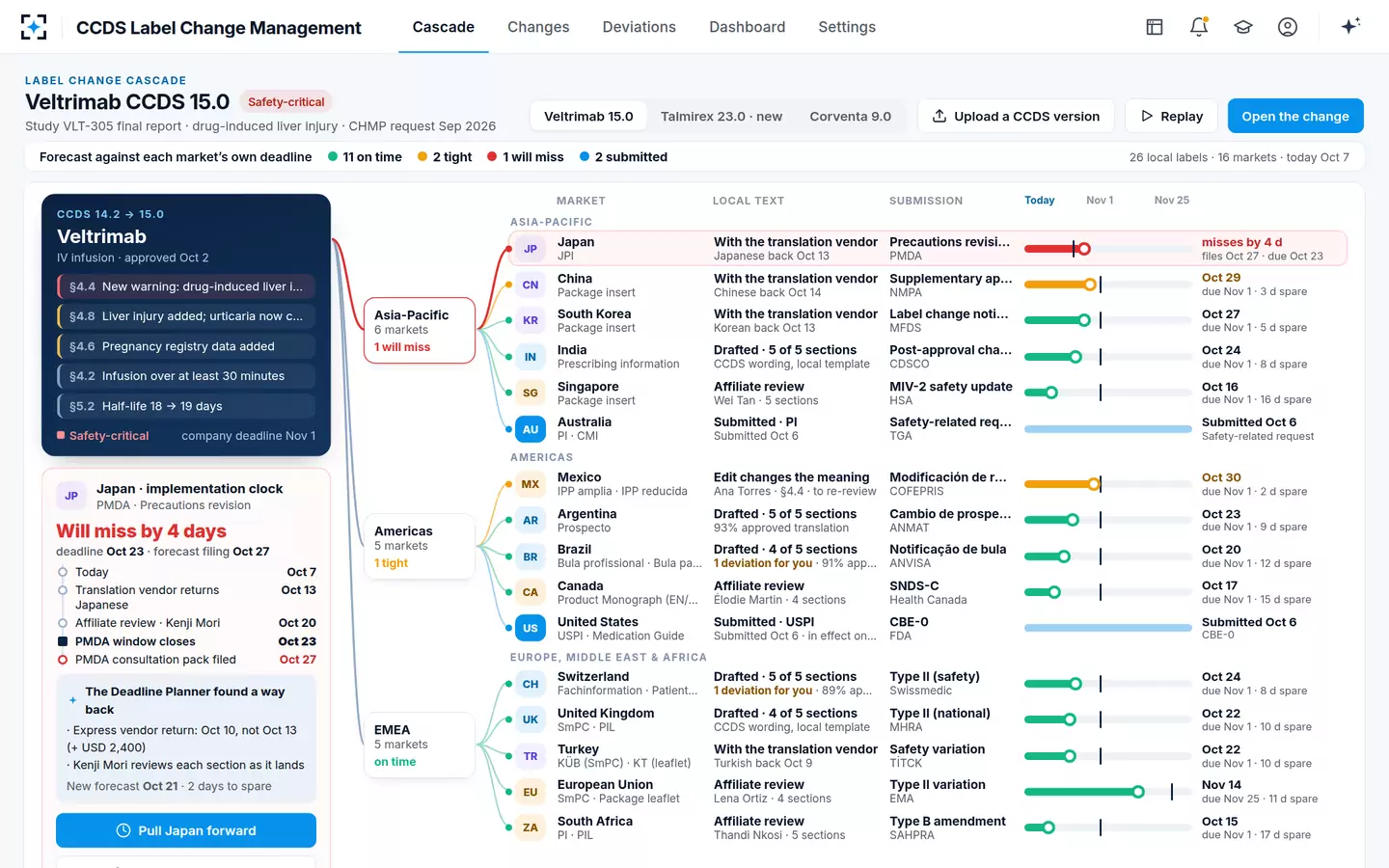
What a well-built core sheet does for the people who implement it
The difference between a good core data sheet and a merely correct one shows up in the first forty-eight hours after approval. A core sheet with stable section numbers, one statement per sentence, an explicit monitoring instruction and a citation beside each claim can be compared mechanically against its predecessor, classified, and mapped onto national sections. A core sheet written as flowing narrative, renumbered at each revision, with the evidence held in a separate file, has to be read by a person in every market — and sixteen people will reach sixteen slightly different readings of what changed.
What one approved change sets in motion in CCDS Label Change Management
Agent
CCDS ComparerAligns the previous and the new core data sheet by section number and heading and lists every real change with its old and new text and the page in both versions.
Never: Never merges two changes into one; layout-only edits are reported separately, never as changes.
Agent
Safety Change ClassifierMarks each change safety-critical, safety or editorial, with the reason and the study report, agency request or committee minutes it rests on.
Never: When unsure between two classes it takes the stricter one.
A person decides
Global medical leadConfirms every safety-critical classification before any clock starts, and signs off new warning wording.
Agent
Label Impact MapperReads the registration data and the core-to-local section map to find each market’s documents and sections, comparing meaning rather than words: update, already aligned, not in this label, or deviation.
Never: Never marks a passage aligned without a cited local sentence.
Agent
Local Text DrafterDrafts each market’s wording sentence by sentence in its own language and template, from approved translations first, and shows where every sentence came from.
Never: Never overwrites a registered deviation.
A person decides
Global labelling leadDecides every deviation, approves each local draft and e-signs it, with the meaning of the signature stored beside the decision.
Agent
Deadline PlannerOpens a task per market with its procedure, submission date and affiliate owner, and forecasts each filing against that market’s own deadline rather than the company one.
Never: Spends nothing and notifies nobody without the lead’s click.
A person decides
Affiliate regulatory managerReviews and approves the local text, then files it in their own market under that market’s procedure.
Two of those limits are worth borrowing even by a company with no software at all. "Never merges two changes into one" keeps a safety addition from being filed under an editorial tidy-up. "Never marks a passage aligned without a cited local sentence" is the rule that stops a mapping exercise from quietly becoming a guess: the claim that Spain already says this is only worth having with the Spanish sentence attached.
How often it changes, and what a single change starts
There is no published figure for how often a company core data sheet is revised, and anyone who offers one is generalising from their own portfolio. What can be said is what drives it: a new study report, a signal evaluation that concludes, an authority's request, a periodic report that changes the company's own view of a risk. A product with new studies reporting or a signal under evaluation tends to change more often than a mature one, which may go a long time between revisions and then change twice in quick succession.
The arithmetic that matters more is the one at the other end. Thirty products in fifteen markets, each document updated four times a year, is about 1,800 local label revisions annually — arithmetic on those three assumptions, not a published benchmark, and worth redoing with your own three numbers. It is the figure that explains why the effort lands on implementation rather than on authorship: the core sheet is revised once, and the revision is implemented dozens of times.
Every changed section redlined, with the markets it lands in
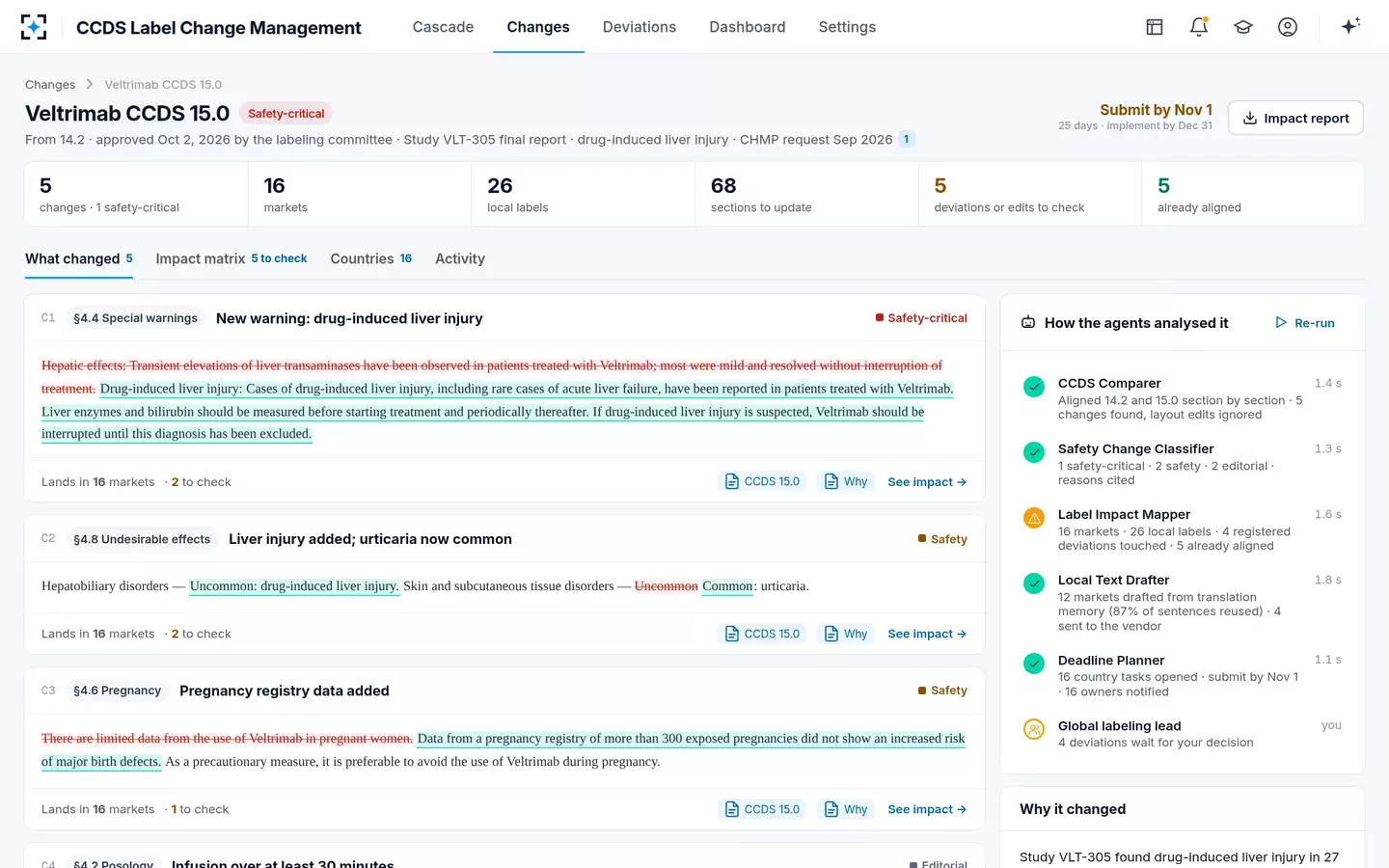
On that sample revision, five changes to one core data sheet produced 68 sections to update across 26 documents in 16 markets, with five differences to check against the register and five passages already aligned. One of the sixteen markets would have missed its own filing window, and the company clock would not have shown it: the clocks a company sets itself — submit a safety-critical change within 30 days of committee approval, implement within 90 — are its own policy, adjustable settings in the solution and in any procedure, and they say nothing about when a given market's door closes. The United States runs its own clocks in the opposite direction, and the markets that close earliest are usually the ones nobody has looked at.
Questions people ask
Is there an official company core data sheet template?
No. No regulator publishes one, because the core data sheet is an internal company document that no authority receives or approves. What exists instead are two definitions — CIOMS Working Groups III and V, and the glossary of ICH E2C(R2) — which fix the content families (safety, indications, dosing, pharmacology) and leave the layout to the company. The useful constraint is to structure the sections so that each maps onto a section of a national document somebody will have to change.
What is the difference between a CCDS and company core safety information?
The core safety information is the safety subset of the core data sheet, and it is the part with reporting consequences. ICH defines it as all the relevant safety information the holder requires to be listed in every market where it sells the medicine, except where a local authority specifically requires a modification, and adds that it is the reference information by which listed and unlisted are determined for periodic reporting. The rest of the core data sheet — indications, dosing, pharmacology — matters a great deal operationally, but it does not decide listedness.
What is development core safety information?
It is the pre-approval equivalent, introduced by CIOMS Working Group V in the second edition of the same report "as a discrete, focussed section of Investigator's Brochures, which would have the same format as, and would evolve into, the CCSI at initial marketing of the product". A company that builds its development core safety information in the shape its core safety information will take does not have to rebuild the document at launch.
Does the FDA or the EMA approve a company core data sheet?
Neither approves it. They approve the national documents the core sheet governs — the prescribing information in the United States, the summary of product characteristics and package leaflet in the European Union. The Agency's pharmacovigilance guidance treats the core sheet as a practical option for the reference information in a periodic safety update report, which means an assessor may read it; that is not approval, and it does not make the document's wording binding on any authority.
How often is a company core data sheet updated?
There is no published rate, and it varies by product more than by company. The triggers are what matter: a completed study report, a signal evaluation, an authority's request, or a periodic report that revises the company's view of a risk. For planning, the figure to track is not revisions per year but national revisions per year, which is the product of your core changes, your markets and your document count per market.
Who signs the company core data sheet?
Whoever the company's own procedures name — no source specifies it. The arrangement that holds up is a standing labelling committee with a global labelling lead who owns the document, a medical or safety lead who owns the safety statements, and regulatory representation for the major markets. What the signature should always be paired with is the implementation plan: approving wording without knowing which markets can carry it, and by when, is approving an instruction nobody has costed.