Structured product labeling software is publishing software. It takes an approved United States prescribing information and turns it into the marked-up file the agency processes, with the formatting rules the regulation demands — the Recent Major Changes entry that has to stay in Highlights for a year, the vertical line down the left edge of modified text, the sections in the order the rule names. Good SPL tools do that job properly, and a company that files in the United States needs one. What they do not do is decide what the text should say, find the other twenty-five documents the same change touches, or tell you which market's window closes first. That is a different job, and Botminds' CCDS Label Change Management is built for it: comparing two versions of a core data sheet, mapping the change into every market's documents and sections, drafting the local wording and forecasting each filing against that market's own deadline.
This page is a buying guide, so it should be said plainly at the top: these are not competing products. A labelling operation that files in the United States and in other markets usually needs both, and the interesting question is not which to buy but which problem is actually hurting. The sample screens come from a fictional company in the solution's own data — Northwind Bio, the products Veltrimab and Talmirex, and the people named on them are invented.
What is structured product labeling, and what is it for?
It is a markup standard, and the agency says so in one sentence.
The Structured Product Labeling (SPL) is a document markup standard approved by Health Level Seven (HL7) and adopted by FDA as a mechanism for exchanging product and facility information.
FDA, Structured Product Labeling Resources
Three words in that sentence set the scope. It is a markup standard, so it describes how content is tagged, not what the content should be. It is for exchanging information, so its purpose is transport between a company and an agency. And it was approved by a health informatics standards body and adopted by one regulator, so its reach is the submissions that regulator processes. Everything an SPL tool does well follows from those three facts, and so does everything it does not do at all.
The confusion is understandable, because the file is the label in the United States in a way it is not elsewhere. The content of labeling that goes to the agency, the text that appears in the public listing, and the text in the package are versions of one artifact. It is natural for an American labelling operation to think of the label as the file. A global one cannot, because in most of its markets the label is a document in another language, notified or authorised under another procedure.
What SPL software is genuinely good at
A publishing tool earns its place on precision in a narrow space. It holds the valid section and subsection structure so that nothing is in the wrong place or missing. It manages the identifiers and coded elements that let the agency's systems process the submission. It validates the file before it goes, so a formatting fault is found at the desk rather than in a refusal. It keeps versions of the file as submitted, which is what an inspector asks to see. And it does the small, tedious, high-consequence formatting that the regulation makes mandatory and a human being does badly at four in the afternoon.
None of that is trivial, and a team that does it in a word processor and a validator will eventually get something wrong on a day that matters. The point of this guide is not that the work is small. It is that the work begins at the moment the text is already decided and approved — and the expensive part of a global safety change happens before that moment, in every market at once.
Is SPL required, and what has to be in it?
For United States applications the electronic form is in the regulation. The annual reporting rule requires that the content of labeling, "including all text, tables, and figures, must be submitted in electronic format", and separately requires "a summary of any changes in labeling that have been made since the last report listed by date in the order in which they were implemented, or if no changes, a statement of that fact".
Read those two requirements together and something useful appears. The first is a publishing requirement: produce the file. The second is a change-history requirement: say what changed, when, and in what order it was implemented. A publishing tool answers the first perfectly. The second is a question about events across a year, and a company whose only labelling system is a publisher usually answers it by asking someone to go through their e-mail.
The formatting rules a publishing tool has to get right
Two rules in the content and format regulation show exactly what kind of precision this is, and why it belongs in software rather than in a style guide. The first governs Recent Major Changes in Highlights: a changed section has to be listed under that heading for at least a year after the date of the labelling change, and then removed at the first printing after the year is up. That is a rule with a timer in it. Something has to remember, eleven months later, to take an entry out at the right printing.
The second is typographic and absolute: a section identified as carrying a recent major change has to be marked in the full prescribing information with a vertical line down the left edge of the new or modified text. A line in the margin, in the right place, on exactly the text that changed and no more. These are the rules an SPL tool exists to keep, and keeping them is a genuine service.
They also show the ceiling. Both rules are about presenting a change that has already been decided, in one document, in one jurisdiction. Neither has anything to say about whether the Brazilian leaflet needs the same sentence, or whether the Japanese affiliate can file in time.
Where SPL stops: one country, one format, one language
Take one safety change through three regions and the asymmetry is obvious. The United States wants a document, published as a marked-up file. Europe wants, among other things, a data notification about the authorisation itself, within a fixed period. Japan wants an electronic package insert revised after a consultation that ends in a notification instructing it. These are three different deliverables produced by three different processes on three different clocks, and only the first is what an SPL publisher makes.
What one safety change owes in three regions, after the wording is agreed
| Region | What is produced | What governs the format or the period | Does an SPL publisher make this? |
|---|---|---|---|
| United States | Content of labeling as a marked-up file, with Highlights, Recent Major Changes and the changed-text rule applied | 21 CFR 201.57 for content and format; 21 CFR 314.81 for electronic submission and the annual summary of changes | Yes. This is exactly what it is for. |
| European Union | A variation or notification, the product information in every EU language, and a data notification to the Agency on the amended authorisation | The variations Regulation and the Agency's procedural advice; Article 57 data submission "no later than 30 calendar days from the date on which the amendments have been authorised" | No. Different artifact, different standard, different submission. |
| Japan | A revised electronic package insert, notified under a consultation reference number after the Ministry instructs the revision | The Ministry's standard workflow for revision of electronic package inserts | No. The text is Japanese and the act is a notification, not a publication. |
Language is the sharpest limit of all, and Europe states the consequence rather than hiding it. For type IA variations, the Agency's linguistic review process performs no review of the product information in the other EU languages and makes the holder responsible for the correctness of its own translations. The holder owns every language version, with no authority checking them. No publishing tool for one language has anything to offer that problem; what helps is approved translation memory, a source on every sentence, and a person who decides.
What Europe asks for instead, and why it is not the same job
The European data requirement deserves its own paragraph, because it is the one most often mistaken for a European SPL. The Agency's Article 57 page is explicit about timing: information on amendments to the terms of marketing authorisations following variation, transfer, renewal, suspension, revocation or withdrawal "shall be notified to the EMA no later than 30 calendar days from the date on which the amendments have been authorised".
That is a structured data submission about the authorisation, not a rendering of the leaflet, and its thirty days run from authorisation rather than from implementation. A European labelling operation therefore carries at least three dated obligations from one change — the variation itself, the language versions, and this notification — none of which an American publishing tool knows about. When new European wording actually goes live follows the first two in detail.
The handover that breaks: approved wording to published file
Draw the whole path and the gap sits in the middle. Evidence arrives, a committee decides the core wording, every market works out what its own text should say, each market files under its own procedure, and at the end each market produces its own artifact. Publishing software covers the last step in one market. Everything to its left is where a global change loses weeks.
An SPL publisher and CCDS Label Change Management: two tools, two problems
An SPL publishing tool: An approved United States prescribing information, already decided and signed off.
CCDS Label Change Management: Two versions of a company core data sheet, the local labels, approved translations, registration data and the deviation register.
An SPL publishing tool: A valid marked-up file for submission, with the required formatting applied.
CCDS Label Change Management: The markets and sections the change lands in, draft local wording with a source on every sentence, a task per market and a forecast per deadline.
An SPL publishing tool: One.
CCDS Label Change Management: Every market the product is registered in — 16 markets and 26 local documents in the sample data.
An SPL publishing tool: The agency, at the end of the process.
CCDS Label Change Management: The affiliate managers, at the beginning of it.
An SPL publishing tool: After the text is approved.
CCDS Label Change Management: The morning the core data sheet is approved.
An SPL publishing tool: Decide the wording, or tell you which other markets are affected.
CCDS Label Change Management: Produce a submission file, or file anything with any agency. People approve every local text and submit it.
The handover itself is worth designing deliberately. The publisher needs final, approved American text with the changed sections identified. The change system is what establishes which sections changed, why, and against which evidence — which is the same information the Recent Major Changes entry and the annual summary of labelling changes need. A team that treats the two tools as one pipeline, with the change system feeding the publisher, gets both the file and the history. A team that treats the publisher as the system of record ends up reconstructing the history by hand once a year.
The work that happens before a file is published: one market's text, sentence by sentence
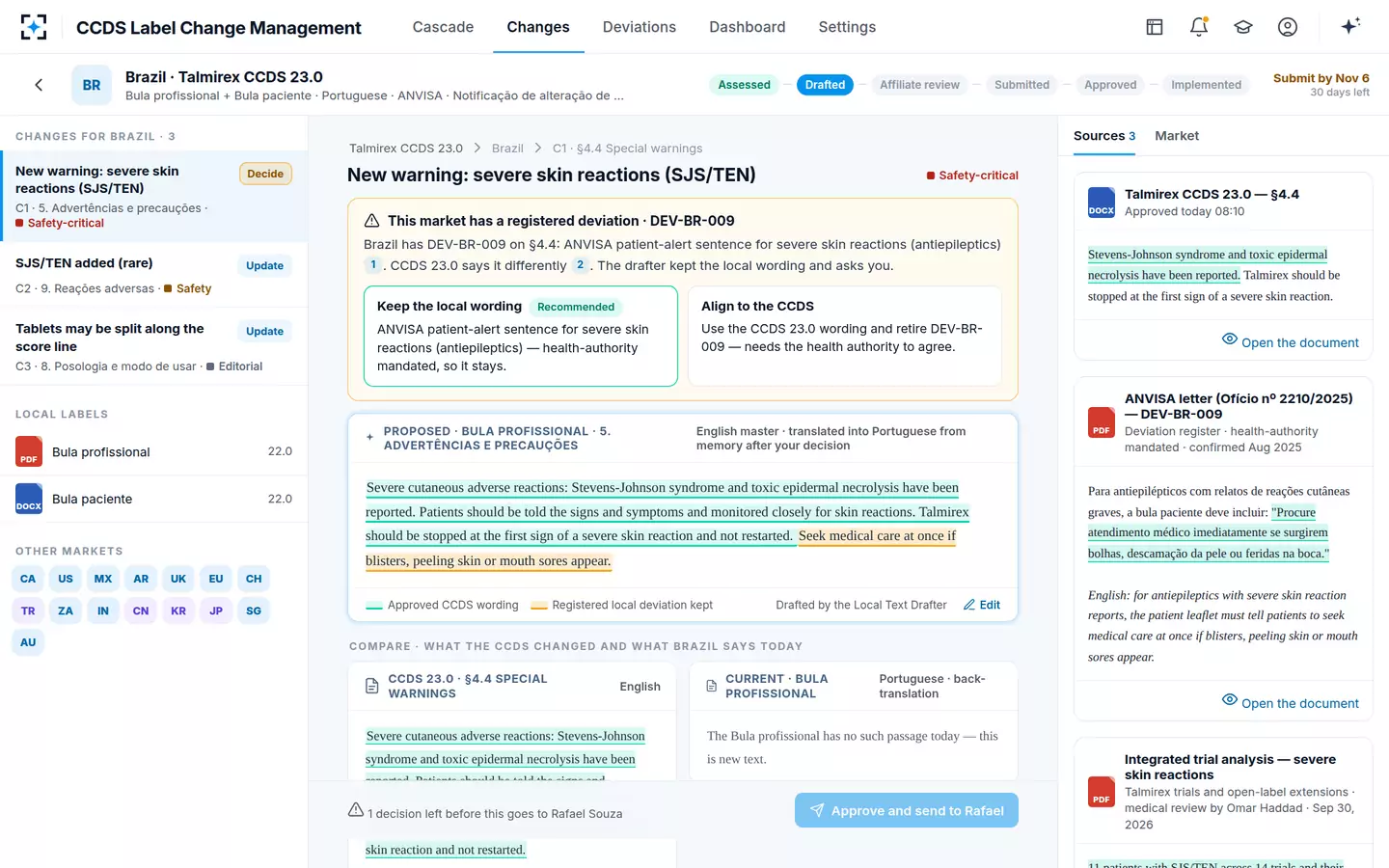
That screen is the thing an SPL publisher is not for. Nothing on it is a formatting decision. It is a wording decision, taken by a named person, with a national authority's letter on one side and the new core sentence on the other, and it has to be taken in sixteen markets at once before any file anywhere can be produced. Where a local label may legitimately differ is the rule that makes the decision necessary.
What CCDS Label Change Management produced on one sample change
26labels
in 16 markets found from one core data sheet change, with the sections each one needs
12markets
drafted from approved translation memory; four languages sent to the translation vendor
87%
of drafted sentences reused from approved translations, each showing the document it came from
Authoring or publishing? The questions that separate them
The vocabulary in this market is loose. Label content management, labelling automation, regulatory information management and labelling software are used for tools that do very different things, and a demonstration will usually look impressive because each of these tools does something real. The way through is to ask questions whose answers cannot be the same for both kinds of tool.
Ten questions, and which kind of vendor each one separates
- Show me the file you produce, and the validation report that proves it is well formed.
Ask the publishing vendor. A change system should not pretend to answer this.
- How do you know a changed section still carries its Recent Major Changes entry eleven months later?
Ask the publishing vendor; this is their timer to keep.
- Here are two versions of a core data sheet. Show me every change between them, classified, with the evidence behind each.
Ask the change vendor. A publisher starts after this question has been answered.
- Which of my markets, documents and sections does this change touch, and which already say it?
Ask the change vendor. Watch for an answer that is a list of markets rather than a list of sections.
- Show me a drafted sentence in a language you do not speak, and tell me where it came from.
Ask the change vendor. If a sentence cannot name its source document, nothing else about the tool matters.
- Which market will miss its own deadline on this change, and by how many days?
Ask the change vendor. A single company deadline is not an answer.
- What happens to a national authority's mandated wording when the global text changes?
Ask both. The publisher should not silently overwrite it; the change system should refuse to.
- Produce the annual summary of labelling changes, by date, in the order they were implemented.
Ask both, and see which one has the history rather than the files.
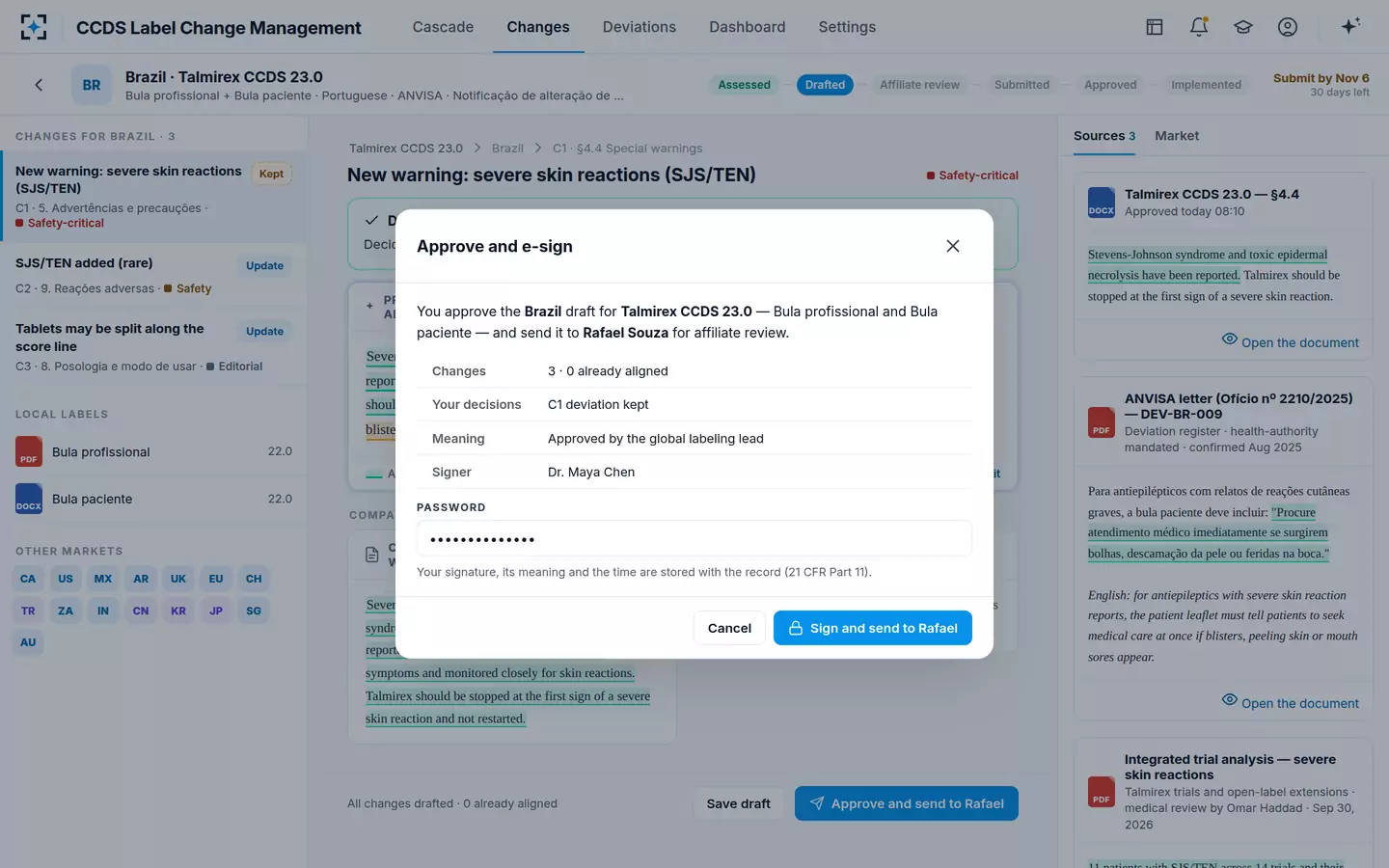
- Who approved this text, what did their signature mean, and when?
Ask both. Any serious tool in this space should answer in one click.
- What will you not do?
Ask both, and distrust the one that says nothing.
The approval the whole thing turns on, before any file exists
Testing a tool on a real safety change
Demonstrations are built from clean inputs. The useful test is to bring one of your own past safety changes — ideally one that went out late — and ask each vendor to run it from its own starting point. For a publishing tool, that starting point is your approved American text, and the test is whether the file is valid, correctly formatted and reproducible. For a change system, it is the two core data sheet versions and your own local labels, and the test is whether it finds the same markets and sections your team found by hand, in the same places, with the deviations intact.
Then ask the question neither vendor will have prepared for: what did this change cost us last time, and where did the days go? If you know, you have a baseline, and you can measure both tools against it. If you do not, that is itself the finding, and it argues for the change system first — because the publisher's work is rarely the part that took the weeks.
One honest caveat about publicly available evidence. The agency's own database of drug safety-related labelling changes is the obvious place to look for comparative figures, and it is useful, but it starts partway through the record: the agency notes that updates are available since January 2016. Any benchmark drawn from it is a benchmark about one country from that date forward, which is a narrower claim than most vendors make of it.
Questions people ask
What does structured product labeling software actually do?
It turns approved United States labelling content into a valid marked-up file for submission, applies the content and format rules that the regulation makes mandatory, validates the result and keeps the submitted versions. It is a publishing and submission tool for one regulator, and it starts work after the wording has been decided and approved.
Is SPL required by FDA?
For United States applications, electronic submission of labelling content is in the regulation: the annual reporting rule requires the content of labeling, including all text, tables and figures, to be submitted in electronic format, alongside a summary of the labelling changes made since the last report. Whether a company uses dedicated software or another route to produce that file is its own choice; the electronic form is not.
What is the difference between SPL software and a label content management system?
SPL software is about the output format for one regulator. A label content management system is about holding the text itself, usually with version history and an approval path. Neither is a change system: a change system is the thing that compares two versions of a global core document, finds every market and section the difference lands in, drafts each local text and tracks each filing against that market's own deadline.
Does SPL software handle other countries?
Not as SPL. Europe asks for a variation, product information in every EU language, and a separate structured data notification on the amended authorisation; Japan asks for an electronic package insert revised after a consultation. Some suites bundle modules for other regions, but they are different artifacts under different rules, so ask to see each one produced rather than listed on a slide.
How do you keep SPL files and the global label in step?
By making the change system the origin and the publisher the destination. The change system establishes which sections changed, against which evidence, and when each market implemented; the publisher renders the American version of that. Run in the other direction — reconstructing the global position from a year of submitted files — and the annual summary of labelling changes becomes an archaeology exercise.
If we can only buy one this year, which should it be?
If you file in the United States and your files are produced reliably today, the publisher is not your problem. If a safety change takes days of spreadsheet work to scope, if a market has missed its own deadline in the last year, or if nobody can say which sentence of a local label came from where, those are symptoms the publishing tool cannot touch. Buy against the symptom you can name, and test it on a change that actually went wrong.