An artwork management system for pharmaceuticals owns everything that happens after the words are settled: the artwork request, the design, the proof, the affiliate approval, the print run and the release of the printed component. It cannot start a day earlier than the moment the text is final in that market's own language, and that single fact explains most of what buyers find confusing about this category. Artwork is rarely late because of the artwork system. It is late because the text arrived in English, or arrived before the translations had been checked, or arrived without the date of revision that has to print on the leaflet, or arrived without anybody saying which of twenty-six documents in sixteen markets actually changed. Botminds' CCDS Label Change Management works on the other side of that line — it stops at an approved local text, sentence by sentence, in each market's own language and template — and this guide is about the handover between the two, because that is what a buyer is really choosing between.
Said plainly, so nobody buys the wrong thing: the solution does not raise an artwork request, hold a proof, approve a mock-up or release a print job, and it is not an artwork management system. The product figures below come from its sample data, in which a fictional company carries invented medicines through sixteen markets; the regulatory requirements quoted are real and linked where they appear.
What is an artwork management system, and where does its work start?
An artwork management system is the system of record for printed and labelled components: cartons, labels, package leaflets, and the files that produce them. It holds the artwork request and the brief behind it, versions of every component, the proofing and annotation trail, the approvals of each reviewer, the link from each component to the markets and presentations it belongs to, and the release of an approved file to a printer.
Its work starts at a handover and ends at a release. Upstream of the handover sit regulatory affairs and labelling, who decide what the component must say. Downstream of the release sit supply and the printers, who decide when it can be made. The artwork system's own contribution is control of the middle: that the file that goes to press is the file that was approved, by the people who were supposed to approve it, carrying the text that was authorised.
That is a genuinely hard job and worth buying software for. It is also a narrow one, and the narrowness is the point: an artwork system has no view of why the text changed, which other markets are changing the same sentence, or when each market's own deadline falls.
From approved local wording to a released component — and where CCDS Label Change Management stops
Agent
Local Text DrafterDrafts each market’s wording sentence by sentence in its own language and template, from approved translations first, marking the source of every sentence.
Never: Never overwrites a difference the register says an authority required.
A person decides
Global labelling leadDecides every registered difference, then approves and signs the local text. This signature is the handover: before it, nothing downstream should start.
A person decides
Affiliate regulatory managerReviews the local text in their own language, approves it and files it under that market’s procedure.
A person decides
Labelling operations · the artwork requestRaises the request against the right components for that market and presentation, with the final text, the language, the date of revision and the effective date. The artwork system’s work begins here.
A person decides
Design and pre-pressLays the text into each component, resolves what no longer fits, and produces a proof.
A person decides
Proofreading and affiliate approvalChecks the proof against the authorised text character by character, and the affiliate approves its own market’s component.
A person decides
Printer and supplyPrints the component and releases it into packaging, with the changeover planned against existing stock.
Why pharmaceutical artwork runs late when the text was approved on time
When a component misses its date after the text was approved on time, the cause is often not design at all but what arrived with the request. Four upstream failures are worth ruling out first.
The text arrived in the wrong language. A request carrying English master wording for a market whose component must be in its own language is not a request; it is a promise of one. In the European Union the labelling particulars "shall appear in an official language or official languages of the Member State where the medicinal product is placed on the market" (Directive 2001/83/EC, Article 63(1)). The artwork chain cannot begin on text that does not yet exist in the language it will print in.
The text arrived before it was final. Starting on a draft feels like saving time and reliably costs it, because every change after the proof means re-proofing, re-approval and sometimes re-plating. The European Medicines Agency's own advice is that a holder "waits for the finalisation of the linguistic review process by the Agency before implementing the variation, as appropriately checked translations are considered essential for a correct implementation of the variation" (EMA, post-authorisation procedural advice).
The text arrived without its dates. A leaflet prints a date of revision, and the component has an effective date relative to stock and changeover. Neither is a design decision, and neither can be invented downstream.
Nobody said what changed. A request that says the leaflet has been updated, without naming which sections moved, turns the proofing step into a full re-read of the whole component — the slowest and least reliable way to check a document.
None of those is fixed by a better artwork system. They are fixed by a handover specification that the upstream side is accountable for, and by a labelling process that produces local text rather than global text.
What the artwork request needs on the day the wording is final
The table below is the handover, item by item. It is worth writing into the procedure on both sides, because every missing line becomes a question, and every question costs a day in a chain that runs on batch handoffs.
Nine things the artwork chain needs on day one
| What the request has to carry | Who produces it | What goes wrong when it is missing |
|---|---|---|
| The final text, in that market’s own language and template | Labelling, after local approval | The chain either stalls or starts on English and is redone. |
| Which sections changed, and the previous text beside them | Labelling | Proofreading becomes a full re-read of the component rather than a check of the delta, which is slower and misses more. |
| The components affected, by market and presentation | Regulatory and supply together | The wrong carton is updated, or one of three strengths is quietly left on the old text. |
| The date of revision to print | Regulatory | The leaflet prints a wrong date or none, and a correct leaflet becomes a defect for a reason that has nothing to do with its content. |
| The effective date, and what happens to existing stock | Regulatory and supply | Either stock is scrapped that need not have been, or product ships with superseded text after the date it should have changed. |
| Whether the change is safety-driven, and how urgent | Labelling, from the classification | A safety change queues behind a brand refresh. The artwork chain cannot prioritise what it cannot see. |
| Whether user consultation is needed, and its result | Regulatory | The leaflet is designed, proofed and approved before anyone asks whether the change needed testing — then redone. |
| The authorised reference the proof will be checked against | Regulatory | The proof is checked against the request instead of the authorised text, so a transcription error passes twice. |
| One named owner on each side | Both | Every question becomes a thread. The handover is the moment accountability is most likely to be dropped. |
Translations first: why the language versions set the print date
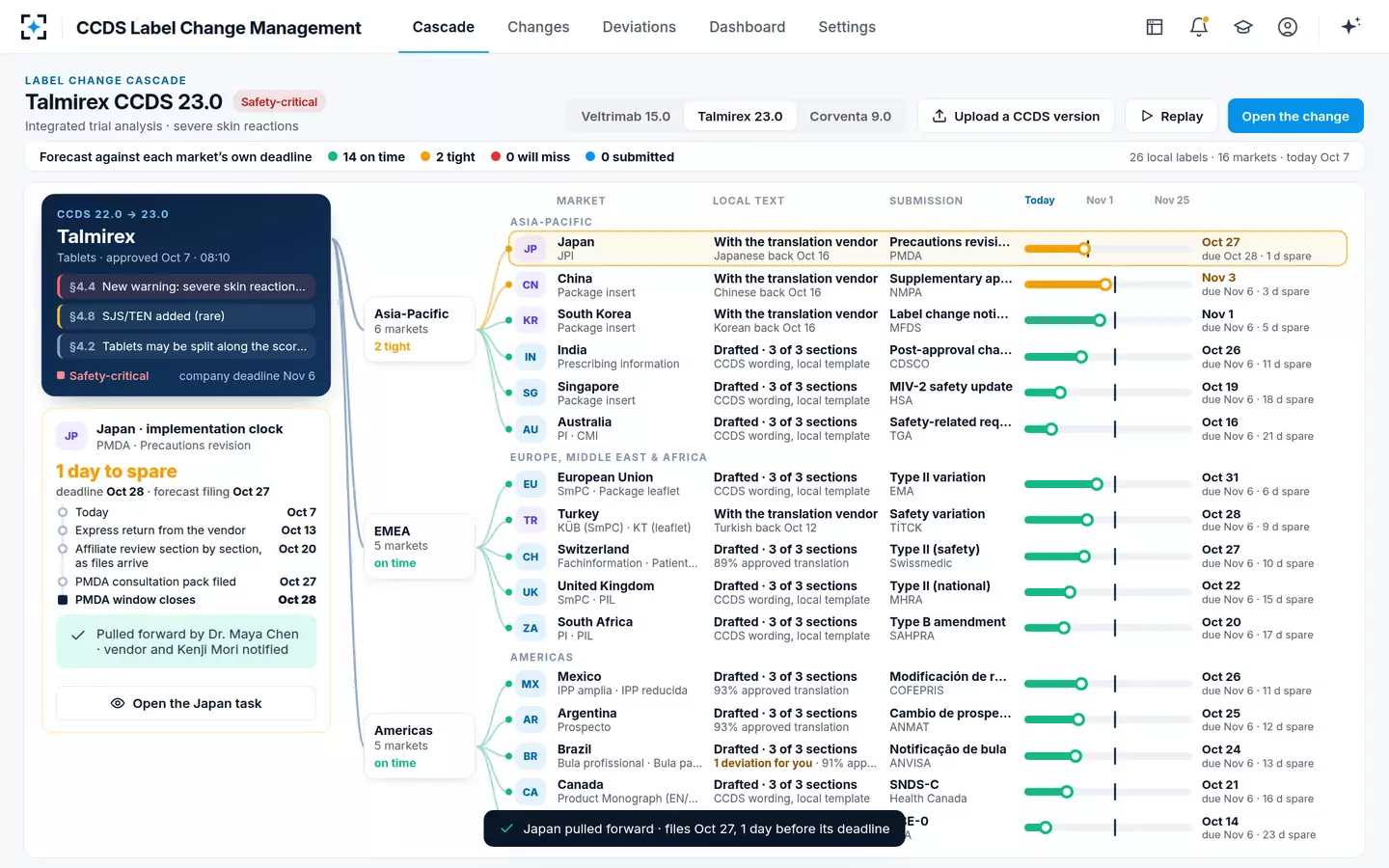
For any market that does not work in the master language, the critical path runs through translation, and the artwork chain inherits whatever that step produces. This is where a labelling function's standing assets pay for themselves: approved sentence pairs from previously authorised labels let most of a change be drafted the same day, and only the remainder goes to a vendor.
On the sample change, twelve of sixteen markets were drafted from approved translations and four went to the translation vendor, with 87% of drafted sentences reused from previously approved wording. The four vendor markets were the ones whose dates then decided everything downstream — and the one market at risk was at risk because of a vendor return date, not because of anything the artwork chain would do later.
The four markets waiting on a vendor, and the date that moved
Europe adds a procedural layer worth knowing before a plan is built on it. The Agency's linguistic review applies to the centralised procedure's product information, but not uniformly: "for Type IA variations, no linguistic review of the PI in all other EU languages will be performed and the MAH will be responsible for ensuring the correctness of the translations" (EMA, the linguistic review process of product information in the centralised procedure). So for some variation types the quality check that the schedule assumes is simply not there, and the holder owns it.
The deadline that is about the printed document, not the filing
Most regulatory deadlines are about a submission. A few are about the document people actually read, and those are the ones that make the artwork chain a compliance matter rather than a logistics one.
Brazil is the clearest case. For a medicine without a reference insert of its own, Resolução-RDC 47/2009 says that when safety information is added, the package inserts are notified, submitted electronically, "e ser disponibilizadas em até 180 (cento e oitenta) dias após a notificação, independentemente de manifestação prévia da Anvisa" — made available within 180 days of the notification, regardless of any prior response from the authority (RDC 47/2009, Art. 17, §1º). Made available, not filed. The clock covers the chain this guide is about, and the next paragraph of the same article runs a second clock for altered or removed safety information, where the 180 days run from the approval of the petition rather than from the notification.
Europe runs a different kind of date dependency. In the centralised procedure, the date of revision printed on the product information is not the day anybody finished working on it: for the Type II variations listed in Article 23(1a)(a), the Agency's advice is that "this should be the date of the Commission Decision amending the marketing authorisation" (EMA, post-authorisation procedural advice). Which means the artwork request cannot carry a final date of revision until the decision exists, and a chain that prints before it has printed a defect. When new wording actually goes live in the European Union is worth settling before a print date is promised to anybody.
Mock-ups, user testing and a leaflet that changed too much
Occasionally the change is large enough that the leaflet itself has to be tested on readers before it can be used, and discovering this after the proof is approved is an expensive way to find out. The European guideline on readability is explicit that for existing authorisations, "the need for user consultation covers in principle situations where significant changes are made to the package leaflet, either through a variation or a procedure according to Article 61(3) of Directive 2001/83/EC" (European Commission, readability guideline). It also names cases where testing is always required, including "medicinal products with particular critical safety issues".
Those two sentences together describe exactly the kind of change a core data sheet most often generates: a significant addition to the leaflet, on a critical safety issue. So the question "does this one need user consultation?" belongs in the handover, answered by regulatory, at the moment the local text is approved. It is the cheapest line in the request and the most expensive one to omit, because the answer arriving late invalidates work that has already been approved.
What has to show on the printed page: the date, the line, the language
The printed component carries obligations that exist nowhere in the text itself, and each of them is an input the artwork chain needs rather than a decision it can make.
The language. The particulars must appear in an official language of the member state where the medicine is placed on the market, as that state specifies. One European change can therefore become two dozen language versions, each on its own component.
The date of revision. Printed on the product information, and in the European centralised procedure tied for some variation types to the date of the Commission decision rather than to any internal milestone.
The change marking. In the United States, sections identified as containing recent major changes "must be highlighted in the full prescribing information by the inclusion of a vertical line on the left edge of the new or modified text" (21 CFR 201.57(d)(9)). That is a typographic instruction with a regulatory source — and a removal task a year later, when the marking comes off. An artwork chain that is told which sections changed can apply it mechanically; one that is told the document has been updated cannot.
Artwork system or labelling change system? What each one owns
Buyers often arrive at this category after a safety change reached the market late, and the question they ask is which system would have prevented it. The honest answer is that they solve different problems and a company with the volume to need one usually needs both.
An artwork management system against a labelling change system, and the handover between them
Artwork management system: Requests, component versions, proofs, approvals and release of printed and labelled components.
Labelling change system: What each market’s document must say after a core data sheet change, and when each market has to say it.
Artwork management system: At the artwork request — which is to say, once the text is final in that market’s language.
Labelling change system: At the moment a core data sheet change is approved, before any market has a date.
Artwork management system: Right-first-time proofs, cycle time from request to release, and components released without defect.
Labelling change system: Markets on time against their own deadlines, differences accounted for, and no market discovered late.
Artwork management system: Why the text changed, which other markets carry the same sentence, and which market’s window closes first.
Labelling change system: Whether the text will fit the carton, what the proof said, and when the printer can run it.
Artwork management system: Shows where in the chain the component sat, and who held it.
Labelling change system: Shows which market was forecast to miss, how early that was known, and what was offered to recover it.
Artwork management system: Receives: final local text, changed sections, components, dates, urgency, testing status, the authorised reference, a named owner.
Labelling change system: Produces exactly that, at the moment the local text is approved and signed.
One market, from a settled core change to a printed leaflet
- Local text signeddays 1–10
- Affiliate review and filingreview, file
- Artwork request, design, proof, approvalthe artwork chain
- Print and release into packagingprint and changeover
- Local text signeddays 1–10
- Vendor return+9 days
- Affiliate review and filingreview, file
- Artwork request, design, proof, approvalthe artwork chain
- Print and release into packagingprint and changeover
Eight questions for a vendor, and the one handover to test
A demonstration will show a clean request moving through a clean chain. The questions below are the ones that reveal how a system behaves when the handover is imperfect, which is how it will usually arrive.
Eight questions for an artwork vendor, each with the answer that proves it
- What does the system refuse to start without?
Proof: a request raised with no language version, no date of revision and no changed-section list — and what the system does about it. A system that cheerfully accepts an empty request will not protect the chain.
- How does a changed section reach the proofreader?
Proof: show the delta view. If proofreading is a full re-read every time, cycle time scales with document length rather than with the size of the change.
- How is a component linked to markets and presentations?
Proof: change one sentence and list every component affected, across strengths and pack sizes. Ask what happens to the three that are not in the request.
- What happens when the text changes after the proof is approved?
Proof: do it live. The answer is a re-version and a re-approval; what matters is whether the earlier approvals are clearly voided rather than quietly carried forward.
- How does an urgent safety change overtake a marketing refresh?
Proof: show two live requests and reprioritise one. A chain with no concept of urgency will run a safety change at brand-refresh speed.
- What does the audit trail show for a released file?
Proof: open a released component and trace it back to the authorised text and every approver. If the trail stops at the request, the regulatory question cannot be answered from this system.
- What integrations exist with the system that produces the text?
Proof: a request created from an approved local text rather than re-keyed. Re-keying is where transcription errors enter a chain that has no other defence against them.
- Who is accountable for the handover itself?
Proof: name them, on both sides, in the contract or the procedure. This is a question procurements often skip, and the one that decides whether the two systems help each other.
The one thing worth testing end to end is the handover itself: take a real approved local text from a recent change, in a market that is not English, and see how much of it can be turned into a complete artwork request without a human re-keying anything or asking a question. Whatever cannot be is the work the chain will keep paying for.
What the artwork request should be built from — approved local text, sentence by sentence
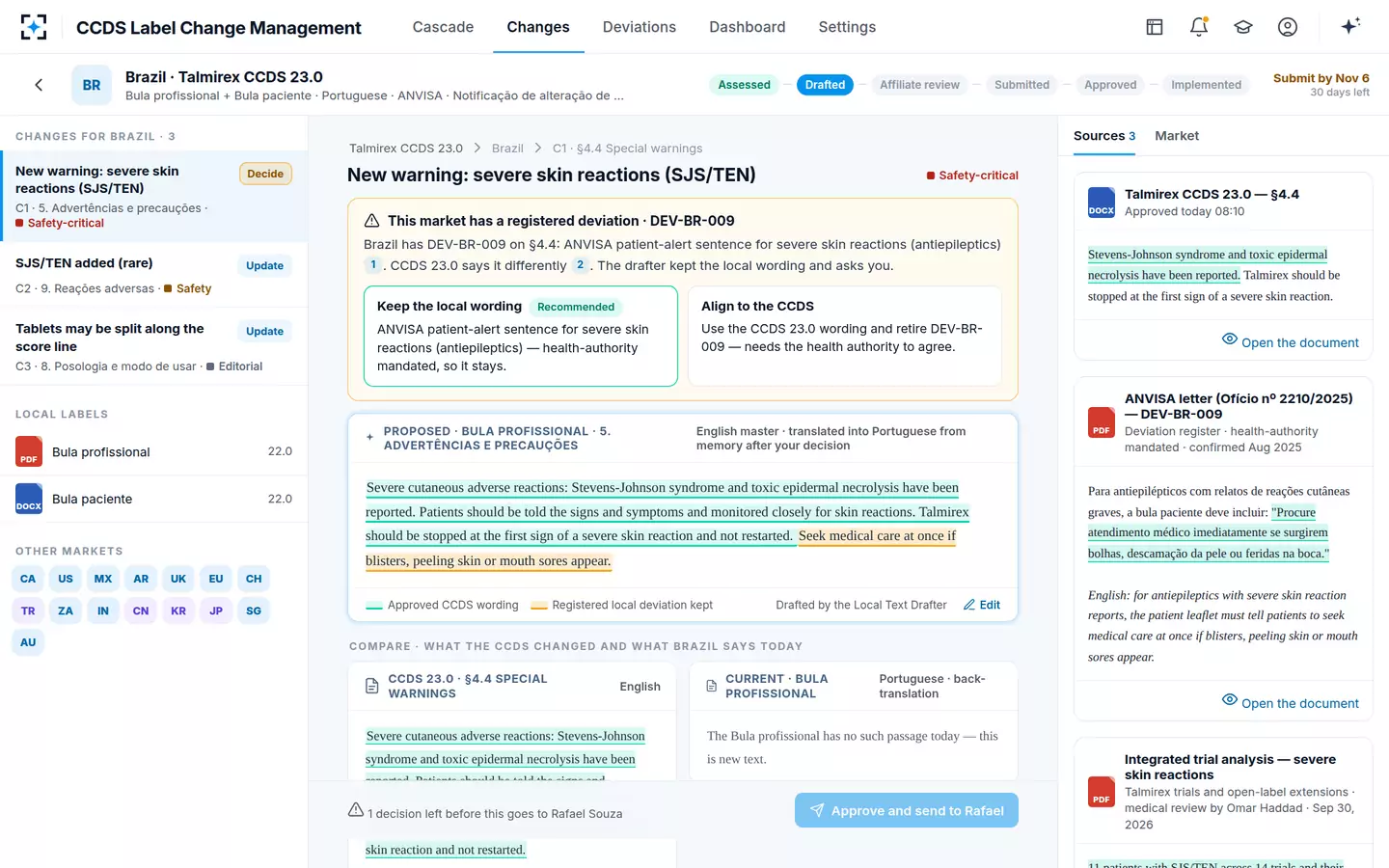
And a last word on sequencing. An artwork request raised before the local text is decided is the most expensive habit in this chain, because the register of differences can still move the wording — a passage an authority required will not be overwritten, and when a local label may legitimately differ is a question settled before the handover, not after the proof.
Questions people ask
What does artwork management software do in pharma?
It controls printed and labelled components from the artwork request to the release of the file that goes to press: versions of every component, the proofing and annotation trail, each reviewer's approval, the link from a component to the markets and presentations it belongs to, and the audit trail behind a released file. What it does not do is decide what the component must say, or know why the text changed.
How long does it take to get new label text onto a carton?
There is no published figure, and the honest answer for any company is the one its own chain produces. What the shape of the chain tells you is where to look: the step that moves the date is almost always upstream of design — translation, affiliate review, or a date of revision that cannot be fixed until a decision exists. Measure from the day the local text was approved, not from the day the request was raised, or the measurement will exonerate the part of the chain that caused the delay.
When does a label change have to reach the printed leaflet?
It depends on the market, and some deadlines are explicitly about the published document rather than the filing. Brazil requires package inserts with added safety information to be made available within 180 days of the notification, regardless of any prior response from the authority, with a separate clock where safety information is altered or removed. Europe ties the printed date of revision for certain variation types to the date of the Commission decision. Both are artwork-chain obligations wearing regulatory clothes.
Do you need a separate system for artwork and for labelling text?
Usually, above a certain volume, yes — they solve different problems and are measured on different things. What matters more than the number of systems is who owns the handover between them. A company with two excellent systems and no named owner for the handover will keep missing dates, and neither system's reporting will show why.
Who approves pharmaceutical packaging artwork?
Practice varies, and the arrangement that holds up names at least three: regulatory, confirming the component carries the authorised text; the affiliate, approving its own market's language version; and quality or packaging technical, confirming the component is manufacturable and correct. The approval most likely to be weak is the first one, because it requires checking the proof against the authorised text rather than against the request that was raised from it.
Why is pharmaceutical artwork always blamed for delays?
Because it is the last step before the component appears, so it inherits every delay upstream of it and shows up at the end. Measuring the chain from the day the local text was approved — and recording separately how long the text itself took to become final in each language — often moves much of the lost time to a step nobody was watching.