PMDA package inserts are revised through a published workflow, not through an approval. When a holder wants to change the Precautions of a Japanese electronic package insert, it applies for a consultation; the Agency reviews, asks questions the holder answers within about two weeks, may put the matter to an Expert Discussion and, when it does, summarises its survey results to the Minister within about a week of that discussion; the Ministry's Pharmaceutical Safety Division then issues a notification instructing a "Revision of Precautions" about two weeks after that. The holder revises the insert. Put a translation and an affiliate review in front of that sequence and Japan takes weeks that no global clock set at thirty days ever counted — which is why Botminds' CCDS Label Change Management forecasts each market's filing against that market's own date rather than against the company deadline.
The screens below show a fictional company in the solution's sample data — Northwind Bio, the products Veltrimab and Talmirex, and the people named on them are invented, and every date they show is that company's own planning date rather than a published deadline. The Japanese periods on this page come from the Ministry's own workflow and guideline, in the Agency's English translations, linked where they appear.
The periods the published Japanese workflow names
1day
to be told the consultation application has been received, as a general rule the next working day
2weeks
for the holder to answer the Agency's inquiries, in principle
10–40days
to the next Expert Discussion, typically held every five weeks
3weeks
from the end of that discussion to the notification instructing the revision
What is a Japanese package insert, and who decides what it says?
The package insert is the Japanese label: the legally notified product information whose contents the Act requires to be based on the latest literature and other evidence. The 2014 guideline on revising Precautions was sent to the prefectures for holders to use in their own operations, and its premise is that the holder owns the duty. It asks that safety management information be "collected appropriately and scientifically considered", that procedures exist to turn that consideration into safety-ensuring measures, and that the measures be decided by the marketing supervisor-general with the utmost respect for what the safety management supervisor compiled.
So the first answer to who decides is: the holder decides to propose, and the Ministry decides to instruct. Those are different acts with different timing, and a global labelling plan that compresses them into one milestone called "Japan approval" has lost the part that takes the time. The Agency's own role sits between them, and it is a reviewing and questioning role: it makes inquiries, it may require more documents, it may convene outside experts.
One more thing is worth knowing before a global team reads a Japanese text at all. The documents quoted on this page are the Agency's English translations of Japanese originals, and each carries the same warning in its header: the English version is reference material, and where it differs from the Japanese original, the original prevails. The same is true of the label itself. An English rendering of a Japanese package insert is a working aid; it is not the text that was notified.
How do you revise the Precautions?
Through one of two paths, and the difference matters to a plan. The Agency may reach a revision on its own initiative, through signal detection, validation and evaluation of the reports that flow into its database. Or the holder may ask: if a holder "requests consultation concerning safety measures involving required revisions or amendments to a drug product electronic package insert", it submits a consultation application form to the Agency by e-mail or facsimile, with the supporting materials the workflow lists.
A core data sheet change usually takes the second path, because the trigger is the company's own evidence rather than a Japanese signal. The holder files the consultation; the Agency confirms receipt, as a general rule by the next working day; and from there the workflow says the signal-evaluation provisions apply, which is where the two-week inquiry period and the possible Expert Discussion come in.
The published Japanese workflow after a consultation application, with and without an Expert Discussion
- Inquiries answered by the holder2 weeks
- To the next Expert Discussion10–40 days
- Survey results to the Minister1 week
- Notification instructing the revision2 weeks
- Inquiries answered by the holder2 weeks
- Review results to the holder2 weeks
The consultation route, step by step and week by week
Read in order, the workflow is a conversation with named turns. The holder applies. The Agency acknowledges by the next working day. The Agency reviews the contents of the consultation and then follows its signal-evaluation provisions: it puts inquiries to the holder and seeks its opinion on whether the risk is new and whether safety measures are necessary, and the holder answers, in principle, within two weeks — and if it cannot, it tells the Agency when it will.
Then the Agency decides whether outside experts are needed. If they are, the deliberation is made "within approximately 10-40 days at the next Expert Discussion (typically held every five weeks)" after the holder's documents arrive. If they are not, the Agency notifies the holder of the review results within two weeks of the documents being submitted. Either way, the Agency notifies the holder of the consultation reference number the insert's notification will need.
The last stretch belongs to the Ministry. Where an Expert Discussion was held, within about one week of its completion the Agency summarises the survey results, including the proposed safety measures, and notifies the Minister. The Pharmaceutical Safety Division then issues the notification instructing a "Revision of Precautions" within approximately two weeks of receiving that, publishes the survey results on the Agency's website the same day, and the holder revises the electronic package insert.
Who does what in a Japanese Precautions revision, and the period named for it
| Who | The step they own | The period the workflow names | What a global team has to have ready |
|---|---|---|---|
| The holder | Applies for the consultation and supplies the materials | Application by e-mail or facsimile; receipt confirmed as a general rule by the next working day | The nine materials listed below, including the revised core data sheet and the rationale behind it. |
| The holder | Answers the Agency's inquiries on whether the risk is new | In principle within 2 weeks; if not, the holder gives the date it will answer | A Japanese-language answer, which usually means a translation and an affiliate review inside those two weeks. |
| PMDA | Reviews, decides whether experts are needed, sets the consultation reference number | Review results within 2 weeks of the documents where no Expert Discussion is held | Nothing, but every day of this is a day the holder cannot shorten. |
| PMDA and outside experts | Expert Discussion on the appropriateness of the proposed measures | Within approximately 10–40 days, at a discussion typically held every five weeks | A position the affiliate can defend, consistent with what the company has said elsewhere. |
| PMDA | Summarises the survey results and notifies the Minister | In principle within 1 week of the discussion finishing | Nothing. |
| Pharmaceutical Safety Division | Issues the notification instructing "Revision of Precautions" | In principle within approximately 2 weeks of the survey results | The revised insert, ready to notify under the reference number. |
When the Ministry instructs a revision, and what the reference number is for
Two small mechanics in the workflow are worth a global team's attention because they are where a plan breaks. The first is the consultation reference number: the Agency notifies the holder of the number "necessary for notification of the package insert", and it issues that number whether or not an Expert Discussion is held. A revised Japanese text that is ready before its reference number is not ready to be notified.
The second is publication. On the same day the Pharmaceutical Safety Division issues the notification instructing the revision, the Agency publishes the survey results on its own website. The Japanese position becomes public at a moment set by the Ministry, not by the company — which matters when the same change is still under assessment in Europe or in another market. A global labelling team that has not planned for Japan to be first in public has planned for one sequence and will live through another.
There is also a route around the whole thing, and it belongs to the authorities rather than to the holder.
For urgent matters, the PMDA and the Pharmaceutical Safety Division may instruct the revision of the electronic package insert, etc. not according to this standard workflow because they need to be handled promptly.
MHLW, Standard Workflow, administrative notice
That sentence is the fast lane, and reading it as a holder's option is a costly mistake in a Japanese plan. The authorities may step outside the workflow when a matter needs handling promptly. A holder cannot elect to be urgent; it can only be ready if the Agency decides the matter is.
Electronic package inserts: what changed, and what it means for a revision
The workflow in force was issued as an administrative notice on 27 September 2021, and its subject is the electronic package insert. It replaced the 2014 standard workflow for the revision of drug product package inserts, which it abolished on issue, and it applies not only to drugs but to quasi-pharmaceutical products, cosmetics and cellular and tissue-based products in general.
For a labelling operation the practical consequences are in the vocabulary. The thing being revised is an electronic package insert; the act that completes a revision is a notification of that insert, carrying the consultation reference number; and the comparison the Agency asks for in the consultation materials is a comparative table of the new and old contents. A global labelling team that holds its Japanese text as a translated document, rather than as a notified one, will find that its own system cannot answer two questions an inspection is likely to ask: which version was notified, and on what date.
That is the same discipline the rest of a cascade needs, in a market that states it explicitly. How one core sheet change reaches every local label sets out the general mechanism; Japan is the market where its absence shows first.
Foreign measures and the core data sheet: what Japan asks you to show
Japan does not treat a foreign label change as a reason on its own. The 2014 guideline on revising the Precautions tells holders what to look at when they are working out a safety-ensuring measure, and the core data sheet is on the list.
When establishing safety-ensuring measures, confirm the present description in the package insert used in Europe and the United States, CCDS, CCSI, and package inserts of similar products.
MHLW, Guideline on Revision of Precautions and other information, section 4
The next line of the same guideline sets the condition, and it is the one that costs the time: where a measure rests on foreign regulatory information, including a revised core data sheet, the holder is asked to confirm the rationale behind the foreign action and to consider whether the measure is necessary in Japanese medical practice. The ask is for a judgement, not a transcription. That is why the consultation materials run to nine items rather than one, and why "the core sheet changed" is not an answer a Japanese affiliate can file.
The nine materials a Japanese safety consultation asks for, and the ones a global team has to translate first
- A comparative table of the new and old package insert contents
In Japanese, against the notified text, not against the English master.
- A line listing of adverse drug reactions occurring in Japan, and how the data were collected
- Where necessary, the same for reactions occurring outside Japan
- The revised company core data sheet and the revised sections
The global document arrives here as evidence. Which version, and which sections, has to be exact.
- The documents showing the rationale for the core data sheet revision
Usually the study report, the agency request or the committee minutes behind the change.
- Package inserts in other countries, and the status of their descriptions
- The measures taken by regulatory agencies in other countries, and the status of consultations with them
- The relevant literature
- The holder's own opinion, and the specific reasons a revision is necessary in Japan
The judgement the guideline asks for, written down.
Why the Japanese sequence often closes before the company clock
Add the periods up and the arithmetic is uncomfortable. Two weeks to answer inquiries, ten to forty days to an Expert Discussion that convenes about every five weeks, a week to the Minister, two more to the notification: on the published periods alone, a consultation that goes to experts runs to roughly two months after the documents are complete. In front of that sits the holder's own work — translating the core sheet change into Japanese, having the affiliate review it, assembling nine materials — which in the solution's sample data takes another two and a half weeks.
A company clock of thirty days from labelling committee approval cannot contain that, and nothing about the Japanese sequence is unusual or badly run. It is simply a different length, measured from a different starting point, and a single global deadline cannot see it. In the sample change, Japan is the market the forecast marks red on day one: the Japanese text comes back from the translation vendor on 16 October, the affiliate manager finishes his review on 24 October, and the consultation would be filed on 2 November — five days after the date that market had been given.
The market that will miss, found on the day the core sheet was approved
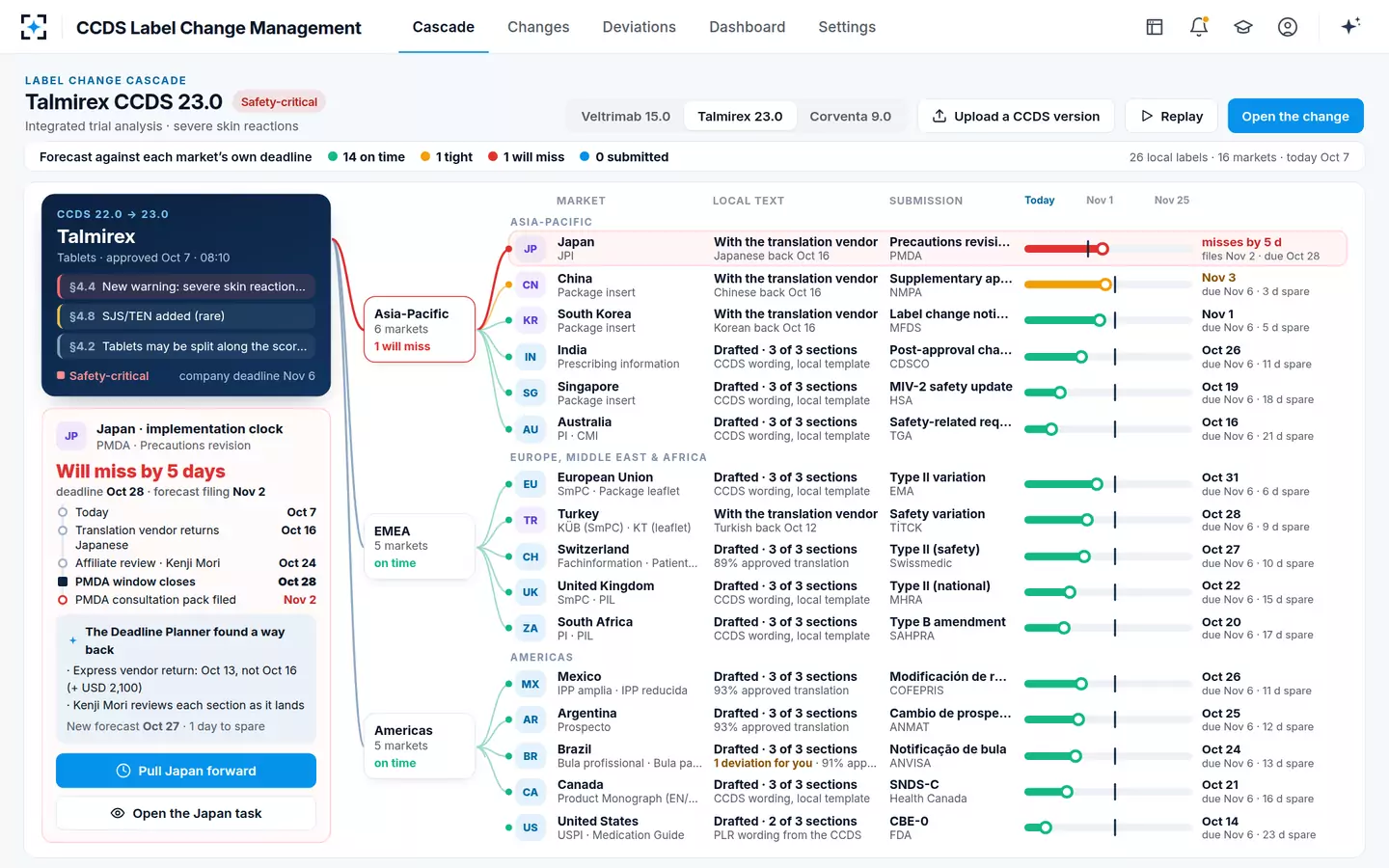
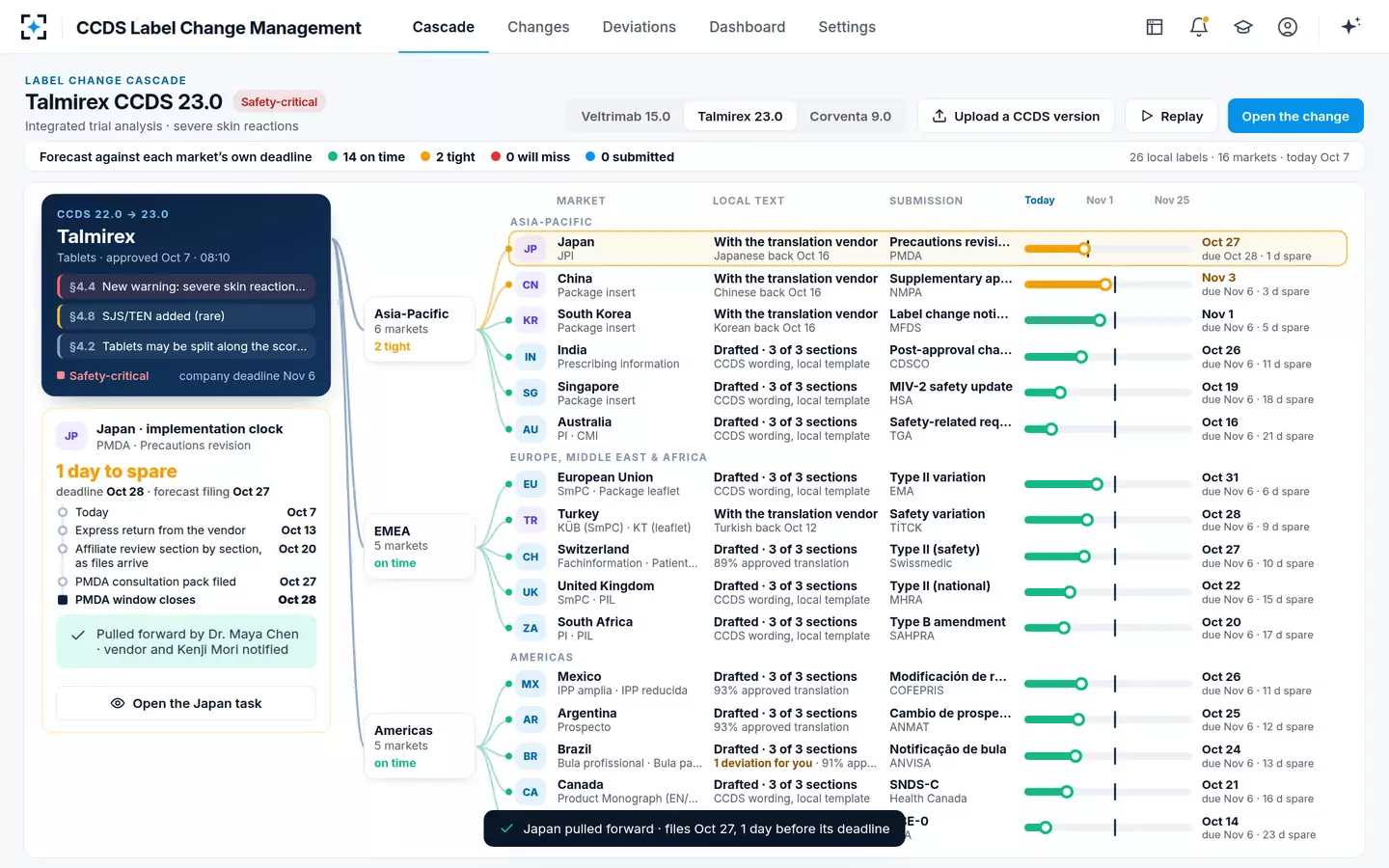
The screen above is the point of the whole exercise. The forecast is built from the steps still ahead — vendor return, affiliate review, the filing itself — rather than from a status, so the market that will miss is visible on the morning the core sheet is approved rather than on the morning it is missed. And because the shortfall is five days of vendor time, the way back is a costed, specific option: express the translation, review it section by section as it lands, file a day before the date. It spends nothing until a person accepts it.
One click, and the Japanese forecast moves inside its own date
What the published comparisons say about Japanese timing
It would be easy to turn all of this into a story about Japan being slow. The published comparison does not support it. Fukuda and Narukawa reviewed safety-related labelling changes for new drugs approved within one year in Japan, the United States and the European Union, and found the counts and the timing close together across all three.
Median days from approval to a safety-related labelling change, for new drugs in three regions
The authors' conclusion was that there was no trend of fewer or later labelling changes in Japan compared with the United States or the European Union, and that the distribution of revision dates showed no trend of delay in any particular region. Japan is not behind. It is on a different track, with different turns, and a global plan that assumes the tracks are the same will keep arriving at a station the train has left.
The same paper measured how often the three regions made the same change, and found the agreement low in every pair. That is a separate argument — about judgement rather than speed — and it is the reason the Japanese guideline asks a holder to work out whether a foreign measure is necessary in Japanese practice rather than simply to copy it.
Planning a Japanese submission backwards from its own dates
The method that works is the one the workflow implies. Start at the date Japan needs, not at the company deadline. Subtract the periods the workflow names for the steps the authorities own, which the holder cannot shorten. Subtract the holder's own steps, which it can: translation, affiliate review, the nine materials, the Japanese opinion on whether a measure is necessary in Japanese practice. What is left is the date the Japanese work has to start, and for a consultation that goes to experts it can be earlier than the day the core data sheet was approved.
That is the forecast the solution builds for every market, from the steps still ahead and the market's own date rather than from a single global deadline. It also means a shortfall has a cause with a price attached: so many days of vendor time, so many of affiliate review. The alternative — a status column that says "in progress" until the day it says "late" — tells a labelling lead nothing she can act on. Where a local label may legitimately differ from the core sheet covers the other half of the Japanese question, which is what the text should say once it gets there.
Questions people ask
Does PMDA have to approve a package insert change?
The workflow is not an approval. The holder applies for a consultation, the Agency reviews and may convene an Expert Discussion, the Agency notifies the Minister of its survey results, and the Pharmaceutical Safety Division issues a notification instructing a "Revision of Precautions". The holder then revises the electronic package insert. Several of those steps are the authorities' and cannot be shortened by the holder.
How long does a PMDA safety consultation take?
The workflow names the periods rather than a total: receipt as a general rule by the next working day, inquiries answered by the holder in principle within two weeks, an Expert Discussion within approximately 10 to 40 days at a sitting typically held every five weeks, survey results to the Minister in principle within one week of that discussion, and the notification instructing the revision in principle within approximately two weeks after that. Where no Expert Discussion is held, the Agency notifies the review results within two weeks of the documents.
What is a Revision of Precautions notification?
It is the instrument that instructs the change: a notification issued by the Pharmaceutical Safety Division of the Ministry of Health, Labour and Welfare after the Agency has reported its survey results to the Minister. On the same day it is issued, the Agency publishes the survey results on its website, and the holder revises the electronic package insert to reflect the safety measures.
Where can I find Japanese package inserts in English?
Treat any English version as a working aid rather than as the label. The Agency's own English translations of the governing notices carry a standing warning that the English is reference material and that the Japanese original prevails where the two differ, and the same logic applies to a package insert: the notified text is the Japanese one. A global labelling operation should hold the Japanese text as the label and the English as a reading of it.
How does a core data sheet change reach a Japanese label?
Not automatically. The guideline asks the holder, when acting on foreign regulatory information including a revised core data sheet, to confirm the rationale behind the foreign action and to consider whether the measure is necessary in Japanese medical practice. The consultation materials then ask for the revised core data sheet, the revised sections, the documents behind the revision, the other countries' inserts and measures, and the holder's own reasons for thinking a Japanese revision is needed.
What should a global team do first when a core sheet change touches Japan?
Work out the Japanese date before anything else, because it is the one most likely to sit inside the company deadline rather than outside it. Then start the Japanese translation before the other markets rather than after, since the two-week inquiry window assumes a Japanese answer, and assemble the nine consultation materials in parallel instead of in sequence.