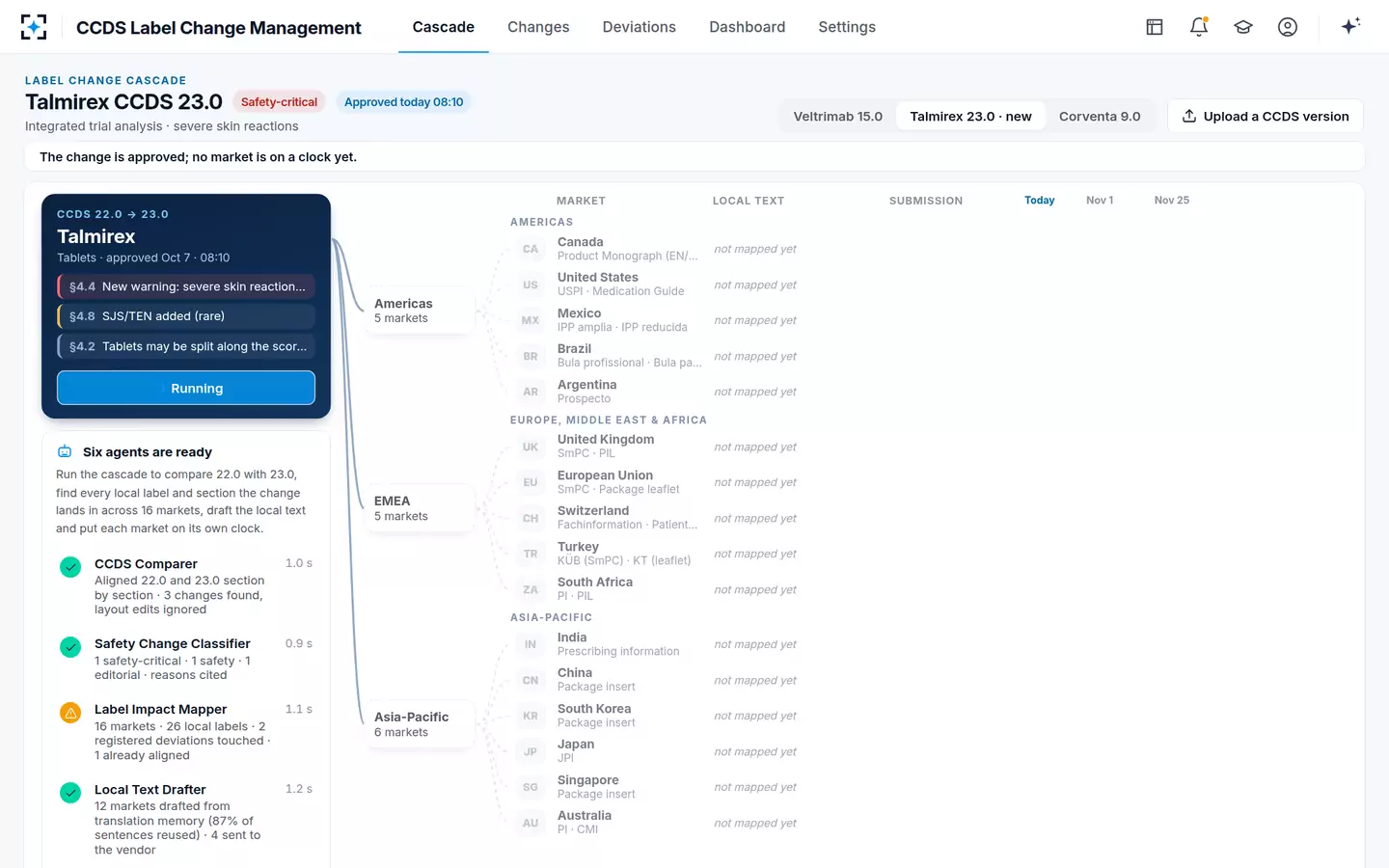
A safety labeling change in the United States can start in either of two places, and the FDA guidance that practitioners mean when they ask about safety labeling changes — the guidance implementing section 505(o)(4) of the Federal Food, Drug, and Cosmetic Act — covers only one of them. The company's own duty comes first and is written into the content-of-labeling rule: labelling must be revised to include a warning about a clinically significant hazard as soon as there is reasonable evidence of a causal association. The agency's route comes second: once FDA issues a safety labeling change notification letter, a labelling supplement or a rebuttal statement is owed within thirty days. Both clocks assume the company already knows what its own label says, and why, which is why the slow part of a US safety change is almost never the submission. Botminds' CCDS Label Change Management is built for that assumption: it classifies each change with the evidence it rests on, finds the American documents among the two dozen the change reaches, and keeps the US date beside fifteen other markets' dates rather than in a file of its own.
The product figures below come from the solution's sample data, in which a fictional company carries invented medicines through sixteen markets. The regulations and guidance quoted are real and linked where they appear.
Who starts a safety labeling change: the holder or FDA?
A safety labeling change is any revision to approved prescribing information that adds, strengthens or otherwise alters what the label says about a risk: a new contraindication, a new or strengthened warning or precaution, a new adverse reaction, a changed monitoring instruction, or a change to the patient-directed guide that travels with the medicine.
It can be started by the application holder, when its own data, a completed study or a core data sheet revision requires it. It can be started by the agency, through a notification letter under section 505(o)(4) telling the holder that new safety information should be included in the labelling. The two routes converge on the same document and diverge in almost everything else: who sets the wording, who sets the date, and what happens if nothing is filed.
The distinction that matters operationally is that the holder-initiated route is the one a global labelling function controls, and the agency-initiated route is the one that arrives without warning and has a short, countable deadline. A team that can only do the second one well is a team that is always reacting.
The company's own duty: as soon as there is reasonable evidence
The threshold for a new warning is set in the content-of-labeling rule, and it is lower than most people expect.
"In accordance with §§ 314.70 and 601.12 of this chapter, the labeling must be revised to include a warning about a clinically significant hazard as soon as there is reasonable evidence of a causal association with a drug; a causal relationship need not have been definitely established."
21 CFR 201.57(c)(6)(i), Warnings and precautions
Three things follow. Reasonable evidence, not proof: a company that waits for a definite causal relationship is applying a standard the regulation explicitly declines to require. As soon as: the rule attaches the duty to the moment the evidence exists, not to the next planned revision. And the cross-reference to the supplement rules means the duty and the mechanism are written as one thing — the regulation tells you to revise and, in the same breath, where to find the route for doing it.
This is the clock a labelling committee is actually on when it approves a core data sheet change on the strength of a completed study. The company deadline that then appears on a tracker — submit a safety-critical change within thirty days of committee approval — is a policy choice, adjustable in the solution's own settings as in any written procedure. It is a sensible discipline. It is not what the regulation says, and neither the regulation nor the FDA guidance counts anything from a labelling committee meeting.
CBE-0, CBE-30 and prior approval: which supplement, and when you may ship
Which supplement to use is a question about two things at once: what the change is, and when the holder may start distributing product bearing the new text. The regulation answers both in the same section.
The US routes for a labelling change, and when distribution may begin
| Route | Where it comes from | What it carries | When distribution of the changed product may begin |
|---|---|---|---|
| Changes being effected, CBE-0 | 21 CFR 314.70(c)(6) — the agency "may designate a category of changes" for which the holder may begin distributing the product as soon as the agency has received the supplement. | Labelling changes reflecting newly acquired information that add or strengthen a contraindication, warning, precaution or adverse reaction meeting the 201.57(c) standard, among the other changes the paragraph lists. Changes to the Highlights are excluded and go by prior approval. | On the agency’s receipt of the supplement. The supplement is labelled "Supplement—Changes Being Effected". |
| Changes being effected in 30 days, CBE-30 | 21 CFR 314.70(c)(4) — distribution "may begin not less than 30 days after receipt of the supplement by FDA", except where (c)(6) applies. | The other changes the changes-being-effected paragraph covers. | Thirty days after receipt — and not at all if, within those thirty days, FDA says prior approval is required or that required information is missing. |
| Prior approval supplement | 21 CFR 314.70(b) — the route for changes that require approval before distribution. | Changes outside the changes-being-effected categories, and alternative labelling proposed in answer to a notification letter. | After FDA approves the supplement. |
| Annual report | 21 CFR 314.70(d) — minor changes reported in the annual report. | Editorial and other minor changes with minimal potential to have an adverse effect. | Not a safety route. A change belongs here only if it is genuinely minor. |
The practical difference between CBE-0 and CBE-30 is a month of exposure, and the regulation is careful about which changes get the faster route. A holder reaching for CBE-0 should be able to say, in a sentence, which part of paragraph (c)(6) the change falls under and what the newly acquired information is. A holder reaching for it because the deadline is tight is making a filing decision for the wrong reason.
What the FDA guidance on section 505(o)(4) actually says
Section 505(o)(4) gives FDA the authority to require a safety labelling change when it becomes aware of new safety information that should be in the labelling. The agency's guidance for industry explains how it uses that authority, and the sentence everyone needs is about counting.
"Following notification, the labeling supplement or rebuttal statement must be submitted within 30 days (section 505(o)(4)(B))," the July 2013 guidance states. "FDA has interpreted within 30 days to mean within 30 calendar days of the date that the notification letter is issued" (FDA, Safety Labeling Changes — Implementation of Section 505(o)(4) of the FD&C Act, section IV.B). Calendar days, and counted from the date the letter is issued rather than the date anyone in the company read it — two details that can cost several days between them.
The guidance also decides which supplement to use, and it ties the choice to whether the holder agrees: "If the application holder submits a supplement proposing labeling changes identical to those that FDA included in the notification letter, the application holder may submit a supplement - changes-being-effected (CBE-0). In all other situations, the application holder(s) should submit a prior approval supplement to propose alternative labeling changes that reflect the new safety information." Agreement buys the fast route; any variation on the agency's own wording moves the filing into prior approval.
A revision is in progress. FDA issued a draft Revision 1 in September 2025 which "revises the guidance for industry Safety Labeling Changes—Implementation of Section 505(o)(4) of the FD&C Act issued in July 2013" and which, "after it has been finalized … will replace the July 2013 guidance" (FDA, draft guidance, Revision 1, section I). Until that happens the July 2013 guidance is the one in force; the draft is worth reading for where the agency is going, and worth not citing as current practice.
How long do you have to answer an FDA safety labeling change notification?
Thirty calendar days from the date the letter is issued, with either a labelling supplement or a rebuttal statement. The figure below sets that clock beside the company's own, because they are the same length, they start from different events, and a tracker that shows them in one column will eventually be read wrongly by somebody under pressure.
Two 30-day clocks, counted from two different events
- Notification letter issuedday 0
- Assess, decide agree or disagree, prepare the filingdays 1–29
- Supplement or rebuttal submittedday 30
- Labelling committee approves the changeday 0
- Compare, map, check differences, draft, signdays 1–29
- Submit in each marketday 30
The thirty days are short because almost all the work they require should already exist. Deciding whether to agree with the agency's proposed wording means knowing what the current label says, what the underlying data show, what the company's core position is and which other markets carry the same statement. A company that has to assemble all four inside the thirty days is spending its deadline on archaeology.
What a notification letter brings, and the five answers to have ready before one arrives
- The new safety information the agency has identified, and the labelling change it proposes
Read it against the current approved label first, not against the core data sheet. The question on the clock is what the US label will say.
- Answer one: does the company agree with the agency’s wording, exactly?
Identical wording allows a CBE-0 under the guidance. Anything else moves the filing to a prior approval supplement, which is a different preparation and a different timetable.
- Answer two: what does the company’s own evidence show?
The study report, the case series, the signal evaluation. A rebuttal that is not built on the company’s own analysis is an opinion with a deadline attached.
- Answer three: what does the core data sheet already say about this risk?
If the core sheet is silent and the agency is right, a US-only change leaves every other market carrying a label the company now disagrees with.
- Answer four: which other documents carry the same statement?
The patient-directed guide, and the national labels in every other market. A US change that is not mapped outward creates divergence on the day it is filed.
- Answer five: who signs, and is that person available inside thirty days?
Medical sign-off on new warning wording is a step that can stall in a holiday week. Name the deputy before the letter arrives, not after.
Disagreeing with FDA: the rebuttal statement and the order
A holder that does not believe the proposed change is warranted is not required to make it on the spot. The statute provides for a rebuttal statement, filed within the same thirty days, setting out why the labelling change is not warranted. What follows is a discussion rather than an immediate instruction, and in many cases it ends in agreed wording that is neither the agency's first draft nor the company's.
What is not available is silence. The July 2013 guidance states plainly that FDA "can also issue an order if a supplement or rebuttal statement is not submitted within 30 calendar days of the date of the notification letter" (FDA guidance, July 2013, section IV.D), and the September 2025 draft revision keeps the same position. Missing the deadline removes the company from the conversation about its own label.
The decision to rebut should therefore be made early and recorded with its reasoning, because the rebuttal and the supplement are different pieces of work and only one of them can be prepared well in four weeks. In the sample solution the equivalent decision — whether a change is safety-critical, and on what evidence — is made by the classifier and confirmed by the global medical lead before any clock starts, with the study report, agency request or committee minutes attached to the classification.
Classification before the clock, in CCDS Label Change Management
1
safety-critical change, confirmed by the global medical lead before any market is put on a clock
1
safety change, on its own slower company deadline
1
editorial change, carried at the next revision rather than on its own
Each change classified, with the evidence cited, before any market is put on a clock
Recent Major Changes: the year a label carries its own history
A US safety labelling change leaves a visible trace for a year, and it is one of the few places where a label is required to tell the reader that it recently changed. The listing is limited to substantive changes in the boxed warning, indications, dosage and administration, contraindications, and warnings and precautions, and a changed section "must be listed under this heading in Highlights for at least 1 year after the date of the labeling change and must be removed at the first printing subsequent to the 1 year period" (21 CFR 201.57(a)(5)).
Two operational consequences follow. The first is that the label has a removal task as well as an addition task, and the removal is the one that gets forgotten: an entry that should have come off at the first printing after a year is a quiet compliance defect. The second is that this listing is a gift to anyone reading a competitor's or a predecessor's label, because it says what changed and roughly when, without anybody having to compare two versions by hand.
Precedent wording from FDA's public record, and its limits
FDA publishes the changes themselves. Its Drug Safety-related Labeling Changes database records the safety updates made to the labelling of prescription drugs under NDAs and of prescription biologics under BLAs (FDA, SrLC database overview). For a labelling function it is useful in three ways: as a check on whether a class-wide concern is moving through other products, as a source of precedent wording for a risk the company is about to address, and as a reality check on how long these changes actually take to appear.
It is a US view only, which is the limitation to keep in mind. A change that appears there has no counterpart in a European or Japanese feed, and research comparing the three regions found that most safety labelling changes for the same new medicines did not match between them. Reading the US database as a proxy for global activity will systematically mislead.
What the US answer does to the other fifteen markets
The moment a US label changes, every other market carrying the old statement is out of step with it — not with the core data sheet, which may not have moved at all, but with a sister label. That is the point at which a US-first company quietly accumulates divergence, because the US change is operationally urgent and the mapping outward is not.
The discipline that prevents it is to treat the US change as a core data sheet question before it is a filing question. If the new information is right, the core sheet should say so, and if the core sheet says so, every market owes an answer. Running it the other way — file in the United States, update the core sheet at the next scheduled revision, let the markets catch up — produces exactly the pattern the deviation register is supposed to be free of.
In practice that means the US filing and the cascade start together. What one change actually touches, market by market, is the list the rest of the work runs on; the markets that will struggle are rarely the ones with the earliest company deadline, and the European and Japanese routes have their own dates that no US clock predicts — when new wording goes live in the European Union is a question about the variation and the linguistic review, not about the filing date.
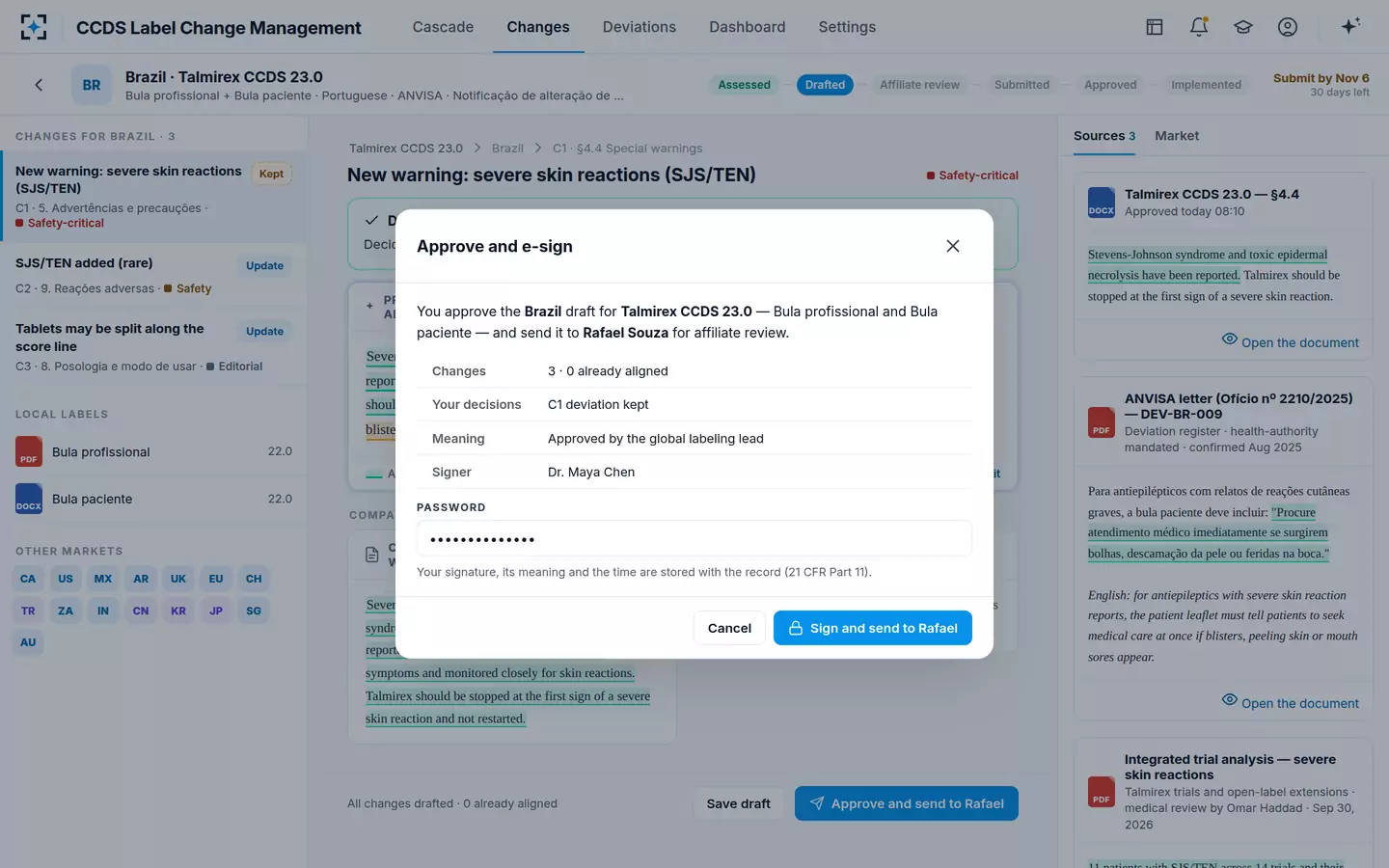
Approve and e-sign: the decision, its meaning and the signer, stored together
Questions people ask
When can you change a drug label without FDA approval first?
Under the changes-being-effected provisions of 21 CFR 314.70. For the categories the agency has designated under paragraph (c)(6) — which include labelling changes reflecting newly acquired information that add or strengthen a contraindication, warning, precaution or adverse reaction — distribution may begin on the agency's receipt of the supplement. For other changes-being-effected supplements, distribution may begin thirty days after receipt, and not at all if FDA says within those thirty days that prior approval is required.
What is the difference between CBE-0 and a prior approval supplement?
Timing and risk. A CBE-0 lets the changed product be distributed as soon as the agency receives the supplement; a prior approval supplement waits for approval. Under the section 505(o)(4) guidance the choice is not free: a holder proposing labelling changes identical to those in the agency's notification letter may use a CBE-0, and in all other situations should submit a prior approval supplement proposing alternative wording.
What is a rebuttal statement?
It is the filing a holder makes, within the same thirty days, when it does not believe the labelling change the agency proposed is warranted — setting out why, on the company's own evidence. It keeps the holder in the discussion about its own label. What it is not is a way of buying time: the deadline applies to the rebuttal exactly as it applies to the supplement, and nothing filed at all is the one outcome with no upside.
What is the Recent Major Changes section?
It is the listing in the Highlights of US prescribing information naming the sections — boxed warning, indications, dosing, contraindications, warnings and precautions — that have recently had a substantive change. A changed section must appear there for at least a year after the date of the labelling change, and must come off at the first printing after that year. Treat the removal as a task in its own right; it is the half of the requirement that gets forgotten.
Is FDA's 2025 draft safety labeling changes guidance in force?
Not yet. FDA issued Revision 1 as a draft in September 2025, for comment and marked not for implementation, and says it will replace the July 2013 guidance only once it is finalised. Until then the July 2013 guidance is the one to work from; the draft keeps the same 30-day position on supplements, rebuttals and orders, so it is worth reading for direction rather than citing as current practice.
Does the 30-day FDA clock apply to our own core data sheet changes?
No. The thirty days in section 505(o)(4) run from the date FDA issues a notification letter. A company deadline of thirty days from labelling committee approval is an internal policy — a configurable setting in the solution, and a written procedure elsewhere — and the two are unrelated. Showing them in the same column on a tracker is how a team ends up treating a statutory deadline as negotiable, or an internal target as immovable.