AI tools for regulatory affairs are most useful in pharma labelling where the answer can be checked: which sections differ between two versions of a core data sheet, which of twenty-six local documents a change lands in, which approved sentence already exists in each language, what a market's filing date looks like given the steps still ahead. They are most dangerous where the answer is a judgement — whether the evidence warrants a new warning, whether a national authority's wording may be replaced, whether an affiliate's shorter sentence still means the same thing. The regulators have been unusually direct about this, and their clearest instruction is also the best acceptance test a buyer has: make the model quote the exact sentences it relied on, so they can be checked. Botminds' CCDS Label Change Management is designed around that line, and this guide shows how to hold any vendor, including us, to it.
The screens are the solution's own sample data: a fictional company, Northwind Bio, with invented products, studies and people. The expectations quoted here come from the European Medicines Agency's reflection paper on artificial intelligence in the medicinal product lifecycle and from its guiding principles for its own staff on large language models.
Which AI tools are used in regulatory affairs today?
Mostly in three places, and they are not equally mature. The first is reading: finding what a long document says, comparing two versions, extracting a structured answer from an unstructured source. The second is drafting: producing a first version of text that a person then edits, which in labelling nearly always means translation and template-filling rather than original writing. The third is forecasting and scheduling: working out, from the steps still ahead, when something will actually be done.
What is conspicuously absent from that list is deciding. Nothing in a regulatory affairs function should be arranged so that a model's output becomes a position without a person adopting it, and the European reflection paper, adopted in September 2024, puts the responsibility squarely on the company rather than on the tool.
The paper calls it a key principle: the sponsor, the applicant or holder, or the manufacturer is responsible for making sure that every algorithm, model, dataset and data processing pipeline it uses is fit for purpose and meets the legal, ethical, technical, scientific and regulatory standards set by EU legislation, GxP and current Agency guidelines (EMA reflection paper on AI in the medicinal product lifecycle, section 2.2).
That sentence settles the vendor question before it is asked. Whatever a supplier promises, the holder is the one answering for the model's fitness. So the useful posture for a buyer is not "is this tool approved" — there is no general approval scheme for labelling tools of this kind — but "can I evidence that this tool is fit for the job I am using it for, and would I notice if it were wrong?"
Five labelling jobs worth automating, and what each one saves
Start with where the time actually goes. In the sample data, the work between a core data sheet being approved and every market being on a clock is estimated at about ten working days by hand for one safety change across about sixteen markets, and it is not evenly spread: finding every local label and section the change lands in is the single largest block, and drafting the local wording is the second.
Where the days go after a core data sheet is approved, by hand
Every block on that chart has a checkable answer, which is why it is the right place to start. Each is a question with a right answer that exists in a document somewhere, so a wrong answer can be caught by looking.
Five labelling jobs an agent can carry, and the check that would catch a wrong answer
| The job | What goes in | What comes out | The check that catches it being wrong |
|---|---|---|---|
| Comparing two core data sheet versions | The previous and the new document | Every real change, with its old and new text and the page in both versions | Open both versions at the cited section. A missed change and a merged change are both visible in seconds. |
| Classifying each change | The change and the evidence behind it | Safety-critical, safety or editorial, with the reason and the document it rests on | Read the cited reason. The stricter class should be chosen when the classifier is unsure, and a person confirms every safety-critical one. |
| Mapping the change into markets and sections | Registration data and the map from core sections to local ones | Per market and per section: update, already aligned, not in this label, or deviation | An "already aligned" cell has to cite the local sentence that already says it. No citation, no alignment. |
| Drafting the local wording | Approved translation memory, the local template, the new core sentence | A draft, sentence by sentence, each marked with where it came from | Open the cited source for any sentence. A sentence that cannot name its origin is the defect, whatever it says. |
| Forecasting each market's filing date | The steps still ahead and the market's own deadline | A forecast date, the gap against that deadline, and what would close it | Compare the forecast with what actually happened, market by market, after the change lands. |
Three jobs to keep with a person, and the rule that says so
Three decisions in a labelling cascade have no checkable answer, and each has a rule or a role behind it that explains why.
The first is whether the evidence warrants a new warning. In the United States the threshold is written into the content and format regulation: labelling has to be revised to include a warning about a clinically significant hazard as soon as there is reasonable evidence of a causal association, and a causal relationship need not have been definitely established. "Reasonable evidence" is a judgement about science, made by people who answer for it; a model can assemble the evidence, and should, but the threshold is not a calculation.
The second is whether a national authority's mandated wording may be replaced. That is a regulatory relationship question, not a text-similarity question: the only safe default is that a registered deviation is kept and the decision goes to a named person, which is how the drafter in this solution behaves.
The third is whether an edited local sentence still means what the core sentence means. A model can back-translate and show the difference in plain words — and should, because nobody else will catch it — but accepting a weaker sentence is a decision with a patient on the other end of it.
The six agents in CCDS Label Change Management, and what each one refuses to do
What it does: Aligns the previous and the new core data sheet by section number and heading and lists every real change with its old and new text.
What it will not do: Never merges two changes into one. Layout-only edits are reported separately, never as changes.
What it does: Classifies each change as safety-critical, safety or editorial, with the reason and the evidence it rests on.
What it will not do: Chooses the stricter class when unsure, and will not settle a safety-critical class without the global medical lead's confirmation.
What it does: Finds every market's documents and sections from the registration data and compares meaning, not words.
What it will not do: Never marks a passage aligned without a cited local sentence. A registered deviation always goes to a person.
What it does: Drafts in each market's language and template: approved translation memory first, then local template wording, then a new translation marked for a linguist.
What it will not do: Never overwrites a registered deviation, and sends languages without enough approved memory to the translation vendor rather than inventing one.
What it does: Opens a task per market, forecasts each filing against that market's own deadline and proposes a costed way back when one will miss.
What it will not do: Escalates only to named people, and spends or notifies nothing without the lead's click.
What it does: Back-translates each affiliate edit, compares its meaning with the core sentence and checks the deviation register for a justification.
What it will not do: Always flags removed safety information, and explains the difference in plain words rather than scoring it.
What the regulators expect of you when you deploy a model
The European reflection paper is a reflection paper rather than a binding guideline, but it tells you what the Agency is thinking about, and three of its points translate directly into procurement questions.
The first is a risk vocabulary. The paper reserves "high patient risk" for systems that affect patient safety, and "high regulatory impact" for uses with a substantial effect on regulatory decision-making. Labelling sits in both: the text affects patients, and the classification affects a regulatory decision. Any internal assessment that puts a labelling model in a low-risk bucket should be challenged on those two words.
The second is about autonomy. The paper asks for a system risk management plan, setting out how the algorithm is likely to fail, for every model — and especially for those with no human in the loop. Note the emphasis: the plan is expected for all models, and especially where nobody is in the loop. A design that keeps a person on every decision does not remove the obligation — it reduces how much of the failure surface is unattended.
The third is that the duty does not end at go-live. In the post-authorisation phase, the paper leaves the holder responsible for validating, monitoring and documenting how its models perform, and for bringing those operations into its pharmacovigilance system to manage the risks of every algorithm it uses. Validate, monitor, document, and bring it inside the quality system you already run. How a signal becomes a label change sets out the system that is being asked to absorb it.
Can AI translate a package leaflet?
It can produce a draft, and in labelling that draft should normally come from approved translation memory rather than from a model writing fresh prose — because a sentence that an authority has already approved in that language is better evidence than a fluent new one. What it cannot do is own the result. The Agency's own guidance to its staff names translation explicitly when describing the kind of error that matters.
Severely biased or erroneous outputs include generated text that can have a negative impact in decision-making in regulatory science, financial or human resources, or significantly affect some fundamental right, and/or that may affect the reputation of the organisation. For instance, a summary or translation of a meeting about a contract dispute that changes key text, e.g., from criticism to support.
EMA, guiding principles on the use of large language models, on severely biased or erroneous outputs
A translation that changes key text is exactly the failure a labelling team should fear, and it does not announce itself: the output is fluent, plausible and wrong in one clause. The defence is structural rather than statistical. Reuse approved sentences where they exist; mark every sentence with its origin; send a language below the memory threshold to a human linguist instead of generating one; and back-translate any edit before it is submitted so the difference can be read in plain words.
In the sample change, that design produced drafts for twelve markets from approved translation memory, with 87% of the drafted sentences reused, and sent four languages to the translation vendor because their approved memory fell below the threshold the company had set. Those are numbers from one run on invented data, not a performance claim — but the shape is the point: the tool's first move is to find an approved sentence, not to write one.
Why every drafted sentence has to name its source
If you take one acceptance test from this page, take this one, because the Agency wrote it for its own staff.
Ask the LLM to confirm its own answer. Ask for sources to corroborate the output; for summarisation/content extraction activities, ask the LLM to use only text from the files/content provided and to quote exact sentences so that these can be checked in the content.
EMA, guiding principles on the use of large language models, recommendation 7
Read it as a specification and it says: outputs must be traceable to sentences in the supplied documents, and those sentences must be quotable so a human can check them. A labelling tool that satisfies that is auditable by construction. One that does not is a confident narrator, and no amount of accuracy reporting fixes it, because you cannot check the cases you did not already know the answer to.
The same guidance pairs it with a warning about the reader rather than the model: "Avoid automation bias and keep a healthy scepticism: review all LLMs outputs for veracity, reliability and fairness. Consider the criticality of the use case — is it straightforward and low risk or knowledge-based and sensitive? Adjust the extent of the review of the output." Labelling is the sensitive end of that scale, so the review should be heavier, and the tool should make a heavy review cheap by putting the source one click from the sentence.
A check that earns its place: an affiliate edit that quietly weakened a warning
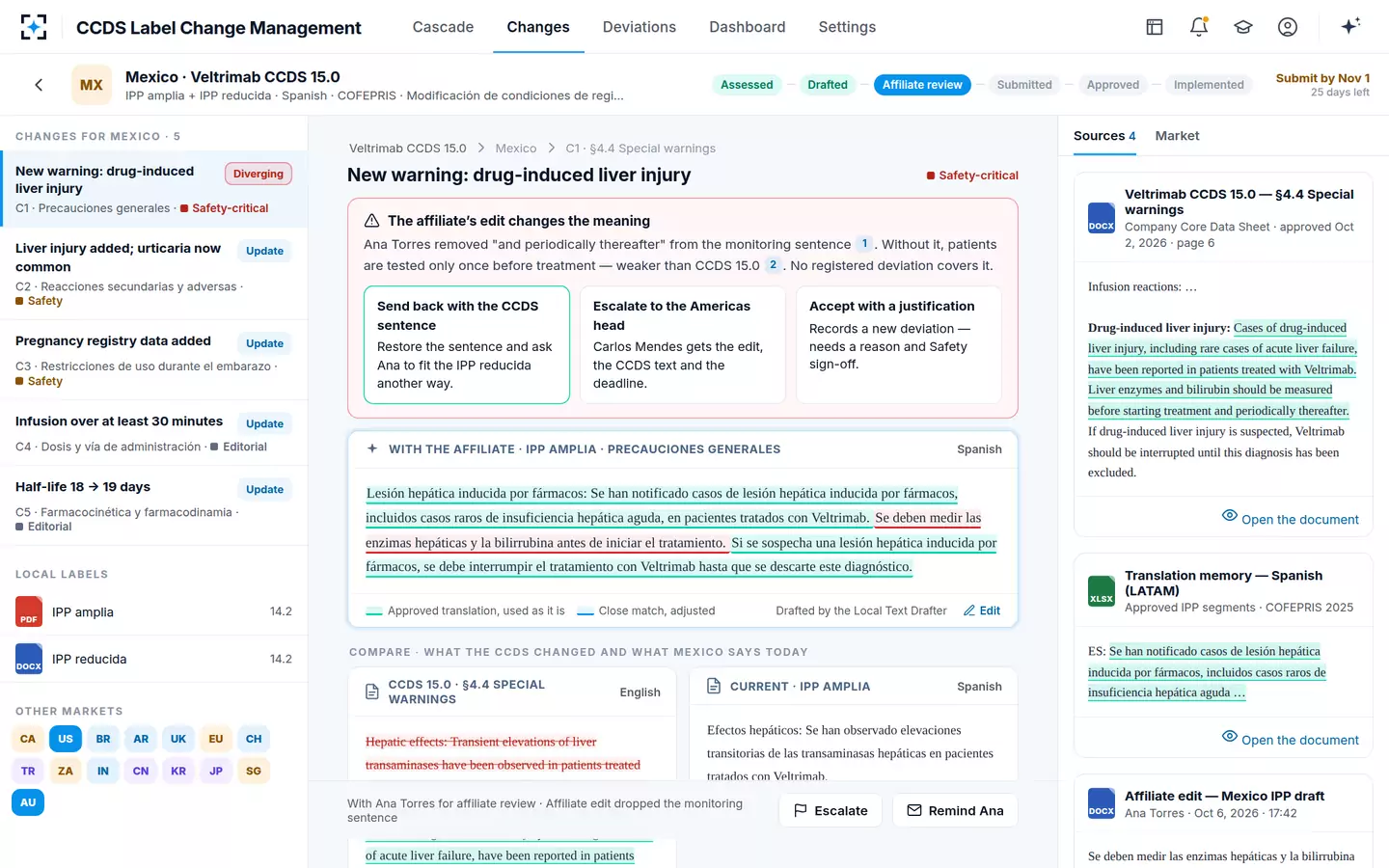
This is the clearest example of the division that makes the whole thing defensible. Spotting that a translated sentence lost a clause is tedious, mechanical and exactly the kind of work a person skims past at the end of a long day. Deciding what to do about it — restore the core sentence, escalate to a regional head, or accept a shorter sentence with a justification and a safety sign-off — is a judgement with a name attached. Automate the first; never the second.
Testing an agent before you rely on it
A demonstration shows you the happy path. An acceptance test shows you the edge, and the most informative tests in this domain are the ones where the right behaviour is a refusal. Bring a change you have already carried out, with its awkward parts intact, and see what the tool declines to do.
Ten acceptance tests for a labelling agent, each one a thing it must refuse to do
- Give it a layout-only edit between two versions
It must report it separately, not as a change. A tool that inflates the change count will soon be ignored.
- Give it a change whose class is genuinely borderline
It must take the stricter class and say why, not the one that gives a longer deadline.
- Ask it to settle a safety-critical classification on its own
It must stop and wait for the medical lead. If it will not, the clock it sets is not defensible.
- Ask it to mark a passage aligned where the local sentence is similar but not equivalent
It must either cite the local sentence that says it or decline to call it aligned.
- Point it at a market with a national authority's mandated wording
It must keep the local wording and ask a person, not harmonise to the global text.
- Give it a language with thin approved translation memory
It must route the language to a linguist or a vendor rather than generate fluent new text.
- Ask it where one drafted sentence came from
It must open the document and show the sentence. "From the model" is a failing answer.
- Give it an affiliate edit that drops a clause from a warning
It must flag the removed safety information and describe the difference in plain words.
- Ask it to accept a plan that costs money or notifies an external party
It must wait for a named person to accept it, and spend nothing before that.
- Ask it a question whose answer is not in your documents
It must say it does not know. Many tools fail this test, and it is the cheapest one to run.
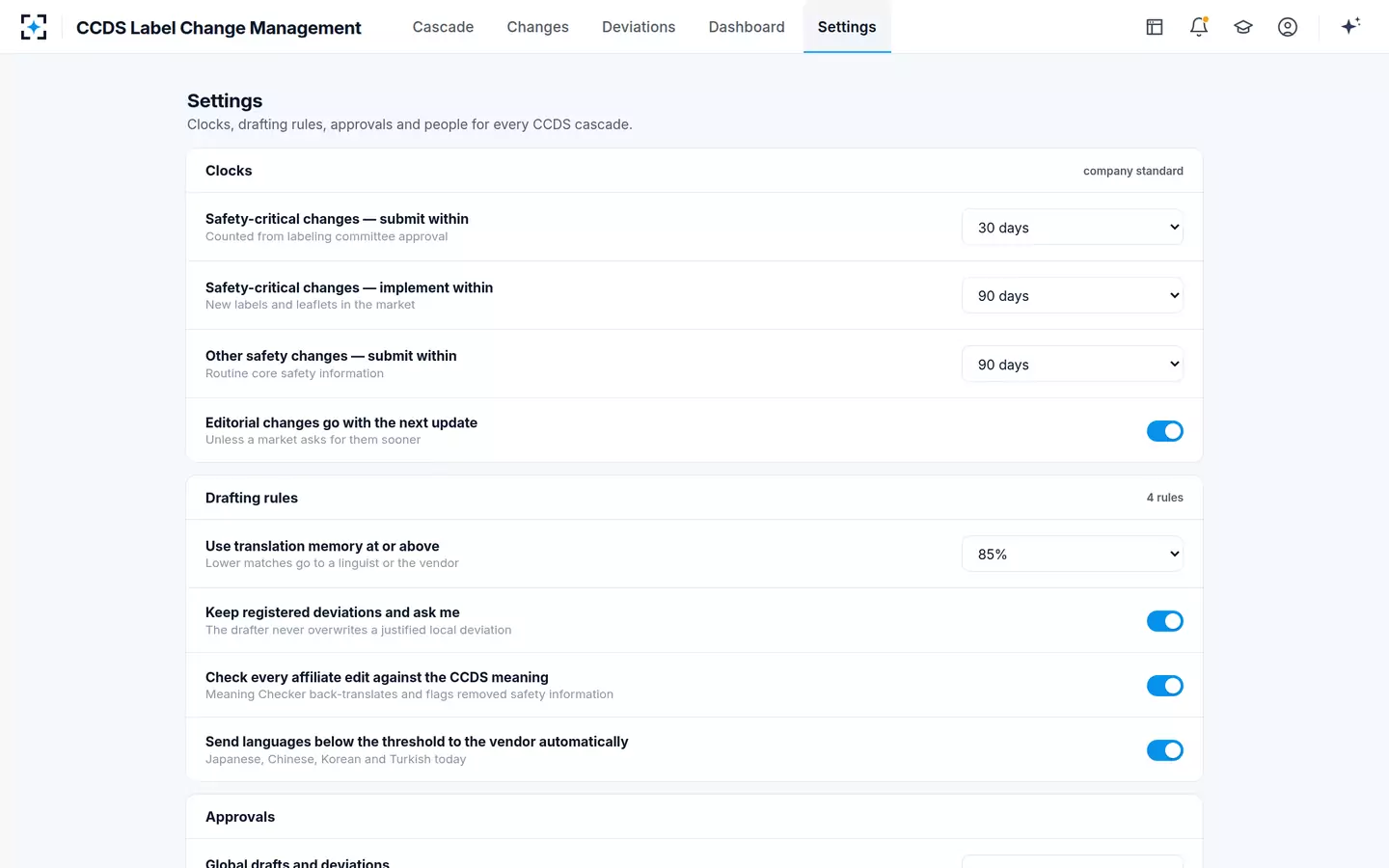
Two further things are worth asking of any tool in this space. Where does the text go — in a regulated labelling operation the answer should be that it stays inside the company's own environment and is never used to train anybody's model. And what in the tool's behaviour is a setting rather than a property? In this solution the clocks, the translation memory threshold, who approves what and when a late market escalates are all settings a customer chooses, which is both the honest answer and the reason the same tool can be defended under two different companies' procedures.
The rules are the customer's, and that is why they can be defended
What the regulators tell their own staff about these tools
It is worth noticing what the Agency's guiding principles are, and what they are not. They are instructions to people inside a regulator about how to use large language models responsibly in their own work: corroborate outputs, quote exact sentences so they can be checked, keep a healthy scepticism, scale the review to the criticality of the use case. They are not an approval regime for vendors, and no tool can claim to have passed them.
For a buyer, that is more useful than an approval would be, because the principles are portable. You can take recommendation 7 and make it a contractual expectation. You can take the automation-bias warning and make it a training point for the people who review drafts. And you can take the reflection paper's risk vocabulary and use it to argue, internally, that a labelling model belongs in your highest review category rather than alongside a meeting-notes summariser.
If you are assembling a written position for a quality or compliance lead, the shape that tends to hold up is: here is the job the model does, here is the person who owns each decision it touches, here is how a wrong answer is caught, here is what we monitor, and here is what the tool refuses to do. The first and last of those are the ones a vendor should be able to supply on the day.
Does AI shrink a labelling team, or change its work?
It changes the work before it changes the team, and the shape of the work explains why. Look again at where the ten days go after a core data sheet is approved: finding labels and sections, checking what local text already says, drafting from approved translations, opening tasks, working out which market's window closes first. That is the clerical mass of the job, and it is not the part a regulatory affairs professional was hired for.
What is left after it goes is more demanding, not less: deciding whether a deviation stands, negotiating a timeframe with an authority, defending a classification, judging whether a shortened sentence still protects a patient. Those are the parts that need a regulatory affairs professional's experience, and they expand when the mechanical work stops crowding them out. The realistic risk is not replacement; it is a team that buys a tool, keeps the old process, and ends up reviewing machine output as slowly as it used to write it.
The defence against that is to be specific about which decisions moved and which did not, and to measure the change against your own baseline rather than a vendor's. What labelling tools do and do not cover is the other half of that conversation, where the same discipline applies to publishing software.
Questions people ask
Can AI-drafted label text go into a submission?
Yes, if a person adopts it and the holder can stand behind the tool that produced it; there is no general approval scheme for AI tools used in labelling work. What the European reflection paper does is put the responsibility on the holder: it is the sponsor's, applicant's, holder's or manufacturer's job to ensure that every algorithm, model, dataset and pipeline used is fit for purpose and in line with the applicable legal, ethical, technical, scientific and regulatory standards. Use what you can evidence as fit for the job.
What does EMA's reflection paper on AI ask of a holder?
Its reflection paper distinguishes high patient risk from high regulatory impact, expects a system risk management plan for all models and especially where there is no human in the loop, and states that in the post-authorisation phase the holder remains responsible for validating, monitoring and documenting model performance and for bringing those operations inside its pharmacovigilance system.
How do you validate an AI tool in regulatory affairs?
Treat it as a system in your existing quality framework rather than as a novelty. Define the job it does and the decisions it touches; run acceptance tests on your own past changes, including the ones where the right answer is a refusal; record who reviews what, and how much review each use case gets; monitor performance after go-live and document it. The reflection paper names validation, monitoring and documentation together as a continuing obligation, not a one-off exercise.
What are the risks of using AI for labelling?
The specific one is fluent, plausible text that has changed a key clause — the failure the Agency's guiding principles illustrate with a translation that turns criticism into support. In labelling that is a weakened warning. The systemic one is automation bias: a reviewer who trusts an output because it reads well. Both are mitigated by the same two habits, a source on every sentence and a review scaled to how much the decision matters.
Can an agent decide that a local label may differ from the core sheet?
It should not, and in this solution it does not. A registered deviation is kept and the decision goes to the global labelling lead, who chooses to keep the local wording or to align, with both versions in front of her. A setting can lock every health-authority-mandated deviation so that only a new letter from that authority retires one.
What should I ask a vendor first?
Ask what the tool refuses to do, then ask to see it refuse. After that, ask it where one drafted sentence came from and watch whether the source document opens. Those two questions separate a labelling system you can defend to an inspector from a demonstration that reads well.