In pharmacovigilance the company core data sheet does one job above all others: its core safety information is the reference against which a reported reaction is judged listed or unlisted for periodic reporting. That judgement shapes what the periodic report has to argue and marks when the company's own view of a medicine's safety profile has formally changed — so a change to the core data sheet is not an administrative act but a measurement being re-calibrated. The part most safety teams underestimate is what happens next. The moment the core sheet moves, the work stops being a pharmacovigilance problem and becomes a labelling one in every market the product is registered in, and Botminds' CCDS Label Change Management is built for exactly that handover: it starts at an approved core data sheet version and carries it into every local label, section and deadline it touches.
The worked example is the solution's own sample data, and everything in it is invented: a fictional company, Northwind Bio, its product Veltrimab, its study VLT-305 and the people who appear on its screens. The pharmacovigilance rules come from the international guideline, the European good practice modules and the Japanese guideline, linked where they appear.
One core data sheet change, measured the morning it was approved
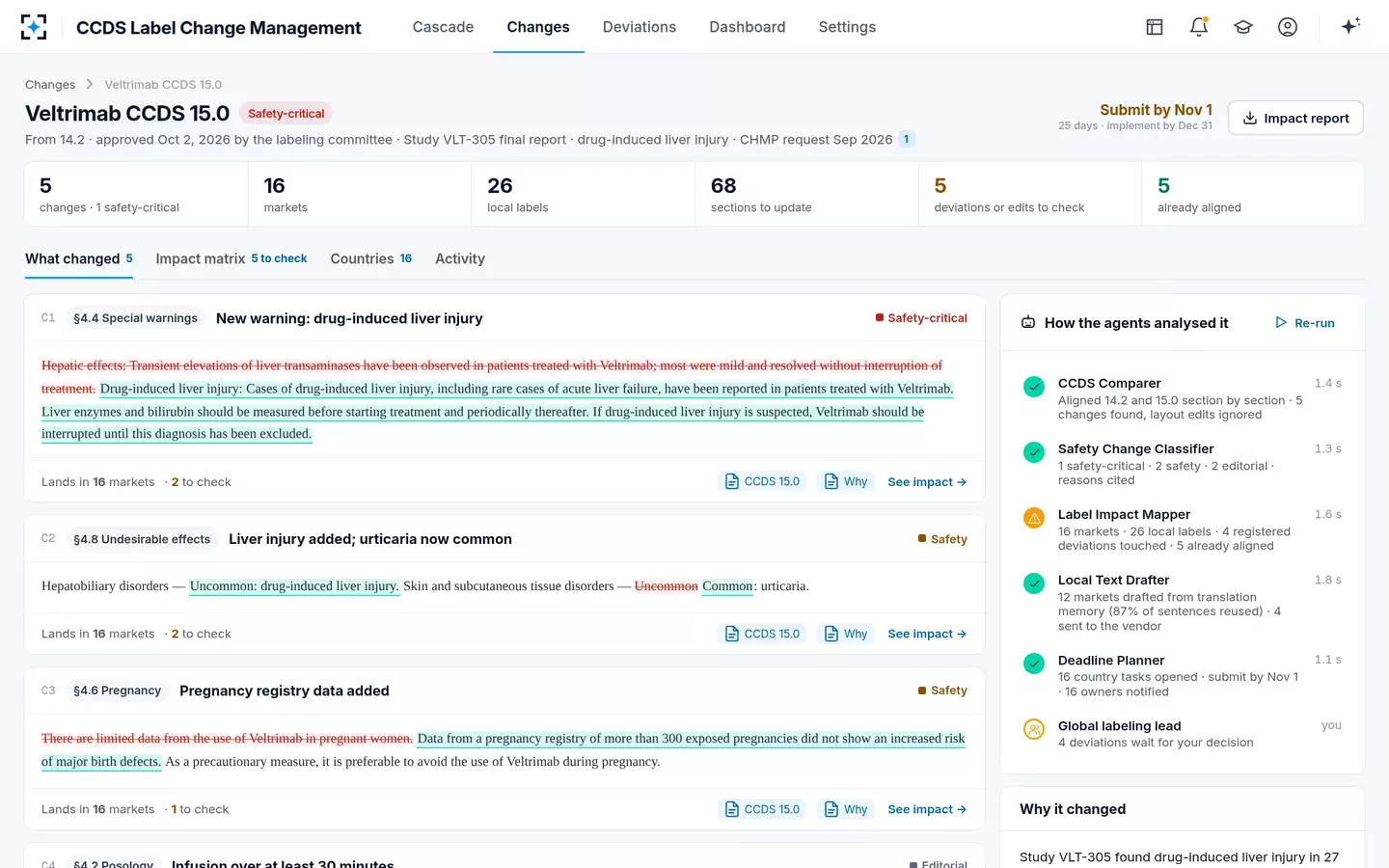
5changes
between the previous version and the new one, of which one was safety-critical
68sections
to update across 26 local documents in 16 markets
5
passages where a local label already said it, and no change was needed
5
registered deviations or affiliate edits that had to go to a person
What the core data sheet does in pharmacovigilance
The core data sheet is the company's own document; the safety information inside it is what the rules actually point at. The international guideline on periodic reporting defines that inner set as the reference by which listed and unlisted reactions are determined for the purposes of periodic reporting for marketed products. Everything else the document carries — indications, posology, the rest — is context around that function.
Two consequences follow, and both are operational rather than theoretical. The first is that the core data sheet is consulted constantly, not occasionally: every case that arrives has to be judged against it. The second is that it has a version and a date that matter, because the same case judged against two versions can give two different answers. A safety database that points at "the CCDS" without pointing at a version has a quiet defect.
The European good practice modules add the duty that sits behind all of it. Under Module IX, marketing authorisation holders "shall keep their product information up-to-date in the light of scientific knowledge, including the assessments and recommendations made public via the European medicines web-portal". Keeping the product information current is a standing obligation, not a project, and the core data sheet is how a global company discharges it consistently in thirty places at once.
Listed and unlisted: the decision the core safety information makes every day
Listed means the reaction appears in the reference safety information; unlisted means it does not. The distinction drives the structure of the periodic report, and it is the reason the reference document has to be unambiguous about which version applies. It is not the test for expedited reporting: the ICH glossary states that the core safety information is the reference for listed and unlisted in periodic reporting, but not for deciding what is expected or unexpected in expedited reporting, which is judged against the local label.
All relevant safety information contained in the reference product information (e.g., CCDS) prepared by the MAH and which the MAH requires to be listed in all countries where the company markets the drug, except when the local regulatory authority specifically requires a modification.
ICH E2C(R2), Appendix A glossary, reference safety information
The last clause is where pharmacovigilance and labelling meet, and it is easy to read past. The reference safety information is what the holder requires to be listed everywhere — except where a national authority has specifically required something different. That exception is not a failure of the process; it is written into the definition. A company with no register of where its local labels legitimately differ, and why, cannot tell a deliberate national requirement from a drafting error, and will eventually delete one believing it is correcting the other.
Four reference documents, the national label they produce, and what each decides
| Document | What it is | What it decides |
|---|---|---|
| Company core data sheet (CCDS) | The holder's own reference document for a product, containing the safety information and, usually, indications, posology and the rest. | The company position. Every local label is written from it, and every local difference is measured against it. |
| Company core safety information (CCSI) | The safety part of the core data sheet, which the holder requires to be listed in every country where it markets the drug. | Whether a reaction is listed or unlisted for periodic reporting on a marketed product. |
| Reference safety information (RSI) | The same safety content named by its function, in the reference product information the holder has chosen. | Listedness for the periodic report, and therefore what it must evaluate and what it must argue. |
| Development core safety information (DCSI) | The equivalent for a product still in development, held as a dedicated section of the investigator's brochure. | Expectedness during clinical trials, where a reaction outside it is unexpected. |
| National label (SmPC, USPI, package insert, bula) | The text an authority has authorised or had notified in one market, in that market's language. | What a prescriber and a patient in that country actually read. |
How does a signal become a label change?
Through a sequence with a clear handover in the middle. Pharmacovigilance detects, validates and evaluates; a committee decides what the core safety information should now say; and from that decision, labelling owns everything that follows. The international guideline makes the first half a continuous duty rather than a periodic one: the holder "should continuously evaluate whether any revision of the reference product information/RSI is needed whenever new safety information is obtained throughout the reporting interval".
In the European system the authority may make the same move from the other side. Among the recommendations open to the committee that assesses signals is that "the marketing authorisation holder should update the product information through an application for a variation to the terms of the marketing authorisation". When that happens, the company's own core sheet and the European text have to move together, and the company that has already carried the change into its core document is in a very different position from the one that has not.
Signal to local label, and where CCDS Label Change Management picks it up
A person decides
The safety teamDetects and validates the signal, evaluates it against the reference safety information and decides whether the risk is new.
A person decides
Safety and labelling committeeApproves the new core data sheet version and its date, with the study report, agency request or minutes behind it.
Agent
CCDS ComparerAligns the previous and the new version section by section and lists every real change with its old and new text.
Never: Layout-only edits are reported separately, never as changes
Agent
Safety Change ClassifierClassifies each change as safety-critical, safety or editorial, citing the evidence it rests on, and so sets the clock that follows.
Never: When unsure between two classes, chooses the stricter one
Agent
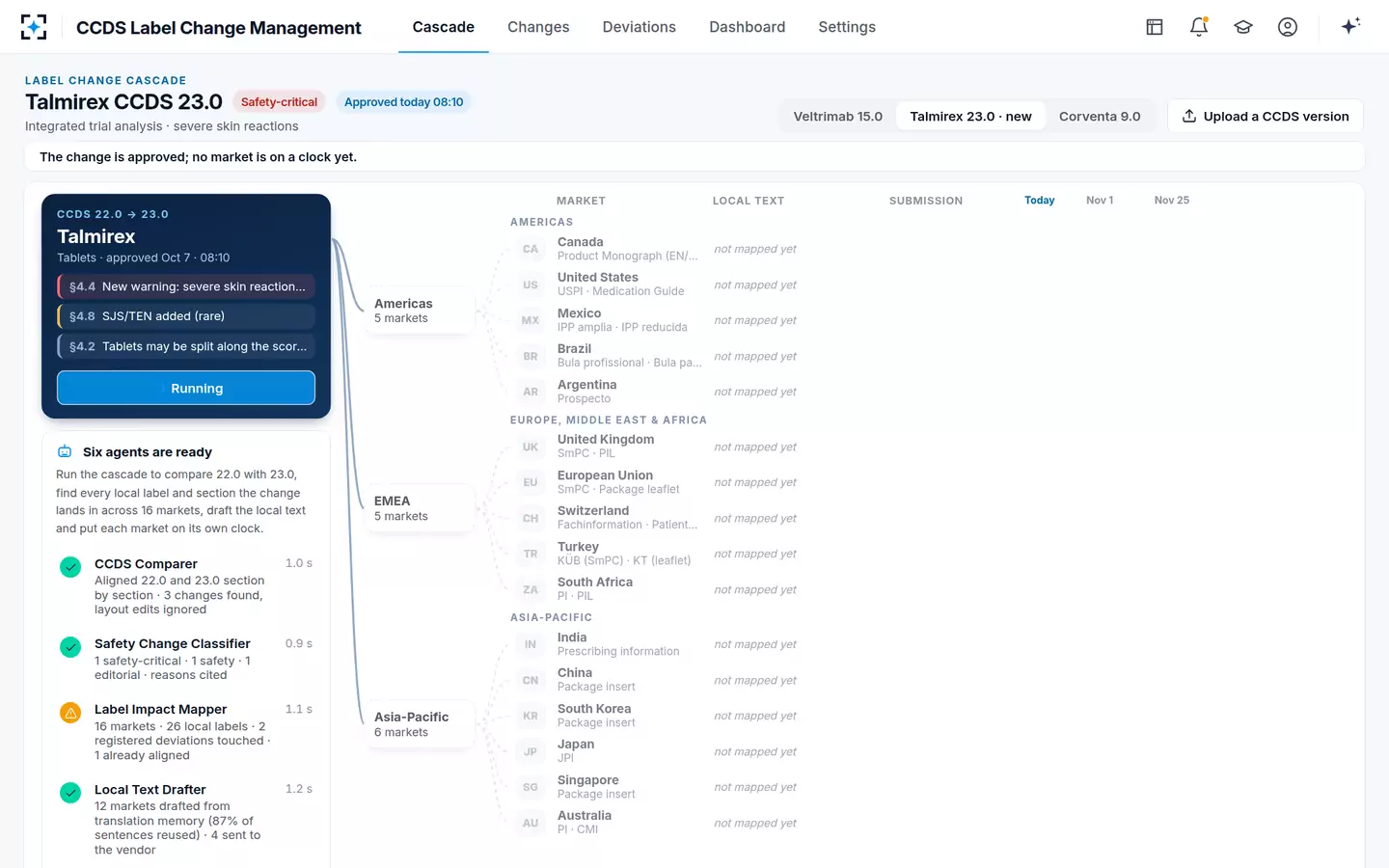
Label Impact MapperFinds every market's documents and sections and compares meaning rather than words: update, already aligned, not in this label, or deviation.
Never: Never marks a passage aligned without a cited local sentence
A person decides
Global medical leadConfirms the safety-critical classification and signs off the new warning wording before it moves on.
A person decides
Affiliate regulatory managerApproves the local text and files it under that market's own procedure, on that market's own deadline.
What the periodic report has to say when the reference information moves
A change to the reference safety information is an event the periodic report has to deal with, in two distinct ways. First, the report needs a reference version, and the European guidance offers the practical rule: "A practical option for the purpose of the PSUR is for each marketing authorisation holder to use the CCDS in effect at the end of the reporting interval, as reference product information for both the risk sections of the PSUR as well as the main authorised indications for which benefit is evaluated."
Second, the change itself is a risk minimisation activity to be evaluated, because "risk minimisation activities evaluated in the PSUR include updates to the product information". So the report must say what the holder did to the product information and whether it worked — which means knowing not only that the core sheet changed, but in which markets the change had actually reached a patient-facing document by the end of the interval, and in which it had not.
That second question is the one a pharmacovigilance system usually cannot answer on its own. It is a question about twenty-six documents, sixteen procedures and sixteen dates, and it is answered by whatever holds the implementation state of the cascade. How one core sheet change reaches every local label is the mechanism behind that answer.
Who confirms a safety-critical class, and on what evidence
Classification sets the clock, so it is the most consequential judgement in the handover. In the sample change the classifier marks one of five changes safety-critical, two safety and two editorial, and cites the reason for each against the study report, the agency request or the committee minutes. It then stops: a safety-critical class is not settled without the global medical lead's confirmation, and safety-critical wording needs medical sign-off before it moves on.
That design is deliberate and it is the right shape. Deciding that evidence is strong enough to warrant a new warning is a medical judgement with consequences for patients; finding which of twenty-six documents the resulting sentence lands in is bookkeeping across registration data. Automating the second is a gift to a safety physician. Automating the first would be taking the decision away from the person whose name is on it.
Every change redlined, with the evidence behind it and the markets it lands in
The version in effect: why the date on a core sheet matters
Two dates attach to any core data sheet change, and conflating them is an easy and expensive error. The first is the date the version was approved — the committee's decision, which is when the company position changed. The second is the date on which each market's text actually said the new thing, which is different in every market and sometimes months later.
Pharmacovigilance needs the first to judge listedness and to pick the version in effect at the end of a reporting interval. Regulators, inspectors and the periodic report's own risk minimisation section need the second. A system that stores one date per change can answer only half the questions it will be asked, and the half it cannot answer is often the one that comes up in an inspection.
In the sample data the gap is visible as soon as the change is approved. The company's own clock gives thirty days to submit and ninety to implement, counted from committee approval — but those are the company's settings, not anyone's law, and the markets underneath them have dates of their own.
One core data sheet change, and three different dates counted from the same morning
- To the Japanese date21 days
- The rest of the company window
- To the company submission date30 days
- The rest of the company window
- To the European submission date54 days
- The rest of the company window
What the authorities publish, and the languages that come with it
One piece of European practice is worth knowing because it changes the cost of a change. When the committee that assesses signals recommends an update to the product information, the agreed wording "is published in all EU official languages, as well as Norwegian and Icelandic", and holders "can use these translations to update the product information of the medicinal products they are responsible for".
That is a substantial amount of translation work handed over at no cost, and a labelling operation that does not look for it will pay a vendor to redo it. It also sets a quality bar for everything else: if a holder's own translation of an equivalent sentence differs from the published European wording, somebody should be able to say why. The practical answer is approved translation memory used first, local template wording second, and a new translation marked for a linguist only when neither exists — which is the order the solution's drafter works in, and the reason 87% of the drafted sentences in the sample change came from approved translations rather than from a vendor.
After the core sheet: the part pharmacovigilance does not own
It is worth being plain about what this solution is and is not. CCDS Label Change Management is not a pharmacovigilance system. It does not receive cases, detect signals, calculate disproportionality or write a periodic report. It begins at an approved core data sheet version and ends when every market has filed and implemented, and the page is stronger for saying so: a safety team evaluating it should be asking whether it closes the gap after its own work, not whether it replaces any of it.
The gap is real, and it is where time is lost. A safety team that hands labelling a new sentence has handed over a fraction of the job. What the receiving team needs is the sentence, the sections it belongs in, the evidence behind it, the classification and who confirmed it, and the date the version took effect. Everything after that — which markets, which documents, which already say it, which have a national authority's wording in the way — is work that can be done from registration data and the previous texts, and it is the work the agents do in the sample change in about a second each.
The handover itself: an approved version in, every market mapped out
Keeping an old product's label honest
The last part of this work has no signal behind it at all, and it is the part most often left undone. Japan's guideline on revising the Precautions names it directly: for drugs, including generic drugs, "in which much time has elapsed since their initiation of marketing and little recent safety information has been obtained, it is important to periodically review those current package inserts from the perspective of whether they are reflecting the latest evidence". The comparison it suggests includes the core data sheet and core safety information, the current status of foreign measures, accumulated literature and, for a generic, the originator's text.
The international guidance points the same way for development documents, where the suggestion is that the development core safety information be updated as needed and, depending on the nature of the information, "as soon as possible and no later than within a month of a decision to add or change information". There is no equivalent published deadline for a marketed product's core data sheet; what there is, is a standing duty to keep the product information current and a continuous duty to evaluate whether the reference information needs revising. A company that wants a number has to set its own, as the sample company does, and should say so rather than cite it as a rule.
For a mature portfolio this periodic review is where quiet drift is found: a market whose text still says what the core sheet said three versions ago, a deviation nobody can explain, a sentence that was shortened by an affiliate and never checked. Where a local label may legitimately differ is the standard against which that review is run.
Questions people ask
What is reference safety information?
It is the safety content in the reference product information — typically the company core data sheet — that the holder requires to be listed in every country where it markets the drug, except where a local authority specifically requires a modification. It is the yardstick for listedness in the periodic report, so it determines whether a reported reaction is treated as listed or unlisted there; expectedness for expedited reporting on a marketed product is judged against the local label instead.
What is the difference between listed and unlisted adverse reactions?
A listed reaction appears in the reference safety information in effect; an unlisted one does not. The distinction governs how the periodic report has to treat a case; for expedited reporting the comparable test, expectedness, is made against the locally approved label. Because it depends on a document that changes, the version and the date of the reference information are part of the answer, not an administrative detail.
How does the core safety information relate to the periodic report?
It is the report's reference. The European guidance offers the practical option of using the core data sheet in effect at the end of the reporting interval as the reference product information, for both the risk sections and the main authorised indications whose benefit is evaluated. Separately, updates to the product information count among the risk minimisation activities the report evaluates.
Who decides that a new adverse reaction goes in the label?
The holder decides to change its own core data sheet, usually through a safety or labelling committee, on the evidence pharmacovigilance has evaluated. A regulator may also recommend it — in Europe, by recommending that the holder update the product information through a variation. In the solution, the agents classify and cite; the global medical lead confirms every safety-critical classification and signs off the wording.
How quickly must the core data sheet be updated after a signal is confirmed?
There is no single published deadline for a marketed product's core data sheet. What is published is a standing duty to keep the product information up to date in the light of scientific knowledge and a duty to evaluate continuously, throughout a reporting interval, whether the reference information needs revising. For development documents the CIOMS guidance suggests updating as soon as possible and no later than a month after the decision. Most companies set their own clock; it is a company rule, and it should be presented as one.
Does a pharmacovigilance system handle the local labels too?
Rarely, and it is worth checking rather than assuming. Safety systems are built around cases, signals and periodic reports; local labels are documents in other languages, under other procedures, with other deadlines. The question to ask of any system is whether it can name, for a given change, which markets have implemented it and on what date — and if it cannot, that work is being done in a spreadsheet somewhere.