The CCDS vs SmPC question almost always arrives as an argument. Head office has approved new core wording; an affiliate says its own authority required something else; somebody has to decide which text the label will carry. The way out is to notice that the two documents are not competing drafts. A company core data sheet is the manufacturer's own instruction to its affiliates, and it binds nobody outside the company. A summary of product characteristics is part of a marketing authorisation, and its content belongs to the authority that granted it. So the question is never which document is right. It is whether this particular difference is one of the shapes a national label is allowed to take — and, if it is, whether anyone has written down why, so that the next core data sheet change does not silently delete it. Botminds' CCDS Label Change Management is built around that second half: it drafts local text sentence by sentence and will not overwrite a registered difference, and it puts every unexplained one in front of a person.
The worked cases below come from the solution's sample data — a fictional company, Northwind Bio, with invented medicines, authority letters and affiliate staff. The regulatory texts quoted are real and linked where they appear.
The core data sheet and the summary of product characteristics, side by side
Company core data sheet: The marketing authorisation holder. It is written, revised and approved inside the company.
Summary of product characteristics: The authority that granted the authorisation. It is part of the authorisation itself.
Company core data sheet: A company body — typically a labelling committee, with medical sign-off on safety wording.
Summary of product characteristics: The competent authority, through a variation procedure. The content "cannot be changed except with the approval of the originating competent authority".
Company core data sheet: Every national label the company produces, and its other official statements about the medicine.
Summary of product characteristics: One medicine in one authorisation, and the package leaflet derived from it.
Company core data sheet: The indications the company will defend globally.
Summary of product characteristics: Only the indications authorised there.
Company core data sheet: By a company decision, effective for the company the day it is signed.
Summary of product characteristics: By a procedure, with a date the company does not set alone.
Company core data sheet: An instruction not yet carried out — or a difference somebody agreed to.
Summary of product characteristics: The authorised position, whatever the core sheet says about it.
What is the difference between a CCDS and an SmPC?
The shortest honest answer is: one is an instruction and the other is a permission. The core data sheet records what the company requires every market to say. The summary of product characteristics records what one authority has agreed the company may say in its territory, and the European Commission's guideline is explicit about the consequence: the document "sets out the agreed position of the medicinal product as distilled during the course of the assessment process. As such the content cannot be changed except with the approval of the originating competent authority" (European Commission, guideline on summary of product characteristics).
That asymmetry explains almost everything that follows. A company can revise its core sheet on a Tuesday morning and have it in force, for itself, by lunchtime. It cannot do anything of the kind to a summary of product characteristics. Between those two moments — the core change and the authorised change — every market the medicine is sold in is, strictly speaking, out of line with the company's own instruction, and the work of carrying one change into every local label is the work of closing that window as quickly as each procedure allows.
There is a second difference people trip over: scope. The core sheet is a single document for the medicine everywhere. A summary of product characteristics is one document for one authorisation, and a company may hold several in Europe alone. A core change that touches four core sections can therefore touch four sections in each of several European documents, each moving under its own procedure.
Three legitimate shapes a local label can take
CIOMS Working Groups III and V did not treat divergence as a failure. They expected it, and they named the forms it takes. A national label may be fully congruent with the core safety information. It may carry the core safety information in full plus something additional. Or — rarely — it may carry less.
The three variants CIOMS names, and what each one asks of a labelling function
| The variant | In the Working Group’s words | What it looks like in practice | What the register has to hold |
|---|---|---|---|
| Full congruence | "full congruence with CCSI — i.e., the ‘label’ in the country contains information identical to that in the CCSI" | The ordinary case, and the one the next core change updates mechanically. | Nothing. There is no difference to account for — only the current approved local text, so the next comparison is honest. |
| Core plus something more | "full inclusion of the CCSI plus supplementary comments or mention of additional adverse experiences for which, in the manufacturer’s opinion, the relationship has not been sufficiently well substantiated" | A typical real deviation: an authority has asked for a warning, a frequency or a monitoring interval the company does not require everywhere. | The addition itself, the authority’s letter or decision, its date, and which core section it attaches to — so the next change to that section meets it. |
| Less than the core | "less information than in the CCSI" — the case "in which a national authority is unwilling to accept the manufacturer’s minimum Company Core Safety Information and requires selective removal of certain items", which the Working Group says "is expected to occur rarely" | Rare, and never a convenience. If a market carries less than the core safety information and no authority asked for that, it is a defect rather than a deviation. | The authority’s requirement in writing, what was removed, and the company’s own position on the risk that is now unlisted there. |
Notice what is missing from the list. There is no variant for "different wording the affiliate preferred", none for "shortened to fit the leaflet", and none for "the translation drifted". Those are not shapes a national label may take; they are findings. Which is why the practical test for any difference is not whether it is defensible in principle but whether somebody can produce the document that required it.
Can a local label say something different from the core data sheet?
Yes — and ICH builds the possibility into its own definition. Reference safety information is what the holder requires to be listed everywhere, with one carve-out:
"All relevant safety information contained in the reference product information (e.g., CCDS) prepared by the MAH and which the MAH requires to be listed in all countries where the company markets the drug, except when the local regulatory authority specifically requires a modification."
ICH E2C(R2), Appendix A, item 14, Reference Safety Information
The exception is narrow and it is worth reading literally. It is not "except where local practice differs", nor "except where the affiliate disagrees". It is where the local regulatory authority specifically requires a modification. That phrase is the whole test, and the evidence for it is a document: a letter, a condition of approval, an assessment report conclusion, a published national requirement. A difference with such a document behind it is a deviation and has to be respected by every subsequent change. A difference without one is work that was never finished.
CIOMS reaches the same place from the other direction, allowing that national data sheets "may contain safety information that differs slightly from the CCSI; particularly they may contain additional information pertinent to a particular country" — and explaining why: indications, treatment patterns, medical practice and legal considerations in a country may govern what safety information goes beyond the core, and the wording may differ too.
Why core wording cannot simply be pasted into an SmPC
Even when the meaning is identical, the text usually cannot be. A summary of product characteristics has a fixed section structure and house conventions, and the sentence has to arrive in the form that structure expects. Adverse reaction frequencies have to be expressed in the template's own categories rather than the company's. The patient leaflet derived from the document has its own reading-level obligations, so a core sentence often becomes two sentences in plain language there. And a national document carries only what is authorised in that market, so core wording that refers to an indication or a presentation not registered there has to be adapted or left out.
Then there is the matter of who decides. A core change proposing to replace an authority-required phrase is a change to the authorised text, and in the European Union that needs the authority's approval like any other. In Brazil the direction of the change decides the route: the two inserts — "bula para o paciente: bula destinada ao paciente, aprovada pela Anvisa, com conteúdo sumarizado, em linguagem apropriada e de fácil compreensão" and "bula para o profissional de saúde: bula destinada ao profissional de saúde, aprovada pela Anvisa, com conteúdo detalhado tecnicamente" (RDC 47/2009, Art. 4º) — are both approved documents, and, for a medicine without a reference insert of its own, removing or altering safety information in either has to be petitioned and analysed before it can be published. Overwriting a Brazilian sentence that an authority asked for is therefore not a wording preference. It is an alteration nobody filed.
Japan adds a different caution, aimed at the opposite error. Its ministry's guideline on revising the Precautions tells holders that when "establishing safety-ensuring measures based on foreign regulatory information (including revision of CCDS, CCSI), confirm the rationale of the foreign regulation and consider whether safety-ensuring measures are necessary at medical practices in Japan" (MHLW notification PFSB/SD 0929-2, attachment section 4, in PMDA's English translation). A core change is a reason to ask the question in Japan, not an answer to it.
The deviation register: what a usable entry contains
A deviation register is the only artefact that makes a difference survivable. Without one, every local difference has to be re-litigated at every change, and the fastest way to resolve an argument under deadline pressure is to overwrite the local text — which is exactly the failure the register exists to prevent.
A usable entry has seven parts: the market and the document; the section, in both the core and the local numbering; the core wording and the local wording, side by side; the category of the difference — required by the authority, a template or legal necessity, or historical; the evidence, as an openable document and a date; the decision, with who made it and when; and a review state, because a difference that was right in 2022 may have been overtaken by a later core change.
The category matters more than it looks. Only the first category is immovable. In the sample solution a setting locks every health-authority-mandated deviation so that only a new letter from that authority can retire it, and the drafter is not permitted to overwrite one at all: it keeps the local wording, shows both versions, and asks the global labelling lead to decide. The other categories are open to revisiting, and should be revisited, because an unexamined historical difference is how a label quietly stops matching the medicine.
The deviation register in CCDS Label Change Management
Health-authority-mandated wording, and why it outlives the next change
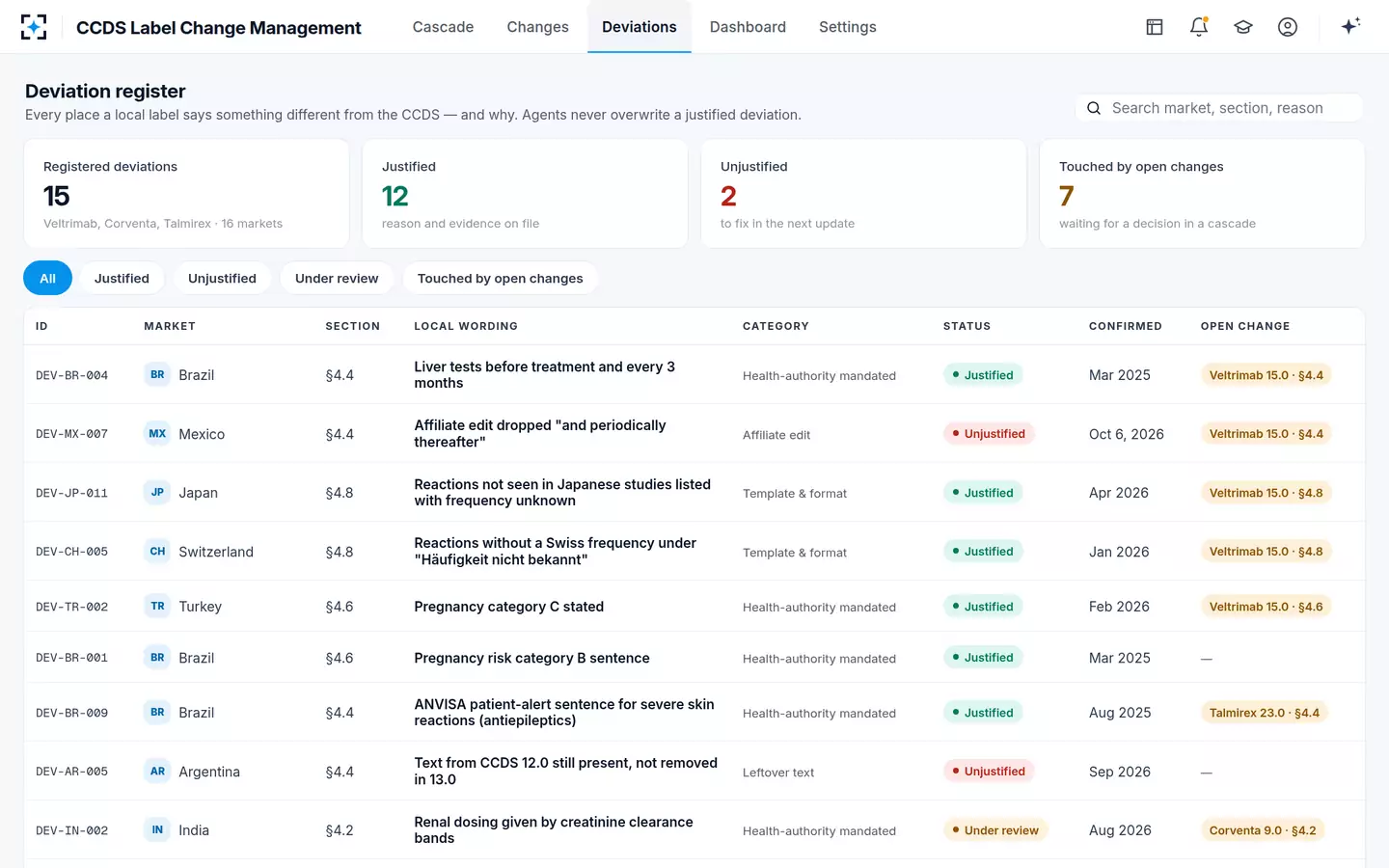
Take the clearest case in the sample data. The core sheet says liver function should be monitored "periodically". Brazil's insert says every three months, because the Brazilian authority asked for it in a letter, and the register holds that letter as entry DEV-BR-004. Now the core sheet changes. What should happen?
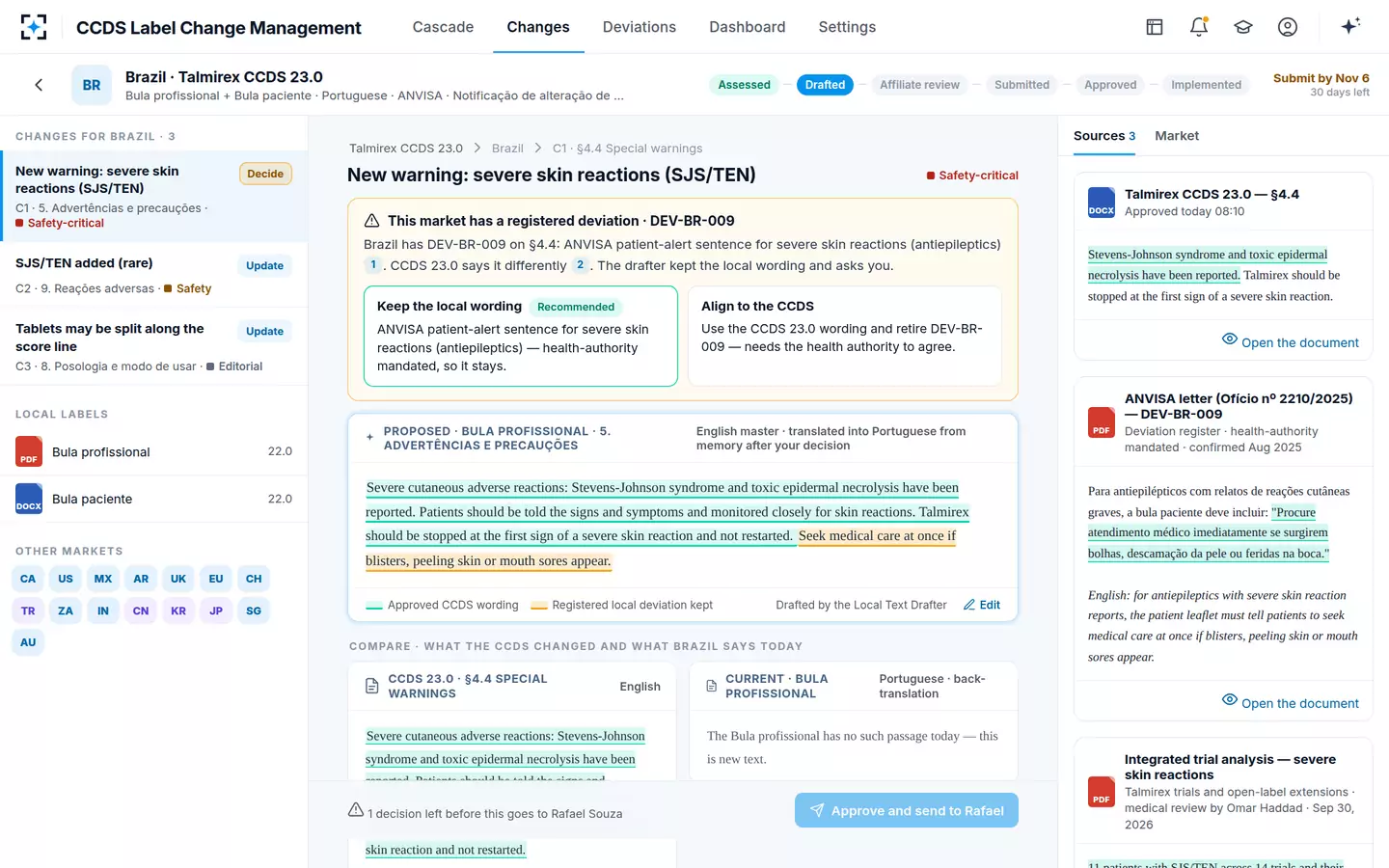
Not an overwrite. The local wording is stricter than the core requirement and therefore still satisfies it — a market testing every three months is a market testing periodically — and it is what an authority required. The right behaviour is to keep the local sentence, draft the rest of the section from the new core text, and put the question to the person who owns the global document: keep the local wording, or go back to the authority and ask to align. In the sample solution that is exactly what happens, and the decision is re-confirmed and dated rather than assumed.
The second Brazilian entry shows the same rule from the other side. DEV-BR-009 records an authority letter requiring a patient alert about severe skin reactions. When a new core warning on severe skin reactions arrives, the two are about the same risk, so a naive mapping would replace the local sentence with the core one. The register is what stops it: the letter is still in force, and nothing about a new core sentence retires it.
The habit to build is to treat a mandated deviation as an inherited obligation with its own expiry conditions, not as a difference to be reconciled. It expires when the authority that required it says so, and at no other moment.
How much do labels actually differ? What the comparisons found
Divergence is not an occasional embarrassment. Studies that compare the initial labelling of the same new medicines across regions find that a large minority of safety warnings do not match, even between the two regions whose requirements are closest.
Safety warning concordance in the initial labelling of the same new medicines
Two readings of those numbers are useful. The first is that a company whose register holds three deviations for a medicine sold in sixteen markets may well be under-counting: the differences exist whether or not anyone has written them down. The second is that the right response is not to drive the number to zero. Some of that divergence is authorities doing their job in their own context — which is precisely what the Japanese guidance asks for. The goal is that every difference is accounted for, not that no difference exists.
Stricter, weaker or merely different: three cases decided three ways
Stricter, with a letter. Brazil's three-month monitoring interval against the core sheet's "periodically". The local text does more than the core requires and an authority asked for it. Decision: keep the local wording, note it against the new core section, and move on. The affiliate is not asked to defend it again.
Weaker, with nothing behind it. In the sample data a Mexican affiliate shortened the local leaflet to fit its space and dropped the words "y periódicamente después" from a monitoring sentence. Back-translated, the sentence now says patients are tested once, before treatment. That is less than the core safety information requires, nobody required it, and no register entry covers it. Decision: it is not a deviation at all. It is sent back with the core sentence, or escalated, or accepted only with a justification that safety has to sign. The useful rule is that the person who notices a weakening never resolves it alone.
Merely different. A market whose template expresses adverse reaction frequencies in its own categories, or whose patient document splits one core sentence into two plain-language ones. These are not deviations and should never enter the register, because a register full of translation artefacts is a register nobody reads. The test is whether the meaning differs, not whether the words do.
Sentence by sentence, with the source of each, before anyone approves
Reading a local label against the core sheet, sentence by sentence
The review that catches real problems is not a document-level comparison; it is a sentence-level one, done in the local language, with the same questions asked of every passage.
Six questions before a deviation is accepted, and the one answer that ends the discussion
- Does the local sentence differ in meaning, or only in wording?
Back-translate before deciding. A template’s phrasing is not a deviation; a changed instruction is, whatever the words look like.
- Does it say more than the core sheet, or less?
More is usually acceptable and must still be recorded. Less is the case CIOMS expects to be rare, and needs the authority’s own requirement behind it.
- Who required it — and can you open the document that proves it?
This is the answer that ends the discussion. A named letter or decision with a date settles it; "the affiliate has always done it this way" does not.
- Which core section does it attach to?
A deviation that is not filed against a core section will not be met by the next change to that section, which is how mandated wording gets deleted.
- Is the requirement still in force?
Authority requirements can be superseded. A register with no review state slowly fills with obligations that expired years ago.
- What happens to listedness in that market?
If a market carries less than the core safety information, decide deliberately what that means for case handling and periodic reporting there, rather than discovering it later.
Done this way, the review produces one of three outcomes per passage and never a shrug: aligned, a registered deviation with its evidence, or a finding with an owner. That is also the shape the core data sheet itself should be built in, because a core document with stable section numbers and one instruction per sentence is a document a deviation can be filed against.
Questions people ask
Which wins, the CCDS or the SmPC?
In its own territory, the summary of product characteristics. Its content is part of the marketing authorisation and cannot be changed without the approval of the authority that granted it. The core data sheet wins inside the company: it decides what the company requires its affiliates to seek, and it is the reference against which adverse reactions are judged listed or unlisted. The practical consequence is that a core change is a mandate to file, never a mandate to edit.
What is a label deviation, and how is it registered?
A deviation is a deliberate difference between a national label and the core data sheet, recorded with the reason it exists. A usable entry holds the market and document, the section in both numbering systems, both wordings, the category of difference, the evidence as an openable document with a date, who decided and when, and a review state. The entry has to be filed against a core section, or the next change to that section will not meet it.
Who decides whether to keep a local deviation?
The person who owns the global document — in practice the global labelling lead, with medical sign-off where safety wording is involved — because the decision affects every market, not only the one asking. What the affiliate owns is the evidence: the letter, the condition, the national requirement. A decision made by the affiliate alone tends to preserve differences nobody can account for; a decision made by head office alone tends to delete the ones an authority required.
Can a regulator refuse the company's core safety wording?
Yes. ICH's own definition carves out the case where a local regulatory authority specifically requires a modification, and CIOMS describes a national authority that is unwilling to accept the manufacturer's minimum core safety information and requires selective removal of items — while adding that this is expected to occur rarely. If it happens, record what was removed, the authority's requirement, and the company's position on the risk that is now unlisted in that market.
What happens if a local label is stricter than the CCDS?
Usually nothing needs to happen, provided it is recorded. A market that requires liver tests every three months where the core sheet says periodically is doing more than the company requires, not less, so the core requirement is still met. It becomes a problem only when the next core change arrives and somebody replaces the local sentence with the new core one — which is why the deviation has to be filed against the core section it relates to.
How do you justify a deviation from the core data sheet?
By producing the document that required it, not by arguing from practice. Name the authority, the letter or decision and its date, state what it required and which core section it displaces, and record who accepted it on the company's behalf. If no such document exists, the honest conclusion is that this is not a deviation but an unexplained difference, and it belongs on a findings list with an owner and a date.