The implementation date of a type II variation is the date the new wording may actually be used, and in the centralised procedure it is almost never the date the Committee adopted its opinion. Which date it is depends on the variation. A type II variation listed in Article 23(1a)(a) of the variations Regulation may only be implemented once the Commission has amended the marketing authorisation and told the holder so. A type II variation that needs no amendment may be implemented as soon as the Agency reports the favourable outcome — except that where the product information changes, the Agency expects the holder to wait for the linguistic review to finish first. And a variation related to a safety issue has no calendar date at all: it must be implemented without delay, within a timeframe agreed with the Agency. Botminds' CCDS Label Change Management treats that as what it is — a date to be planned, not read off — and forecasts the European filing from the steps still ahead, the way it does for every other market a core data sheet change reaches.
The worked examples below come from a fictional company in the sample data that ships with the solution: Northwind Bio, its products Veltrimab and Talmirex, its study VLT-305, and the people named on its screens are all invented. The European figures come from the Agency's own procedural advice and from the Commission's guidelines, linked where they appear.
The four European dates a labelling team has to hold at once
Day +5
after the opinion, the holder sends the translations to the member states
Day +19
the latest day national reviewers send their comments back
Day +25
the final translations go to the Agency; no revision after Day +27
2months
from opinion to Commission Decision on a 30-day safety timetable
When can you implement a type II variation?
Three answers, and the holder has to know which one it is in before it tells supply chain anything. The Agency's post-authorisation advice sets them out together. Type II variations listed in Article 23(1a)(a) "may only be implemented once the Commission has amended the marketing authorisation and has notified the MAH accordingly". Type II variations that need no amendment, or that ride a yearly update of the Commission Decision, "can be implemented once the MAH has been informed of the favourable outcome by the Agency". And variations related to safety issues, including urgent safety restrictions, sit outside both.
Variations related to safety issues, including urgent safety restrictions, must be implemented without delay and/or within a timeframe agreed by the MAH and the Agency.
EMA, post-authorisation procedural advice, Implementation
Read as a labelling lead rather than as a lawyer, that sentence says something awkward: on the change that matters most, the implementation date is negotiated. There is no period to count and nothing a company clock set at thirty or ninety days can tell you. What a holder can do is arrive at that conversation already knowing how long its own steps take — translation, affiliate review, artwork, print — because the timeframe it agrees is only credible if it can meet it.
Article 23(1a)(a) is worth reading once, because membership of its list decides both the implementation and the date printed on the text. The list covers centrally authorised changes the Commission must decide within two months of receiving the opinion: a new or modified therapeutic indication, a new contraindication, a change in posology, certain vaccine changes, and other type II variations meant to implement a change to the authorisation because of a significant public health concern. Everything else gets twelve months. A new warning in section 4.4, on its own, is often not on that list unless it comes with an agreed communication to healthcare professionals or follows an urgent safety restriction, which the Agency's advice counts as a significant public health concern — and that is exactly the kind of detail that decides whether a market's text is live in March or in the autumn.
Three European clocks: assessment, decision and implementation
The European sequence is three clocks running one after another, and only the first is the one most project plans draw. Assessment is the timetable the variation is placed on. Decision is the Commission's period after the opinion. Implementation is when the wording may be used, and it is governed by the rules above plus one expectation about language.
A safety type II variation in the centralised procedure, and the language versions inside it
- Assessment on a 30-day timetable30 days
- Opinion to Commission Decision, up to two monthsup to 2 months
- Translations to the member states+5
- National comments back+19
- Final translations to the Agency+25
Drawn this way, the uncomfortable part is visible. The language work is not a tail at the end of the procedure; it runs inside the decision period, and it begins five days after an opinion the holder cannot schedule. For urgent 30-day type II variations on safety issues the language work can start much earlier: the holder "will have to send the translations to the Member States upon validation of the Type II variation", so the linguistic review runs beside the assessment — an arrangement the Agency says has to be discussed and agreed with it before the procedure starts.
Safety variations: what without delay means in practice
Without delay is not a period, but it is not nothing either. In practice it means three things a labelling team can plan for. First, the agreed timeframe is a commitment, so it has to be built from steps and durations the holder can evidence, not from a round number. Second, it can start earlier than the opinion: on an urgent timetable agreed with the Agency, the translations go out on validation, not on adoption. Third, it ends later than the submission, because the wording has to reach a printed leaflet in every pack on every national market, and a national market's leaflet is in its own language by law.
That last point is the one most global clocks miss. Under Directive 2001/83/EC, the labelling particulars have to appear in an official language or languages of the member state where the product is placed on the market, as that state specifies. A centrally authorised product carries one set of annexes in all EU languages, and the Agency's advice adds that the Icelandic and Norwegian versions must always be included. Every one of those versions has to be right before the change is implemented, because every one of them is the text a patient in that country reads.
Four European routes for a change to the product information, and when each may be used
| Route | Who assesses it | Linguistic review | When the holder may implement |
|---|---|---|---|
| Type IA | Notification after the change is made | None in the other EU languages; the holder is responsible for the correctness of its own translations | The change is made first and notified afterwards; translation quality is the holder's own risk. |
| Type IB | Notification assessed before the change is made | Where the wording has not been reviewed before, in parallel with the 30-day assessment | After the authority accepts the notification, or it is deemed accepted. |
| Type II, 30-day timetable | Committee, on a monthly start timetable for urgent safety issues | Yes; on an urgent timetable agreed with the Agency, started on validation rather than on the opinion | Without delay and within a timeframe agreed with the Agency. |
| Type II, Article 23(1a)(a) | Committee, decision within two months of the opinion | Yes, Day +5 to Day +25 after the opinion | Only once the Commission has amended the authorisation and notified the holder. |
| Article 61(3) notification | The Agency, on labelling or leaflet text not connected with the SmPC | Handled within the notification | On the Agency's response, or after 90 days of silence. |
Why the translations decide the implementation date
For the one case where a holder could implement immediately, the Agency says plainly that it should not.
However, it is expected that where the variation includes changes to the product information, the MAH waits for the finalisation of the linguistic review process by the Agency before implementing the variation, as appropriately checked translations are considered essential for a correct implementation of the variation.
EMA, post-authorisation procedural advice, Implementation
The reasoning is worth keeping: a translation that has not been checked is not an implementation of the change, it is a different change. So the European implementation date is the date the last language version is finished, and the linguistic review process says when that is. The holder sends the translations to the member states' contact points by Day +5. Each translation gets one member state's review, co-ordinated by the national reviewer, whose comments come back by Day +19 at the latest. The holder returns final translations, tracked and clean, to the Agency by Day +25, and after Day +27 there is no further revision of the annexes.
Twenty days, then, to receive comments in every European language, decide which to accept, justify the ones it does not, and send a package that matches a checklist. A holder that misses it loses more than a few days: the Agency warns that "poor quality translations or a poor implementation of Member States' comments or absence of a completed QRD form 2 may lead to a delay in transmission to EC". This is the one place in the European sequence where the holder's own quality decides the date.
The language round trip, and where CCDS Label Change Management buys back the week
Agent
CCDS ComparerAligns the previous and the new core data sheet section by section and lists each real change with its old and new text.
Never: Never merges two changes into one
Agent
Label Impact MapperFinds the European documents and sections the change lands in, and marks each one update, already aligned, not in this label or deviation.
Never: Never marks a passage aligned without a cited local sentence
Agent
Local Text DrafterDrafts each language sentence by sentence: approved translation memory first, then local template wording, then new translation marked for a linguist.
Never: Never overwrites a registered deviation
A person decides
Translation vendor linguistTakes the languages whose memory match falls below the threshold set in the solution, and returns them by the date the plan assumes.
A person decides
National reviewersOne member state reviews each language version and sends comments to the holder by Day +19.
A person decides
Global labelling leadDecides each deviation, accepts or justifies each national comment, approves and e-signs the text that goes back to the Agency.
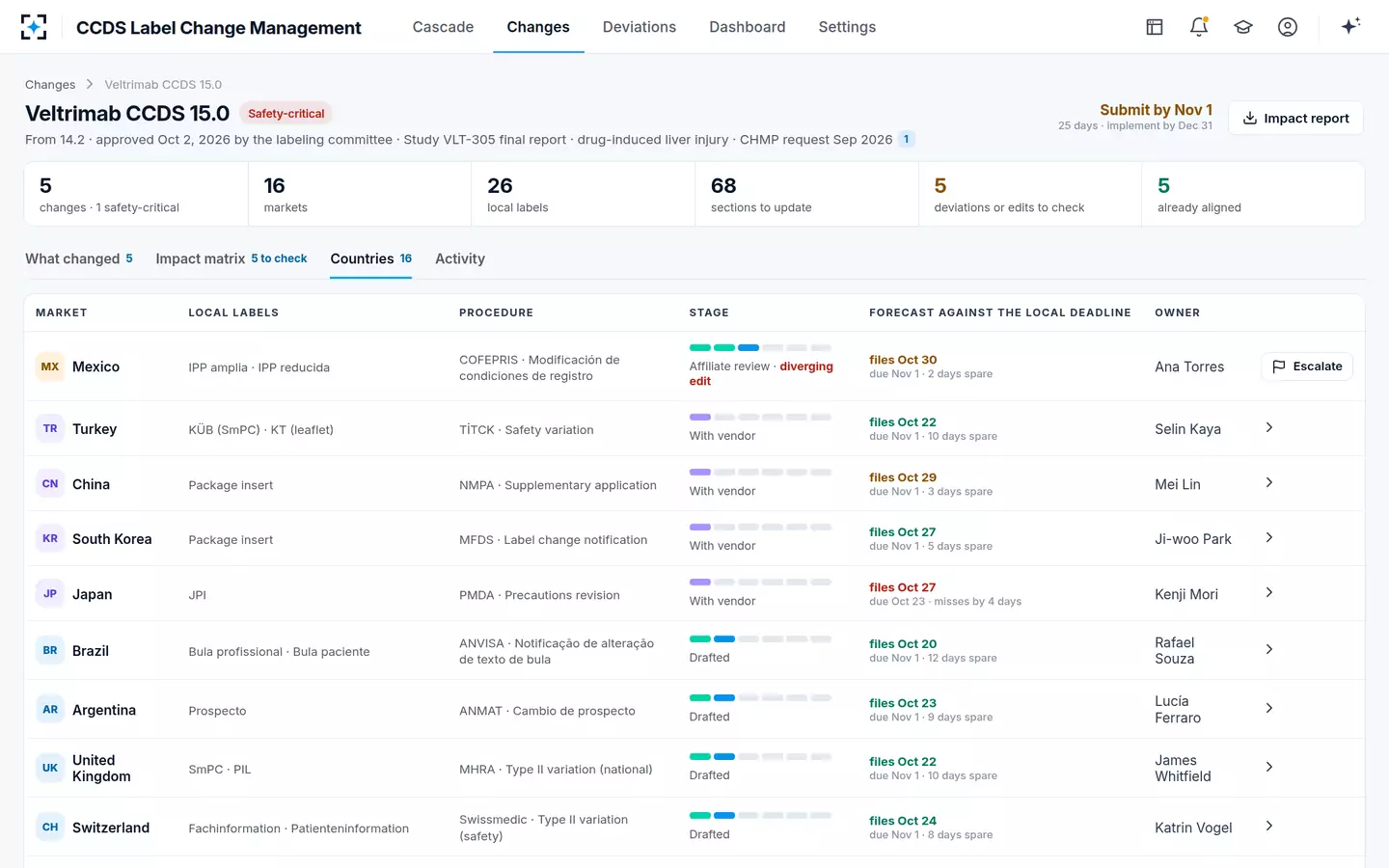
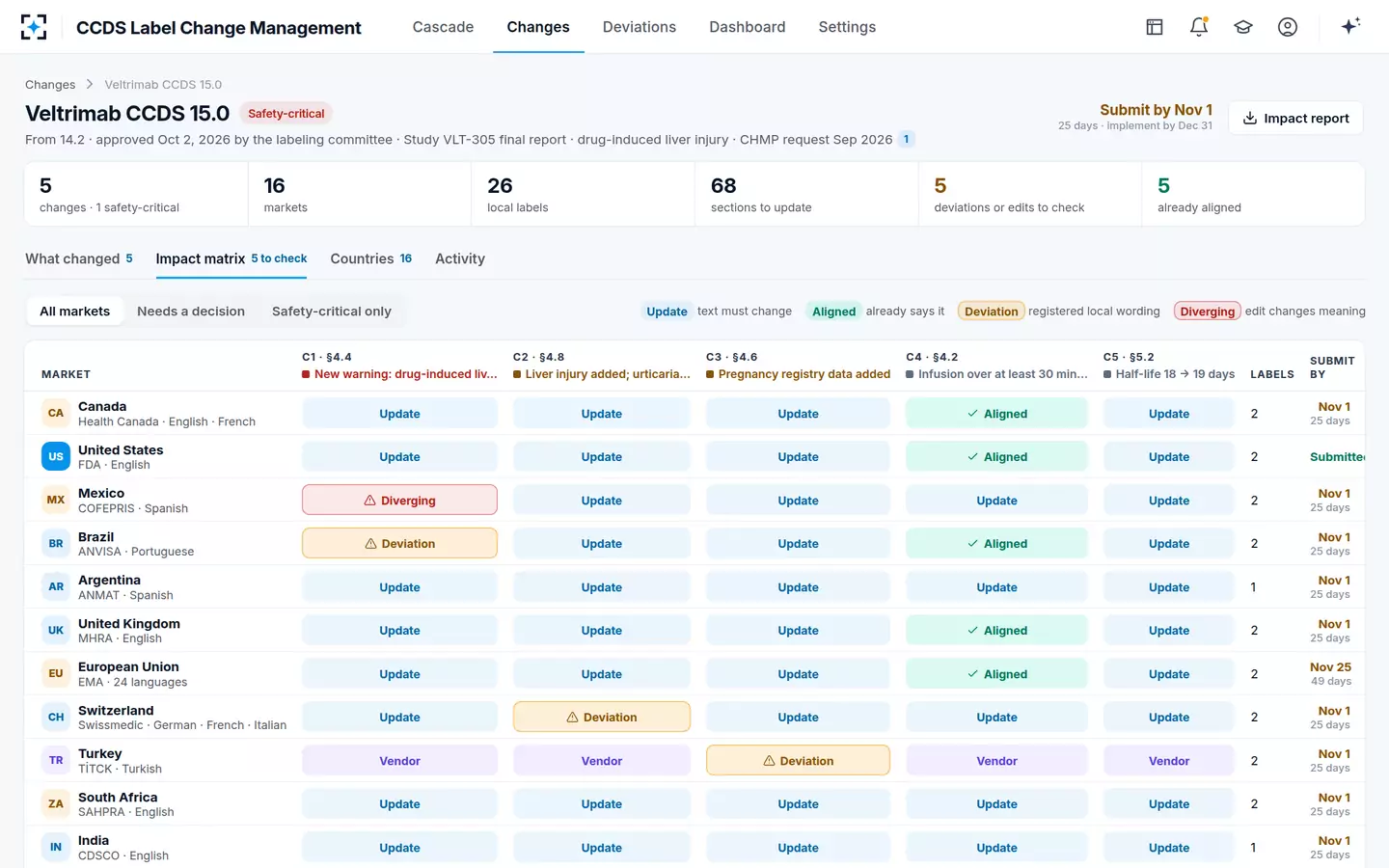
The days a holder can lose sit between the opinion and the first draft, and it is spent deciding what each language version should say. That is the work the solution does before the opinion arrives, from the core data sheet version the committee approved: every European section the change touches, each sentence drafted with the approved translation it came from, and the languages that need a linguist sent out early rather than late. How one core sheet change reaches every local label follows the same mechanism across all sixteen markets in the sample.
Urgent safety restrictions and the fifteen-day application
An urgent safety restriction is the route for a change that cannot wait for a variation at all: an interim change to the product information, taken because of a risk to public health, which is applied first and regularised afterwards. The regularisation is the part teams forget. The Agency's advice is explicit about the deadline.
Variation applications reflecting the outcome of an Urgent Safety Restriction (USR) shall be submitted immediately and in any case no later than 15 days after the initiation of the USR to the Agency.
EMA, post-authorisation procedural advice, on submitting the variation
So an urgent safety restriction creates two dates, not one: the day the restriction is applied, and a day no later than fifteen days afterwards by which the corresponding variation has to be in. For a global labelling team this is the sharpest example of why a single company deadline is the wrong instrument. The European fifteen days run from the initiation of the restriction, which may be weeks before or after the committee that approved the core data sheet change ever met.
What an Article 61(3) notification can and cannot carry
Not every leaflet change is a variation. The Agency's advice defines the alternative: a so-called "61(3) Notification" is "a change to an aspect of the Labelling and/or Package Leaflet (PL) text not connected with the Summary of Product Characteristics (SmPC)", laid down in Article 61(3) of Directive 2001/83/EC. It is the route for the things that live only on the carton and in the leaflet — a change of local representative, a new pack presentation's details, layout and mock-up changes — and not for a new warning, because a new warning is connected with the SmPC.
Its timing rule has a quirk worth knowing. If the Agency does not issue its response within ninety days of the request being introduced, "the applicant may put the change into effect". Silence is permission. That is a useful fact for planning artwork, and a dangerous one for planning safety text, because the kind of change that qualifies for the route is by definition not the kind that carries a new warning. A labelling team that files a safety change as a 61(3) notification to catch the ninety-day rule has chosen the wrong instrument.
Nine things that have to be true before a new European leaflet is printed
- The route is settled, and with it the implementation rule
Each of type IA, IB, II and an Article 61(3) notification answers "when may we use this text" differently.
- You know whether the variation is listed in Article 23(1a)(a)
If it is, implementation waits for the Commission Decision, and so does the date printed in section 10.
- For a safety variation, the timeframe is agreed and written down
Agree it against your own steps, not a company default.
- Every language version has been through one member state's review
Comments by Day +19, final translations by Day +25, no revision after Day +27.
- Comments you did not take have a justification agreed with that member state
The Agency checks that comments were implemented before sending the texts on.
- The date of revision of the text in section 10 is the right date
- User consultation has been considered, and the answer is written down
Significant leaflet changes, and products with particular critical safety issues, are where the readability guideline expects it.
- Registered national deviations are still in the text
A national authority asked for them; a new European master is not a reason to delete them.
- The artwork cycle has a date behind the implementation date, not in front of it
The date of revision of the text, and what a reader sees
Section 10 of the SmPC, and the corresponding place in the leaflet, carries the date of revision of the text. It is the one date a prescriber and a patient can see, and the Agency says which date belongs there. For type II variations listed in Article 23(1a)(a) it "should be the date of the Commission Decision amending the marketing authorisation". For type II variations not on that list, which follow a yearly timeframe for updating the decision, it should be the date the positive opinion was adopted.
So the published date on a European label is neither the day the committee approved the core wording nor the day the leaflet was printed: it is the date of whichever European act governed that variation. This matters when a safety team is asked, months later, to show when a warning reached each market. A global labelling view that stores one implementation date per change has already lost the answer.
Does a changed package leaflet need user testing again?
Sometimes, and the test is not whether the change is large but what kind of change it is. The Commission's readability guideline puts the need for user consultation, in principle, on changes to an existing authorisation that make significant changes to the package leaflet — whether by variation or by an Article 61(3) procedure. It then names four situations where a consultation is always required: a first authorisation with a new active substance, a change of legal status, a new presentation, and medicinal products with particular critical safety issues.
That fourth case is the one a safety change can land in. A new warning for a serious reaction, added to a leaflet that patients have to act on, is the profile the guideline has in mind, and a holder that assumes testing applies only to new products can find a consultation sitting between its approved wording and its printed pack. The guideline also allows evidence from tests on similar leaflets, on a sound justification — a route worth considering early rather than discovering late.
User consultation usually takes weeks rather than days, and it belongs in the forecast at the moment the change is classified, not when the text is final. What happens after the text is approved takes the rest of that path, through artwork and into the pack.
Every market on its own clock, including the European one
Mutual recognition and national labels: the same change, later
Most products are not centrally authorised, and the variations Regulation gives those routes their own rule. For variations submitted under the mutual recognition and decentralised chapter, implementation comes "30 days after the competent authority of the reference Member State has informed the holder that it has accepted the variation pursuant to Article 10, under the condition that the documents necessary for the amendment to the marketing authorisation have been provided to the Member States concerned". The thirty days are a real period; the condition attached to them is the part that slips, because providing those documents to every concerned member state is the holder's own work.
For a company with a mixed portfolio this is the quiet source of divergence. One core data sheet change produces a centralised implementation on the Commission's decision, a mutual-recognition implementation thirty days after the reference state accepts, and a set of purely national implementations on each authority's own terms. One change, one meaning, and a dozen different days on which patients see it.
One change, five sections, and a European row with a date of its own
The quotation from the Regulation above is from the Commission's consolidated text of August 2013. The Regulation has been amended since, most recently by Delegated Regulation (EU) 2024/1701, applicable from 1 January 2025, so check the current consolidated text before relying on its exact wording. Where a local label may legitimately differ from the core sheet takes up what happens when one of those national texts is deliberately not the same.
Questions people ask
How long does a safety type II variation take, start to decision?
It depends on the timetable the variation is placed on and on what follows the opinion. The Agency's advice says type II variation procedures following a 30-day timetable, such as urgent safety issues, will in principle follow the monthly start timetable, are likely to be discussed at the plenary meeting, and require a Commission Decision within two months of the opinion. Add the post-opinion language work, which runs from Day +5 to Day +25, and the realistic answer for a safety change is a quarter, not a month.
When must a safety variation be implemented?
Without delay, within a timeframe agreed between the holder and the Agency. There is no fixed period in the Agency's advice, which is why a company clock expressed in days cannot answer the question on its own. The useful preparation is to know how long your own translation, affiliate review and artwork steps take, so the timeframe you agree is one you can meet.
Do you have to wait for the translations before implementing a variation?
Where the variation changes the product information and could otherwise be implemented on the favourable outcome, yes: the Agency expects the holder to wait for the linguistic review to finish, because appropriately checked translations are considered essential to implementing the variation correctly. Where the variation is listed in Article 23(1a)(a), the question does not arise, because implementation waits for the Commission Decision in any case.
What date goes in section 10 of the SmPC?
The date of revision of the text is the date of the Commission Decision amending the marketing authorisation for a type II variation listed in Article 23(1a)(a), and the date the positive opinion was adopted for a type II variation not on that list which follows a yearly timeframe for updating the decision. It corresponds to the European act that affected that particular annex, not to the date the company approved the wording.
What is an Article 61(3) notification for?
A change to labelling or package leaflet text not connected with the Summary of Product Characteristics — the carton and leaflet matter that does not touch the prescribing text. Its distinctive rule is that if the Agency's response is not issued within ninety days of the request being introduced, the applicant may put the change into effect. It is not a route for a new safety warning, which by definition is connected with the SmPC.
What is an urgent safety restriction?
An interim change to the product information applied because of a risk to public health, taken before the corresponding variation has been approved. The variation that reflects it has to be submitted immediately, and in any case no later than fifteen days after the restriction was initiated. Like any variation related to a safety issue, it must then be implemented without delay and within a timeframe agreed with the Agency.