CCDS labeling — or CCDS labelling, depending on which side of the Atlantic wrote your procedure — is the whole job of carrying a change in the company core data sheet into every local label that has to answer to it. It is not the writing. The sentence the committee approves is usually a paragraph long and was argued over for weeks before the meeting. The hard part begins the moment it is signed: finding every document, in every market, that now says something the core sheet no longer says, and deciding for each one whether it has to change, whether it already agrees, whether it does not contain that passage at all, or whether a difference is there on purpose and must be kept. Botminds' CCDS Label Change Management does that search from the registration data and a section map rather than from memory, and produces a task per market with its own procedure, owner and deadline before the first affiliate email goes out.
The worked figures below come from the solution's sample data, in which a fictional company, Northwind Bio, carries two core data sheet changes through sixteen markets; its medicines, studies, deviations and people are all invented. The regulatory rules quoted are real and linked where they appear.
What one safety change turned out to touch
26labels
local documents under one core data sheet change, in 16 markets
68
national sections to update across those documents
5
registered differences or affiliate edits standing in the way
5
passages already saying what the new core text says
What happens to local labels after a CCDS change?
Nothing happens automatically, and that is the whole problem. A core data sheet has no legal force over a national document. It is the company's own instruction, and every national document it governs is held by a different authority under a different procedure. So the approved change creates an obligation inside the company, and a queue of separate regulatory actions outside it.
The obligation is not vague. CIOMS Working Groups III and V put the core safety information at the base of every official national data sheet, package insert and product label the manufacturer produces, and of its other official statements about the medicine (CIOMS, section 2.f). In the European Union the duty is written into law: the holder "shall ensure that the product information is kept up to date with the current scientific knowledge, including the conclusions of the assessment and recommendations made public by means of the European medicines web-portal" (Directive 2001/83/EC, Article 23(3)). Neither of those tells you which documents, or by when.
So the first deliverable after approval is a list, not a draft. Every national document that holds the passage, named; the section in each; what has to happen to it; who owns it; under which procedure; against which date. Everything downstream — translation, affiliate review, filing, artwork — is an elaboration of that list, and every day the list is wrong is a day spent in the wrong markets.
The four answers a market can give: update, aligned, not here, deviation
For every passage in every national document, exactly one of four answers applies, and the discipline of forcing the answer into one of four buckets is what turns a vague impact assessment into work anyone can pick up.
Update. The document says something the core sheet no longer says, or is silent where the core sheet now speaks. This is the ordinary case and it produces a draft, a procedure and a date.
Already aligned. The local text already carries the meaning of the new core wording, often because that market got there first — an authority asked for the warning two years ago, or a regional template always carried it. No submission is owed. The rule that makes this answer safe is that it must be evidenced: the claim that Spain already says this is worth nothing without the Spanish sentence quoted beside it. In the solution the mapper is not permitted to mark a passage aligned without citing the local sentence it is relying on.
Not in this label. The passage has no home in that document — the indication is not registered there, the presentation is not sold there, the national template has no such section. This answer needs the registration data behind it, not an opinion, because "we don't think Korea has that section" is how a market gets missed for a year.
Deviation. The local text differs on purpose, and the difference is recorded with the letter or decision behind it. This answer never goes straight to a draft; it goes to a person, because resolving it means choosing between the company's new wording and something a national authority asked for. Which differences are legitimate, and how a deviation is registered, is a question in its own right.
A fifth state is worth tracking separately even though it is not an answer: a passage where an affiliate has already edited the local text in a way nobody registered. On the sample change that is Mexico, where a shortened leaflet dropped two words from a monitoring sentence. It is not a deviation; it is a defect that the cascade happens to surface.
The 78 national sections one change reached, by the answer each gave
Veltrimab core data sheet 15.0, 26 documents in 16 markets
- Update: 68 sections · 87%
- Already aligned: 5 · 6.5%
- Deviation or edit to check: 5 · 6.5%
Why finding the labels is harder than writing the words
Three things make the search hard, and none of them is solved by a better document template.
The first is that the registration picture is not in the labelling team's head. Which documents exist in which market, for which presentations and which indications, under which licence number — that lives in the registration data, and it changes without anyone telling the labelling function. A list built from memory is a list of the markets somebody happens to think of, which is reliably the large ones.
The second is that national sections do not line up with core sections. A single core warning can land in a European section 4.4 and in parts of 4.2 and 4.8; in the United States it can touch Warnings and Precautions, Adverse Reactions and the patient-directed guide; in Brazil it reaches both the professional insert and the patient insert, which are two documents with different wording obligations. One core sentence routinely becomes four or five national sections.
The third is that agreement has to be judged on meaning, not on words. Two labels can carry the same warning in wording that shares almost nothing — different template, different language, different reading level — and two labels can share almost every word while differing on the one clause that matters. "Monitor liver function periodically" and "realizar provas de função hepática a cada três meses" are not the same instruction, and a text comparison will not tell you which of them is the stricter.
That is why the labels, not the wording, are where the days go — and why the comparison has to be done against the current approved local text of each document, not against last year's copy in a shared drive.
How many documents does one safety change really touch?
There is no published average, and anyone quoting one is describing their own portfolio. What is published is how differently the same medicine ends up being described in different places, which is the same phenomenon seen from the other end. Comparing safety-related labelling changes for new medicines approved in Japan, the United States and the European Union, Fukuda and Narukawa found a concordance rate of "36.1% (30/83) in US-EU, 21.2% (21/99) in Japan-US, and 23.0% (20/87) in Japan-EU" (Pharmacoepidemiology and Drug Safety, 2023). Even between the two most closely aligned regions, barely a third of safety labelling changes matched.
For your own number, the arithmetic is simple and worth doing once: markets where the medicine is registered, times documents per market, times the share of those documents that hold the kind of passage being changed. A medicine in sixteen markets with a professional document and a patient document in most of them is in the mid-twenties before anyone counts cartons. Thirty products in fifteen markets, each document revised four times a year, is about 1,800 national revisions annually — arithmetic on those three assumptions rather than a published benchmark, and the reason implementation, not authorship, is where a labelling function spends its year.
The map you need before the committee meets
Almost everything that makes the first week slow can be built before the change exists, because it is about the products and the markets rather than about this particular sentence. The core-to-local section map — which core section corresponds to which section of which national template — is stable for years. The registration picture changes slowly. The deviation register changes only when a deviation is agreed or retired. The approved translations accumulate.
Eight things to have in hand on the day of approval
- The previous core data sheet version, as a document and not a memory
Answers: what actually changed? A redline against the right predecessor is the only honest starting point, and layout edits must be separated from real ones.
- A classification for each change, with the evidence behind it
Answers: which clock does this start? Safety-critical, safety and editorial changes do not travel at the same speed or need the same sign-off.
- The registration picture per market
Answers: which documents exist where? Without it the list is the markets somebody remembered, which is never the long tail.
- The core-to-local section map
Answers: where in each document does this land? Built once per template family, reused for every change afterwards.
- The current approved local text of every document
Answers: does this market already say it? Comparison against an out-of-date copy produces work nobody needed and misses work somebody did.
- The deviation register, with the letter behind each entry
Answers: is this difference deliberate? A difference with a health-authority letter behind it has to survive the change; one without it is a finding.
- Approved translation memory by language
Answers: can this be drafted today or does it go to a vendor? The split decides the critical path for every non-English market.
- Each market’s own deadline, not just the company one
Answers: who closes first? The market whose window shuts earliest is rarely the one the company clock would make you start with.
A team that keeps those seven standing assets current can turn the first week after approval into a day or so. A team that rebuilds them per change pays the same cost every time, and pays it under time pressure.
Three markets, three answers to the same new warning
The same sentence, approved once, meets three different regimes within hours of leaving the committee. The table below takes a new warning — the kind that adds or strengthens a precaution on the strength of a completed study — through three of them.
One new warning, three regulatory answers
| Market | The route for a new safety warning | Who has to agree first | When the new wording takes effect |
|---|---|---|---|
| United States | A supplement under the changes-being-effected provisions of 21 CFR 314.70, for labelling changes that reflect newly acquired information and add or strengthen a contraindication, warning, precaution or adverse reaction. A change to the Highlights of the label is the exception and needs prior approval. | Nobody, before distribution: that route exists precisely so the new text can go out while the agency reviews it. The agency can still require changes afterwards. | On submission, under that route. The clock that matters next is the agency’s, not the company’s. |
| European Union | A variation to the marketing authorisation, with the product information amended as part of it. | The competent authority that granted the authorisation. The content of the summary of product characteristics cannot change without it. | When the procedure concludes — except that safety variations "must be implemented without delay and/or within a timeframe agreed by the MAH and the Agency". |
| Brazil | For adding safety information to a package insert: notification, submitted electronically to the authority. For removing or altering safety information: a petition, analysed first. | For an addition, nobody in advance. For a removal or an alteration, the authority, before anything is published. | For an addition, the notified insert is made available within 180 days of the notification, without waiting for the authority; for an altered or removed statement, within 180 days of the petition’s approval. |
Brazil is the market where the asymmetry sits in the rule rather than in the product. Resolução-RDC 47/2009 says that for adding safety information, "as bulas devem ser notificadas, submetidas eletronicamente à Anvisa" — the inserts are notified and submitted electronically. But for removing or altering it, "as bulas devem ser peticionadas na Anvisa e, posteriormente à análise, ser submetidas eletronicamente à Anvisa … e ser disponibilizadas em até 180 (cento e oitenta) dias após a aprovação da petição" — the inserts must be petitioned, analysed, then submitted and made available within 180 days of the petition's approval (RDC 47/2009, Art. 17, §1º and §2º). Adding a warning is fast. Taking one away, or changing one, is not. The same resolution sets a clock that speaks directly to a core data sheet change: where the change in safety text originates with the parent company or with the authority of the country that granted the original registration, the Brazilian holder has to petition or notify it within 30 days of becoming aware of it (RDC 47/2009, Art. 18). Both articles apply to medicines that have no reference insert (Bula Padrão) of their own. Which means that head office quietly replacing a Brazilian sentence that an authority asked for is not merely discourteous: it is an alteration nobody filed.
The European row carries its own trap, because concluding the procedure and being able to print are different dates. When new wording actually goes live in the European Union depends on the variation type and on the linguistic review, and the United States runs its own, opposite clocks, set out in the guidance on safety labeling changes and the 30-day answer.
Where the days after approval actually go
It is tempting to assume the drafting is what takes the time. The estimate below says otherwise: the search dominates, and the drafting is comparatively quick once the list is right.
The first ten working days of a change, by hand — and what CCDS Label Change Management does in their place
Two of those rows are worth reading together. Finding the labels is the longest, and finding the markets whose own window closes first is the shortest and the one most often skipped entirely — because by day nine, with the drafts moving, nobody wants to discover that one market needed to start on day one. On the sample Talmirex change it was Japan: its consultation window closed five days before its forecast filing date, and the only reason that was visible on the first morning was that the planner forecast every market against its local deadline rather than against the company's.
How do you read an impact matrix without trusting it?
An impact matrix is a grid: markets down one side, the changes across the top, and in each cell what that market has to do about that change. It is the most useful artefact the first day produces and the easiest one to believe too readily, because a grid of confident-looking cells hides exactly the thing you need to see — how each cell was decided.
Three habits keep a matrix honest. Make every aligned cell open onto the local sentence that justifies it; an aligned cell with nothing behind it is a market you have quietly decided to skip. Make every not in this label cell name the registration fact behind it — the indication that is not approved there, the presentation that is not marketed there — rather than an absence of evidence. And make every deviation cell open onto the register entry and the letter, so the person deciding can see whether an authority asked for the difference or whether somebody once preferred it.
The impact matrix in CCDS Label Change Management, market by change
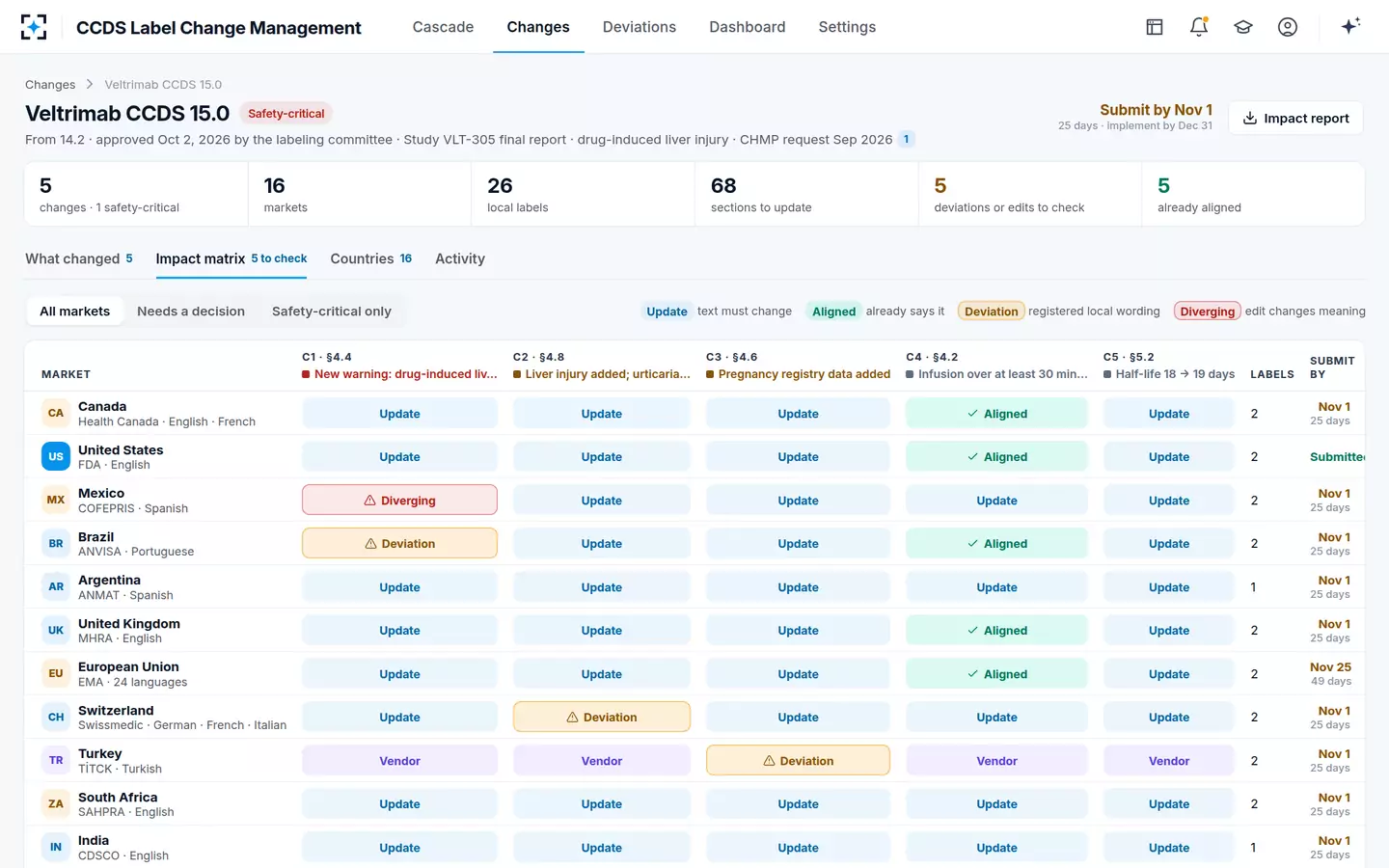
The five states on this screen are worth copying even on a spreadsheet. Update and Aligned are the obvious pair. Deviation says a registered difference stands in the way and a person has to decide. Diverging says the local text differs and nothing explains why — a finding, not a task. Vendor says the market is waiting on translation, which is a scheduling fact, not a labelling one, and keeping it visible stops a market that is merely queued from being read as a market that is late.
Tracking the change to the last market
A cascade is finished when the last market has implemented, not when the last draft has been approved, and the gap between those two events is where most of the elapsed time of a change actually sits. Tracking it well means holding four things per market at once: the procedure the change is travelling under, the stage it has reached, the forecast date it will be filed, and that market's own deadline.
The forecast is the part teams most often omit, and it is the only part that gives anyone time to act. A stage tells you where a market is; a forecast tells you where it will be. On the sample Veltrimab change the forecast line read eleven markets on time, two tight, one that would miss and two already submitted — worked out from the steps still ahead of each market rather than from how the last change went.
Every market on its own clock, with its owner
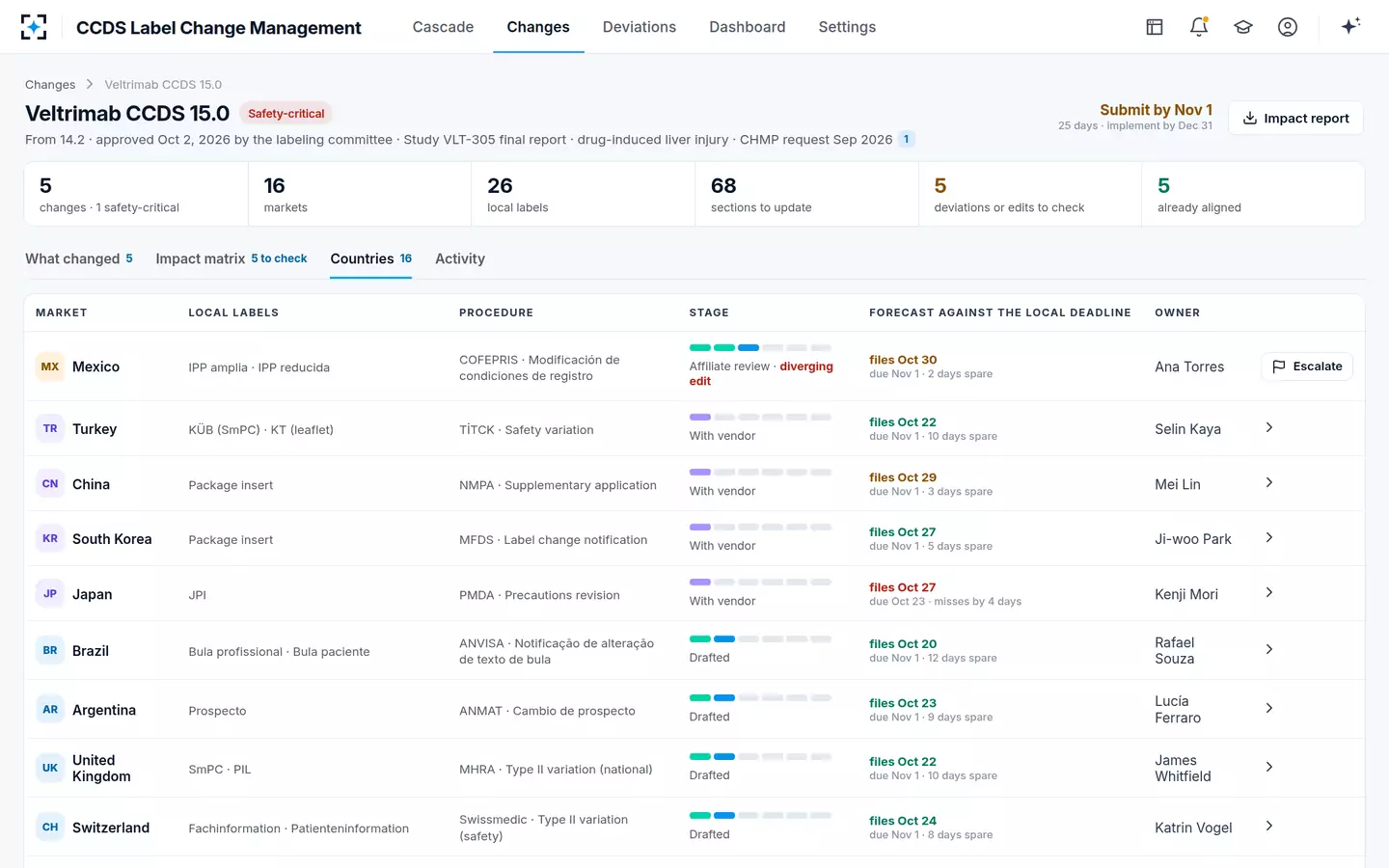
One warning about the dates on a screen like this. The company deadlines — submit a safety-critical change within 30 days of committee approval, implement within 90 — are policy settings, adjustable in the solution as in any procedure, and none of the regulators quoted in this guide counts from the committee meeting itself — the nearest is Brazil's thirty days from the moment the local holder learns of a parent company's change. The market deadlines beside them are a mixture: some are rules, some are the company's own planning dates for that market's cycle. A tracker that does not distinguish the two trains everybody to treat both as soft.
Questions people ask
What is a label impact assessment?
It is the exercise of determining, for one core data sheet change, every national document and section it affects and what must happen to each — update, already aligned, not present, or blocked by a registered difference. Its output is a list of concrete tasks with owners, procedures and dates, not a narrative. It is the first deliverable after approval and everything downstream depends on it being right.
How long does a CCDS change and impact assessment take?
By hand, for a medicine in roughly sixteen markets, the solution's own estimate is about ten working days: three of them finding the documents and sections, two and a half drafting, and the rest comparing, checking differences, opening tasks and working out which markets close first. The step that decides the total is the search, which is why teams that keep a section map and current registration data finish in a fraction of the time.
What is a CCDS to local label mapping?
It is the standing table that says which core data sheet section corresponds to which section of which national document template — core section 4.4 to the European 4.4 and parts of 4.2 and 4.8, to the United States Warnings and Precautions and the patient guide, to both Brazilian inserts, and so on. It is built once per template family and maintained, not rebuilt per change, and it is what makes a mechanical first pass possible at all.
What does it mean when a local label is aligned with the CCDS?
That the local text already carries the meaning of the core wording, so no submission is owed for that passage. The word to insist on is meaning: alignment is not a word match, and a market can be aligned in entirely different wording or misaligned while sharing most of its sentence. An alignment claim should always be evidenced by the local sentence it rests on, in the local language, so that a reviewer can disagree with it.
How do you track local label implementation across countries?
Hold four facts per market and keep them current: the procedure the change travels under, the stage it has reached, the forecast filing date, and that market's own deadline. Stage alone cannot tell you who is at risk; the forecast against the local deadline can. Escalate on the forecast rather than on the miss, and escalate to a named person rather than to a distribution list.
Does every market need a submission for every change?
No, and assuming so wastes a great deal of effort. A passage that is already aligned owes nothing. A passage that is not in that document owes nothing. An editorial change may be carried at the next revision rather than on its own. What every market does owe is an answer that somebody can check later — which is why "no action" should be a recorded decision with its reason, not a silence.