Claims closed without payment are claims an insurer has finished handling with nothing paid, and after a hurricane they are a large share of the book: fourteen months after Hurricane Milton, insurers had reported 134,177 Florida claims closed without payment out of 385,146, about 35%. Most are closed correctly, below the deductible or outside the policy, but regulators now ask insurers to report the reason for each, and a closing that cannot name its reason looks, in a data call or a market conduct exam, like a claim that was never adjusted. Catastrophe Claims Management is Botminds' catastrophe claims software: its agents take in a storm's notices, route each claim with a stated reason and keep the regulatory clocks, while adjusters make every decision to pay, deny or close.
This guide is for the catastrophe claims leaders, claims compliance officers and quality teams who answer for those closings. The figures come from insurers' reports to Florida's Office of Insurance Regulation, which notes they are unaudited and change as claims move. Product examples come from a fictional sample event, Hurricane Delphine, and a fictional carrier, Corvane Mutual.
Claims closed without payment after Hurricane Milton, as insurers reported them
385,146
claims reported to Florida insurers
219,994
closed with a payment
134,177
closed without payment, about 35%
14,403
still open without a payment
What claims closed without payment are, in a regulator's count
A claim closed without payment is a status, not a reason. Florida's regulator counts every catastrophe claim in one of four states: open with a payment, open without, closed with a payment and closed without. The fourth tells a regulator only that the file is finished at zero. Whether that was right depends on why, and since April 2025 Florida has asked insurers to say why.
The regulator was explicit about the change. "OIR is scouring data and demanding more specific answers for closed claims without payment," it said, and it is "expanding the required reporting and updating the OIR website for recent storms ... to show all reasons why a claim may be closed without payment" (Florida OIR, April 2025). For a carrier, that turns a closing reason from a claims-system code into a figure published storm by storm, beside every other carrier's.
Insurers in the industry shorten the status to CWOP. The shorthand is harmless; the habit it can hide is not. A team that tracks only the CWOP count, or only its share of claims, cannot tell a below-deductible closing explained to the policyholder from a claim closed because nobody answered the phone.
Why do so many catastrophe claims close without payment?
Mostly because the damage was below the hurricane deductible, then because of reasons the insurer recorded as administrative, then because the policyholder withdrew the claim or could not be reached. When Florida first published the split, below-deductible closings were 41% of Milton's closed-without-payment claims and 33% of Helene's, with flood denials a further 20% for Helene (Florida OIR, April 2025).
Milton's closed-without-payment reasons: below deductible first, administrative second
Fraud is a rounding error in the ranking, 187 claims across every line, so fraud explains almost none of Milton's zero-paid closings. Three categories together, withdrawn, lack of communication or cooperation, and administrative, account for more than 80,000 Milton closings. Those are the closings in which a policyholder may never have had the damage adjusted, and they are where an examiner looking for unadjusted claims would start.
The administrative bucket: when the reason is the carrier's own data
"Administrative" is the reason a carrier reports when its claim system cannot say anything more specific. Hurricane Helene's table, reported in finer categories, shows what such a bucket holds: 6,401 claims closed under "Claim System Not Capturing Specific Data Points", about one in eight of all the reasons insurers reported for that storm (Florida OIR, Helene data).
Hurricane Helene: the closing reasons insurers could name, and the one they could not
| Reason reported | Claims | What the carrier needs on file |
|---|---|---|
| Damage below the deductible | 15,251 | The covered damage valued, and the deductible in dollars |
| Denial of coverage, other than flood | 10,147 | The exclusion or condition relied on, quoted |
| Denial of coverage, flood | 10,097 | Which damage was water, which was wind, and why |
| Claim system not capturing specific data points | 6,401 | A reason, which the system did not keep |
| Withdrawn by the insured | 4,268 | Who withdrew it, when, and whether damage was disclosed |
| No coverage, such as a wind exclusion | 938 | The policy form and endorsement |
| No contact by the insured | 757 | Each attempt to reach the policyholder, dated |
| Opened in error | 634 | The claim the damage actually sits under, if any |
| Duplicate claim | 456 | The surviving claim number |
The lesson is that a closing reason is easier to keep than to reconstruct. A system that records only the final status forces a team, months later and under a data call, to read files to recover why each one closed. A system that records the reason when the claim is routed, and again when it closes, can answer the data call from the claims themselves.
What must a closing letter explain?
The basis in the policy, in relation to the facts, and, where the payment differs from the adjuster's estimate, the difference. Florida requires the insurer to "provide a reasonable explanation in writing to the policyholder of the basis in the insurance policy, in relation to the facts or applicable law, for the payment, denial, or partial denial of a claim" (Fla. Stat. §627.70131(7)(a)). The NAIC's model unfair claims act, which many states have adopted in some form, names the opposite as an unfair practice: "Failing in the case of claims denials or offers of compromise settlement to promptly provide a reasonable and accurate explanation of the basis for such actions" (Model #900, §4L).
Not every closing without payment is a denial, but every one benefits from the same discipline. A withdrawn claim, a duplicate or an inquiry still produces a letter, and a letter that says only "your claim has been closed" invites the call, the complaint and the reopening that a reasoned one would have avoided.
What a closing-without-payment letter should carry
- The reason, in the category the regulator uses
Below deductible, flood, other exclusion, withdrawn, no contact, duplicate, wrong date of loss.
- The figures behind a below-deductible closing
What the covered damage came to, and the hurricane deductible in dollars, not only as a percentage.
- The policy wording relied on, quoted
For a flood or other coverage denial, the exclusion or condition and the facts it was applied to.
- The adjuster’s detailed estimate, if one was made
Florida requires a copy within 7 days of the estimate being generated.
- The adjuster’s name and license number
Florida requires both on communications after a physical inspection.
- The surviving claim number, for a duplicate
So the policyholder knows the damage is still being handled.
- How to ask for a second look, and the deadline
Reopening, a supplemental claim or mediation, with the window for each.
Below the deductible: the closing that must show its arithmetic
A below-deductible closing is usually correct and often misunderstood, because Florida hurricane deductibles are commonly a percentage of the dwelling limit. On a home insured for $418,000, a 2% hurricane deductible is $8,360; a torn soffit, a fence and some shingles can fall well under it. The letter that states both numbers is the one that does not come back.
The closing also has a life after the claim. Florida applies the hurricane deductible "on an annual basis to all covered hurricane losses that occur during the calendar year" with the same insurer or group, and "Insurers may require policyholders to report hurricane losses that are below the hurricane deductible or to maintain receipts" so they count toward later hurricane claims that year (Fla. Stat. §627.701). Helene and Milton struck Florida within weeks of each other in 2024. A carrier that closed a Helene claim below the deductible needed that amount on hand when the same household reported Milton damage.
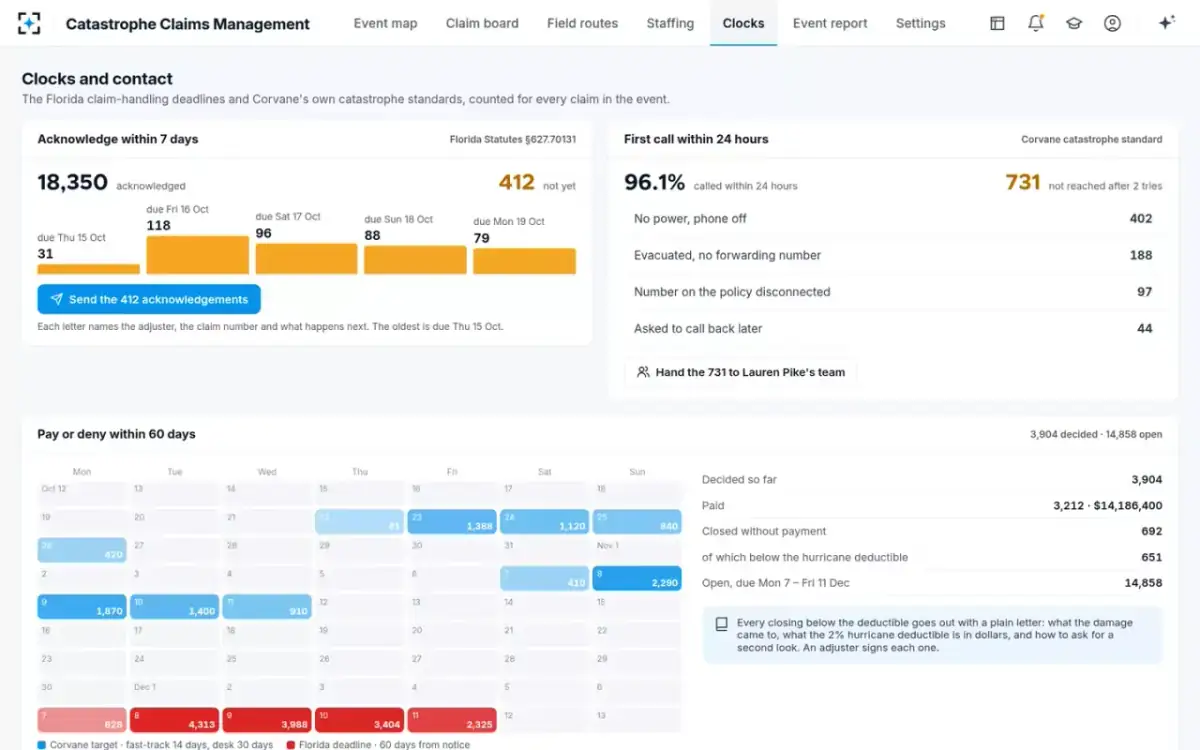
The pay-or-deny calendar, with closings below the deductible counted apart
No contact and withdrawn: closings that may never have been adjusted
A claim closed for no contact, lack of cooperation or withdrawal can be correct, but it is the category in which the carrier must prove effort. After a storm, the policyholder who cannot be reached is often the one with the worst damage: no power, an evacuated household, a phone number that died with the house. Milton had 15,440 closings for lack of communication or cooperation and 21,588 withdrawn.
The model act is why the pattern matters more than the single claim. An act becomes an unfair claims practice when it is "committed with such frequency to indicate a general business practice", and the list includes "Refusing to pay claims without conducting a reasonable investigation" (Model #900, §§3B and 4F). One claim closed after a single unanswered call is a file problem; ten thousand are a finding. Florida requires insurers to keep dated claim records of "Any claim-related communication" and "Any claim-related request for information made by the insurer" (§627.70131(4)), which is exactly the evidence a no-contact closing rests on.
On the fictional sample event, the contact team's screen keeps that evidence by reason: of 731 policyholders not reached after two tries on day 4, 402 had no power, 188 had evacuated with no forwarding number, 97 had a disconnected number and 44 had asked for a call back. A later closing for no contact can say what was tried and when, and a supervisor can see whether a cluster needs a different channel before anyone closes anything.
When a closed claim comes back: reopened and supplemental claims
A closed claim comes back as a reopened claim or a supplemental claim, and in Florida both restart the pay-or-deny clock. A reopened claim is one "that an insurer has previously closed, but that has been reopened upon an insured's request for additional costs for loss or damage previously disclosed to the insurer"; a supplemental claim is for additional loss "from the same peril" (Fla. Stat. §627.70132).
Florida's windows and clocks for a claim that comes back
| Claim type | Notice must be given within | Then the insurer must |
|---|---|---|
| New or reopened claim | 1 year after the date of loss | Pay or deny within 60 days of notice, with a written explanation |
| Supplemental claim | 18 months after the date of loss | Pay or deny within 60 days of notice, with a written explanation |
| Hurricane date of loss | The date the hurricane made landfall | Measure both windows from that date |
| Mediation | Once the insurer has paid or denied under the 60-day rule, or elected to reinspect | Have told the policyholder of the right at policy issue, renewal and claim filing |
Reopenings are a quality signal as much as a workload. A cluster of reopened claims from one route, one adjusting firm or one closing reason points to a closing practice, not to a run of new damage. Helene's table even carries a category for it: 67 claims "Closed Due to Claims Reopened", a reminder that the same claim can be counted twice across a storm's life.
Measuring closings without payment so the number means something
A share of claims closed without payment is only useful split by reason and by how the claim was handled. A catastrophe claims leader should be able to answer, for any storm and any day, what share of zero-paid closings had a reason the regulator recognises, how many were closed after no contact, and how many came back.
Two ways to report closings without payment to a regulator or a board
Status only: A count of claims closed at zero, and a share of the storm.
Reason kept from first routing: Each closing by reason, route, adjusting firm and days to close.
Status only: A large bucket nobody can explain without reading files.
Reason kept from first routing: Small, because the reason was kept when the claim was routed.
Status only: A number, with the attempts in free-text notes.
Reason kept from first routing: Each attempt dated, with the reason the policyholder could not be reached.
Status only: A code on the claim.
Reason kept from first routing: The damage valued and the deductible in dollars, ready for a later hurricane that year.
Status only: A file review, under a deadline.
Reason kept from first routing: A query over the claims, with each reason traceable to a person.
Three further measures show pressure building before it reaches a data call. Closings per adjuster per day, closings without payment by route, and reopenings within 90 days by closing reason tell a leader whether the desk is under pressure to clear files. Those measures belong beside the clocks, not in a quarterly report.
How Catastrophe Claims Management keeps the reason before the claim closes
Catastrophe Claims Management records why each claim went where it went at the moment it is routed, so the reason exists before anyone closes it. Its severity and routing agent applies the carrier's routing rules to the notice, the photos and the imagery, and every claim carries a stated reason, such as "Roof surface missing over 25% on imagery" or "Below the hurricane deductible · explained by phone". An adjuster can re-route any claim, and the change keeps its reason and who made it.
Every claim on the board carries the reason it went where it went
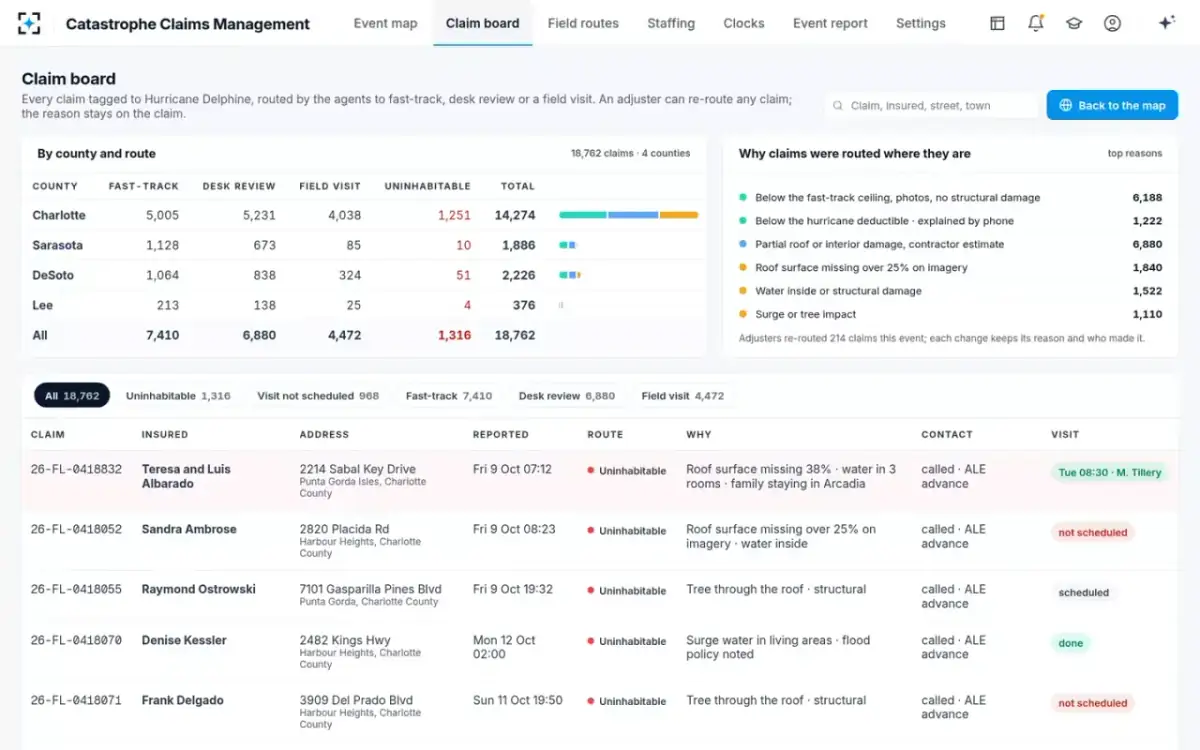
The control that matters most is a setting: whether agents may close a claim is fixed at "Never · an adjuster decides", including below the hurricane deductible. The agents count, route, forecast and draft; they do not close, deny or pay. On the sample event, 1,222 claims carry the reason that the damage on the notice and imagery fell under the deductible and the contact team said so on the first call, and each one still closes only when an adjuster decides. How a storm's claims are sorted from the first hour is set out in a catastrophe claim, hour by hour, and how each notice is tied to the right storm, and so the right deductible, in what a catastrophe code is. Flood denials, the other large reason, are taken up in separating wind from flood.
Questions people ask
What does CWOP mean in insurance claims?
It is shorthand for a claim closed without payment: finished, with nothing paid. Florida's regulator reports CWOP counts storm by storm with the reason for each, such as below the deductible, flood denial, withdrawn or no contact.
Is a claim closed without payment the same as a denial?
Not always. A flood exclusion or other coverage finding is a denial; a claim below the deductible, withdrawn, duplicated or opened in error is closed without being denied. Florida still requires a written explanation of the policy basis for a payment, denial or partial denial.
What share of hurricane claims close without payment?
For Hurricane Milton, insurers reported 134,177 of 385,146 Florida claims closed without payment as of 9 December 2025, about 35%. Below-deductible closings were the largest reason, at 51,625.
How long does a policyholder have to reopen a hurricane claim in Florida?
Notice of a new or reopened claim must be given within one year after the date of loss, and of a supplemental claim within 18 months. For a hurricane, the date of loss is the date of landfall, and a reopened claim runs on the same 60-day pay-or-deny clock.
Do insurers have to report why claims closed without payment?
In Florida, yes, through the regulator's catastrophe data calls, which since April 2025 ask for the reasons behind closings without payment and publish them by storm. The regulator also audits and examines claims payments after every catastrophe.
Can a below-deductible claim affect a later claim?
In Florida it can. The hurricane deductible applies once per calendar year across hurricane losses with the same insurer or group, and insurers may require policyholders to report below-deductible hurricane losses so they count toward a later hurricane claim that year.