An anti-concurrent causation clause is policy wording that excludes a loss caused by an excluded peril, such as flood, even when a covered peril, such as wind, "acted concurrently or in any sequence" to cause it. On a hurricane claim it means damage the wind did on its own stays covered, while damage that wind and water caused together is excluded, so the outcome rests on separating the two, house by house, often after the evidence has washed away. Federal courts applying Mississippi law enforced such clauses after Hurricane Katrina, and the federal flood program now tells its adjusters exactly how to divide a two-peril loss. Catastrophe Claims Management is Botminds' catastrophe claims software: its agents build each storm's wind and surge footprint, read imagery for roof damage and water lines, and route each claim with a stated reason, while adjusters make every coverage decision.
This guide is for property claims leaders, coverage counsel and catastrophe managers. It quotes the court opinions, the federal flood program's claims manual and the Government Accountability Office, linked where they appear. Product examples come from a fictional sample event, Hurricane Delphine, and a fictional carrier, Corvane Mutual.
Why the wind and water line matters to a homeowners carrier
20%
of Hurricane Helene’s Florida closings without payment were flood denials
10,097
Helene claims closed without payment for flood, all lines
2
parts every two-peril flood assignment is split into, by FEMA’s claims manual
90%
accuracy NOAA must certify before its storm model feeds FEMA’s slab-case formula
What an anti-concurrent causation clause does on a hurricane claim
It takes the flood exclusion and makes it win any tie. A typical homeowners form excludes flood, then adds that the exclusion applies whatever else contributed. The State Farm form litigated after Katrina read: "We do not insure for such loss regardless of: (a) the cause of the excluded event; or (b) other causes of the loss; or (c) whether other causes acted concurrently or in any sequence with the excluded event to produce the loss" (Tuepker v. State Farm, 5th Cir. 2007).
The Nationwide form in the companion case put it more briefly, excluding loss "even if another peril or event contributed concurrently or in any sequence to cause the loss", and defined the water exclusion to cover "flood, surface water, waves, tidal waves, overflow of a body of water, spray from these, whether or not driven by wind." The last four words matter on a coast, because storm surge is water driven by wind. Under the clause, wind that pushed the water does not bring the water damage back into cover.
If wind blows off the roof of the house, the loss of the roof is not excluded merely because a subsequent storm surge later completely destroys the entire remainder of the structure.
U.S. Court of Appeals for the Fifth Circuit, Tuepker v. State Farm (2007)
That sentence is the practical boundary. The clause excludes damage that would not have happened without the water; it does not reach back and exclude damage the wind finished first. A carrier that applies the clause to the whole house because surge was present is applying it beyond what the court enforced.
Is the anti-concurrent causation clause enforceable?
In Mississippi, yes, on the Fifth Circuit's reading after Katrina, and the court described its reach precisely: "any damage caused exclusively by a nonexcluded peril or event such as wind, not concurrently or sequentially with water damage, is covered by the policy, while all damage caused by water or by wind acting concurrently or sequentially with water, is excluded." The clause, with the water exclusion, "clearly provides that indivisible damage caused by both excluded perils and covered perils or other causes is not covered" (Tuepker).
The clause works by displacing a state's default causation rule. The court noted that efficient proximate cause is the "default causation rule in Mississippi regarding damages caused concurrently by a covered and an excluded peril", under which a policyholder recovers if the covered peril was the efficient cause, and held, following Leonard v. Nationwide, that "use of an ACC clause to supplant the default causation regime is not forbidden by Mississippi caselaw ... , statutory law, or public policy." Other states set their own default rules and limits, so coverage counsel confirms the law of the state where the property sits before a storm, not after it.
The same damaged house under two causation rules
Efficient proximate cause, the default in Mississippi: Covered: wind caused it.
With an anti-concurrent causation clause enforced: Covered: it happened in the absence of the excluded peril.
Efficient proximate cause, the default in Mississippi: Covered only if wind is shown to be the efficient cause.
With an anti-concurrent causation clause enforced: Excluded: water caused it, whatever drove the water.
Efficient proximate cause, the default in Mississippi: Covered if wind was the efficient cause.
With an anti-concurrent causation clause enforced: Excluded: concurrent damage falls to the exclusion.
Efficient proximate cause, the default in Mississippi: Covered as wind damage.
With an anti-concurrent causation clause enforced: Covered, if the evidence separates it from the flood damage below.
Who has to prove what was wind and what was water?
On open-peril dwelling coverage, the insurer. The court restated the rule from Leonard: under open-peril coverage "the insurer bears the burden of proving that a particular peril falls within a policy exclusion," and "must plead and prove the applicability of an exclusion as an affirmative defense." On named-peril coverage, such as personal property in the forms litigated, the policyholder must prove a covered peril caused the loss (Tuepker).
The insurer in that case argued that once it showed damage resulted at least in part from water, the burden should shift back to the policyholder to show how much was wind. The court did not decide the point, because the parties had settled. For a claims leader, the unsettled question is a reason to treat evidence as the insurer's job from the first inspection: the clause excludes nothing a carrier cannot show was water.
Why separating wind from water is the hard part
Because the evidence is thin, perishable and, on the worst-hit properties, gone. The Government Accountability Office reviewed the Katrina and Rita claims and found the adjustment "is further complicated when the damaged property is subjected to a combination of high winds and flooding and evidence at the damage scene is limited." Evidence at damage scenes "may have been further compromised by subsequent natural and man-made events (such as the clearing of debris from streets and roadways)" before adjusters arrived (GAO-08-28).
GAO also named a structural problem. When one company writes the homeowners policy and services the flood policy for the federal program, "the same company is responsible for determining damages and losses to itself and to NFIP, creating an inherent conflict of interest." And the flood program "does not systematically collect and analyze both wind and flood damage claims data", so it could not always check whether flood payments covered only flood. Congress later gave the program access to both sides' claims information, which the GAO page records as implemented.
For a homeowners carrier, the conflict cuts both ways. Allocating too much to flood shifts cost to the federal program and invites the scrutiny GAO described; allocating too little exposes the carrier's own policy. The defence in either direction is the same: a documented, consistent method applied to each property, with the evidence dated before the debris is cleared.
How the federal flood program tells adjusters to split a two-peril loss
FEMA's flood claims manual gives the most detailed public procedure for a house damaged by wind and water. It starts from the policy's scope: the flood policy "is a single-peril policy and will only pay for direct physical loss by or from flood", and it expressly excludes "wind, or windstorm" (44 CFR Part 61). Then it tells the adjuster to split the work: "At the outset, if the adjuster determines at least one other peril is involved, the adjuster must separate the activity to be performed on the loss assignment into two parts: one for flood, and a second for the other peril" (NFIP Claims Manual).
The flood adjuster's procedure on a wind-and-water loss, step by step
A person decides
Split the assignmentOne part for flood, one for the other peril, from the outset; inspect as if flood were the only cause.
A person decides
Document both scopesPhotograph interior and exterior waterlines; record wind damage below the waterline, such as framing, and damage above it from rain or wind.
A person decides
Read the debrisNote wind-driven against flood-borne debris, and the direction of wind damage against the direction of flood flow or wave action.
A person decides
Ask for the other insuranceCarrier, policy number, claim number, the other adjuster and the agent.
A person decides
Coordinate where scopes meetIf the scopes border or overlap, agree the line with the other adjuster; if they disagree, exchange photos, involve a supervisor or a licensed engineer.
The manual's examples show where coordination is and is not needed. Flood two feet deep inside and a wind-damaged roof with nothing else: the scopes do not touch, and each adjuster finishes alone. The same flood with rain through the roof into the ceiling: the scopes border at the painted seam between wall and ceiling, so the adjusters must agree who pays for what, or one estimate will pay twice. Where the flood estimate is ready first, the adjuster can "zero-out the price of any overlapping line items" the other policy should cover.
Four two-peril situations and what the manual expects of the file
| Situation | Coordination | What the file must show |
|---|---|---|
| Scopes do not overlap or border | None needed | Photographs that prove the separation, noted in the other-insurance section |
| Scopes border or overlap | Contact the other adjuster and agree the scope | The call in the claim notes; the first finished estimate sent to the other |
| Adjusters disagree | Exchange photographs; adjusting-firm supervisor; licensed engineer if needed | The disputed scope, the engineer’s report and the other estimate |
| Total loss, including slab-only | Building valuation | Detailed valuation less the other peril’s scope, depreciation and the deductible |
Slab cases and the COASTAL Act
When nothing is left but the foundation, observation cannot separate the perils, and federal law supplies a model instead. The COASTAL Act, signed on 6 July 2012, aims to lower the flood program's costs "by better discerning wind versus water damage in the case of 'indeterminate losses;' that is, where little tangible evidence beyond a building's foundation ('slab') remains" (NOAA).
The mechanism is a hindcast. NOAA runs what the Act calls the Named Storm Event Model to estimate "the strength and timing of damaging winds and water at a given location". If the result for a slab case can be certified "as being greater than 90 percent accurate", it goes into "a FEMA-managed formula", and "FEMA will determine the appropriate loss allocation between wind and water." The observations behind it are published in a Coastal Wind and Water Event Database.
The Act governs the flood program's allocation, not a private homeowners policy, and it covers only indeterminate losses. Its value to a homeowners carrier is indirect but real: it confirms that timing, which peril reached a location first and how strongly, is the evidence that decides concurrent-causation questions, and it makes a federal timing record available for the hardest cases.
Two claims, two clocks
A house with wind and flood damage carries two claims on two calendars, and a carrier that waits for the flood side to finish before settling its own risks missing its own deadline. In Florida the homeowners insurer must pay or deny a residential claim "Within 60 days after an insurer receives notice" and give "a reasonable explanation in writing ... of the basis in the insurance policy" (Fla. Stat. §627.70131(7)(a)). The flood policy puts the next step on the policyholder: "Within 60 days after the loss, send us a proof of loss" (44 CFR Part 61), unless FEMA extends it.
The wind claim and the flood claim on one Florida house
| Homeowners claim (wind) | Flood claim (NFIP) | |
|---|---|---|
| Peril covered | Wind, and rain through an opening the wind made | Direct physical loss by or from flood, including surge |
| Who adjusts | The carrier’s staff or independent adjusters | A flood adjuster for a Write Your Own insurer or NFIP Direct |
| First clock | Pay or deny within 60 days of notice, with a written explanation | Policyholder’s proof of loss within 60 days of the loss, unless extended |
| Where the clause bites | Damage wind and water caused together is excluded | Wind damage is excluded; the other insurance is asked for |
| What decides the line | Evidence of wind damage before or apart from the water | Waterlines, debris and direction, coordinated with the other adjuster |
The closing side of the same problem appears in Florida's data. For Hurricane Helene, flood denials were a fifth of all claims insurers closed without payment (Florida OIR). A flood denial on a homeowners claim is correct only for the water damage; how carriers report and explain those closings is set out in claims closed without payment.
What to capture on the first call and the first inspection
The clause rewards whoever has the earliest, best-dated evidence. Almost everything a coverage decision will need later exists only in the first days: the waterline before drywall is torn out, the debris before streets are cleared, the policyholder's account of what failed first while it is fresh.
Evidence a homeowners carrier should hold before anyone applies the clause
- Whether a flood policy exists, and its insurer and claim number
The flood adjuster will ask for the same details from the other side.
- Interior and exterior waterlines, photographed and measured
Against fixed objects, so each item is clearly above or below the line.
- Wind damage above the waterline, and wind damage below it
Roof covering, openings, framing; the manual names framing structurally damaged by wind.
- Debris type and direction
Wind-driven against flood-borne, and the direction of each, dated.
- The timing of wind and surge at the address
From the storm’s advisories and, for the hardest cases, the federal hindcast.
- The policyholder’s account of what failed first
Recorded in their words on the first call, before repairs and memory change it.
- An engineer referral where the scopes overlap
Before the carrier takes a position, not after a dispute.
How Catastrophe Claims Management keeps the wind and water evidence from the first hour
Catastrophe Claims Management does not decide causation, and it does not apply an exclusion. What it does is put the evidence for both perils on each claim before an adjuster arrives. Its footprint reader builds the event footprint from each advisory's wind field and storm surge zones and finds the policies inside it. Its imagery reader reads post-event aerial and drone captures for roof surface missing, structures down, debris and water lines. Its routing agent records why each claim went where it went.
Surge and water inside are routing reasons on the claim board, not afterthoughts
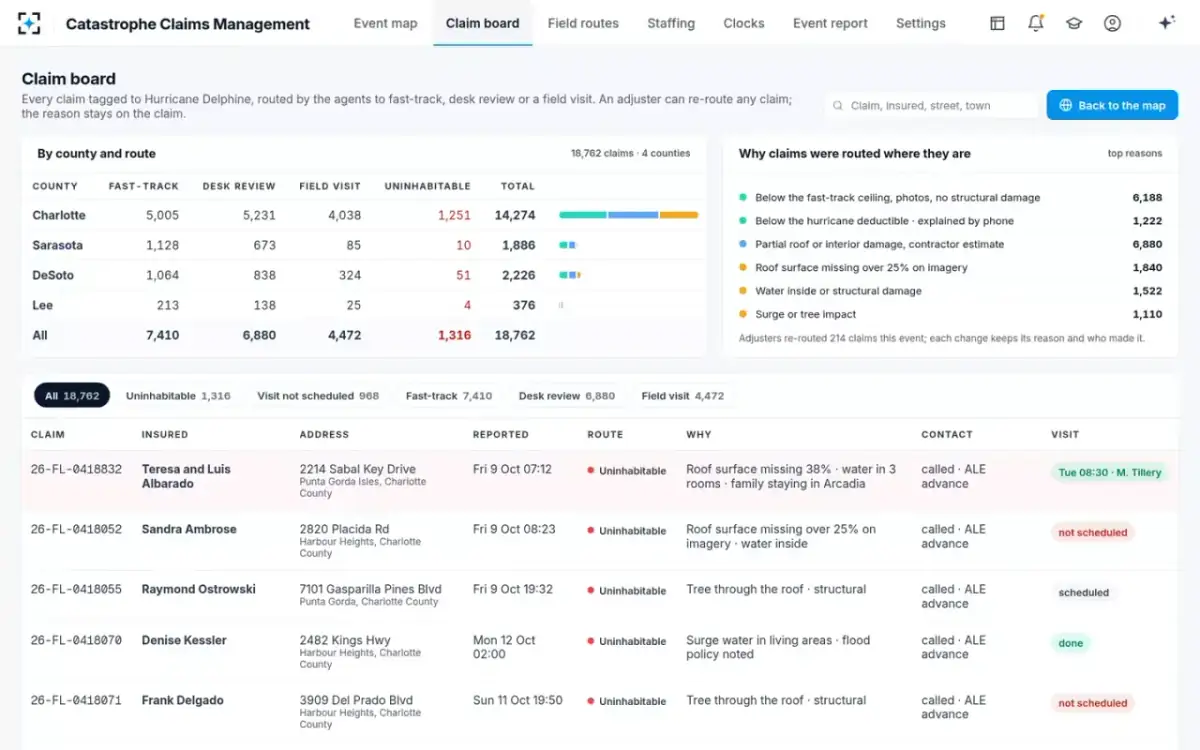
On the sample event, "water inside" is one of the triggers that sends a field adjuster rather than settling from photos, so under the sample playbook a claim with water in the house is not settled at the desk from a policyholder's pictures. Each claim carries its imagery, the footprint it fell inside and the reason it was routed, so the adjuster who walks the house knows before arriving whether the surge zone reached the address. The agents may not close, deny or pay a claim; the coverage position, including any reliance on the clause, is an adjuster's and the carrier's. How the event's adjusters are sent where they are needed is in CAT adjuster deployment, and what the imagery can and cannot settle in drone inspections for insurance claims.
Questions people ask
What is an anti-concurrent causation clause in simple terms?
It is policy wording that keeps an exclusion in force even when a covered cause contributed to the same loss. On a hurricane claim, damage that wind and flood caused together is excluded, while damage the wind caused on its own, before or apart from the water, stays covered.
Did courts enforce anti-concurrent causation clauses after Hurricane Katrina?
Yes, under Mississippi law. In Leonard v. Nationwide and Tuepker v. State Farm (2007), the Fifth Circuit held the clauses unambiguous and enforceable, overriding the state's default efficient proximate cause rule, while confirming that wind-only damage remains covered.
Does the clause exclude a roof the wind removed before the surge?
No. The Fifth Circuit gave that example: a roof blown off by wind is not excluded merely because a later storm surge destroyed the rest of the structure, because the roof loss happened without the excluded peril.
Who bears the burden of proof on a wind and water claim?
On open-peril dwelling coverage, the insurer must prove the loss falls within the exclusion. On named-peril coverage, such as personal property in the forms litigated, the policyholder must prove a covered peril caused the loss.
What is a slab case?
A house so destroyed that little beyond the foundation remains, leaving no physical evidence to separate wind from water. For the flood program, the COASTAL Act allows FEMA to allocate such losses using NOAA's storm model when its result is certified more than 90 percent accurate.
Does flood insurance cover wind damage?
No. The Standard Flood Insurance Policy covers direct physical loss by or from flood and excludes wind and windstorm, so its adjusters split every two-peril loss and ask for the details of the other insurance.