Reg F in collections is Regulation F, 12 CFR part 1006, the rule the Consumer Financial Protection Bureau wrote to carry out the Fair Debt Collection Practices Act. It took effect on 30 November 2021, and in day-to-day collections work it is known for three things: a presumption that seven calls about one debt in seven days is not too many, a second presumption that a call within seven days of a conversation about that debt is too many, and a default window of 8 a.m. to 9 p.m. in the borrower's own time zone. The rule binds debt collectors. A bank's own staff collecting in the bank's own name are excluded from that definition, which is why the most important contact decision in a hardship program is usually a policy decision rather than a legal one. Borrower Hardship Management is Botminds' software for that program, and it pauses collection calls while a hardship request is open because the request, not the rule, is the reason to stop.
The worked example on this page is sample data on fictional people inside the solution: Renée Okafor, a patient care technician whose hours were cut from 36 to 29 a week, and her request HC-24117 against a $9,786.40 card balance. The law quoted here is quoted from the regulation itself.
The four numbers a collections floor runs on
7in 7
calls about one debt in seven days, the frequency the rule presumes is compliant
7days
of silence after a telephone conversation about that debt
8–9
the hours, a.m. to p.m., presumed convenient at the consumer’s own location
2days
the decision clock a pause has to cover, from a complete hardship request
What is Reg F in collections?
Reg F is the rulebook that turned a 1977 statute into operating instructions. The FDCPA had always banned calls made over and over with the intent to annoy, abuse or harass, which told a dialler administrator nothing. Regulation F kept the prohibition and added numbers to it, in the form of two presumptions that work in opposite directions, plus rules on times, places, channels, third parties, and the validation notice a collector must send.
For a collections operations lead the practical content is short. Count calls per debt, not per borrower. Stop for seven days after a conversation. Keep inside 8 a.m. to 9 p.m. where the borrower is, not where the call centre is. Honour a written request to cease. Give an opt-out on every electronic channel. Everything else in the rule is detail on how to say what you say.
What Reg F does not do is decide anything about relief. It governs contact. The question of what a borrower is offered is governed elsewhere — by the account agreement, by the anti-discrimination rule, and by the lender's own hardship policy, which is where the design of a credit card workout program is settled.
How many times can a collector call in seven days?
Seven, about one debt, with a conversation resetting the clock. The regulation does not phrase it as a limit; it phrases it as a presumption of compliance. A debt collector "is presumed to comply" with the harassment prohibition if it places a call to a particular person about a particular debt neither more than seven times in seven consecutive days nor at all within seven consecutive days of a telephone conversation with that person about the debt. The date of the conversation is day one of that second period.
Three details change how a dialler has to count. The seven-day windows are rolling, not calendar weeks. The count is per debt: the rule defines "particular debt" to mean "each of a consumer's debts in collection", so a borrower with a card and an instalment loan in collection can lawfully receive two sets of calls, with student loans serviced under one account number treated as one debt. And some calls are excluded from the count altogether: calls placed with the person's prior consent given directly to the collector, within seven days of that consent, and calls "Not connected to the dialed number".
That last exclusion is the one that most often separates a system's call log from a compliance report. A number that never completes is not a counted call. A dialler that logs attempts rather than connections will overstate the count; one that logs only conversations will understate it badly.
One week on one debt, and where each call leaves the presumptions
| Day | What the collector did | Counted calls in the rolling seven days | Where the presumptions stand |
|---|---|---|---|
| Monday | 2 calls, neither answered | 2 | Inside the frequency presumption |
| Tuesday | 2 calls, one not connected to the dialled number | 3 counted; the unconnected call does not count | Inside it |
| Wednesday | 1 call, no answer | 4 | Inside it |
| Thursday | 2 calls; the second is a 4-minute conversation | 6, and a conversation on Thursday | A second clock starts: seven days of silence |
| Friday | 1 call placed anyway | 7, one day after the conversation | Outside the compliance presumption, and presumed to violate |
| Saturday | No call | 7 | Still inside the seven days after the conversation |
| Next Thursday | Calls may resume on the seventh day after the conversation | The first week has rolled off | Inside the presumption again |
The two presumptions, and the difference between complying and not violating
A presumption is not a safe harbour, and the asymmetry matters. Staying inside seven-in-seven means a court or an examiner starts from the position that the calls were lawful; the consumer may still rebut it with evidence about the circumstances. Going outside it means the collector is "presumed to violate" the prohibition, and has to rebut that.
So the honest way to read the rule is as a burden-of-proof switch rather than a speed limit. Six calls a week to a borrower who has twice asked to be left alone is inside the presumption and still indefensible. One call a day to a borrower who asked to be called daily is outside the presumption until the consent exclusion is proved — which is why consent has to be recorded with its date, not remembered.
For a hardship program this is the whole argument for a pause. A borrower who has filed a hardship request is, by definition, mid-conversation with the lender. Calls placed into that gap are not merely close to a presumption; they are calls asking a question the borrower has already answered in writing.
Inconvenient times and places: the 8 a.m. to 9 p.m. default
A collector must not communicate at an unusual time, or at a time it knows or should know is inconvenient. The regulation then supplies the default: unless the collector knows of circumstances to the contrary, any time before 8 a.m. or after 9 p.m. local time where the consumer is counts as inconvenient. The same sentence structure covers places, so a call to a workplace the collector has been told not to call is inconvenient whatever the hour.
"Local time at the consumer's location" is the operational trap. A borrower with an area code from a state she left three years ago, or a mobile number that travels, puts the window somewhere the dialler cannot read off the number. The defensible answer is to hold the borrower's own stated time zone on the file and to use the narrower of that and the number's, and to write down which rule was applied.
The phrase "knowledge of circumstances to the contrary" cuts both ways. A borrower who says a night shift makes mornings impossible has moved her own window; the knowledge is now the collector's, and a 9 a.m. call is inconvenient despite the default. A note of that kind, taken on a first call, is worth more than the whole dialler configuration.
Does Regulation F apply to the original creditor?
Usually not. Regulation F binds debt collectors, and the definition at 12 CFR 1006.2(i)(2)(i) says the term "excludes: Any officer or employee of a creditor while the officer or employee is collecting debts for the creditor in the creditor's name". A bank's own collections floor, calling as the bank, is outside the rule's frequency and time presumptions.
That is a narrower exclusion than it sounds, for four reasons. State law often reaches first-party collection where federal law does not. The prohibition on unfair or deceptive acts and practices applies to a creditor regardless of who the FDCPA covers. A servicer collecting another institution's debt is collecting for another person, and is usually a collector. And a first-party operation that stops looking like the creditor loses the exclusion outright.
Who the rule binds: a debt collector against a bank collecting in its own name
A debt collector under Regulation F: Seven calls in seven days per debt; no call within seven days of a conversation.
A creditor collecting in its own name: Not bound by them. Many lenders adopt them anyway as policy, which is the simplest defensible answer.
A debt collector under Regulation F: Before 8 a.m. and after 9 p.m. at the consumer’s location is presumed inconvenient.
A creditor collecting in its own name: Not bound federally. State law, the account agreement and unfair-practice standards still apply.
A debt collector under Regulation F: Must stop communicating about the debt, with three narrow exceptions.
A creditor collecting in its own name: No federal duty to stop, and no notice duty. Ignoring the request is a complaint and a reputational cost rather than a breach of federal rule.
A debt collector under Regulation F: Every email or text must carry a simple way to opt out of that channel.
A creditor collecting in its own name: Not bound by that provision; other messaging and consent rules still apply.
A debt collector under Regulation F: Not applicable.
A creditor collecting in its own name: By using any name other than its own that suggests a third party is collecting — then the creditor is a debt collector.
The exclusion that covers a bank's own collectors, and the name trap that undoes it
The same definition that excludes a creditor's own employees pulls the creditor back in if it hides behind a name. The term debt collector "includes any creditor that, in the process of collecting its own debts, uses any name other than its own that would indicate that a third person is collecting or attempting to collect such debts".
"The term debt collector excludes: Any officer or employee of a creditor while the officer or employee is collecting debts for the creditor in the creditor's name"
12 CFR 1006.2(i)(2)(i)
In practice the name trap is sprung by marketing, not by collections. A recoveries unit given its own brand, a letterhead with a trading name the borrower has never seen on a statement, a caller ID that resolves to something other than the bank: each is an argument that a third person is collecting. The cure is dull and cheap — call as the bank, write as the bank, and keep the hardship program under the same name as the card.
There is a second reason to keep the name straight. A borrower who cannot tell whether the caller is her lender or an agency cannot tell whether her hardship request has reached anyone. Half the value of a pause is that the silence is legible to her.
Why a hardship request is the moment to pause the dialler anyway
Three arguments, in the order a credit committee will accept them. The first is evidential: a borrower mid-request is producing the documents the decision needs, and a dialler that keeps calling produces nothing but an awkward contact history for the file. The second is economic: the calls are being spent on a borrower who has already self-identified and whose plan is days away. The third is fairness: the options a borrower is offered have to stand comparison with what similar borrowers got, and a borrower who agrees to a payment to end a phone call has not been assessed at all.
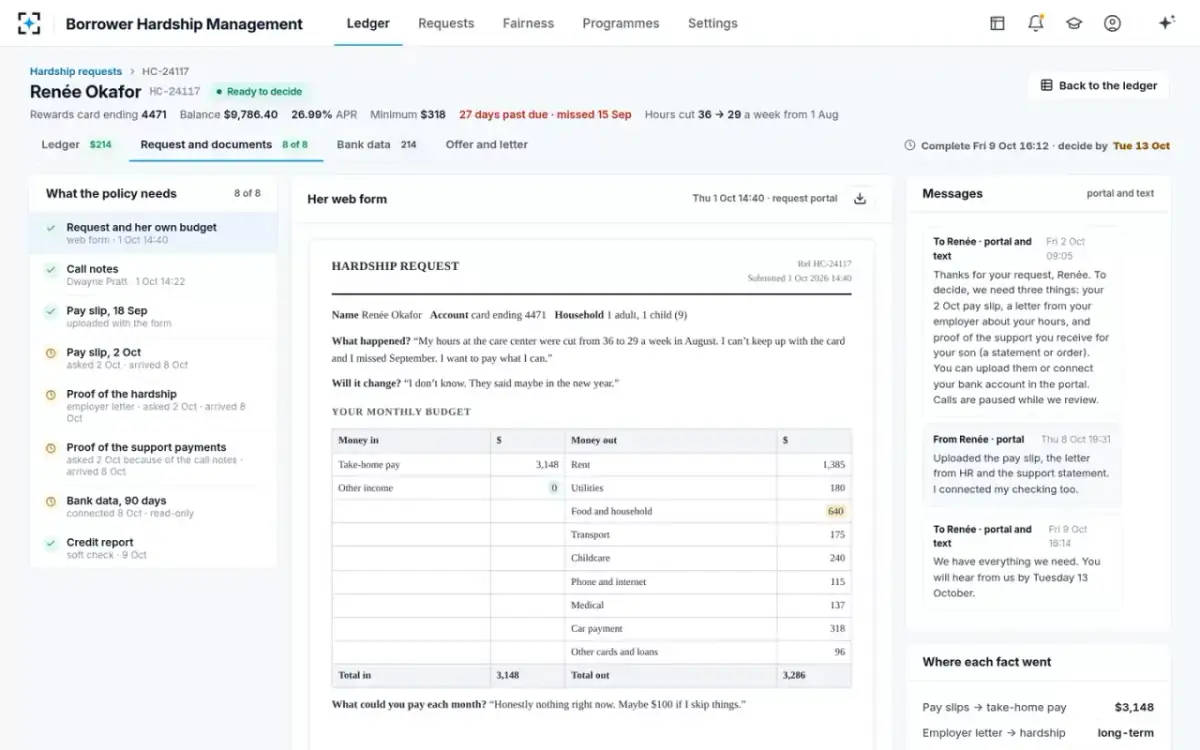
The sample request below shows the shape of the pause. Dwayne Pratt took Renée's first call on 1 October and wrote "hours cut, ex helps with the kids"; her web form arrived 18 minutes later. Three items were missing — a pay slip, proof of the hours cut and proof of the support payments that only the call notes mentioned — and she was asked for them once, through the portal and the text channel she had chosen. She sent them on 8 October. The request was complete on 9 October at 16:12, the two-business-day clock ran to Tuesday 13 October, and the offer was signed and co-signed on Monday 12 October. Calls were paused throughout.
Twelve days of one hardship request in Borrower Hardship Management, with the dialler quiet
- Waiting on three documents8 days
- Complete: the decision clock3 days
- Signed and co-signed1 day
- Asked once, by portal and texther own pace
- The lender’s own clock2 business days
Every open request on its clock, with collection calls paused
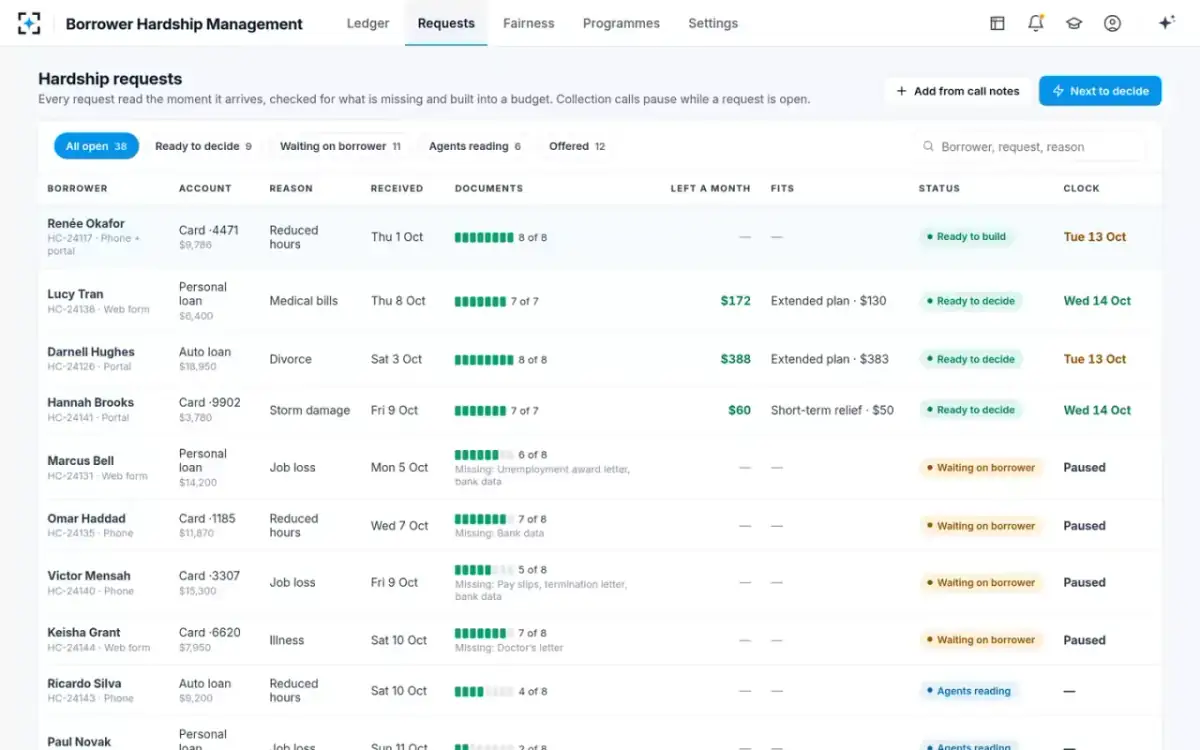
The release matters as much as the trigger. A pause with no release rule becomes a quiet amnesty that nobody signed off, and an account that stops being worked while still rolling is the kind of thing the agencies have criticised in workout programs. The rule in the solution is narrow: the pause begins when a request is opened, it covers the decision clock, and it ends when the decision is signed or the request is withdrawn.
Channels: portal, text and the one no issuer reported using
Regulation F treats email and text as communications like any other, and adds one requirement of its own: a collector communicating electronically must include, clearly and conspicuously, a reasonable and simple way for the consumer to opt out of further messages to that address or number, and may not make the consumer pay a fee or provide information beyond what is reasonably necessary to do it.
What issuers actually use is narrower than the channel list suggests. The CFPB's December 2025 report to Congress on the credit card market found that "About half of issuers report using mobile apps to communicate with consumers about delinquent balances. No respondents reported utilizing social media communication as a collection tool". Nobody is collecting through social media, and half the market is not yet using the app the borrower already has on her phone.
The channels a borrower can choose, and what belongs on each
| Channel | What it is good for | What the rule adds | In the sample request |
|---|---|---|---|
| Phone | The first conversation, where the reason and the dates come out. | Frequency presumptions, the 8 a.m. to 9 p.m. window, and a conversation that starts seven days of silence. | One inbound call on 1 October; no outbound calls while the request was open. |
| Portal | Documents, the borrower’s own budget figures, the offer and the acceptance. | A communication like any other; nothing in it may misrepresent the debt. | The web form, the three missing items and the signed offer. |
| Text | A short nudge that a document is still outstanding. | Must carry a simple opt-out for that number, with no fee and no extra information demanded. | One request for the missing items, on the number she chose. |
| A letter that has to be read twice, and its attachments. | Same opt-out requirement, per address. | Not used: she chose portal and text. | |
| Mobile app | Reaching a borrower where she already banks. | No separate provision; the same communication rules apply. | About half of issuers use one for delinquent balances. |
| Social media | Nothing, on the evidence. | Private messages are communications; public posts about a debt are not permitted. | No surveyed issuer reported using it as a collection tool. |
Writing the pause into policy: the clock, the trigger and the release
A pause is only defensible if the contact history shows it was deliberate. That means four things on the file: when the request opened, what the pause covered, when the decision was made, and when calling resumed. In the solution each of those sits on the activity trail of the request, next to the documents and the signatures, and the clock itself is a setting of one, two or five business days with pausing on or off.
What has to be on the contact record for a pause to be provable
- The request, with the minute it opened
A pause whose start cannot be dated is a gap in the call history that someone will later read as neglect.
- The channels the borrower chose, and when she chose them
Consent and channel preference are both dated facts. Undated, they are recollections.
- Her own time zone, as she stated it
The 8 a.m. to 9 p.m. window is local to the borrower, and an area code is not evidence of where she is.
- Every outbound attempt, connected or not
Unconnected calls are excluded from the frequency count, so attempts and connections have to be distinguishable.
- Each conversation, with its date
A conversation starts a seven-day period of its own. If conversations are not marked, the second presumption cannot be tested.
- The decision, the signature and the release
The pause ends on a dated event, not on a diary note.
- Any written cease request, and what was sent afterwards
The three statutory exceptions are narrow; a letter sent after a cease request has to be one of them.
- The policy version in force that day
Clocks and pause settings change. The record has to show which rules the account was worked under.
Asked once, through the channels she chose
One more line belongs in the policy: what the pause does not do. It does not stop the account ageing, it does not waive a fee, and it does not change what the borrower owes. Those are separate decisions with separate rules — re-aging a delinquent account has its own conditions, and what a lender reports for a hardship plan is governed by what is accurate, not by what is kind. Treating a quiet dialler as relief is how a borrower ends up surprised in January by an account that has been rolling since October.
Questions people ask
What must a collector do when a borrower asks in writing to stop calling?
Stop, with narrow exceptions. Under the FDCPA, if a consumer notifies a debt collector in writing that she refuses to pay the debt or wishes the collector to cease further communication, "the debt collector shall not communicate further with the consumer with respect to such debt", with three narrow exceptions: to say that efforts are ending, to say that specified remedies may be invoked, or to notify her that a remedy ordinarily invoked will be. A creditor collecting in its own name is not bound by that provision, though most large lenders honour such requests as policy.
What happens if a collector calls after a cease request?
The call is a communication the rule prohibits, and the FDCPA is privately enforceable, so the exposure is a consumer claim as well as a supervisory finding. Operationally the harder problem is that cease requests arrive as letters and portal messages rather than as a system flag, so the control that matters is the one that gets the request onto the account the same day it is received.
Do collection calls stop while a hardship request is open?
Only if the lender decides they do. No federal rule suspends contact because a borrower has asked for relief. In Borrower Hardship Management it is a setting: the pause starts when the request opens, covers the decision clock of one, two or five business days, and releases when the decision is signed or the request is withdrawn — and because it is a setting, the record shows which version of the policy the account was worked under.
Is seven calls in seven days a hard limit?
No. It is the frequency at which a debt collector is presumed to comply with the harassment prohibition. Fewer calls can still be harassment on the facts, and more can be defensible where an exclusion applies — a call placed with the borrower's prior consent within the previous seven days, or a call that never connected. The presumption decides who has to prove what, not whether the eighth call is automatically unlawful.
Does the seven-in-seven count apply per borrower or per debt?
Per debt. The rule defines "particular debt" as each of a consumer's debts in collection, so a borrower with two delinquent accounts can lawfully be called about each. Student loans are the exception: all of a consumer's student loan debts serviced under a single account number when the collector obtained them count as one debt. A borrower who gets two sets of calls on the same day is being treated correctly by the rule and badly by the lender.
Does Reg F cover texts and emails?
Yes. Electronic messages are communications, subject to the same prohibitions on inconvenient times and on contacting a borrower known to be represented by an attorney, and they carry one extra duty: each must describe a reasonable and simple way to opt out of further messages to that address or number, free of charge. That is why a hardship program should send document requests only through the channels the borrower actively chose.
To see the pause, the clock and the decision it protects on one request, start from Borrower Hardship Management.