Fair servicing risk is the risk that two borrowers in the same situation are treated differently by the people servicing their loans — different relief, different patience, different effort — on grounds the lender cannot explain afterwards. It is a quieter risk than fair lending at origination, because almost nothing about it is written down: the anti-discrimination rule names collection procedures as part of the credit transaction, but a decision to decline a payment plan on a delinquent account is generally not adverse action, so there is no notice, no statement of reasons, and no file the examiner can read unless the lender built one. Borrower Hardship Management, Botminds' software for hardship requests, closes that gap by showing the specialist what similar borrowers were offered before the decision is made, and by requiring a written reason for any departure.
The figures from the solution on this page are sample data on fictional people and a fictional lender. The rules are quoted from the regulation and from the agencies' own guidance.
Ninety days of hardship decisions in Borrower Hardship Management
1,284
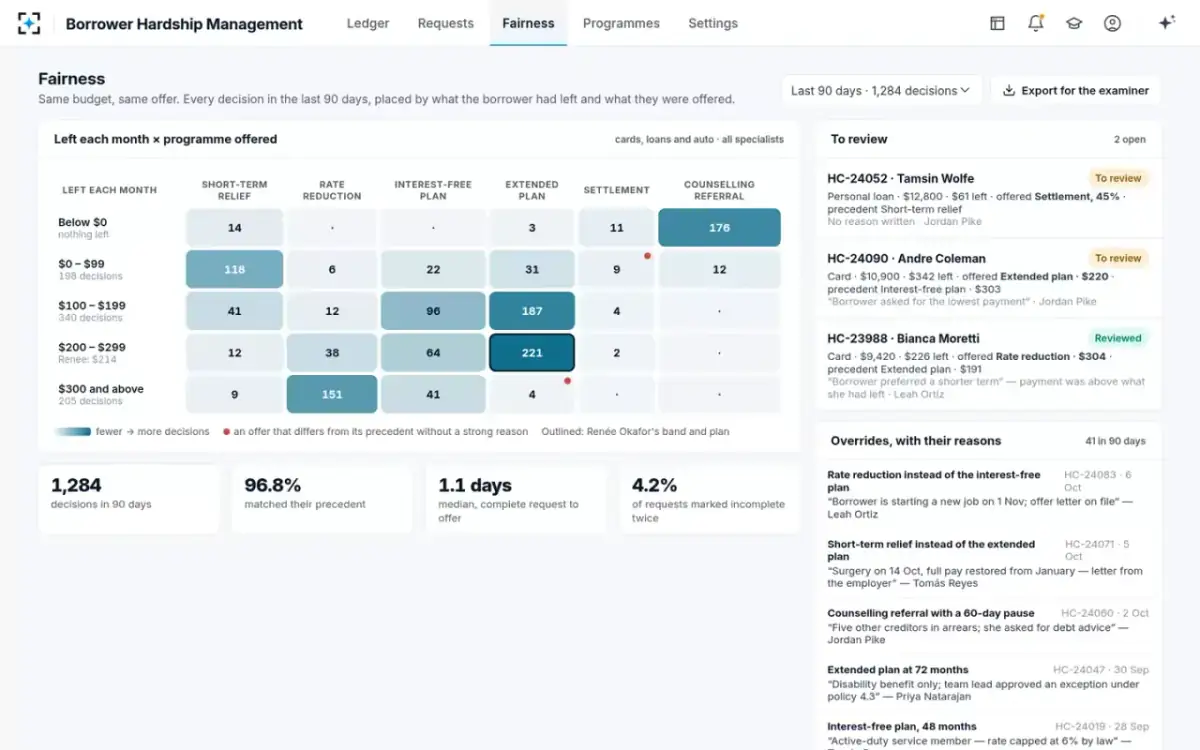
decisions placed by what the borrower had left and what she was offered
14
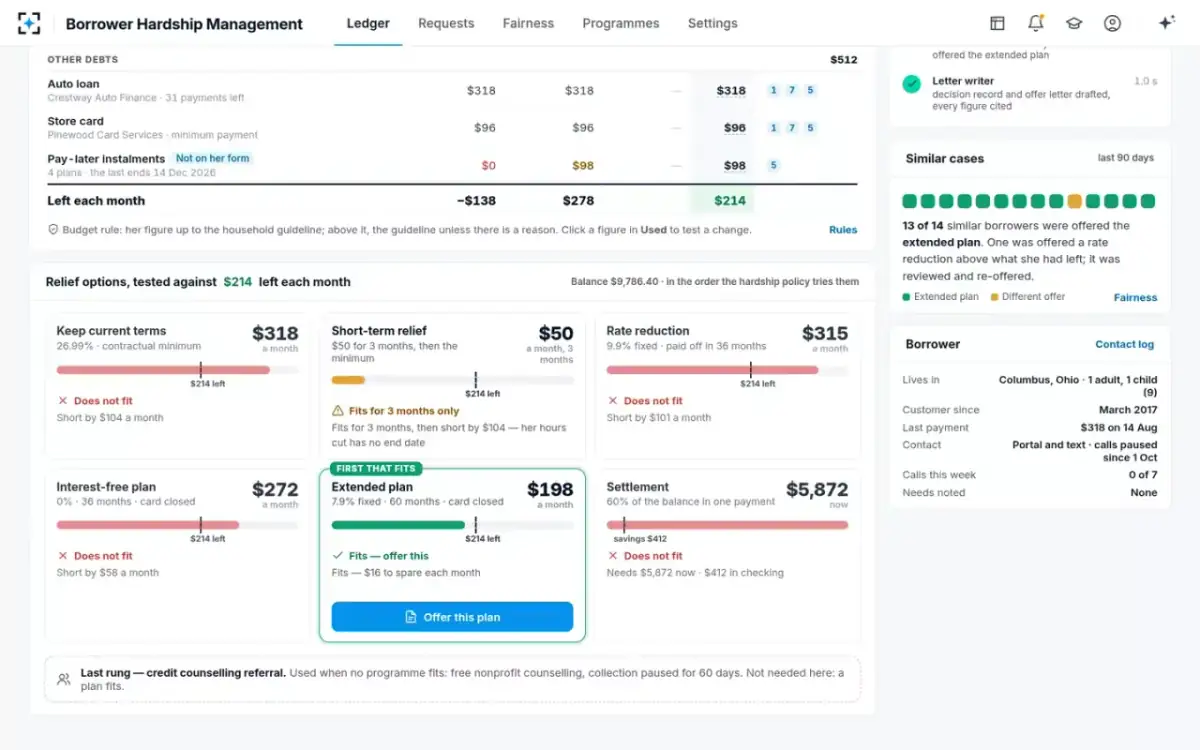
borrowers comparable to the one in front of the specialist today
13of 14
were offered the same plan — shown before the decision, not after
1
offer that differed: reviewed, not approved, and re-offered
What is fair servicing risk?
Fair servicing risk is fair lending risk after the loan is made. It covers everything a servicer or a collections floor does with an account that already exists: how hard it chases, what forbearance it offers, whether it waives a fee, how fast it escalates, how it handles a request for help. The exposure is the same as at origination — a pattern of worse outcomes for borrowers on a prohibited basis — but the evidence is far worse, because servicing decisions are made in hundreds of small judgements by people whose reasons are rarely captured.
Three things make hardship work the sharpest part of it. The decisions are discretionary by design: a relief ladder exists precisely so that a person can choose the rung. The inputs are soft: what a borrower can afford depends on which figures are believed. And the outcome differences are large and durable — a 60-month plan at 7.9% against a settlement against nothing at all is the difference between a borrower who recovers and one who does not.
The useful test is not whether a lender can prove the absence of discrimination. It is whether, for any two requests an examiner picks out of the queue, somebody can say in one sentence why they ended differently — and show that the sentence was written before anyone asked.
Collection procedures are part of the credit transaction, in the rule's own words
Lenders sometimes treat the anti-discrimination rule as an origination rule. Regulation B does not read that way. It defines a credit transaction to mean "every aspect of an applicant's dealings with a creditor regarding an application for credit or an existing extension of credit", and then lists what that includes, ending with collection procedures.
"…including, but not limited to, information requirements; investigation procedures; standards of creditworthiness; terms of credit; furnishing of credit information; revocation, alteration, or termination of credit; and collection procedures."
Regulation B, 12 CFR 1002.2(m)
The operative prohibition is one sentence long: a creditor "shall not discriminate against an applicant on a prohibited basis regarding any aspect of a credit transaction". Put the two together and the reach is plain — the relief ladder, the documents demanded, the figures believed and the vigour of the chase are all aspects of the credit transaction, and the rule applies to all of them.
"Information requirements" and "investigation procedures" are worth dwelling on, because they are where a hardship program can go wrong without anyone choosing an outcome at all. If one borrower is asked for three months of bank statements and another with the same stated reason is not, the difference is in the rule's own list before any plan has been offered.
Do you have to send an adverse action notice when you decline a hardship plan?
Usually not, and that is the hinge of this whole subject. Regulation B defines adverse action to cover a refusal to grant credit in substantially the amount or on substantially the terms requested, a termination or unfavourable change to an existing account, and a refusal to increase available credit. It then excludes, in terms: "Any action or forbearance relating to an account taken in connection with inactivity, default, or delinquency as to that account".
A hardship request is almost always made on an account that is already delinquent or heading there. Declining the plan the borrower asked for, offering a different one, or ending a forbearance arrangement is therefore an action relating to an account taken in connection with delinquency — outside the definition, and so outside the notice duty at 12 CFR 1002.9, which otherwise requires a written notification that states the action taken, names the creditor and its address, sets out the anti-discrimination provision of the Act and names the federal agency that supervises the creditor, together with a statement of specific reasons or the right to request one.
Adverse action at origination against a hardship decline on a delinquent account
A declined credit application: Yes: a refusal to grant credit in substantially the amount or on substantially the terms requested.
A declined hardship plan: Generally no: an action or forbearance relating to an account taken in connection with delinquency is excluded.
A declined credit application: Written notification within 30 days, with the content 12 CFR 1002.9(a)(2) lists.
A declined hardship plan: None owed. Many lenders write to the borrower anyway, because a decision with no letter is a decision she cannot question.
A declined credit application: Either the principal reasons, or the right to ask for them within 60 days.
A declined hardship plan: None owed, so none are generated unless the lender requires them internally.
A declined credit application: The application, the notice, the reasons, kept 25 months under 12 CFR 1002.12.
A declined hardship plan: Whatever the servicer chose to keep. No regulation starts a clock, because no notice was given.
A declined credit application: Declines against approvals, with the stated reasons in hand.
A declined hardship plan: Offers against offers, with nothing stated — unless the lender built the comparison itself.
Why the answer is usually no, and why that makes the record matter more
Every exemption in a consumer rule is a transfer of responsibility, not a removal of it. The notice duty exists so that a borrower learns why, and so that a comparison can be made later. Where the duty does not bite, the borrower still wants to know why and the examiner still wants to compare — they simply have to use whatever the lender happened to keep.
This is why the most valuable artefact in a hardship program is a written reason attached to every decision that departs from the first option the policy would have produced. It is cheap to create at the moment of the decision, when the specialist knows exactly why, and impossible to reconstruct eighteen months later from a notepad.
The agencies have been explicit that workout programs are supervised ground. The interagency guidance on credit card account management warns that the agencies will criticise management and require corrective action where workout programs are not managed properly — and lists adverse classification of whole portfolio segments, nonaccrual, higher loss allowances and accelerated charge-offs among the actions that may follow. A program whose decisions cannot be explained is, by any reading, not managed properly.
Similarly situated: choosing the comparison that an examiner will accept
"Similarly situated" is doing the real work in any fair servicing analysis, and it is where a comparison is usually lost. Draw the circle too wide — every borrower who asked for help in the quarter — and the differences are explained by facts nobody disputes, so the test proves nothing. Draw it too narrow and the group has one member.
The defensible circle is the one the lender's own policy implies. If the hardship policy tries the ladder in a fixed order against what the borrower has left, then two requests are comparable when the inputs the policy actually uses are close: the same product, a similar balance, the same kind of hardship and about the same money left each month. That is a definition an examiner can test, because it is the definition the decision itself used.
Four dimensions that make two hardship requests comparable
The comparison, dimension by dimension, and why each one is in it
- The same product
A revolving card and a closed-end instalment loan have different ladders, different terms and different accounting. Comparing across them compares policies, not decisions.
- A balance within 25%
Payment arithmetic scales with balance. A 60-month plan on $9,800 and on $19,000 are not the same offer even at the same rate.
- The same kind of hardship
A temporary hardship with a stated end date and an open-ended income drop belong on different rungs; short-term relief fits one and not the other.
- What is left within $40
The money left after essentials and other debts is the figure every rung is tested against. Two borrowers $40 apart face the same options; $150 apart, they do not.
Applied to the sample request, the circle contained 14 borrowers from the previous 90 days: a card balance between $7,000 and $12,000, a long-term income drop, and between $180 and $260 left each month. Thirteen were offered the 60-month extended plan. One was not.
Fourteen comparable borrowers, and the one offer that departed
What 14 comparable borrowers were offered in the last 90 days
- Extended plan, 60 months · 93%
- Rate reduction above what the borrower had left · 7%
The departure is the interesting case, and not because someone was careless. A specialist who believes a borrower's hours will return in November will prefer the plan that costs her least if that belief is right. The problem is that the belief was not evidenced: no employer letter said so, and the arithmetic of the offer required a monthly payment $78 above the money the borrower actually had. Shown the precedent before deciding, the same specialist would have had to write that sentence down — and writing it down is what makes it reviewable.
Ninety days of decisions, placed by what was left and what was offered
The exception log: what a written reason has to contain
An exception log is only as good as the sentences in it, and most are useless because they record the decision rather than the reason. "Offered rate reduction" is a decision. "Specialist judged the borrower would return to full hours in November; no employer letter supported it" is a reason, and it is reviewable precisely because it names the missing evidence.
Three entries from a hardship exception log, as the compliance analyst reads them
| Date | Request | What departed from the policy | The reason written at the time | Who approved | Outcome |
|---|---|---|---|---|---|
| 24 Sep | HC-23988 · card, $11,240 | Plan offered: rate reduction at $304, not the extended plan at $191 | Specialist judged the borrower would return to full hours in November; no employer letter supported it | Reviewed by the compliance analyst, not approved | Re-offered as the extended plan at $191 |
| 2 Oct | HC-24067 · card, $8,410 | Food and household raised from the $540 guideline to $612 | Prescribed diet for a dependent, with a letter from the treating clinician on file | Approved by the team lead | Extended plan at $176, still above the spare margin |
| 12 Oct | HC-24117 · card, $9,786.40 | None kept: the $640 food figure was tested and undone | The test left nothing on the ladder that fit; the borrower was asked for the clinician letter instead | Specialist, co-signed by the team lead | Extended plan at $198, matching 13 of 14 precedents |
Four tests tell a good entry from a bad one. Does it name the fact relied on, not the conclusion? Does it say what evidence supported that fact, or that none did? Does it identify the person, not the team? And would a stranger reading it in two years reach the same decision, or at least understand this one? An entry that fails the last test is a note to self, not an exception log.
Discretion is not the problem; undocumented discretion is
It is tempting to answer fair servicing risk by removing judgement — a rigid ladder, no overrides, no exceptions. That trade is worse than it looks. Hardship facts are irregular by nature: a prescribed diet, a child's medical cost, a seasonal job, a support payment that will stop in December. A policy with no give either forces specialists to distort the figures to reach a humane answer, which destroys the comparison entirely, or produces plans that break.
The workable answer is to keep the discretion and price it in paperwork. Let the specialist test any figure, show what it does to the arithmetic, and require one sentence to keep the change. In the sample request the specialist tested a $640 food figure against the $540 household guideline, found nothing on the ladder fit at $114 left, and asked the borrower for the clinician's letter rather than keeping the change unsupported. The test is on the record either way, which is the point.
Every rung tested against what she has left, with the precedent beside it
Testing outcomes monthly rather than defending them annually
Most fair servicing programmes test once a year, which is late enough that a pattern has already run for four quarters. A monthly cadence changes what the test is for: it becomes an operational control rather than an audit, and the volumes are small enough to read.
Three measures carry most of the value. First, the share of decisions that match their precedent, by specialist and by queue — a specialist 20 points below the floor is a coaching problem before it is a compliance problem. Second, the exception rate and its reasons, grouped: twenty exceptions all citing the same missing document mean the policy asks for the wrong document. Third, performance of the plans written: a specialist whose offers match precedent but whose plans break at twice the rate is being too generous to be kind.
The supervisory expectation points the same way. The uniform retail credit policy says that, "To be effective, management information systems should also monitor and track the volume and performance of loans that have been re-aged, extended, deferred, renewed, or rewritten and/or placed in a workout program". Volume and performance, tracked — not a yearly sample.
One honest limit belongs here. Borrower Hardship Management compares offers against the lender's own definition of comparable borrowers; it holds no demographic data and does not test for disparate impact on a prohibited basis. That analysis is the compliance function's, using the lender's own monitoring data, and the solution's contribution to it is a clean, dated, exportable set of decisions with their reasons attached.
What to hand an examiner, and in what order
An examination of hardship work usually starts with a list of accounts and a question of the form "why this offer". The order below answers that question before it has to be asked twice; it is our suggestion, built from the provisions and guidance on this page rather than from any published examination procedure.
A hardship review file, in the order it answers the examiner's questions
| Order | What to hand over | The question it answers |
|---|---|---|
| 1 | The hardship policy in force on the decision dates, with its version history | What was the rule the decision was supposed to follow? |
| 2 | The relief ladder, with the payment rule, maximum term and signing limit for each rung | What could the borrower have been offered? |
| 3 | The budget behind the decision, each line citing its document or transactions | Why did the lender believe this borrower could afford that? |
| 4 | The comparison set: who counted as similar, and what each was offered | Were similar borrowers treated the same? |
| 5 | The exception log for the period, with reasons, approvers and outcomes | Where the treatment differed, why? |
| 6 | Monthly outcome testing, with what changed after each round | Did anyone notice, and did anything change? |
| 7 | Plan performance by rung and by specialist | Were the offers affordable in fact, not just on paper? |
Two sibling questions sit next to this one. The arithmetic that produces the comparison is in how a collections budget is built, and the contact rules that govern the weeks before the decision are in when the calls must stop.
Questions people ask
Does ECOA apply to loan servicing and collections?
Yes. Regulation B's prohibition covers "any aspect of a credit transaction", and the definition of a credit transaction expressly includes collection procedures as well as information requirements and investigation procedures. The duties that attach to an application — the notice, the statement of reasons — mostly do not follow, but the prohibition itself does.
What is a comparative review of servicing decisions?
It is the servicing version of a comparative file review: pick a set of decisions that should have come out the same way, line them up, and explain every difference. The work is in defining the set. A review that compares all declines against all approvals will find differences that the facts explain; one that compares borrowers with the same product, a similar balance, the same kind of hardship and the same money left each month is testing the thing the policy actually decided.
How long should hardship decision files be kept?
Longer than the rules require, because the rules mostly do not reach them. Regulation B's retention clock runs 25 months from a notification of adverse action, and a hardship decline on a delinquent account usually generates no such notification, so no clock starts. The practical floor is the life of the plan plus the period an examination can look back over, which for a 60-month plan means keeping the budget, the comparison and the reason for at least as long as the borrower is paying.
What makes a discretionary workout decision risky?
Three things together: an outcome that differs from the policy's default, a reason that was never written, and a pattern. Any one alone is manageable. The dangerous combination is a specialist whose offers differ from precedent more often than anyone else's, with no reasons on file to explain why — because at that point nobody, including the specialist, can say whether the difference was judgement or something else.
Does Borrower Hardship Management test for discrimination on a prohibited basis?
No, and it is worth being plain about it. The solution holds no demographic data and runs no disparate impact analysis. What it does is make such analysis possible: every decision carries the budget it rested on, the comparison set, the offer, the reason for any departure and the signature, exported as a dated set the compliance function can test with its own monitoring data.
Can two specialists reach different offers on the same budget?
They can, and sometimes they should — a hardship with a documented end date justifies a different rung from an open-ended one even when the money left is identical. What a program cannot survive is two different offers with no stated reason for the difference. The design question is not how to prevent disagreement but how to make sure each specialist sees the other's precedent before deciding, and writes one sentence when departing from it.
To see the comparison, the exception log and the export on one set of requests, start from Borrower Hardship Management.