Collections automation software is the category that covers everything between a delinquent account and a resolution: diallers and contact strategy, payment portals, promise-to-pay tracking, agency placement and recall, settlement workflows, and — the part this guide is about — hardship management and loss mitigation case handling. The category is broad enough that two products called the same thing may share no function at all, which is why an evaluation that starts from a feature list ends in a demonstration nobody can score. For hardship work the right test is narrow: can this system produce a decision that a borrower, a team lead and an examiner can all read two years later, and can the lender change the rules behind it without asking anyone? Borrower Hardship Management is Botminds' software for that part of the problem, and this guide uses it as the worked example for what to ask.
The baseline figures below are our estimates for a typical card hardship request, labelled as estimates; the solution's own sample data is on fictional people. Nothing here is a customer's measured result.
The baseline a hardship evaluation should start from
5–7days
from a complete request to a signed offer, worked by hand (estimate)
3days
of that spent reading pay slips, letters and bank statements before any decision (estimate)
6
steps between a complete request and a signed offer, each timed in the estimate below
1day
from a complete request to a signed offer — the design target, not a measured result
What does collections automation software actually do?
Strip the category down and there are four jobs, bought in roughly this order by most lenders. Contact: deciding whom to call, when, on which channel, and recording what happened. Payment: taking money, setting up arrangements, tracking whether promises are kept. Movement: placing accounts with agencies, recalling them, handing off to recovery or to legal. And decisioning: working out what a borrower can afford and what should be offered.
The first three are mature, well-priced and broadly interchangeable. The fourth is where lenders still run on spreadsheets and judgement, because it is the only one of the four that requires reading unstructured documents and applying a credit policy to a household. That is also where the money is: the difference between a plan that holds for five years and a plan that breaks in four months is worth more than any improvement in contact rates.
It is worth naming what this guide is not about. A dialler is not a hardship system. A payment portal is not a hardship system. Both are necessary and neither will tell you why a borrower was offered a 60-month plan instead of a settlement.
Why contact efficiency is the wrong test for hardship work
Contact metrics measure the funnel before the decision. In hardship work the borrower has already raised her hand; the funnel is over. Optimising contact at that point is optimising the wrong half of the process, and it can actively damage the right half — a borrower pressed into a payment arrangement she cannot keep is a cure that unwinds.
The supervisory framing is blunt about where the risk sits. The interagency guidance on credit card account management opens its workout section with four words that have been quoted at a great many lenders: "Institutions should properly manage workout programs." Its list of concerns is about program design and information rather than contact: liberal terms, high charge-off rates, accounts moved from one program to another, repeated re-agings, and poor management information to monitor performance.
There is a second reason contact efficiency misleads here. Most issuers keep hardship enrolment in-house precisely because it is hard: the CFPB's December 2025 report to Congress found that "Most issuers also reported that they do not allow their third-party collection agencies to offer and enroll borrowers in hardship programs, due to the complexity of managing these programs." The work that cannot be handed to an agency is the work that deserves the investment.
How do you evaluate collections software for hardship cases?
By running your own past requests through it and reading the output, not by watching a demonstration on a vendor's data. An evaluation that does not produce, for twenty of your own real requests, a budget with citations, a tested ladder, a precedent set and a decision file, has not tested the thing you are buying.
Three rules make such a trial worth the effort. Choose the awkward requests, not the clean ones: the borrower paid fortnightly with a second job, the joint account, the one whose documents arrived in three batches. Have a specialist record the right answer first, so there is something to score against. And insist that the vendor configure your ladder and your budget rule before the trial rather than mapping your policy onto theirs afterwards.
Nine questions, and the evidence each answer needs
These are the questions whose answers decide whether the system will survive an examination and a change of policy. Each one has an artefact attached, because an answer with no artefact is a sales position.
Nine questions for a hardship system, and the artefact that answers each
- Where does each figure in the budget come from?
Artefact: one budget from your own data where every line opens onto the document or the transactions behind it. A figure that cannot be opened cannot be defended to the borrower who disputes it.
- Can we change the relief ladder ourselves?
Artefact: a new rung added, with its payment rule, term and signing limit, in front of you, without a release. If this needs a change request, your credit policy now moves at the vendor’s pace.
- What does it do when nothing on the ladder fits?
Artefact: a request where every rung costs more than the borrower has left. The right answer is a referral, not the cheapest rung.
- Is the precedent shown before the decision or after it?
Artefact: the comparable cases on screen while the specialist is choosing. Shown afterwards, it is an audit; shown before, it is a control.
- What happens when a specialist disagrees with a figure?
Artefact: a what-if that moves the arithmetic, demands a written reason to keep the change, and can be undone.
- Who can sign what, and is it enforced?
Artefact: an offer above the limit that cannot be sent without the co-signature, with the rule version on the record.
- What does the decision file look like?
Artefact: the printed record for one request. Read it as if you were an examiner who knows nothing about the case.
- What can it never do?
Artefact: the written limits, and a test for each. A vendor that cannot list its own system’s prohibitions has not thought about them.
- How do we get our decisions out?
Artefact: an export of a period’s decisions with their evidence, in a format you can keep after the contract ends.
Where the days go on one hardship request, by hand and in Borrower Hardship Management
The last two rows make the argument of the whole category. When the reading and the arithmetic fall to a tenth of a day, the decision and the sign-off become half the elapsed time — which is the right place for the time to be, and the reason the measure to improve next is the sign-off queue rather than the document reading.
Configurability that matters: the ladder, the budget rule, the clocks, the limits
Every vendor says the product is configurable. The question is which decisions the lender owns after signing, and the answer should be checked against a single test: if the economy turns in eighteen months and the credit committee wants a new rung on the ladder, who does the work?
What the buyer should configure, and what the product should hold fixed
| The rule | What the lender must own | What the product should hold fixed | Why the line falls here |
|---|---|---|---|
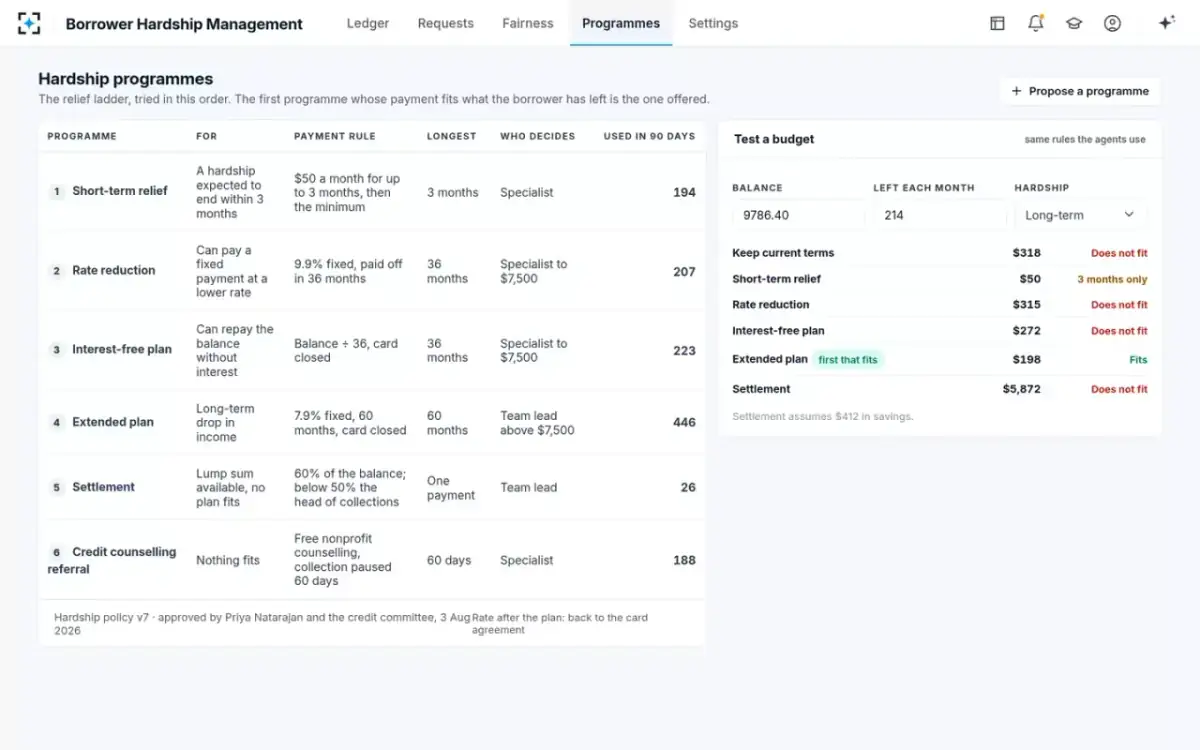
| The relief ladder | Every rung: who it is for, the payment rule, the longest term, the rate, who may sign it, and the order the policy tries them in. | That a ladder exists and is tried in order. | The ladder is the lender’s credit policy. A vendor that owns it owns your loss mitigation. |
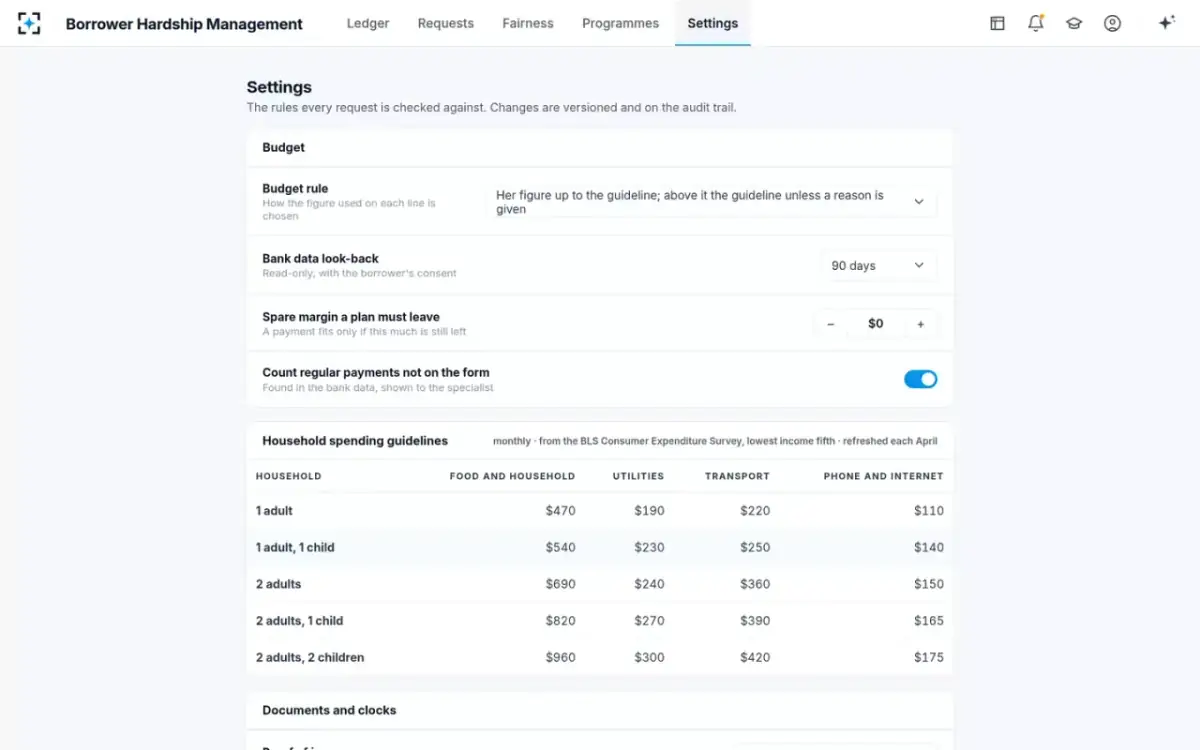
| The budget rule | Which source wins where the form, the account data and the household guideline disagree, and what happens above the guideline. | That three sources are shown side by side with the figure used. | This single rule moves more decisions than anything else on this list. |
| The household guidelines | The reference table by household size, and how often it is refreshed. | That a guideline exists and is cited on the line it affects. | A lender that cannot change its reference table cannot respond to inflation. |
| The clocks | The decision clock in business days, and whether collection calls pause while a request is open. | That the clock is enforced and visible on every open request. | Service levels differ by lender and by product, and they change under volume. |
| Signing limits | The balance each role may sign alone, the co-signer by name, and where settlements go. | That a signature is required before anything reaches the borrower. | Authority is the lender’s own governance; no vendor should be setting it. |
| The documents required | What the policy asks for by hardship reason, and what it must never ask for. | That the list is checked before a request is called complete. | Document demands are an information requirement, which is part of the credit transaction. |
The rules screen: the settings a lender owns in Borrower Hardship Management
The decision file: what a stranger has to be able to read two years later
The decision file is the artefact the whole purchase exists to produce, and it is the one most rarely examined during an evaluation. Ask for one, printed, for a request with an awkward fact in it, and read it cold.
It should carry, in order: what the borrower asked for and when; what the policy required for that reason and what was received; the budget, each line with its source and the rule that chose between sources; every rung of the ladder with its payment against what was left; what comparable borrowers were offered; any figure that was changed, with the reason and who approved it; the decision, the signature and the co-signature; and the letter that went out. If a stranger cannot answer "why this offer" from that document alone, it is a case summary rather than a record.
The supervisory expectation is specific here too. Adequate management information systems, in the uniform retail credit policy's description, identify and document every loan that has been re-aged, extended, deferred, renewed or rewritten, and how many times. The number of times is the clause that catches most systems: a product that records the current arrangement but not the history of arrangements cannot answer it, and the question is one examiners ask early. How those arrangements are counted and when they may be granted is the subject of re-aging a delinquent account.
Integrations that are not optional, and one that usually is
A hardship system sits between six other systems, and five of those connections decide whether it works at all. The sixth — the bank data connection — is the one most likely to be sold as essential and most important to be able to live without, because a material share of borrowers will not or cannot connect an account.
The six systems a hardship program touches, and what flows each way
| System | What comes in | What goes out | How optional it is |
|---|---|---|---|
| Request portal and web form | The request itself, the borrower’s own budget figures, her uploads, and her acceptance of an offer. | The questions the policy requires for her stated reason, the offer and the letter. | Not optional. A hardship program with no borrower-facing front door runs on call notes. |
| Contact centre notes | The first call, in the collector’s own words, where the reason and the dates come out. | Nothing. The notes are read, never rewritten. | Not optional, and the most underrated feed: the support payment in the sample request existed only in a call note. |
| Bank data connection | 90 days of transactions, read-only, on the accounts the borrower connected. | Nothing. The connection is never written to. | Optional in the sense that the budget must work without it, mandatory in the sense that it is where the omissions are found. |
| Card and loan servicing | Balance, rate, minimum payment, due date, delinquency and payment history. | Nothing automatically: the plan is applied by the servicing system after a signature. | Not optional. A hardship decision made on a stale balance is a wrong decision. |
| Credit report | A soft check for other debts the borrower may not list. | Nothing. | Not optional for anything but the simplest single-product lender. |
| Hardship policy | The relief ladder, the documents required by reason, the budget rule and the letter templates. | Versions: every change is dated and on the audit trail. | Not optional, and it belongs to the lender. A ladder the vendor owns is a ladder you cannot change in a recession. |
The flow direction in the third column is the detail to press on. It is tempting to want a product that applies the plan automatically, and it is a mistake in this part of the business: the servicing change is the thing the borrower is contractually bound by, and it should follow the signature rather than anticipate it. What the solution does and does not do is worth stating plainly — it does not dial, does not change account terms, does not furnish anything to the credit bureaus, does not re-age an account and does not send a letter.
Third-party risk: what the agencies expect you to have asked before signing
Buying a system that touches delinquent borrowers' financial data is a third-party relationship of the kind the agencies' 2023 interagency guidance addresses. The guidance sets out risk management principles to be scaled to the bank's own risk profile and complexity and to how critical the outsourced activity is, and it is explicit that third-party relationships do not all carry the same level of risk or criticality.
Criticality is the word to argue about internally before procurement starts. A hardship decisioning system is customer-facing, handles sensitive financial data, affects consumer outcomes and produces the evidence for a compliance obligation. It will sit at or near the top of most criticality scales, which changes the due diligence, the contract terms and the ongoing monitoring the second line will expect. Buyers who classify it as a workflow tool discover this late.
The questions that follow from that classification are the usual ones with a hardship edge: where the data is held and for how long; who at the vendor can see a borrower's documents; what the exit looks like, including whether decisions and their evidence come out in a readable form; how changes to the product are notified and tested; and what the vendor's own subcontractors do. The CFPB's market report notes that issuers generally keep hardship enrolment away from third-party agencies because the programs are complex to manage — a lender that will not delegate the decision to an agency should look carefully at how much of it a software contract delegates by default.
Where automation stops: the judgement a person has to keep
Four decisions should stay with named people, and a product that offers to take any of them is offering a liability. Which rung of the ladder a borrower is offered, where the first rung that fits is not the obviously right answer. Whether to believe a figure the documents do not support. Whether a departure from precedent is justified, and what the reason says. And whether to sign.
The reason is not sentiment about human oversight. It is that none of the four can be stated as a rule in advance: each turns on a fact about one household that the policy did not anticipate — a prescribed diet, a seasonal job, a support payment that ends in December. The system's job is to make the facts visible, to do the arithmetic, and to make a departure cost one written sentence. The argument about where exactly that line falls, and what an agent may never decide, is worked through in what an agent may never decide.
The relief ladder, with who decides each rung
Measuring it afterwards: four numbers worth a baseline
Take all four before anything is bought, from your own queue, and take them the same way afterwards. A business case built on a vendor's figures is a business case nobody will be able to defend at the first review.
Four measures to take before and after, and what each one tells you
Measure it like this, before: Median and 90th percentile over a quarter, counted from the moment the file has everything the policy requires.
What a change in it means, after: The headline operational gain. Watch the 90th percentile: medians improve while the awkward cases stay stuck.
Measure it like this, before: How many requests needed a second or third ask for documents.
What a change in it means, after: Improvement here is a reading gain, not a decision gain, and it is usually the first thing to move.
Measure it like this, before: Hand-score 50 decided requests against comparable ones from the same period.
What a change in it means, after: The fairness measure. A rise here is the one worth showing the compliance committee.
Measure it like this, before: Cohort the plans written in a quarter and track them.
What a change in it means, after: The only measure that says whether the offers were affordable in fact. A faster process writing worse plans will show up here and nowhere else.
One warning about the fourth measure, because it is the one that distinguishes a good purchase from a fast one. A system that speeds up decisions without improving their quality will show a large gain in the first three measures and a deterioration in the fourth only once the first cohorts have had time to fail, by which time the evaluation is forgotten. Build the cohort before you sign.
Questions people ask
Can collections software decide a payment plan?
It can compute one. Deciding is a different act: it means choosing among rungs that differ in cost to the borrower by thousands of dollars, on facts the policy did not anticipate, and being able to say afterwards why. The workable design has the software test every rung against what the borrower has left, recommend the first that fits, show what comparable borrowers were offered, and hand the choice to a person with a signing limit.
What should a hardship workflow system record?
The request and when it arrived; what the policy required and what was received; the budget with a source on every line; each rung of the ladder with its payment against what was left; the comparison set; any figure changed, with the reason and the approver; the signature and co-signature with the rule version in force; the letter sent; and the plan's performance afterwards. If any of those is missing, the record cannot answer "why this offer" without someone's memory.
Is a dialler the same thing as collections automation software?
No, and conflating them is the most common error in these evaluations. A dialler decides who gets contacted and when; a hardship system decides what a borrower can afford and what she should be offered. They share a queue and nothing else. Scoring one against the other's criteria produces a purchase that does neither job.
How configurable should a relief ladder be?
Completely, by the lender, without a release. Each rung needs its own eligibility, payment rule, maximum term, rate treatment, fee treatment and signing limit, and the order the policy tries them in has to be the lender's. The practical test during an evaluation is to ask for a new rung to be added live; if that requires a change request, the lender's credit policy now moves at the vendor's release cadence.
What are the risks of outsourcing hardship decisions?
Most issuers surveyed by the CFPB do not let third-party collection agencies offer or enrol borrowers in hardship programs, citing the complexity of managing them. The same logic applies to software: the further the decision moves from the lender, the harder it is to evidence consistency, to change policy, and to answer for an outcome. The risk is not that a third party makes bad decisions; it is that the lender cannot explain the decisions that were made in its name.
How do you measure whether collections automation worked?
With four numbers taken before and after on the same basis: days from a complete request to a signed offer, the share of requests complete at first pass, the share of offers matching their precedent, and the share of plans still performing at six and twelve months. The first three can improve while the fourth gets worse, which is exactly the outcome a hardship program should not buy.
To see the ladder, the settings and the decision file on one request, start from Borrower Hardship Management.