Re-aging a loan is returning a delinquent account to current status without collecting everything that is contractually due, on the strength of the borrower having shown she can keep to a new arrangement. It is the step that makes a hardship plan worth signing from the borrower's side and the step that makes a delinquency report worth reading from the examiner's — which is why the federal policy that governs it sets four conditions, two counting limits and an expectation about documentation, and why the practices around it have their own paragraph in the agencies' credit card guidance. Borrower Hardship Management, a Botminds agentic solution for collections, does not re-age anything: the servicing system does that. What it produces is the thing a re-age decision rests on, which is a budget, a tested arrangement and a dated record of who decided what, and on what evidence.
This page is written for the collections manager who owns the account management policy and the credit risk or audit lead who has to show an examiner it was followed. The rules quoted are the published supervisory ones. The worked figures come from the solution's sample data on a fictional bank and borrower.
The limits a re-aging policy has to live inside
9months
minimum age of the account before it may be considered
3
consecutive minimum payments, or the equivalent cumulative amount
1in 12 mo
and no more than twice in any five-year period, on an open-end account
+1in 5 yr
one further re-age for a workout program, on top of that limit
What is re-aging a loan?
The policy's own definition is a single sentence with the concession in its second half: to re-age is "Returning a delinquent, open-end account to current status without collecting the total amount of principal, interest, and fees that are contractually due" (FFIEC Uniform Retail Credit Classification and Account Management Policy).
Two words in that definition do a great deal of work. "Open-end" means it applies to revolving credit — cards, lines of credit — and not to instalment loans, which have their own set of tools with their own names. And "without collecting" is the whole point: the arrears stay owed, the account's status changes. A lender that insists on the arrears being cleared first has not re-aged anything; it has been repaid.
What a re-age is for is restoring an account that has a future. The policy frames the whole family of these tools that way: re-aging, and the closed-end equivalents, "can be used to help borrowers overcome temporary financial difficulties, such as loss of job, medical emergency, or change in family circumstances like loss of a family member". The same paragraph then states the risk in the very next sentence, which is a fair summary of why this page exists: "A permissive policy on re-agings, extensions, deferrals, renewals, or rewrites can cloud the true performance and delinquency status of the portfolio."
The four conditions an open-end account must meet before it can be re-aged
The policy sets out what an account "should exhibit" to be considered. Each condition is checkable, and each implies a piece of evidence a file has to carry.
The four conditions, and the evidence each one needs on file
- "The borrower has demonstrated a renewed willingness and ability to repay the loan."
Evidence: an affordability assessment showing the new payment fits what the borrower has left, and payments that have actually arrived. Willingness is shown by conduct; ability is shown by arithmetic.
- "The account has existed for at least nine months."
Evidence: the account open date from the servicing system. This condition has nothing to do with the borrower; it exists so that a lender cannot use a re-age to cover an account that should not have been opened.
- "The borrower has made at least three consecutive minimum monthly payments or the equivalent cumulative amount."
Evidence: the payment history, with dates. The alternative wording matters: three payments’ worth, received, can satisfy it where the payments arrived unevenly.
- "Funds may not be advanced by the institution for this purpose."
Evidence: that no new credit, over-limit advance or fee capitalisation funded the payments. An account re-aged on the lender’s own money has demonstrated nothing.
The fourth condition is the one most often broken without anyone noticing, because it is broken by the servicing system rather than by a decision. Where a fee is added to the balance and the next minimum payment is drawn against the resulting available credit, the institution has advanced funds. The test to write into a policy is not "did anyone intend to fund the payments" but "did any credit extended by us end up in them".
How many times can a lender re-age an account?
Twice in five years, and no more than once in any twelve months. The policy states it plainly — open-end accounts "should not be re-aged more than once within any twelve-month period and no more than twice within any five-year period" — and then adds the sentence that tells you how the agencies expect a good lender to behave: "Institutions may adopt a more conservative re-aging standard; for example, some institutions allow only one re-aging in the lifetime of an open-end account."
That is an unusual thing to find in supervisory guidance. The policy names a stricter practice and holds it up as an example, which is as close as this kind of document comes to saying that the published numbers are a ceiling and not a target. A collections manager who sets the internal rule at the ceiling has chosen the most permissive policy the agencies allow, and should be able to say why.
One related allowance is worth knowing because it is easy to misread. An over-limit account may be re-aged at its outstanding balance, including the over-limit amount, interest and fees — but only "provided that no new credit is extended to the borrower until the balance falls below the predelinquency credit limit". The account is restored; the line is not.
The extra re-age a workout program earns, and what it costs
An account that enters a workout program earns one more. Institutions may re-age an account once it has entered a workout program — the lender's own or a third-party counselling agency's — but only after three consecutive minimum monthly payments, or the same amount in total, have been received under it, and that re-age is "limited to once in a five-year period and is in addition to the existing once-in-12-months/twice-in-five-years limitation" (FDIC, FIL-40-2000).
The price attached to it is in the same paragraph and is usually skipped: "To be effective, management information systems should track the principal reductions and charge-off history of loans in workout programs by type of program." The extra re-age is granted on the assumption that the lender is measuring whether its workout programs actually work. The credit card guidance makes the same demand in stronger terms: accounts in workout programs "should be segregated for performance measurement, impairment analysis, and monitoring purposes", and "where multiple workout programs with different performance characteristics exist, each program should be tracked separately" (OCC Bulletin 2003-1).
A lender running six rungs of a relief ladder therefore owes six sets of numbers, not one: how many accounts entered each rung, how much principal each reduced, and how many charged off anyway. That is a reporting obligation that follows directly from the shape of the ladder, which is set out rung by rung in how issuers design and govern credit card workout programs.
Extensions, deferrals, renewals and rewrites: four different things, four different records
Re-aging applies to open-end accounts. For closed-end loans the policy names four separate tools, defines each, and expects a lender's standards to control the use of all of them. They are routinely used interchangeably in conversation and they are not interchangeable at all: they differ in what happens to maturity, in what the account shows afterwards, and in what has to be re-underwritten.
Five tools, five definitions, and what each leaves behind
| Tool | Which loans | What it does, in the policy’s words | What the account shows afterwards |
|---|---|---|---|
| Re-age | Open-end | "Returning a delinquent, open-end account to current status without collecting the total amount of principal, interest, and fees that are contractually due." | Current. The arrears remain owed; the delinquency stops ageing. |
| Extension | Closed-end | "Extending monthly payments on a closed-end loan and rolling back the maturity by the number of months extended." | Current on granting. Maturity moves out by the number of months extended. |
| Deferral | Closed-end | "Deferring a contractually due payment on a closed-end loan without affecting the other terms, including maturity, of the loan." | Current on granting. Maturity does not move, so the deferred payment has to land somewhere. |
| Renewal | Closed-end, matured | "Underwriting a matured, closed-end loan generally at its outstanding principal amount and on similar terms." | A newly underwritten loan on similar terms. It is an underwriting act, not a status change. |
| Rewrite | Closed-end | "Underwriting an existing loan by significantly changing its terms, including payment amounts, interest rates, amortization schedules, or its final maturity." | A significantly different loan. Also an underwriting act, and the one most likely to be a modification for reporting purposes. |
Renewals and rewrites sit in a different category from the first three because they are underwriting decisions, and an underwriting decision about a borrower in difficulty raises a question the first three do not: whether the new terms are a concession to a borrower who could not have got them elsewhere. That is the test that decides whether the arrangement has to be reported as a modification, and it is worked through in what replaced troubled debt restructuring.
For closed-end loans the policy's requirements are structural rather than numeric. Standards should "limit the number and frequency of extensions, deferrals, renewals, and rewrites", the borrower "should show a renewed willingness and ability to repay the loan", and "additional advances to finance unpaid interest and fees should be prohibited". Where the open-end rules give a lender numbers to count against, the closed-end rules give it a duty to pick its own numbers and stick to them — which, in practice, is the harder of the two to pass an examination on.
Partial payments: the 90 percent rule and the aggregation method
Before any of the counting can be done, a lender has to decide what a payment is. A borrower in difficulty rarely pays exactly the contractual amount, and whether a short payment counts changes both the delinquency bucket and the three-payment test. The policy offers two methods and insists on consistency: an institution "may use either or both methods in its portfolio, but may not use both methods simultaneously with a single loan".
Two ways to count a short payment, on the policy's own example
The 90 percent rule
≥ 90% of the contractual payment = one full payment
A payment equivalent to 90 percent or more of the contractual payment may be treated as a full payment in computing past due status. On a $300 instalment, $270 counts; $269 does not.
Simple to run; a cliff edge at the threshold
The aggregation method
shortfall accumulated ÷ contractual payment = months past due
The policy’s own example: a $300 instalment paid at $150 for six months is $900 short — $150 times six payments — or three full months past due.
No cliff edge; needs the running shortfall carried
Not both on one loan
one method per loan, consistently
An institution may use either or both methods across its portfolio, but not both at once on a single loan. Switching mid-stream is how an account quietly becomes less delinquent than it is.
A control, not a preference
The choice has a direct effect on the re-aging test. Under the 90 percent rule a borrower who pays $270 of a $300 payment three months running has made three consecutive payments and is eligible. Under aggregation she is $90 short and has not. Neither answer is wrong; what is wrong is a desk where the answer depends on who is looking.
Where re-aging turns into masking, and what examiners do about it
The agencies have published what they look for, and the list is short enough to use as a self-assessment. On workout programs, "areas of concern involve liberal repayment terms with extended amortizations, high charge-off rates, moving accounts from one workout program to another, multiple re-agings, and poor MIS to monitor program performance". Where those programs are not managed properly, the guidance continues, "the Agencies will criticize management and require appropriate corrective action".
A well-run workout and re-aging practice against the five things the agencies said they would criticise
The area of concern: Plans whose term stretches until the payment fits, with little principal reduction and the interest clock still running.
What a defensible practice looks like: A term ceiling set in policy, with the rate cut far enough to reach it. Exceptions documented and supported, as the guidance requires.
The area of concern: Programs that enrol borrowers who were never going to perform, measured only in aggregate so the failures are invisible.
What a defensible practice looks like: Charge-off tracked separately for each rung of the ladder, so a rung that fails can be identified and changed.
The area of concern: A borrower who breaks one plan is rolled into a longer one, then a longer one, and never shows as a failure.
What a defensible practice looks like: A rule on how many arrangements one account may have, and a second failure treated as evidence the budget was wrong rather than as a reason to extend.
The area of concern: The counting limits treated as a quota to be used, and the count kept nowhere a reviewer can see it.
What a defensible practice looks like: The count held in the servicing system, visible at the point of decision, with an internal limit stricter than the published ceiling.
The area of concern: One blended delinquency number for the whole book, in which a growing population of re-aged accounts is indistinguishable.
What a defensible practice looks like: Accounts in workout programs segregated for performance measurement, impairment analysis and monitoring, each program tracked separately.
Read together, the five concerns describe one failure with five symptoms: a book whose reported delinquency no longer tracks its real performance. The agencies' own words for it are that a permissive policy "can cloud the true performance and delinquency status of the portfolio". Every control on this page exists to keep that from happening quietly.
The record a re-age has to leave behind
The policy is specific about documentation, and it asks for three things rather than one. "Adequate management information systems usually identify and document any loan that is re-aged, extended, deferred, renewed, or rewritten, including the number of times such action has been taken. Documentation normally shows that the institution's personnel communicated with the borrower, the borrower agreed to pay the loan in full, and the borrower has the ability to repay the loan."
The first — the count — belongs to the servicing system, and so does the re-age itself. The other two belong to the hardship decision, and they are the two that are most often missing a year later. Who spoke to the borrower, and when. What she agreed to. And the evidence that she can afford it, which is a budget with a source against every line rather than a note that affordability was considered.
Every open request on its clock, with what the borrower has left and the plan that fits
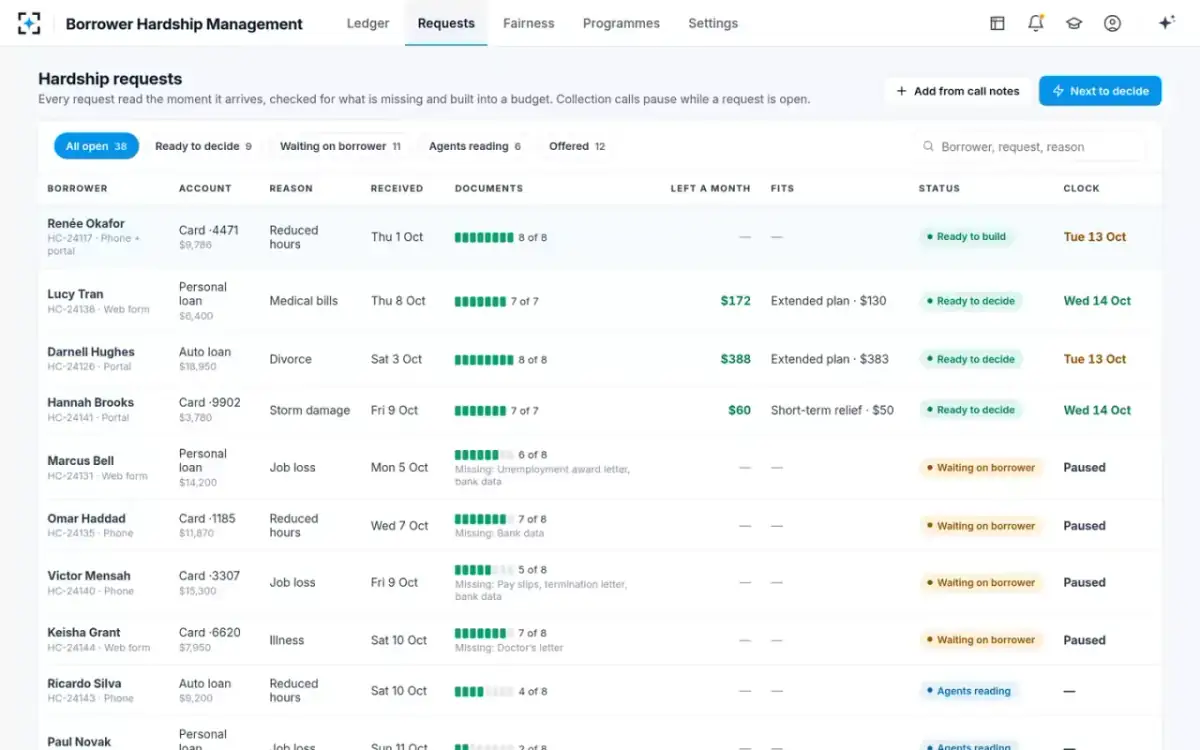
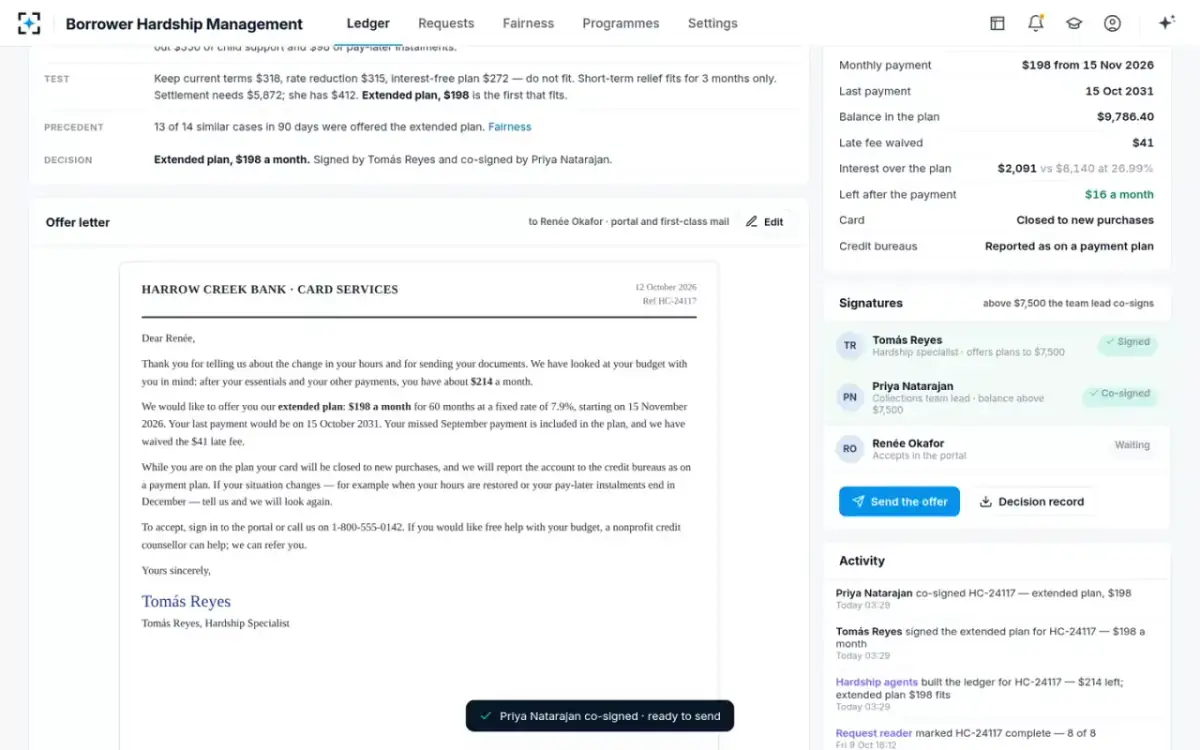
What the solution contributes to a re-age decision is the evidence side of it. The decision file reads request, budget, test, precedent and decision, with every figure citing the document or the transactions behind it; the activity trail holds each step, document and signature with its time; and a consistency check finds decided cases from the last ninety days with the same product, a balance within a quarter of this one, the same kind of hardship and a similar amount left, so that an offer that differs from its precedent is visible before it is made rather than after. It does not track how many times an account has been re-aged — that count belongs to the servicing system, and a policy that relies on it should say where it lives.
Charge-off timing, and why the clock matters to the decision
Every re-aging decision is made against a clock the lender did not set. The uniform policy established "a charge-off policy for open-end credit at 180 days delinquency and closed-end credit at 120 days delinquency", and those two lines govern how much time an arrangement has to prove itself.
Three clocks on the same scale: 180 days, 120 days, and the time a re-age actually takes
- Delinquent, with the arrangement still possible180 d
- Delinquent, with the arrangement still possible120 d
- To a complete request24 d
- Decision and signatures3 d
- Waiting for the start date34 d
- Three consecutive payments61 d
Drawn to scale the point is hard to miss. On an open-end account the whole sequence — getting a complete request, deciding it, waiting for the start date and receiving three payments — fits inside the 180-day line with fifty-eight days to spare. On a closed-end loan the same sequence does not fit inside 120 days at all, which is part of why closed-end relief leans on extensions and deferrals that show the account current immediately rather than on a three-payment proof.
The operational reading for a collections manager is that the twenty-four days spent assembling a complete request are the only part of this clock the lender controls, and on most desks they are the largest single block. A request that is complete in a day rather than in three weeks does not just shorten a service metric; it moves the whole sequence left and leaves room for a plan to prove itself before the charge-off line arrives.
Designing a policy that is stricter than the floor, on purpose
The published limits are the widest a supervised lender may go. A policy worth defending picks narrower ones and writes down the reason for each. Five choices account for most of the difference between a practice an examiner reads quickly and one it picks apart.
How many re-ages over the life of an account, against the published two in five years. Whether a workout's extra re-age is used at all, or reserved for a plan that has run materially longer than three payments. Which partial-payment method applies, chosen once and applied per loan. What evidence of renewed ability is required — a budget with a cited source on every line, rather than a stated figure. And what happens on a second failed arrangement, where the answer is usually that the budget was wrong rather than that the term was too short.
Each of those is a setting, and the reason a lender should want them to be settings rather than code is that the alternative is a rule nobody can produce on request. In the solution the budget rule, the look-back on bank data, the margin a plan must leave, the household guidelines, the documents each reason requires, the decision clock and the signing limits are all configuration, versioned and on the audit trail, so that the question "what rule was in force on the day this decision was made" has an answer. How the budget behind it is built, line by line, is set out in how a collections budget is built.
The dated record behind one arrangement: who decided, who co-signed, and when
Questions people ask
What is re-aging an account?
It is the same thing as re-aging a loan, and the terms are used interchangeably for open-end credit: returning a delinquent account to current status without collecting the principal, interest and fees that are contractually due. The arrears are not forgiven and the history is not erased. What changes is the account's status going forward, which is why it is the step a borrower on a hardship plan most wants and the step a supervisor counts most carefully.
What is the difference between a re-age, an extension and a deferral?
A re-age applies to open-end accounts and changes status without moving anything else. An extension applies to closed-end loans and rolls the maturity out by the number of months extended, so the loan ends later. A deferral also applies to closed-end loans but leaves every other term including maturity untouched, so the deferred payment has to be accounted for somewhere else. All three show the account as current; only the extension changes when the loan ends.
How long before a credit card is charged off?
Under the uniform federal policy, open-end credit is charged off at 180 days of delinquency and closed-end credit at 120. Charge-off is the lender's accounting recognition of a loss; it does not cancel the debt or end collection. For a hardship desk the practical significance is that it bounds how long an arrangement has to be agreed and to demonstrate performance, and the three consecutive payments a re-age needs take about four months on their own.
What counts as a partial payment for past-due status?
Either of two methods, chosen by the institution. Under the first, a payment of 90 percent or more of the contractual amount may be treated as a full payment. Under the second, payments are aggregated and partial amounts credited, so a $300 instalment paid at $150 for six months leaves the loan $900, or three full months, past due. An institution may use both methods across a portfolio but not both on one loan.
What do examiners look for in a workout program?
Five things the agencies named: repayment terms that are too liberal with amortisation stretched out, high charge-off rates, accounts being moved from one program to another, multiple re-agings, and information systems too poor to monitor whether any of it is working. Where those are found, the guidance says the agencies will criticise management and require corrective action, which can extend to adversely classifying the accounts concerned.
Can a lender re-age an account more than once?
Yes, within limits: not more than once in any twelve-month period and not more than twice in any five years, plus one further re-age in five years where the account has entered a workout program and three consecutive payments have been received. The policy also notes that institutions may adopt a stricter standard, and gives the example of lenders that allow only one re-aging in the life of an account.