AI in debt collection is sold as one thing and is really two. One kind reads: it finds the pay slip in a 40-page upload, works out take-home pay from a fortnightly figure, categorises 214 transactions, drafts the letter. The other kind decides: it scores the borrower, picks the plan, sets the payment. The first is where almost all of the value sits in a hardship program and almost none of the risk; the second is where a lender inherits a question it may not be able to answer — why this borrower was offered that. Borrower Hardship Management, Botminds' software for hardship requests, is built entirely on the first side of that line: seven agents read, check and recommend, the arithmetic is fixed, and a named specialist signs every offer.
What follows is specific to hardship work rather than to AI in general, because that is where the line actually falls: a relief ladder with rungs that differ by thousands of dollars to the borrower, signing limits that mean something, and a decision that — unlike a declined application — carries no notice and no stated reason unless the lender writes one. The figures are sample data on fictional people inside the solution, and the two performance numbers are design targets, labelled where they appear.
The division of labour in Borrower Hardship Management, in four numbers
7
agents on one hardship request: six read and check, one drafts
$7,500
balance a hardship specialist may offer on alone, by signature
$25,000
balance above which the collections team lead must co-sign
0
letters an agent sends: drafting is an agent’s job, sending is a person’s
What is AI actually used for in debt collection today?
Three jobs, in descending order of how common they are. Contact optimisation decides whom to call, when and on which channel. Document and data work reads what the borrower sent and turns it into figures. Assistance drafts the letter, summarises the file and answers a specialist's questions about it. A fourth — deciding the outcome — is talked about far more than it is deployed in regulated lenders, for reasons this guide is about.
The CFPB's December 2025 report to Congress on the credit card market puts it at the level of the market: "Artificial intelligence (AI) and other technological advancements have enabled innovations in the credit card market and may introduce new competitive dynamics." The same report records AI-driven applications emerging on the consumer's side of the table, including tools that structure payment plans to pay off card debt — which is a useful reminder that the borrower on the phone may arrive with an AI-produced plan of her own.
In hardship work specifically, the time goes somewhere unglamorous. The reading is slow: pay slips in a dozen formats, employer letters, benefit statements, 90 days of transactions. The arithmetic is trivial but tedious. The judgement — which rung of the ladder fits a borrower whose circumstances are not quite like anyone else's — takes minutes and matters more than everything else combined. Automation that attacks the reading frees the judgement; automation that attacks the judgement removes the only part a lender can be asked to justify.
The line that matters: reading a document is not choosing a plan
The distinction is not between dumb automation and smart automation, nor between rules and models. It is between a system that produces evidence and a system that produces an outcome.
Reading against deciding, and what each produces
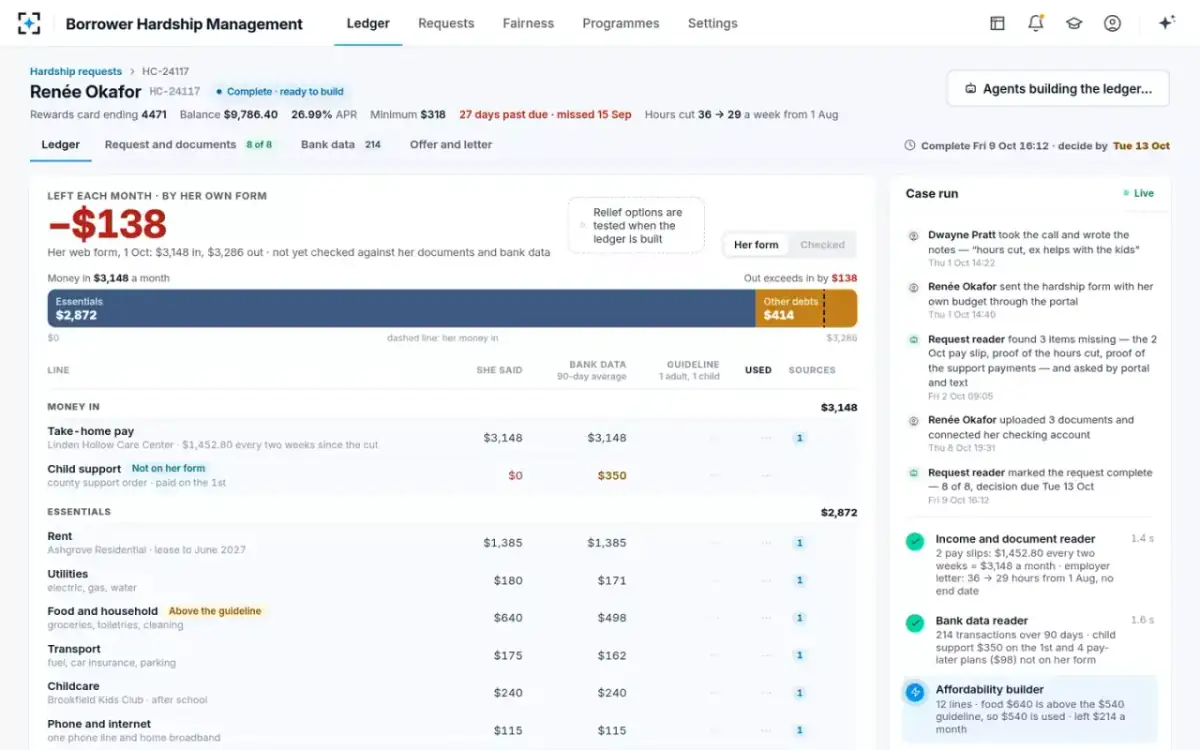
An agent that reads: A figure with a citation: "$1,452.80 every two weeks = $3,148 a month", pointing at two pay slips.
A model that decides: A recommendation or a score: "offer the 36-month plan", pointing at nothing a borrower can read.
An agent that reads: Open the document and look. A specialist can disagree in ten seconds.
A model that decides: Model validation, back-testing, and an explanation layer that is itself a model.
An agent that reads: Visibly and locally: one figure is wrong on one request, and the citation shows why.
A model that decides: Quietly and systematically: a population is offered a worse rung for a reason nobody stated.
An agent that reads: Nothing beyond accuracy; the figure is hers and she can see its source.
A model that decides: A specific reason, if the decision is one the rules require reasons for.
An agent that reads: The document and the line that was read.
A model that decides: The model, its inputs, its validation, its monitoring and its outcomes by segment.
A hardship program makes this unusually concrete, because the outcomes are discrete and far apart. Keep current terms at $318 a month, a rate reduction at $315, an interest-free plan at $272, a 60-month extended plan at $198, a settlement, or a referral to free credit counselling. These are not points on a curve. A model that picks among them is choosing between futures for a household, and the choice is visible to the borrower in the first letter she opens.
Can AI decide whether a borrower gets a hardship plan?
Technically, easily. Defensibly, not without answering a question the rules keep asking in different forms: what, specifically, were the reasons? The clearest statement of that question is in Regulation B, the rule that governs notices when credit is refused: the reasons given have to be specific and have to name the principal ones, and the rule makes no exception for the method used to reach the decision.
The rule is about adverse action on credit applications, and a hardship decision on a delinquent account usually is not adverse action — which is precisely why the principle has to be imported rather than inherited. The CFPB set out in a 2022 circular how the rule applies to complex models, and withdrew that circular in May 2025 along with sixty-six other guidance documents; the regulation itself did not change. The same paragraph of the rule closes the obvious escape routes: saying that the decision followed the creditor's own internal standards or policies, or that the applicant missed a qualifying score, is not enough. A lender that could not satisfy that standard for its hardship decisions, if it had to, is one supervisory question away from an uncomfortable afternoon.
So the answer is not "AI may never touch the decision". It is that whoever or whatever makes the choice must be able to produce the specific reason, in the borrower's own facts, at the moment of the decision — and the cheapest way to guarantee that is to keep the choice with a person who has the arithmetic, the precedent and the evidence in front of them.
Why an unexplainable model is a problem even where no notice is owed
The trap is a design choice rather than a legal one. A model whose inputs interact in ways nobody can trace may score well and still leave its owner unable to say, for one borrower, which facts drove the answer — and every question below starts from that inability.
Three things go wrong in a hardship program even when no notice is owed. The borrower asks why, and the specialist cannot say — which is a complaint, and complaints about relief decisions attract attention out of proportion to their number. The compliance function tests outcomes and finds a pattern it cannot explain, so it cannot tell a coaching problem from a model problem. And the examiner picks two files and asks why they differ; "the model recommended it" is an answer that invites the next twenty questions.
There is also a plainer operational argument. An unexplainable recommendation cannot be partially accepted. A specialist who thinks a figure is wrong can correct a cited budget line and watch the arithmetic move; she cannot correct a score. The explainable design is the one that lets a human be useful.
The seven jobs on a hardship request, and which an agent may hold
Breaking the work into jobs is what makes the line enforceable, because each job can be assigned on its own evidence. In the solution, six agents read and check, one drafts, and the decision is a person's.
One hardship request through Borrower Hardship Management: six read, one drafts, a person signs
Agent
Request readerReads the call notes, the web form and every upload, and asks once for what the policy requires and is missing.
Never: marks a request incomplete for a document the policy does not require
Agent
Income and document readerReads pay slips, employer letters and benefit statements; works out monthly take-home pay and whether the hardship has an end date.
Never: counts income it cannot cite to a document or a deposit
Agent
Bank data readerCategorises the look-back period of transactions into budget lines and finds regular payments the form left out.
Never: treats a one-off as a regular bill
Agent
Affordability builderBuilds the budget line by line — her figure, the bank average, the guideline, the figure used — and works out what is left.
Never: leaves a figure without a source
Agent
Programme matcherWorks out each rung’s payment from the balance and the programme rules and tests it against what is left.
Never: recommends a payment above what the borrower has left
Agent
Consistency checkerFinds comparable decided cases from the last 90 days and shows what they were offered.
Never: blocks a decision — it asks for a reason
Agent
Letter writerDrafts the decision file and a plain-language offer letter with the payment, the term and what happens next.
Never: sends anything
A person decides
The hardship specialist decides and signsReviews the budget and the tested rungs, accepts or changes any figure with a reason, chooses the offer and signs; above $7,500 the team lead co-signs.
Read down the list and notice what is missing. No agent contacts the borrower outside the channels she chose. No agent changes account terms. No agent sends a letter. No agent picks the rung — the matcher tests every rung and recommends the first that fits, which is arithmetic the specialist can redo on paper.
The case run, step by step, each step citing what it read
The never-rules: limits a buyer can test rather than assurances to read
A limit that lives in a design document is a hope. A limit that the product enforces, that appears next to the agent's name on screen and that a reviewer can test is a rule. The seven below are the ones a hardship program needs, and all seven are testable on a demonstration with your own past requests.
Seven never-rules for an agent in a hardship program
- Never recommend a payment above what the borrower has left
The most common way a relief plan fails is that it was never affordable. Test it: feed a request where every rung costs more than the money left, and check that the system recommends the counselling referral rather than the cheapest rung.
- Never count income it cannot cite
Every credit on the budget must open onto a pay slip, a statement, an order or a matched deposit. Test it with an unexplained $400 credit and see whether it lands in the income total.
- Never treat a one-off as a regular bill
A single car repair must not become a monthly cost. Test it with a one-off in the look-back and check the monthly figure.
- Never change the account
Terms, rates, fees, due dates and the status furnished to the bureaus are servicing actions that follow a signature, not a recommendation.
- Never contact the borrower outside the channels she chose
The channel is her decision, and it is recorded. A system that sends a text to a borrower who chose the portal has made a contact decision nobody authorised.
- Never send a letter
Drafting is an agent’s job; sending is a person’s. The test is whether anything can leave the building without a signature on the record.
- Never keep a changed figure without a written reason
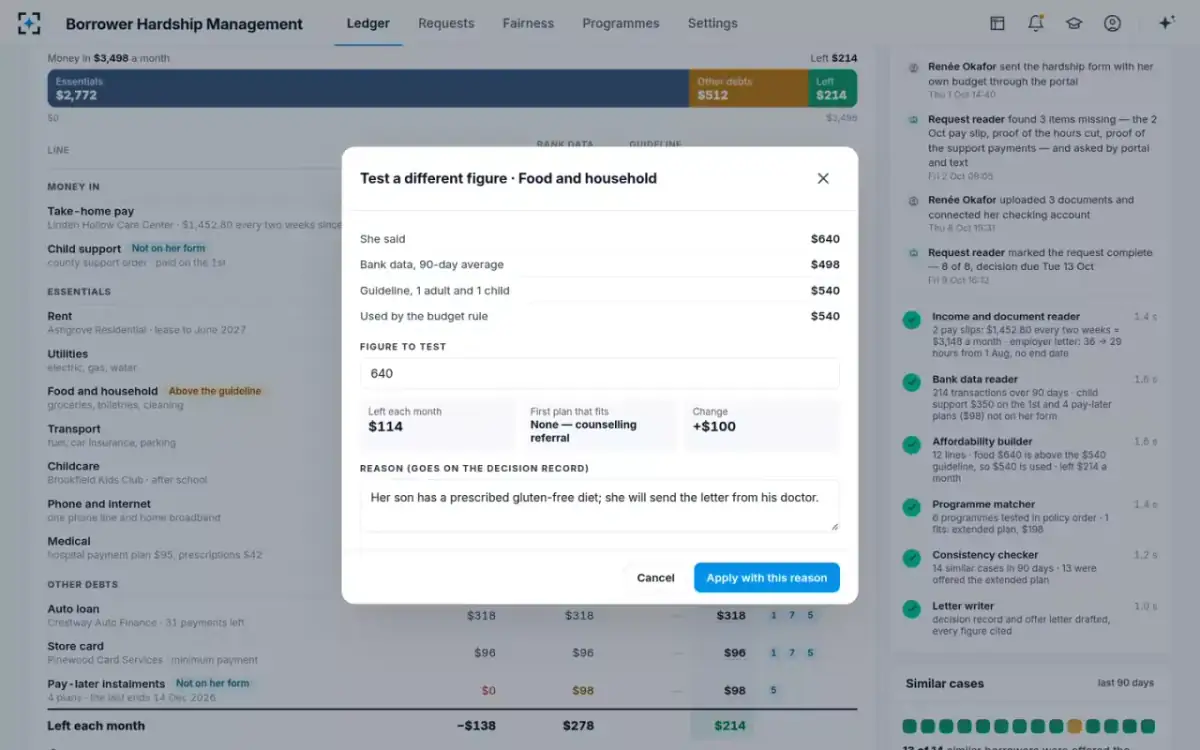
A what-if on any budget line, or an offer other than the first rung that fits, must demand a sentence before it can be kept — and the sentence goes on the decision file.
Evidence an agent must produce with every figure
The rule that makes the rest of it work is simple to state and expensive to retrofit: every figure carries its source. In the solution each budget line shows four values — what the borrower said, the bank average over the look-back, the household guideline for her household size, and the figure used — with numbered chips that open the document or the transactions behind each.
That design has a quiet consequence worth naming. It makes disagreement cheap. A specialist who believes the food figure is wrong does not argue with a system; she opens the transactions, sees the 90-day average, tests her own figure and watches the arithmetic move. In the sample request that is exactly what happened: the specialist tested the borrower's claimed $640 of food against the $540 guideline, saw that at $114 left nothing on the ladder fitted, and asked for the clinician's letter instead of keeping the change unsupported.
Testing a figure, with the reason the change would need
Human in the loop, or human on the hook: signing limits that mean something
"Human in the loop" has been diluted into meaninglessness by products that show a person a recommendation and a single approve control. The question to ask is not whether a person is in the loop but what that person is accountable for, what they can see, and what they are allowed to do.
A signing limit is the clearest version of accountability, because it is specific, enforceable and already familiar to every credit function. In the solution the hardship specialist signs alone to a $7,500 balance; above that the collections team lead co-signs, to $25,000; settlements below half the balance go to the head of collections. In the sample request the balance was $9,786.40, so the specialist's signature sent the offer to the team lead, and both signatures sit on the record with the version of the rules in force that day.
Three properties separate a real approval step from a decorative one. The approver can see everything the recommendation rested on, not a summary. The approver can change the inputs and watch the outcome move, rather than only accept or reject. And the limits are enforced by the system and versioned, so that "who was allowed to sign that, in March?" has an answer. A step that fails any of the three is a human on the hook without being in the loop.
How to audit it: the activity trail, the replay and the what-if
An audit of agent-assisted work asks the same questions as an audit of manual work, but it can get better answers, because the system was watching. The table below lists the questions a reviewer actually asks on a hardship file and where each answer lives.
Seven audit questions, and where the answer lives on a hardship request
| The question | Where the answer is | Why it is the question |
|---|---|---|
| Which agent produced this figure, and when? | The activity trail of the request, step by step, with the time each finished. | A figure with no author cannot be challenged, only believed. |
| What did it read? | The numbered source chips on the budget line, opening the pay slip, the statement or the transactions behind it. | Evidence that cannot be opened is a claim. |
| What was the borrower told, and through which channel? | The messages on the request, against the channels she chose. | Contact is a decision too, and it is the one borrowers complain about. |
| Why this rung of the ladder, and not the one above it? | The programme test: every rung with its payment against what she had left, in policy order. | The arithmetic is deterministic, so the answer is reproducible rather than remembered. |
| Did anyone change a figure, and on what reason? | The what-if on the budget, with the written reason attached to the decision file. | A change with no reason is the single finding most likely to generalise into a programme criticism. |
| Who signed, and were they allowed to? | The signature and co-signature against the limits in force that day, with the version of the rules. | A signing limit nobody enforces is a job title, not a control. |
| What did similar borrowers get? | The comparison set shown before the decision, and the exception log after it. | Consistency is evidenced before the fact or argued after it. |
The supervisory expectation for this sort of work predates the technology by two decades. The uniform retail credit policy states that the decision to re-age, extend, defer, renew or rewrite a loan, "like any other modification of contractual terms, should be supported in the institution's management information systems", and that controls should be maintained so that such actions "can be adequately controlled and monitored by management and verified by examiners". Verified by examiners is the operative phrase: a trail nobody outside the team can follow does not meet it.
How to test it: a truth set, a comparison against the specialist, and a drift check
Testing an agent that reads is much easier than testing a model that decides, and most buyers skip it anyway. Three tests, in the order they are worth doing:
First, a truth set on reading. Take 50 of your own past hardship requests, have an experienced specialist record the correct figures — monthly take-home pay, each essential, each other debt — and score the agents' output against them field by field. The useful output is not an overall percentage but the list of fields that go wrong and why: a pay frequency misread, a benefit missed, an instalment plan counted twice.
Second, a comparison on deciding. Run the same requests through the arithmetic and compare the rung the matcher recommends against the rung your specialists actually chose, then read every disagreement. Some will be the system being wrong; more, usually, will be two of your specialists having been inconsistent with each other, which is the finding worth buying the software for.
Third, a drift check with a date on it. Document formats change, pay-later products appear, a new benefit arrives. Re-run a fixed sample quarterly and watch for fields whose accuracy falls. A capability that was measured once, at purchase, is unmeasured.
Two numbers published for this solution are design targets rather than measured results, and should be read as such: one day from a complete request to a signed offer, and 96.8% of offers matching what borrowers with the same budget got. They describe what the design aims at. What a buyer should ask for is the same two numbers measured on its own past requests, which is also how to size the gain against how to judge collections automation software for hardship.
Questions people ask
Do you have to explain an automated credit decision?
Where the decision is adverse action on an application, yes: the notice must state specific reasons, and those reasons must indicate the principal ones rather than pointing at an internal policy or a score. Nothing in the rule exempts a decision because the method behind it was complex. Where the decision is relief on a delinquent account, the notice duty generally does not apply — which removes the obligation and not the question, because the borrower, the compliance function and the examiner all still ask why.
Can a lender rely on a model it cannot explain?
It can run one, but it cannot use its opacity as a defence, and in hardship work the practical answer is harder than the legal one. If nobody can say why one borrower was offered a 60-month plan and a comparable borrower a settlement, the lender has no way to test its own consistency, no way to coach, and nothing to hand an examiner. The cost of the model is paid in the governance it demands, which usually exceeds the cost of keeping the choice explainable.
How do you audit what an AI agent did on an account?
By reading the activity trail of the request: which agent ran, when, what it read, what it produced, what a person changed and on what written reason, who signed, and under which version of the rules. The test of a product is whether that trail can be exported for a sample of accounts without an engineer. If producing it requires a query against a log store, it will not be produced in an examination.
Does an AI collections tool need a human approval step?
For anything that changes the borrower's obligations or leaves the building, yes — and the step has to be real. The approver must see the evidence rather than a summary, be able to change an input and see the result move, and sit inside an enforced signing limit. An approval control that only accepts or rejects a recommendation moves the accountability without moving the understanding.
Is a hardship decline an automated decision that requires a notice?
Generally not, because an action or forbearance taken in connection with delinquency on that account is excluded from the definition of adverse action. That is the reason this guide argues for building the record voluntarily: the exclusion removes the letter, not the question, and a program with no stated reasons has no defence that does not depend on memory.
What does "the agents recommend, the specialist signs" mean in practice?
It means the agents produce a budget whose every line cites a document or a transaction, a test of every rung of the ladder against what the borrower has left, and a draft letter — and that none of it reaches the borrower until a named person has reviewed the figures, changed any of them with a reason, chosen the offer and signed, with a co-signature above the limit. The agents' work is evidence; the signature is the decision.
To see the seven jobs, the limits and the signature on one request, start from Borrower Hardship Management.