Cash flow underwriting is the practice of assessing a borrower from the money that actually moves through her accounts — wages in, rent out, instalments, benefits, support payments — rather than from a score built on how she has repaid credit in the past. In collections it answers a narrower and more urgent question than at origination: not whether to lend, but what this borrower can pay each month without the plan breaking. It is worth buying for one reason, which is that it finds the regular money a self-reported budget leaves out, in both directions. It is worth buying carefully, because categorisation is a judgement, consent is a precondition rather than a formality, and a borrower who cannot or will not connect an account still has to get a decision. Borrower Hardship Management, Botminds' software for hardship requests, treats bank data as one cited column beside the borrower's own form and the household guideline — never as the answer.
The example figures are sample data on fictional people inside the solution: a patient care technician whose hours were cut, with 90 days of transactions on the accounts she connected. The research is quoted from the agencies and the regulation.
What 90 days of transactions did to one hardship budget
214
transactions categorised into the budget lines over the look-back
3
columns on every line: what she said, the bank average, the household guideline
$350/mo
of regular money coming in that her own form did not mention
$142/mo
of claimed spending the account did not support, on one line
What is cash flow underwriting?
Cash flow underwriting replaces an inference with an observation. A credit score infers capacity from repayment history; a cash flow assessment reads the account and counts what came in, what went out and what was left, month by month. The method is old — commercial lenders have underwritten from bank statements for a century — and what changed is the plumbing: consumer-permissioned access to transaction data made it possible to do in minutes what used to take a clerk and a highlighter.
Done properly, the work has four steps and only the first is technical. Connect the accounts with the borrower's consent. Categorise each transaction into the lines the budget uses. Turn irregular transactions into monthly figures, which means deciding what is recurring and what is not. Then reconcile the result against what the borrower said and against a reference for a household of that size. The second and third steps are where every disagreement lives.
In a hardship decision the output is not a score. It is a set of figures with evidence attached, each of which a specialist can accept, override or ask about — and the arithmetic that turns them into what a borrower has left is deterministic, which is the subject of how a collections budget is built.
What the agencies actually said about alternative data
The five federal financial regulators issued a joint statement on alternative data in credit underwriting in December 2019, and it remains the clearest official description of what this data is. It defines alternative data as information "not typically found in consumers' credit reports or customarily provided by consumers when applying for credit", and names the category directly.
"Alternative data include cash flow data derived from reliable sources, such as consumers' bank account records."
Interagency Statement on the Use of Alternative Data in Credit Underwriting, December 2019
The statement is encouraging rather than permissive. It says cash flow data may improve the speed and accuracy of credit decisions and may help firms evaluate borrowers who would otherwise be declined, and in the same breath it sets the condition: "A well-designed compliance management program provides for a thorough analysis of relevant consumer protection laws and regulations to ensure firms understand the opportunities, risks, and compliance requirements before using alternative data." Data presenting greater consumer protection risk, it adds, warrants more robust compliance management.
The market has moved since. The CFPB's December 2025 report to Congress on the credit card market records that "The use of alternative data, such as bank account cash flow information, is helping to expand credit card access to consumers, particularly for those with limited credit history." A buyer can take from this that the capability is mainstream at origination; what is still unusual is using it in collections, where the borrower's circumstances have already changed and her last twelve months of repayment history is the least informative thing about her.
The two directions a transaction record moves an affordability check
Vendors sell cash flow data as a way to find hidden income. In hardship work it moves the answer both ways, and the downward movement is the one that protects the borrower.
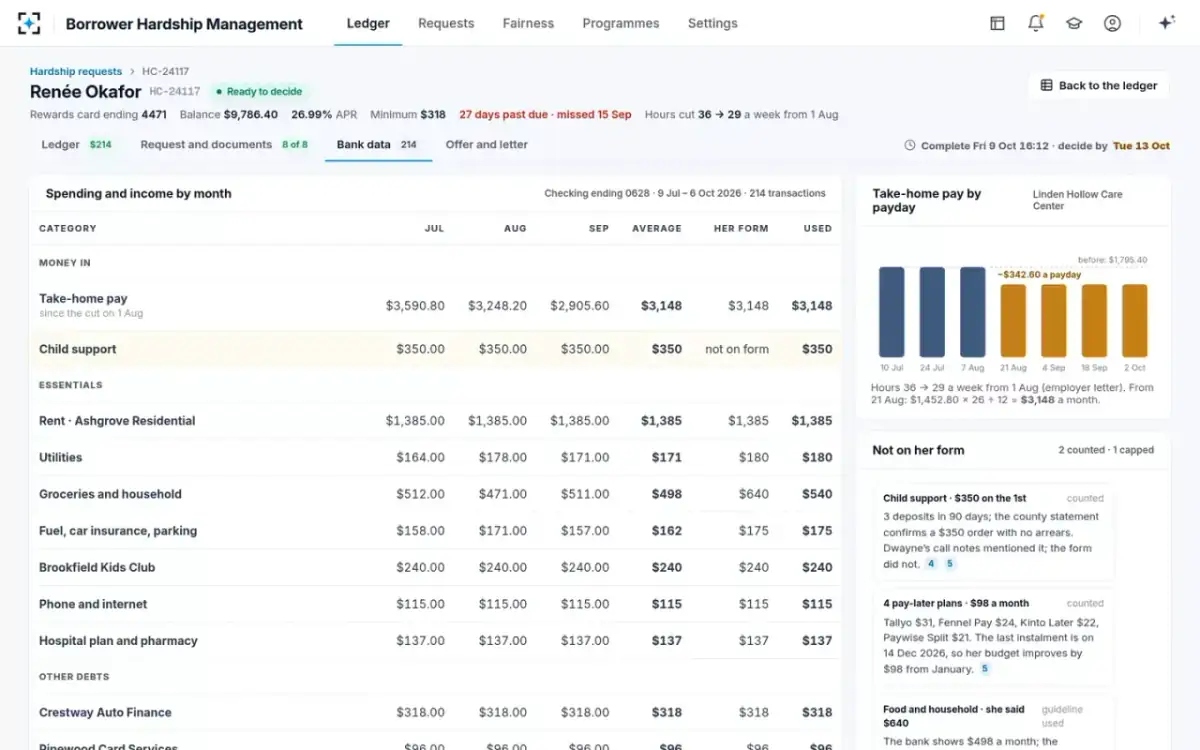
Upward: regular money the form omits. People forget or discount what they do not think of as income — a support payment, a benefit that arrives on a different day, a second job's irregular wages, a lodger. In the sample request the form said $3,148 a month and the account showed $350 of child support arriving on the first of each month, with three deposits and a county order behind it. Without it, nothing on the relief ladder would have fitted and the borrower would have been referred to credit counselling.
Downward: claimed spending the account does not support, and regular payments the form omits. The same borrower wrote $640 a month for food; 90 days of transactions averaged $498. She also had four pay-later instalment plans running at $98 a month, none of them on her form, the last ending in December 2026. One figure made her look poorer than she was and the other made her look richer; the budget needed both.
Three columns on one borrower's budget in Borrower Hardship Management
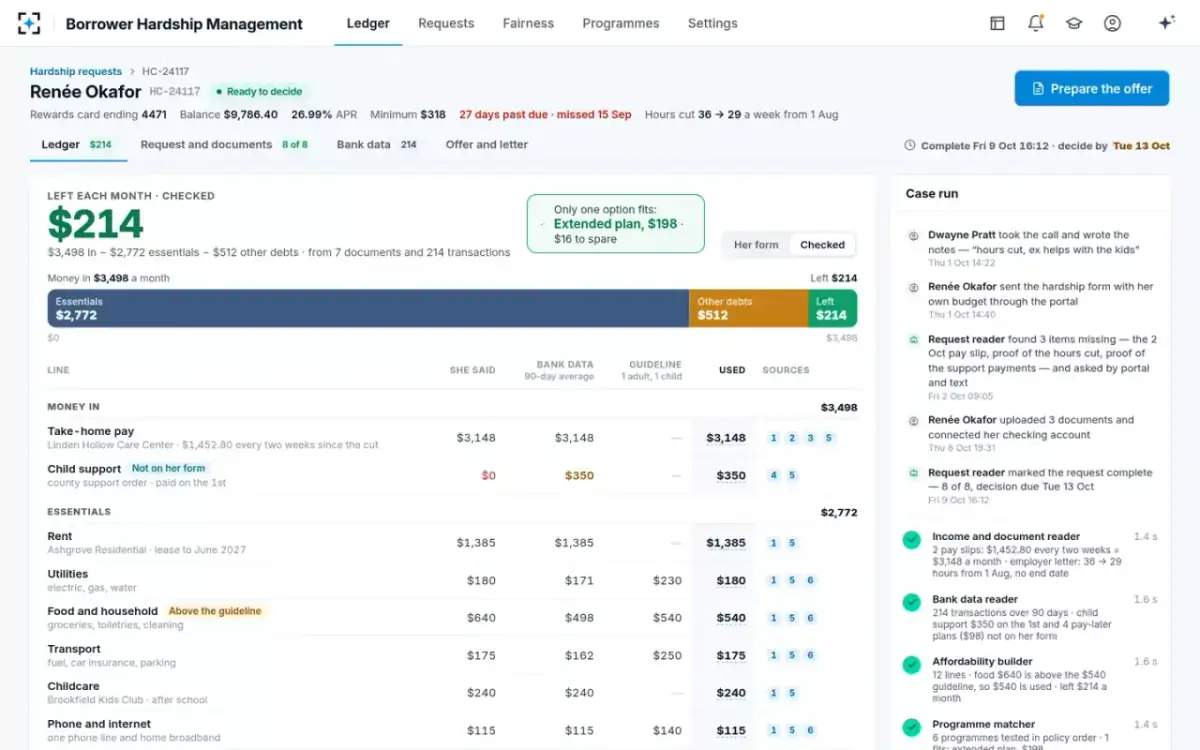
| Line | What she said | The 90-day account average | Household guideline | The figure used, and why |
|---|---|---|---|---|
| Take-home pay | $3,148 a month | $3,148, falling $342.60 a payday from 21 August | Not applicable | $3,148, with the employer letter behind the fall |
| Child support received | Not on the form | $350 on the 1st, three deposits | Not applicable | $350, with the county statement behind it |
| Food and household | $640 a month | $498 a month over 90 days | $540 for one adult and one child | $540, the guideline, under the budget rule |
| Pay-later instalments | Not on the form | $98 a month, four plans, the last ending 14 December 2026 | Not applicable | $98, counted as a regular payment until it ends |
The last column is the one a buyer should interrogate. Three sources that disagree are not an answer; a rule for choosing between them is. A system that silently prefers bank data to the borrower's own figure will under-state the spending of anyone whose circumstances have just changed, which in a hardship queue is everyone.
Do lenders use bank account data to assess affordability?
Yes, and in the regulated form of the question the answer is older than the technology. Regulation Z already requires a card issuer to consider a consumer's ability to make the required minimum payments, and the rule tells issuers what reasonable policies look like: they include "treating any income and assets to which the consumer has a reasonable expectation of access as the consumer's income or assets, or limiting consideration of the consumer's income or assets to the consumer's independent income and assets."
That sentence matters for a hardship budget because it names the judgement nobody can automate: what a borrower has a reasonable expectation of access to. A deposit from a former partner on the first of every month for three months, supported by a court order, is money she can expect. The same deposit with no order and no pattern is not. The transaction record supplies the pattern; the document supplies the expectation; a person weighs them.
What is far less common is using the data after default. The borrower is already in distress, the lender already has the account history, and connecting an account feels to many borrowers like a surveillance demand at the worst possible moment. That is a design problem, not a reason to skip it — and it is why consent, scope and what happens to a refusal should be at the front of a buyer's question list rather than the back.
Consent, access and the data rights rule a buyer should understand
The federal personal financial data rights rule, Regulation 1033, requires a data provider to make a consumer's own data available on request. The obligation runs to "a consumer and an authorized third party, upon request, covered data in the data provider's control or possession concerning a covered consumer financial product or service that the consumer obtained from the data provider, in an electronic form usable by consumers and authorized third parties."
Its compliance dates are staged by size in the text of the rule: 1 April 2026 for depository data providers holding at least $250 billion in assets and the largest nondepository providers, 1 April 2027 for depositories between $10 billion and $250 billion, then April 2028, 2029 and 2030 for successively smaller institutions, down to those above $850 million in assets. Those dates are not running. On 29 October 2025 a federal court in Kentucky stayed them while the CFPB reconsiders the rule, and the Bureau has said it intends to propose new dates. A buyer in 2026 should therefore treat bank data access as something aggregators provide by arrangement rather than as a legal entitlement, expect coverage to be uneven, and ask a vendor for coverage by institution rather than a headline percentage.
Three consent questions belong in the contract, not the demonstration. What exactly is the borrower authorising — which accounts, for how long, refreshed how often? Can she revoke it in one step, and what happens to the data already pulled? And is the access read-only, in a form the lender can prove it was read-only? In Borrower Hardship Management the connection is read-only, covers only the accounts the borrower connected, and the agent that reads it is barred from reading anything else.
Ninety days, sixty or a hundred and eighty: choosing the look-back
The look-back is the single setting that changes the most answers, and there is no correct value — only a trade-off that should be made deliberately and written down.
Sixty days is responsive. It catches a change in circumstances quickly, which is what a hardship decision is about, and it is thin: one unusual month is a third of the evidence, and any quarterly bill may be missed entirely. A hundred and eighty days is stable and smooths seasonality, and it dilutes exactly the change the borrower is calling about — a borrower whose hours were cut in August looks healthier over six months than she is today. Ninety days sits between, long enough to see a quarterly pattern and short enough that a two-month-old income drop dominates the average.
The better design does not pick one number for everything. It takes income from the period since the change, where a document dates the change, and spending from the longer window. In the sample request the employer letter dated the cut to 1 August and the account showed take-home pay falling $342.60 a payday from 21 August, so the two agreed — and where they agree, the look-back barely matters. In Borrower Hardship Management the look-back is a setting of 60, 90 or 180 days, versioned with the rest of the hardship rules.
Ninety days of income and spending, with the drop the employer letter dates
Categorisation is a judgement: the four errors that break a budget
Transaction categorisation is presented as a solved problem and is not one. A merchant name maps to a category; a category maps to a budget line; both mappings are opinions, and the hard cases are not rare. These four errors do the most damage in a hardship budget, because each moves what a borrower has left by enough to change which rung of the ladder fits.
Four categorisation errors, and the test that catches each
| The error | What it does to the budget | The test that catches it |
|---|---|---|
| A one-off read as a regular bill | A single $420 car repair in August becomes a $420 monthly cost, and the borrower qualifies for nothing. | Require a repeat pattern before a line becomes recurring: at least two occurrences in the look-back, at a similar amount. |
| A transfer read as income | Money moved from the borrower’s own savings, or a friend repaying a loan, is counted as money coming in. | Match credits against a named, dated source — an employer, a benefit agency, a court order — and treat anything unmatched as evidence of nothing. |
| A shared account read as one person’s | Two adults’ pay and two adults’ spending land in one budget, and the affordability figure is roughly double the truth. | Ask whose account it is on the form and reconcile the credits against the pay slips; a second salary in the credits is the tell. |
| A seasonal cost annualised | A heating bill read in February, or school costs read in September, sets a monthly average the rest of the year will not see. | Lengthen the look-back for utilities and education lines, or take them from the borrower’s own figure where it is lower than the extrapolated one. |
Ask a vendor to run these four on your own data, not on a demonstration file. The fourth is the one that is usually missed, because it only shows up when the same borrower is assessed twice in different seasons.
One thing a buyer should refuse to accept is an unqualified accuracy figure. Categorisation accuracy depends on the institutions, the merchant mix and the budget lines, and a number measured on someone else's population tells you nothing about yours. Borrower Hardship Management publishes no categorisation accuracy figure for exactly that reason; what it publishes instead is the evidence behind every line, so a specialist can check the figure that matters rather than trust the average.
The borrower who will not connect an account, and why the design must survive it
A material share of borrowers will not connect an account. Some bank somewhere the aggregator does not reach. Some are paid in cash. Some have a joint account with a former partner. Some simply decline, which is their right and sometimes their best judgement. Any hardship design that treats a connection as a precondition has quietly made relief conditional on data sharing, and that is a fair servicing problem before it is a product problem — the subject of whether similar borrowers get similar relief.
The requirement is therefore blunt: the budget must be buildable without any bank data at all. In Borrower Hardship Management, when no account is connected the budget rests on the borrower's own form, the documents she sent — pay slips, employer letters, benefit and support statements — and the household guideline for her household size, with the same three-column display and the same citation on every line. The decision is slower and the figures are softer, and the system says so rather than hiding it.
What a transaction record settles, and what it does not
What the account can show: Amounts, dates, frequency, and a change in take-home pay to the payday.
What it cannot settle: Whether money that arrived will keep arriving. Only a document or an order answers that.
What the account can show: What was actually paid from these accounts over the look-back.
What it cannot settle: What is necessary. A $640 food claim may be a prescribed diet, which the account cannot distinguish from a choice.
What the account can show: Regular payments the form omitted, including instalment plans that end on a known date.
What it cannot settle: Debts paid in cash, debts in arrears that are not being paid, and anything on an account she did not connect.
What the account can show: The flows through the accounts connected.
What it cannot settle: Who the household is, and whose money this is. A joint account looks like one person’s to the data.
What the account can show: Evidence for each line of the budget, with the transactions behind it.
What it cannot settle: Which rung of the relief ladder is right. That is arithmetic plus judgement, and a named person signs it.
What to ask a vendor: coverage, refresh, categorisation accuracy, evidence per line
Most evaluations of this capability go wrong by testing the demonstration rather than the data. The questions below are the ones whose answers a buyer cannot get from a screen, grouped so that procurement and the compliance function can take the halves they own.
Twelve questions for a cash flow data vendor, and what each answer needs
- Which institutions do you actually cover?
Ask for coverage by named institution for your own borrower base, not a national percentage. A 95% figure that misses two regional banks and three credit unions can miss a quarter of a hardship queue.
- What is the connection method per institution?
A documented interface and a screen-scraped connection fail differently and break on different days. You need to know which you have, institution by institution.
- How often does the data refresh, and what happens when it stops?
A connection that silently goes stale is worse than no connection, because the budget looks current and is not.
- How long is the history on first connection?
If your look-back is 90 days and the first pull returns 60, your policy is not the one running.
- How is the consent captured, and how is it revoked?
Ask to see the consumer-facing wording and the revocation path, and ask what happens to data already retrieved.
- What does the categorisation produce, and can we change it?
Budget lines are a lender decision. A fixed taxonomy that cannot be mapped to your own hardship form will be reconciled by hand forever.
- How do you decide what is recurring?
This single rule moves more budgets than the categoriser. Get it in writing, with the threshold.
- Can every figure be traced to its transactions?
A monthly average with no drill-down cannot be defended to a borrower who disputes it, or to an examiner who asks.
- What is your accuracy, measured how, on whose data?
Treat any accuracy figure not measured on your own population as marketing. Ask instead to run a sample of your past requests.
- What happens when no account is connected?
If the answer is a worse product rather than a documented alternative path, the capability is not ready for a hardship queue.
- Where is the data held, for how long, and who else sees it?
Retention and onward use are the questions the compliance function will be asked about first.
- What do we get on exit?
The decisions and their evidence belong to the lender. Establish the export format before signing, not during a migration.
Where this fits beside the form and the guideline, and where it does not
The honest claim for cash flow data in a hardship decision is narrow and still worth paying for: it turns three or four of the softest lines in a budget into evidenced ones, and it does it in minutes rather than in the day and a half our estimate gives a specialist for reading statements by hand. It does not decide anything. It does not know what is necessary. It does not know whose money is in a joint account. And it is absent for a meaningful share of the people who most need relief.
Which is why the architecture that survives contact with a real queue puts the account data in one column, the borrower's own figures in another and a household reference in a third, applies a written rule for choosing between them, cites the source on every line, and lets a named person override any of it with a reason. Buy the data for what it evidences. Keep the judgement where it belongs.
Every budget line with what she said, the bank average, the guideline and the figure used
Questions people ask
What is the CFPB 1033 rule?
It is the personal financial data rights rule, 12 CFR part 1033, which requires a data provider to make a consumer's own account data available to her and to a third party she authorises, in a usable electronic form. The rule staged its compliance dates by institution size from 1 April 2026 to 1 April 2030, but a federal court stayed those dates on 29 October 2025 while the CFPB reconsiders the rule. For a buyer it is therefore a forecast rather than a guarantee: no bank is yet obliged to provide the data, and coverage depends on what aggregators reach today.
Is bank transaction data reliable for an income check?
It is reliable about what arrived and when, and unreliable about what it means. A credit of $350 on the first of three consecutive months is a fact; that it is child support and will continue is an inference a county order confirms and the transaction alone cannot. The workable rule is the one the solution applies: never count income that cannot be cited to a document or a matched deposit.
How accurate is automatic transaction categorisation?
Nobody can answer that for your population, which is why an unqualified figure should be treated as a warning sign. Accuracy depends on which institutions your borrowers bank with, the merchant mix where they live and how granular your budget lines are. Ask any vendor to categorise a sample of your own past hardship requests and score it against what your specialists actually recorded; that number is the only one worth putting in a business case.
Can a lender require a borrower to connect a bank account?
Requiring it as a condition of being considered for relief is a poor idea even where it is permitted, because it makes access to help depend on data sharing and creates differences between borrowers that have nothing to do with their circumstances. The safer design asks for the connection, explains plainly what it is read for, and keeps a documented path to a decision for anyone who declines.
Does cash flow data replace the credit report in a hardship decision?
No. They answer different questions. The credit report shows obligations to other creditors, including ones the borrower has stopped paying and may not mention; the account data shows what is actually being paid. A hardship budget needs both — the report to find the debts, the transactions to size them — and in the solution a soft check of the report sits beside the connection rather than instead of it.
How much does bank data usually change a budget?
Enough to change the answer, which is the only threshold that matters. In the sample request it added $350 a month of income the form omitted and $98 a month of instalment payments it also omitted, and it contradicted a food figure by $142 a month. The net effect moved the borrower from a self-reported deficit of $138 a month to $214 left — the difference between a credit counselling referral and a 60-month plan she could keep.
To see the three columns, the citations and the rule that chooses between them, start from Borrower Hardship Management.