FCRA furnisher obligations require a lender that reports to credit bureaus not to furnish information it "knows or has reasonable cause to believe" is inaccurate, to correct and update what it has furnished, to investigate disputes, and, under Regulation V, to keep written policies so that what it reports "reflects the terms of and liability for" each account and the consumer's performance. A hardship plan tests every one of those duties at once: it changes the scheduled payment, often closes the card, may waive fees or reduce the rate, and later may bring a delinquent account current or end in charge-off. Each change has to reach the bureaus as a matter of fact the lender can substantiate from its own records. The difficulty is that the facts live in the hardship decision (what was agreed, on which date, on what conditions), while the reporting runs from the servicing system. Botminds' Borrower Hardship Management furnishes nothing itself; it keeps a dated, signed decision that states what the lender will report, so the reporting team and any later dispute work from the same facts.
The account worked through below is sample data on a fictional borrower and a fictional bank.
The numbers that govern reporting on a card hardship plan
3
consecutive minimum payments before a workout account may be re-aged
1in 5 yrs
re-ages for workout purposes
180days
past due when open-end credit is classified loss and charged off
4
objectives Regulation V sets for furnishing: accuracy, integrity, disputes, updates
What do the FCRA's furnisher obligations require when a hardship plan starts?
They require that what the lender reports from that date matches the account as modified. The statute's baseline is a prohibition: "A person shall not furnish any information relating to a consumer to any consumer reporting agency if the person knows or has reasonable cause to believe that the information is inaccurate", and a furnisher that finds it has reported something incomplete or inaccurate "shall promptly notify the consumer reporting agency of that determination and provide to the agency any corrections" (15 U.S.C. 1681s-2(a)).
Regulation V turns that into a programme. Each furnisher "must establish and implement reasonable written policies and procedures regarding the accuracy and integrity of the information relating to consumers that it furnishes" (12 CFR 1022.42), and the guidelines it must consider say the information should reflect "the terms of and liability for those accounts", reflect "the consumer's performance and other conduct", be "substantiated by the furnisher's records at the time it is furnished", include "the credit limit, if applicable", and be updated for "any cure of the consumer's failure to abide by the terms of the account" (12 CFR 1022, Appendix E). A hardship plan touches every phrase in that list.
Five things a hardship plan changes on the tradeline
A plan changes five reported facts, and the lender's reporting policy should map each hardship program to each of them in advance, so that two specialists granting the same plan produce the same report. The industry's standard reporting format carries fields for each; the code values are set by the format's publisher, and a lender's policy should name the ones it uses for each program.
What a hardship plan changes, and the duty behind reporting each change
| Reported fact | How a hardship plan changes it | Duty it falls under |
|---|---|---|
| Scheduled monthly payment | Set by the plan, often lower than the contractual minimum | Reflect the terms of the account (Appendix E) |
| Account status and payment history | Continues to show any delinquency until a permitted re-age, then current | Reflect performance; update for any cure |
| Credit line and open or closed status | A workout closes the line to new purchases | Include the credit limit; reflect the terms |
| Indicator that the account is on a plan | Shows the arrangement, so a lower payment is not read as a default | Accuracy and integrity: a form unlikely to be misread |
| Balance and any amount forgiven | Fees waived, rate reduced; on settlement, the remainder charged off | Accuracy; substantiated by the lender's records |
The fourth row matters most to the borrower and is the one most often left to chance. Without an indicator, a payment that the plan reduced to $198 against a contractual $318 can look like a borrower paying less than due. Appendix E asks for information furnished "in a form and manner that is designed to minimize the likelihood that the information may be incorrectly reflected in a consumer report"; an unflagged reduced payment is that likelihood.
Is there a federal rule for reporting accommodations? Only one, and it expired
Congress wrote one, for the pandemic, and its structure is still the clearest model a lender has. Section 1681s-2(a)(1)(F), added by the CARES Act, said that where a furnisher made an accommodation, defined to include an agreement "to defer 1 or more payments, make a partial payment, forbear any delinquent amounts, modify a loan or contract", and the consumer met its terms, the furnisher had to report the account as current, or, if it was delinquent before, "maintain the delinquent status during the period in which the accommodation is in effect" and report it current if the consumer brought it current. Charged-off accounts were excluded.
Two reporting rules for the same arrangement
CARES Act accommodation, during the covered period: Report as current while the consumer meets the accommodation
An ordinary hardship plan today: Report the modified terms and performance accurately; no statutory status rule
CARES Act accommodation, during the covered period: Hold the delinquent status; report current if brought current
An ordinary hardship plan today: Delinquency continues to age until the lender re-ages under its policy and the agencies' limits
CARES Act accommodation, during the covered period: Excluded from the rule
An ordinary hardship plan today: Reported as charged off; a settlement reports the forgiven amount
CARES Act accommodation, during the covered period: 15 U.S.C. 1681s-2(a)(1)(F), for its covered period
An ordinary hardship plan today: 15 U.S.C. 1681s-2(a), Regulation V, and the lender's written policy
Outside that period the statute sets no status rule for hardship plans. What it sets is accuracy, which makes the lender's written policy the operative rule, and makes consistency with that policy the thing an examiner or a court will test.
When does a delinquent account on a plan get reported as current?
Only when the lender re-ages it, and the federal agencies limit when that may happen. Under their uniform retail credit policy, institutions "may re-age an account after it enters a workout program, including internal and third-party debt counseling services, but only after receipt of at least three consecutive minimum monthly payments or the equivalent cumulative amount", and re-aging for workout purposes "is limited to once in a five-year period"; outside workouts, an open-end account should not be re-aged "more than once within any twelve-month period and no more than twice within any five-year period" (FDIC FIL-40-2000). A lender may set a stricter standard.
One sample account: the earliest re-age against the 180-day charge-off line
- Missed payment to complete request24 days
- Decision and signature3
- To first plan payment34
- Three consecutive payments61
- Days past due180 days
Until the re-age, the account's delinquency is a fact and must be reported as one, even though the borrower is paying the plan. After it, the account is reported current from that point, and the history before it remains. The reporting team needs three facts from the hardship side to get this right: the plan's start date, the dates and amounts of the payments that qualify, and whether the account has already used its re-age. How re-aging works as a credit policy is set out in re-aging a delinquent account.
Closing the card and reporting the limit
A workout closes the line to new purchases, and Appendix E's guidelines expect furnished information to include "the credit limit, if applicable and in the furnisher's possession". A closed account reported without its closure, or with a credit limit it no longer has, misstates the borrower's available credit in both directions: utilisation can look worse or better than it is.
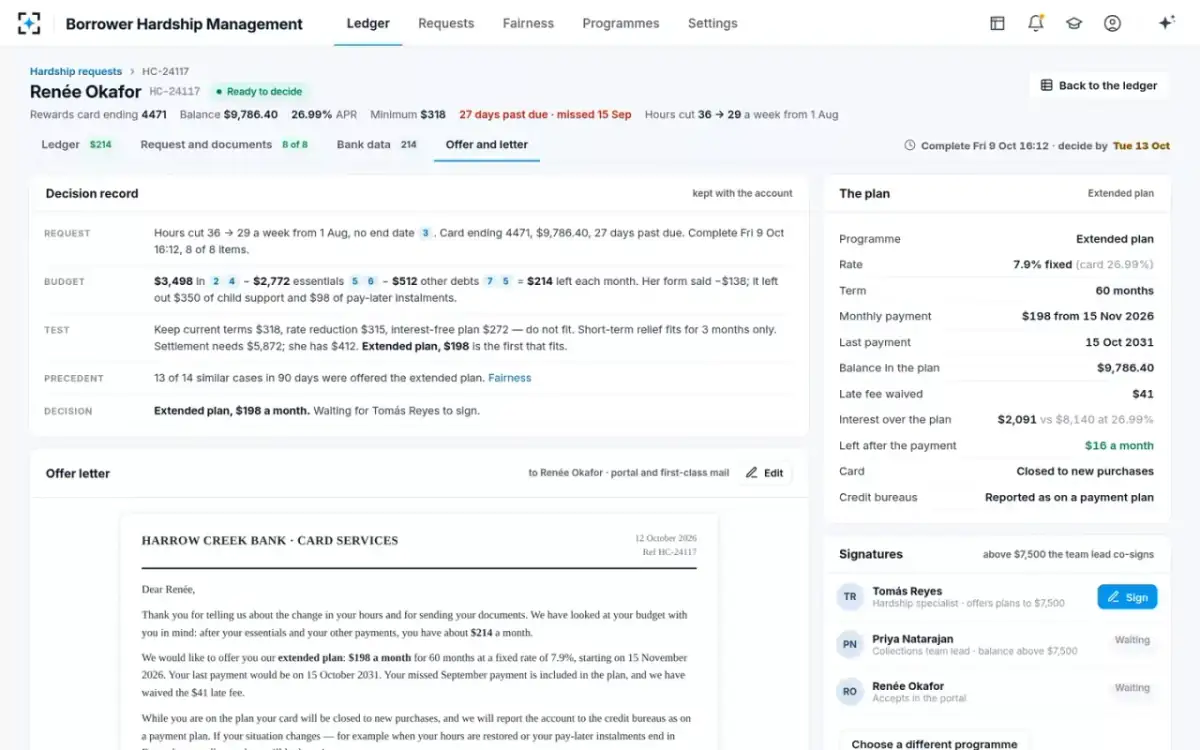
Short-term relief is different: the line often stays open because the account is expected to return to contractual terms. Either way, the reporting follows the terms the borrower agreed to, so the offer letter and the reporting policy have to say the same thing. In the sample, the plan was $198 a month for 60 months at 7.9% fixed, the card closed to new purchases, and the account reported to the bureaus as on a payment plan, all stated in the letter before the borrower accepted.
Borrower Hardship Management states what will be reported before anyone signs
Settlement and charge-off
A settlement ends the plan with a loss, and the reporting has to show both the payment and the charge-off. The agencies' credit card guidance says "the amount of debt forgiven in a settlement arrangement should be classified loss and charged off", and the uniform policy classifies open-end credit as loss at 180 cumulative days past due. A plan that breaks and runs to 180 days is reported as charged off whatever was agreed earlier; a settlement that is paid is reported as settled for less than the full balance, which is accurate and therefore not something the lender may soften. The design of the relief ladder that leads to these outcomes is covered in credit card workout programs.
Why hardship reporting is a dispute risk and a fair lending risk
Hardship accounts generate disputes because the borrower's understanding of the plan and the tradeline can diverge, and both kinds of dispute land on the furnisher. A direct dispute must be investigated when it concerns "the terms of a credit account or other debt with the furnisher, such as … principal balance, scheduled payment amount on an account", or performance, "such as … the current payment status … or the date an account was opened or closed" (12 CFR 1022.43). On a dispute received through a bureau, the furnisher must investigate, report the results and, if the item is inaccurate or cannot be verified, "modify", "delete" or "permanently block" it (15 U.S.C. 1681s-2(b)).
"Cannot be verified" is the risk. A lender that cannot show, months later, what was agreed and when the plan began must delete or modify the item, whatever the truth was. The answer is a decision kept with its date, terms, signatures and reporting instruction.
Fair lending law reaches the same facts. Regulation B defines a credit transaction to include "furnishing of credit information" as well as "revocation, alteration, or termination of credit; and collection procedures" (12 CFR 1002.2(m)). If two similarly situated borrowers on the same plan are reported differently, the lender needs a reason it can show; how hardship outcomes are monitored for consistency is the subject of fair servicing risk.
Controls for reporting hardship plans
Nine controls a furnisher can test on accounts in hardship plans
- Does the written policy map each program to its reporting?
Payment, status, line, indicator and balance, per program, so outcomes do not depend on who granted the plan.
- Is the scheduled payment updated on the plan's start date?
Reflecting the terms as modified.
- Is the plan indicator reported?
So a reduced payment is not read as underpayment.
- Are re-ages applied only within policy and agency limits?
Three consecutive qualifying payments; once in five years for workouts.
- Is closure reported with the credit limit when the line is closed?
Appendix E includes the credit limit in what should be furnished.
- Do charge-offs and settlements report the right amounts?
Forgiven balance classified loss; settled-for-less shown accurately.
- Does the offer letter state what will be reported?
In the same terms the reporting uses.
- Can every reported change be substantiated from records?
The decision, its date, its terms and its signatures.
- Are disputes on hardship accounts tracked by cause?
Recurring causes are a policy or mapping defect, not a borrower problem.
Where Borrower Hardship Management fits, and where it does not
The solution sits upstream of furnishing. It reads the request, builds the affordability figure, tests each relief option, drafts the decision and the offer letter, and keeps both signatures with the date. The decision states the plan's terms, the start date, what happens to the card and what the lender will report, and the letter tells the borrower the same in plain words before acceptance. In the sample, the specialist signed, the team lead co-signed because the $9,786.40 balance was above the $7,500 limit, and the offer went out a day before its decision was due.
It does not send data to credit bureaus, set the codes, apply re-ages or answer disputes; those stay with the lender's servicing and reporting teams under its Regulation V policy. Its contribution is the one Regulation V's guidelines ask for and servicing systems often lack: a record of the decision substantial enough that the furnished information is "substantiated by the furnisher's records at the time it is furnished", and still verifiable when a dispute arrives a year later.
Questions people ask
What are a furnisher's obligations under the FCRA?
Not to furnish information it knows or has reasonable cause to believe is inaccurate, to correct and update what it has furnished, to investigate disputes, and under Regulation V to maintain written policies for accuracy and integrity. Appendix E to 12 CFR Part 1022 lists the objectives those policies should meet.
How should a lender report an account in a hardship plan?
Accurately, as modified: the new scheduled payment, the status as it actually is, any closure and the credit limit, and an indicator that the account is on a plan. No current federal rule sets a special status for hardship plans; the lender's written policy does, within the FCRA's accuracy duty.
Did the CARES Act change how accommodations are reported?
For its covered period, yes: accounts current before an accommodation had to be reported current while the consumer met its terms, and delinquent accounts kept their status unless brought current. Charged-off accounts were excluded.
When can a delinquent account in a workout be reported as current?
After the lender re-ages it, which the agencies' uniform policy allows only after at least three consecutive minimum monthly payments or the equivalent, and for workout purposes once in five years.
Must a furnisher investigate a dispute about a hardship plan's terms?
Yes. Regulation V's direct dispute rule covers disputes about an account's terms, including the scheduled payment amount, and about its status and the date it was closed. If disputed information cannot be verified, the statute requires it to be modified, deleted or blocked.
Do fair lending rules cover credit reporting?
Yes. Regulation B's definition of a credit transaction includes the furnishing of credit information and collection procedures, so differences in how similar borrowers are reported need a reason the lender can show.