A credit card workout program is, in the federal banking agencies' definition, "a former open-end credit card account upon which credit availability is closed, and the balance owed is placed on a fixed (dollar or percentage) repayment schedule in accordance with modified, concessionary terms and conditions". The same guidance sets its design limits: workouts "should generally strive to have borrowers repay credit card debt within 60 months", should be "designed to maximize principal reduction", and any temporary hardship arrangement that runs past 12 months, renewals included, counts as one. An issuer's workout program is therefore one rung of a wider relief ladder, between short-term relief and settlement, and the hard part is choosing the rung consistently: requests arrive incomplete, the budget behind them is the borrower's own estimate, and two specialists given the same file often pick different plans. Botminds' Borrower Hardship Management builds the affordability figure from the borrower's documents and bank data, tests every rung against it, shows what similar borrowers were offered and leaves the signature to people.
The request worked through below is sample data on a fictional borrower and a fictional bank.
The supervisory lines a workout program is designed around
60months
the repayment period workout programs should generally strive for
12months
past which a temporary hardship program, renewals included, is a workout
1
rule for exceptions: clearly documented, with compelling evidence
5
areas of concern named, from extended amortisations to poor program MIS
What makes a card hardship arrangement a workout program?
Two things: the account is closed to new credit, and the balance is put on a fixed concessionary schedule. A temporary hardship program, which helps a borrower "overcome temporary financial difficulties", is not a workout under the guidance, but time converts it: "Temporary hardship programs longer than a 12-month duration, including renewals, are considered workout programs" (OCC Bulletin 2003-1).
The renewal clause is where portfolios drift. A three-month payment reduction renewed four times has become a workout without anyone deciding it should, and it carries none of the workout's design discipline: the line may still be open, the rate may still be contractual, and the balance may not be falling. An issuer's program inventory should therefore classify by elapsed time and terms, not by the name the program was launched under.
The design rules: amortise within 60 months, principal first
The guidance sets three design rules, and each one constrains a lever the issuer controls. Repayment within 60 months fixes the term. Principal reduction fixes the price: "To meet these time frames, institutions may need to substantially reduce or eliminate interest rates and fees so that more of the payment is applied to reduce principal." Exceptions must be "clearly documented and supported by compelling evidence that less conservative terms and conditions are warranted."
The agencies also named the failures they would criticise: "liberal repayment terms with extended amortizations, high charge-off rates, moving accounts from one workout program to another, multiple re-agings, and poor MIS to monitor program performance". The consequences listed include adversely classifying entire portfolio segments, placing loans on nonaccrual, increasing loss allowances and accelerating charge-offs. Settlements have their own accounting rule: "the amount of debt forgiven in a settlement arrangement should be classified loss and charged off." When an account in a program may be brought current is a separate set of limits, covered in re-aging a delinquent account.
The relief ladder around the workout program
Most issuers run the workout as one rung of a ladder and try the least concessionary rung first. The order matters because each rung gives away more: a fee, then rate and time, then principal. A policy that lets a specialist jump to a deep rung because the call was difficult recovers less without helping the borrower more.
Six rungs of a card relief ladder, what each gives up and who signs
| Rung | Fits a borrower who | Payment rule | Term | Signs |
|---|---|---|---|---|
| Keep current terms | Can carry the contractual minimum, perhaps with a fee waived | Contractual minimum | No change | Specialist |
| Short-term relief | Has a hardship with a stated end date | Reduced or deferred payment, then back to contract | Policy; past 12 months with renewals it is a workout | Specialist |
| Rate reduction | Can pay most of the minimum, not at the contract rate | Minimum at a lower rate; line often stays open | Policy | Specialist |
| Interest-free plan | Can clear the balance in a few years without interest | Balance divided by term, at 0% | Commonly 36 months | Specialist |
| Extended plan (workout) | Has a long-term income drop and a larger balance | Amortised at a low fixed rate; card closed | Up to 60 months | Specialist to a limit; team lead co-signs above |
| Settlement | Cannot clear the balance on any schedule | A share of the balance; the rest forgiven and charged off | Lump sum or a few months | Head of collections |
Signing limits are part of the design. The sample bank lets a specialist offer a plan alone on balances up to $7,500 and requires a named team lead to co-sign up to $25,000. Settlement authority sits highest because it is the only rung that creates a loss on the day it is signed.
How should an issuer decide which rung a borrower fits?
By one figure: what the borrower has left each month after essentials and other debts, built from evidence rather than taken from the form. The rung is then the first one on the ladder whose payment fits under that figure. The budget rule that turns the borrower's own numbers into the figure used is a policy choice, and it should be written down.
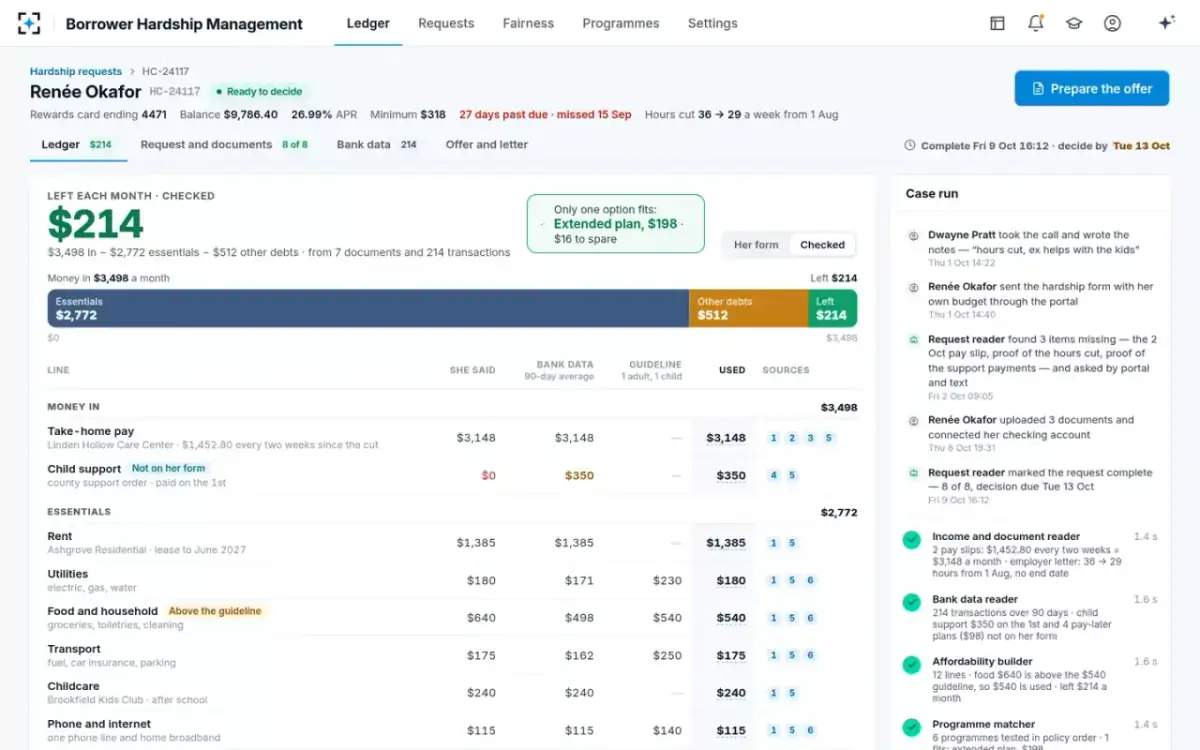
In the sample, the borrower's form said $3,148 a month in and $3,286 out, which is minus $138. Her two pay slips confirmed $1,452.80 every two weeks, $3,148 a month, and her employer's letter confirmed hours cut from 36 to 29 with no end date. Ninety days of bank data, connected read-only with her consent, showed $350 of child support arriving on the 1st that the form left out, four pay-later plans at $98 a month, and food spending averaging $498 against the $640 she had written. The sample bank's budget rule uses the borrower's figure up to a household guideline drawn from the BLS Consumer Expenditure Survey and the guideline above it, unless a reason is given. The result: $3,498 in, $2,772 of essentials, $512 of other debts, $214 left.
Borrower Hardship Management builds the budget line by line, each figure cited
Testing every rung against what is left
With the figure built, each rung's payment is computed from the balance and the program's rules and drawn against it. In the sample, the balance was $9,786.40 at 26.99%.
Each rung's monthly payment against the $214 the borrower has left
Two results are as informative as the fit. Short-term relief was affordable but wrong, because the hardship had no end date and the contractual payment would return unchanged. The extended plan amortises within the 60 months the guidance sets, at a rate low enough that most of each payment reduces principal. Precedent was shown beside it: 13 of 14 similar borrowers in the last 90 days had received the same plan.
A what-if must carry a reason. The specialist learned the borrower's son had a prescribed gluten-free diet and tested her $640 food figure: $114 left, no rung fit, and the policy's last step lit up, a referral to non-profit credit counselling with collection paused for 60 days. The tool lets a specialist apply such a change only with a written reason, which goes on the decision. How affordability assessments are built and tested is covered in affordability assessment in collections.
Reg Z: what must be disclosed before the arrangement starts
A card issuer may raise the rate or fees when a workout or temporary hardship arrangement ends or fails only if it disclosed that in writing first, and never above the pre-arrangement rate on old balances. Regulation Z's exception requires that "prior to commencement of the arrangement … the card issuer has provided the consumer with a clear and conspicuous written disclosure of the terms of the arrangement (including any increases due to the completion or failure of the arrangement)", and that on completion or failure the issuer "must not apply to any transactions that occurred prior to commencement of the arrangement an annual percentage rate, fee, or charge that exceeds" the one that applied before (12 CFR 1026.55(b)(5)).
For program design, that makes the offer letter a compliance document, not a courtesy. It must state the payment, the term, the rate, what happens to the card and what happens if the plan ends or breaks. In the sample, the letter set out $198 a month for 60 months, the $41 late fee waived, the card closed to new purchases, the interest over the plan, and how to ask for a review if the borrower's situation changed.
Why consistency across similar borrowers is a compliance question
Because hardship decisions are part of the credit transaction under fair lending law. Regulation B forbids discrimination "on a prohibited basis regarding any aspect of a credit transaction" (12 CFR 1002.4(a)), and defines a credit transaction to include "revocation, alteration, or termination of credit; and collection procedures" (12 CFR 1002.2(m)). A workout offer alters existing credit. If two similarly situated borrowers get different rungs and the reason is not written down, the issuer cannot show the difference was not on a prohibited basis.
Consistency can be measured case by case. The sample bank's consistency check finds decided cases from the last 90 days with the same product, a balance within 25%, the same kind of hardship and a monthly surplus within $40, and shows what they were offered. An offer that differs from the precedent is not blocked; it goes to the compliance analyst with the specialist's reason. How that monitoring rolls up across a portfolio is the subject of fair servicing risk.
Workout program MIS: what to monitor
The agencies named "poor MIS to monitor program performance" as a concern in its own right. Program MIS should show, at least, where accounts are, how long they have been there and whether balances are falling.
Nine measures a workout program owner should be able to produce on demand
- Accounts and balances by rung and age in program
With temporary programs past 12 months, renewals included, reclassified as workouts.
- Scheduled repayment term by account
Exceptions beyond 60 months listed with their documented evidence.
- Principal reduction per payment
Any account negatively amortising flagged.
- Movement between programs
Accounts moved from one workout to another, a named area of concern.
- Re-ages per account
Against the issuer's policy limits.
- Cure, break and charge-off rates by rung
A rung whose plans break within months is mis-sized.
- Settlements and the amount charged off
Forgiven amounts classified loss.
- Offers that differ from precedent, with reasons
Reviewed by compliance.
- Disclosures given before commencement
Evidence for each arrangement under Reg Z 1026.55(b)(5).
How Borrower Hardship Management runs a workout decision
From a hardship call to a signed workout offer
Agent
Request readerChecks the call notes, web form and uploads against the documents the policy requires, and asks once for what is missing.
Never: Never asks for a document the policy does not require
Agent
Income, document and bank data readersWork out take-home pay, read the cause and whether it ends, and categorise 90 days of consented bank data.
Never: Never counts income it cannot cite
Agent
Affordability builder and programme matcherBuild the budget line by line and test each rung, recommending the first that fits.
Never: Never recommends a payment above what is left
Agent
Consistency checker and letter writerShow what similar borrowers got, and draft the decision and the offer letter.
Never: Never sends anything
A person decides
Hardship specialistDecides, applies any what-if with a reason, and signs.
A person decides
Team leadCo-signs above the specialist's balance limit before the offer is sent.
In the sample, the request was complete at 16:12 the day after the borrower sent her documents and connected her account; the specialist signed, the team lead co-signed because $9,786.40 was above the $7,500 limit, and the offer went out by portal and first-class mail a day before it was due. The solution's own estimate puts reading documents, checking spending and building the budget at about four days by hand for a typical card request, and under half a day with the agents; that is an estimate, not a measured result.
The limits are the issuer's policy, not the tool's. The agents never change account terms, never contact the borrower except through the channel she chose, and never treat a one-off payment as a regular bill. The ladder, the budget rule, the guidelines, the documents required and the signing limits are versioned settings the issuer owns.
Questions people ask
What is a workout program for a credit card?
In the federal banking agencies' 2003 guidance, a former open-end card account closed to new credit, with the balance on a fixed repayment schedule under concessionary terms. Workouts should generally aim for repayment within 60 months.
When does a temporary hardship program become a workout?
When it runs longer than 12 months, including renewals. The guidance then treats it as a workout program, with the workout's expectations on term and principal reduction.
Can an issuer raise the rate after a workout ends?
Only as disclosed in writing before the arrangement began, and never above the rate that applied before the arrangement on balances from before it, under Regulation Z 1026.55(b)(5).
Do fair lending rules apply to hardship decisions?
Yes. Regulation B covers "any aspect of a credit transaction", which it defines to include altering credit and collection procedures. Issuers should be able to show why similarly situated borrowers received different offers.
How should settlements be accounted for?
The agencies' guidance says the amount forgiven in a settlement should be classified loss and charged off, and issuers should hold adequate allowances for accounts subject to settlement arrangements.
What do examiners criticise in workout programs?
The guidance lists liberal repayment terms with extended amortisation, high charge-off rates, moving accounts between workout programs, multiple re-agings and poor MIS. Remedies include classification, nonaccrual, higher allowances and accelerated charge-offs.