An affordability assessment is the piece of work that decides what a borrower in difficulty can actually pay each month, and it is the number every relief decision rests on. It is built by setting three sources beside each other — the borrower's own income and expenditure form, the transaction record from her bank account, and a published guideline for what a household her size spends — and then applying a written rule that says which source wins on each line. Those three will never agree, which is the whole difficulty: an assessment is only as defensible as the rule that resolves the disagreement, and as the citation behind each figure. Borrower Hardship Management, a Botminds agentic solution for collections, builds the budget line by line from all three, shows what each said, and records which figure was used and why.
The work is hard because the disagreements are not random. Borrowers understate income they think will be held against them and overstate spending they are ashamed of; a transaction record catches what a form forgets but mistakes a one-off for a regular bill; a guideline is accurate for a population and wrong for a person. The example below follows a fictional sample borrower, Renée Okafor, with invented employers, banks and figures. The guidelines and the test behind them are the real published ones.
One borrower, two very different answers
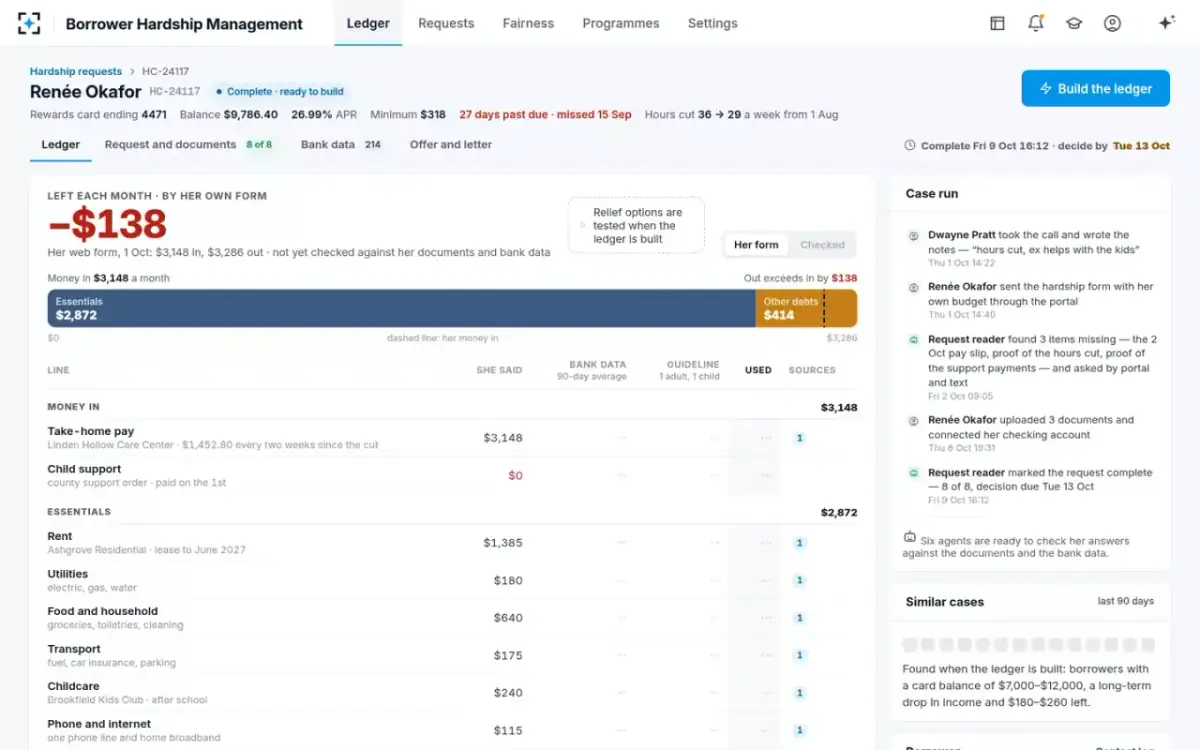
−$138
a month left, by her own form: $3,148 in against $3,286 out
$3,498
money in once her pay slips, the employer letter and a support statement are read
214
transactions categorised across 90 days of her bank data
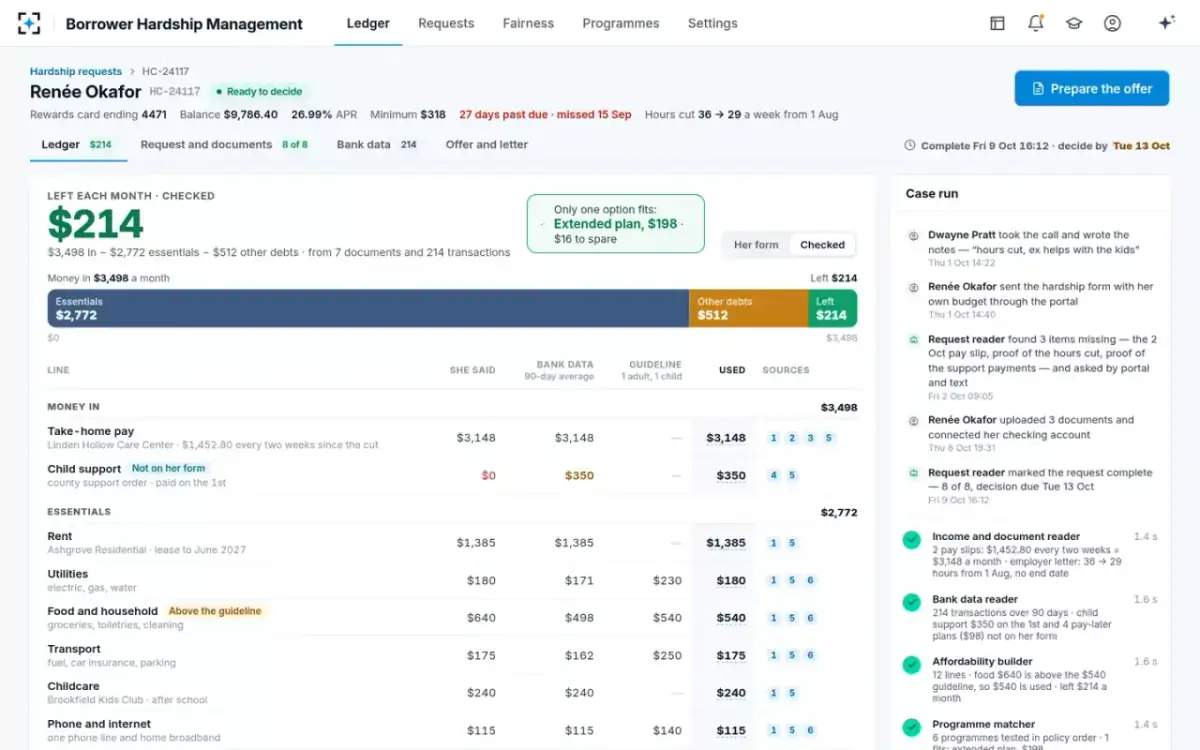
$214
left each month once the budget is built and every line cited
What is an affordability assessment in collections?
It is a structured statement of money in, money out and what remains, built for a borrower who has already said she cannot pay, and used to choose between the arrangements a lender can offer her. It differs from an underwriting assessment in purpose and in direction. Underwriting asks whether a borrower can take on an obligation; a collections affordability assessment asks what obligation is left after the essentials, and it is trying to find a smaller number rather than to justify a larger one.
It is not optional, and it is not a courtesy. Every issuer in the CFPB's December 2025 survey of the card market said it assesses whether the borrower is willing and able to pay on the program's terms, and documents the reason for the difficulty, how severe it is and how long it will last (CFPB, December 2025). Severity and duration are the budget's work. Reason is the document's.
Regulators reach for the same measure at the other end of the relationship. Regulation Z tells a card issuer it must consider a consumer's ability to make the minimum payments before opening an account or raising a limit, and that reasonable policies "include consideration of at least one of the following: The ratio of debt obligations to income; the ratio of debt obligations to assets; or the income the consumer will have after paying debt obligations" (12 CFR 1026.51(a)(1)(ii)). That last option is residual income — exactly what a hardship assessment measures. The rule governs origination, not collections, but it tells you what the regulator thinks a defensible measure of capacity looks like.
Three sources that never agree: her form, her bank data, the guideline
Each source knows something the others do not, and each is wrong in a predictable direction. Setting them out explicitly, rather than silently preferring one, is what makes the result arguable in the right sense: a borrower or an examiner can see what was chosen and challenge it.
What each source knows, where each goes wrong, and when it should win
What it is good for: The only source that knows her circumstances — a child’s prescribed diet, a job starting in March, a car she must keep to work. It is also the only one she has signed.
Where it misleads: Written from memory under stress. Income she thinks will be used against her is left out; spending is estimated high on the lines she worries about and low on the ones she does not think of.
What it is good for: What actually left the account, in date order, with the regular payments a form forgets. It catches the direction and date of an income change to the payday.
Where it misleads: It sees only the accounts she connected, it cannot tell a one-off from a bill without a pattern, and three months of an unusual quarter is three months of an unusual quarter.
What it is good for: A defensible floor and ceiling for an ordinary household of her size, published and the same for everyone, which is what stops a budget being argued line by line in every case.
Where it misleads: It is an average over a population. It knows nothing about her particular household, and the guideline a lender chooses can be far stricter or far looser than another published one.
The mistake that follows from ignoring this is a budget nobody can defend: a specialist takes the lowest figure on each line, because low spending leaves more to pay with, and ends up with a household that eats like a guideline, drives like the bank data and pays rent like the form. That household does not exist, and the plan written for it breaks.
The necessary-expense test, borrowed from the tax collector
The most completely published version of this work in the United States is not a lender's. It is the Internal Revenue Service's, which has to decide every day what a taxpayer who owes back taxes can afford to pay, and publishes both the test and the numbers.
The test is one sentence: "Collection financial standards are used to help determine a taxpayer's ability to pay a delinquent tax liability. Allowable living expenses include those expenses that meet the necessary expense test. The necessary expense test is defined as expenses that are necessary to provide for a taxpayer's (and his or her family's) health and welfare and/or production of income" (IRS, Collection Financial Standards).
Health, welfare, and the production of income. Those three words settle most of the arguments a hardship desk has. A car is necessary where the job requires it and not where it does not. A phone is necessary. A streaming subscription is not, but it is also so small that disallowing it buys nothing and costs the conversation. The test is a principle a specialist can apply to a line nobody has thought of before, which is more useful than a list that always has a gap in it.
The eight expense families a published household standard covers
- Food
Groceries and meals away from home, including tips. The largest single line in every household standard, and the one borrowers most often overstate.
- Housekeeping supplies
Laundry and cleaning supplies, stationery, postage, delivery, household products, lawn and garden.
- Apparel and services
Clothing and footwear, alterations and repairs, dry cleaning, watches and jewellery repair.
- Personal care products and services
Hair, oral hygiene, shaving, cosmetics and bath products, personal care appliances.
- Miscellaneous
A deliberate allowance for what the other lines miss — and, in the federal version, for the part of any expense that runs above the standard.
- Out-of-pocket health care
Medical services, prescriptions and supplies, allowed per person and in addition to what the household pays for health insurance.
- Housing and utilities
Rent or mortgage, property taxes, insurance, maintenance, gas, electricity, water, heating, refuse collection, telephone and internet. Varies by county.
- Transportation
A nationwide allowance for a loan or lease payment, plus a regional operating allowance for fuel, maintenance, insurance, registration, parking and tolls.
How do lenders work out what you can afford to pay?
By adding up verified income, subtracting the essentials the test allows, subtracting what is owed to other creditors, and calling what remains the amount available. The arithmetic is trivial. Four decisions inside it are not.
The first is which income counts. A figure that cannot be tied to a pay slip, a benefit letter or a deposit is not income for this purpose, however confidently it was stated — and equally, income the borrower did not mention is still income once a statement and three matching deposits prove it. The second is the period: a monthly figure built from a fortnightly pay cycle has to be worked out from the frequency, not multiplied by two. The third is which expenses are essential, which is the necessary-expense test. The fourth is the reconciliation rule itself, and it is the one most lenders leave unwritten.
What the amount available then buys is a separate question, answered by the relief ladder: how issuers design credit card workout programs walks it from keeping current terms to a settlement.
National standards and local standards: what varies by household and what varies by place
Published household standards split in two, and the split is worth copying. One set is national: it applies everywhere and varies only by the number of people. The other is local: it varies by county, because what a household pays to be housed in one county bears no relation to another.
The federal version is explicit about how each is applied. On the national lines, "Taxpayers are allowed the total National Standards amount monthly for their family size, without questioning the amount actually spent" — in other words, the standard is granted, not argued. On the local lines the opposite applies: "Maximum allowances for monthly housing and utilities and transportation, known as the local standards, vary by location. In most cases, the taxpayer is allowed the amount actually spent, or the local standard, whichever is less."
The national standards, by household size, and the lower figure one sample lender uses
| Expense | One person | Two persons | Three persons | Four persons |
|---|---|---|---|---|
| Food | $496 | $893 | $1,073 | $1,278 |
| Housekeeping supplies | $44 | $85 | $94 | $95 |
| Apparel and services | $98 | $175 | $211 | $249 |
| Personal care products and services | $54 | $90 | $104 | $118 |
| Miscellaneous | $175 | $315 | $375 | $436 |
| Total allowed each month | $867 | $1,558 | $1,857 | $2,176 |
| For each person beyond four, add | — | — | — | $397 |
That contrast is the practical lesson of the table. Two lenders can both say their budgets follow a published household guideline and produce figures hundreds of dollars apart, because one took an all-household average and the other took the lowest income fifth. Neither is cheating. But a desk that cannot say which table it used, and why, has not written its rule down.
Where the household guidelines come from, and how often they move
Both the federal standards and most lenders' own tables trace back to the same survey. The IRS says so directly about its national lines.
"National Standards have been established for five necessary expenses: food, housekeeping supplies, apparel and services, personal care products and services, and miscellaneous. The standards are derived from the Bureau of Labor Statistics (BLS) Consumer Expenditure Survey (CES)."
IRS, National Standards: Food, Clothing and Other Items, effective 29 June 2026
The survey behind them "provides data on expenditures, income, and demographic characteristics of consumers in the United States" (BLS, Consumer Expenditure Surveys). It is run continuously and published annually, which is why standards derived from it move on a yearly cycle rather than drifting unannounced.
For a lender, three consequences follow. The guideline table has a version and a date, and a budget built on last year's table should say so. The refresh has to be scheduled, because a table nobody updates quietly becomes stricter every year as prices rise. And the table should be a setting rather than a number buried in a calculation, so that changing it is one visible, dated act rather than an edit nobody can find afterwards. In the solution the guideline source, the look-back period, the margin a plan must leave and the budget rule itself are all settings, versioned and on the audit trail.
The budget rule, written out: her figure up to the guideline, the guideline above it
Here is the rule the sample bank uses, stated as a sentence a specialist can apply without thinking twice: take the borrower's own figure where it falls at or below the household guideline; where it is above the guideline, use the guideline, unless there is a written reason not to; never set an essential below what the bank data shows for a fixed bill.
Three properties make it a good rule. It is generous where generosity is cheap — a borrower who says she spends less than the guideline is believed, which is both kind and conservative, since it leaves more apparently available. It is bounded where it is expensive, because an unbounded claim above the guideline is where a budget stops being comparable between borrowers. And it has an escape hatch with a cost attached: the figure above the guideline can be used, but only with a reason that goes on the decision file.
The last clause is the one that protects the plan. A rule that always takes the lower figure would set a fixed bill — rent, a car payment — below what the account plainly pays every month, which produces an amount available the borrower does not have and a plan that breaks on the second payment.
One budget line by line: what she said, what her account shows, what the guideline allows, what was used
| Line | What she said | 90-day bank average | Household guideline | Figure used |
|---|---|---|---|---|
| Take-home pay | $3,148 | $3,148 since the cut | — | $3,148 |
| Child support received | Not on her form | $350 on the 1st | — | $350 |
| Rent | $1,385 | $1,385 | — | $1,385 |
| Utilities · electric, gas, water | $180 | $171 | $230 | $180 |
| Food and household | $640 | $498 | $540 | $540 |
| Transport · fuel, car insurance, parking | $175 | $162 | $250 | $175 |
| Child care · after school | $240 | $240 | — | $240 |
| Phone and internet | $115 | $115 | $140 | $115 |
| The remaining essential lines, together | $137 | $137 | — | $137 |
| Other debts, including pay-later instalments | $414 | $512 | — | $512 |
| Left each month | −$138 | — | — | $214 |
Read down the "figure used" column and the rule becomes visible in a way no policy document makes it. Of the ten lines, seven are exactly the figure she gave. One is capped at the guideline, and two are corrected upwards from her account: the income she left out, and the instalments she did not count as debt. That is the answer to the borrower who assumes the lender will dispute everything, and to the examiner who assumes a standardised budget means nobody listened.
The budget on screen, with a numbered source on every line
What a 90-day transaction record catches that a form does not
Three things, in order of how often they matter. The first is income the borrower did not report. In the worked example the form omitted $350 a month of child support, mentioned only in passing on the first call; three deposits on the first of three consecutive months and a county statement establish it, and without it no arrangement on the ladder would have fitted her budget at all.
The second is obligations the borrower did not count as debts. Pay-later instalments are the common one. Her form listed two debts she thought of as debts — an auto loan at $318 and a store card minimum at $96 — and omitted four pay-later plans running at $98 a month, the last of them ending on 14 December. Borrowers routinely leave them off an income and expenditure form because the form says "loans and credit cards" and a four-payment plan does not feel like either. They are still money that leaves the account before the lender's payment does.
The third is the shape and date of the income change itself. Her take-home pay drops by $342.60 a payday from 21 August, which matches the employer's letter saying her hours fell from 36 to 29 a week from 1 August with no stated end date. A form says "my hours were cut". A transaction record says when, by how much, and whether it has recovered.
What the form left out, on both sides of the budget
Money in · $3,498 a month
- On her form · take-home pay $3,148 · 90%
- Found in the bank data · child support $350 · 10%
Other debts · $512 a month
- On her form · $414 · 80.9%
- Found in the bank data · pay-later instalments $98 · 19.1%
That last point is worth dwelling on, because it is counter-intuitive and it changes how a specialist should open the conversation. The checked budget was kinder to her than her own. A borrower who writes "minus $138" has concluded there is no arrangement she can afford and is bracing for a refusal. Finding $214 is not catching her out; it is finding the plan she thought did not exist.
The same budget as she filled it in: minus $138, and nothing to offer
A one-off is not a regular bill: the categorisation mistakes that break a plan
Automating the reading of a transaction record introduces its own errors, and four of them account for most broken plans. Each has the same remedy: a rule about patterns, not a rule about words.
The first is treating a one-off as a bill. A $680 car repair in September is not $680 a month. A payment that appears once in ninety days is a one-off unless something else says otherwise; a payment that appears three times on the same date is a bill. The second is the reverse: treating a bill as a one-off because its date moves. A fortnightly payment lands six or seven times in ninety days on dates that never repeat, and a rule keyed to the day of the month will miss it entirely.
The third is double counting. Where the borrower's form says "phone and internet $115" and the account shows a $115 debit to a telecoms provider, that is one obligation seen twice, not two. The fourth is counting internal movement as income or spending: a transfer from a savings account to a current account is neither. In a budget built on ninety days, a single misclassified transfer can move the amount available by a hundred dollars.
The remedy that matters most is procedural rather than technical. Every categorised amount should be openable down to the transactions behind it, so a specialist who thinks a line looks wrong can see in seconds whether it is a bill or a repair. A budget whose lines cannot be opened cannot be corrected, only disputed.
When the borrower's figure should win, and the reason that has to be written down
Sometimes the guideline is simply wrong about a particular household, and a rule that cannot accommodate that is a rule that produces unfair outcomes with a straight face. The federal standards make the same allowance: where the facts indicate that the standards are inadequate to provide for basic living expenses, actual expenses may be allowed, but the taxpayer "must provide documentation that supports" it.
The same two conditions should govern a lender's override: a stated reason, and evidence. In the worked example the borrower's son has a prescribed gluten-free diet, which is why her food spend is $640 rather than the $540 the guideline allows. Testing that figure drops the amount available to $114, at which point nothing on the ladder fits and the last rung lights instead: a referral to free non-profit credit counselling, with collection activity paused. The override can be applied, but only with the reason attached, and the reason goes on the decision file where a reviewer will see it.
That is the right shape for an exception. It is available, it is cheap to make, and it is impossible to make invisibly. The alternative — a budget tool with no override — does not stop specialists departing from the rule; it stops them recording that they did. Whether overrides are being used evenly across similar borrowers is then a measurable question, and fair servicing risk is where it gets measured.
Questions people ask
What is an income and expenditure form used for?
It is the borrower's own statement of what comes in and what goes out, and it is the starting point of an affordability assessment rather than its conclusion. It carries two things no other source has: her signature, and the circumstances behind the numbers — a prescribed diet, a job starting next month, a car the job requires. In a well-run assessment it is kept as she wrote it and shown beside the checked figures, not overwritten by them.
What counts as a necessary expense?
The clearest published test is the IRS's: expenses "necessary to provide for a taxpayer's (and his or her family's) health and welfare and/or production of income". Housing, utilities, food, basic clothing, personal care, health costs, child care and the transport a job requires qualify. Discretionary spending does not, though disallowing very small amounts rarely changes the arrangement and usually costs the conversation.
What if my spending is higher than the guideline?
Under the rule described here the guideline is used, unless there is a written reason to use the higher figure — and a reason generally means evidence, not just an explanation. A good desk will tell the borrower which line was capped and by how much, because that is the line she can change the answer on by sending a document. Where a capped figure is restored, the amount available falls, and the arrangement on offer changes with it.
How far back do lenders look at bank data?
Ninety days is the look-back used in the example here, long enough to see three repetitions of a monthly bill and the date an income change started. Sixty days is faster but can miss a quarterly payment; a hundred and eighty is more complete but reaches back into circumstances that have already changed. Whatever the period, it should be a setting with a version rather than a habit, so that two assessments made in the same month used the same window.
What happens if nothing is affordable?
Then no arrangement is offered, which is the honest outcome rather than a failure. A payment the budget cannot carry is not relief; it is a plan that breaks within months and leaves the borrower worse off for having tried. The usual next step is a referral to a free non-profit credit counselling agency, which can work across every creditor rather than one, with collection activity paused while it does.
Can I challenge the figure a lender used?
Yes, and the assessment should make it easy to. Ask which figure was used on each line and where it came from: your form, your account, or a guideline. Every line should have an answer. The two lines worth challenging first are any essential capped at a guideline, where a document can restore your figure, and any expense categorised from your transactions, where a one-off repair can be sitting in the budget as a monthly bill.