Troubled debt restructuring is no longer a designation a bank applies. The subtopic that carried it has been superseded, and the questions it used to answer now live under loan modifications, where the reporting trigger has a longer name and a sharper test: a loan modification to a borrower experiencing financial difficulty. The label changed; the work did not. For every arrangement it grants, a lender still has to ask two things — was the borrower experiencing financial difficulty, and did we give away principal, rate, time or a payment — and because those four forms map almost one to one onto the rungs of a relief ladder, the cleanest place to answer them is inside the hardship decision rather than in a reconciliation three months later. Borrower Hardship Management, a Botminds agentic solution for collections, has no accounting module and makes no call report entry; what it produces is a decision file that already holds the facts the classification needs.
This page is written for the collections or special assets lead who signs the relief and the controller or call report preparer who has to classify what was signed. The authority quoted throughout is the OCC's Bank Accounting Advisory Series, which sets out the Office of the Chief Accountant's interpretations for national banks and federal savings associations. The worked arrangement is sample data on a fictional borrower.
The test, in four numbers
4
forms a modification can take before it becomes reportable
6
factors that may indicate the borrower is experiencing financial difficulty
12months
of prior modifications that must be considered cumulatively when judging whether a delay is insignificant
1
question, asked at the moment the arrangement is decided rather than at quarter end
What was a troubled debt restructuring, and what replaced it?
The designation was the way a creditor flagged that it had granted a concession to a borrower in difficulty that it would not otherwise have considered. It no longer exists as a creditor-side accounting category. The OCC's Bank Accounting Advisory Series now carries a one-line entry where the subject used to be: Subtopic 2A, Troubled Debt Restructurings, is marked superseded, with the note that "This Subtopic has been superseded due to the adoption of ASC Topic 326 by all entities. See Subtopic 12B for questions and answers regarding the accounting for loan modifications" (OCC, Bank Accounting Advisory Series, August 2026).
What took its place is both narrower and plainer. Rather than asking whether a concession was one a creditor would not otherwise consider — a judgement that produced a great deal of argument and not much comparability — the current test names the forms. "A loan modification should be reported as a loan modification to a borrower experiencing financial difficulty if the borrower is experiencing financial difficulty and the terms of the loan were modified in the form of one or more of the following: Principal forgiveness · An interest rate reduction · An other-than-insignificant payment delay · A term extension."
Two conditions, joined by "and". Difficulty alone is not enough; so is a modification alone. Both have to be true, and the second is a closed list.
The superseded designation and the test that replaced it
Troubled debt restructuring: Subtopic 2A of the Bank Accounting Advisory Series, now marked superseded.
Modification to a borrower experiencing financial difficulty: Subtopic 12B, Loan Modifications, which the superseded entry points readers to.
Troubled debt restructuring: Superseded on the adoption of ASC Topic 326 by all entities — the current expected credit loss model.
Modification to a borrower experiencing financial difficulty: Introduced by ASU 2022-02, "Financial Instruments – Credit Losses (Topic 326): Troubled Debt Restructurings and Vintage Disclosures".
Troubled debt restructuring: A concession to a debtor in financial difficulty that the creditor would not otherwise consider — a judgement about the creditor’s own intent.
Modification to a borrower experiencing financial difficulty: Financial difficulty, plus a modification in one or more of four named forms. The second limb is a list, not a judgement.
Troubled debt restructuring: Associated in practice with accounts already in trouble.
Modification to a borrower experiencing financial difficulty: Expressly capable of applying to a performing loan: a borrower may be contractually current when the bank modifies the loan.
Troubled debt restructuring: Loans identified before adoption, under the prospective method, keep the pre-modification effective interest rate until paid off, charged off or modified further.
Modification to a borrower experiencing financial difficulty: The post-modification effective interest rate is used as the discount rate where a discounted cash flow method is applied.
Troubled debt restructuring: A disclosure category of its own.
Modification to a borrower experiencing financial difficulty: Reported in the call report, and every modified loan has to be evaluated to see whether it belongs there.
The four forms a reportable modification can take
Principal forgiveness, an interest rate reduction, an other-than-insignificant payment delay, a term extension. Four, and a combination of them counts as readily as one. For a consumer collections desk the useful observation is that three of the four are things a relief ladder does by design, which means the question is not whether a hardship program produces reportable modifications but which rungs do and how many.
The reach of the list is wider than most desks assume in one specific respect. A loan does not have to be delinquent. Asked directly whether a modification of a performing loan can be reportable, the guidance answers: "Yes. A borrower may be contractually current when the bank modifies the loan. The loan modification will be reported in the call report if it meets the disclosure requirements in ASC 310-10-50." A borrower who calls before she misses a payment — the borrower every collections book wants more of — can still produce a reportable modification, and a process that only looks at delinquent accounts will miss her.
How do you tell whether a borrower is experiencing financial difficulty?
By applying a list of indicators that is explicitly not exhaustive, and by recording which ones applied. The guidance gives six.
The six indicators, and what each looks like on a consumer account
- "Default or, in the absence of a modification, default in the foreseeable future"
The most common one on a hardship desk, and the one the budget evidences: a borrower whose essentials and other debts leave less than the contractual minimum will default without an arrangement.
- "Bankruptcy"
Rarely the trigger on a card hardship request, because a borrower in bankruptcy is usually on a different path entirely. Where it is present it settles the question.
- "Doubt as to whether the debtor will continue as a going concern"
A commercial indicator with no direct consumer equivalent. On a small business or sole trader exposure it is the one that bites.
- "De-listing of securities"
Commercial only. Listed on this page so a reader who meets the six-item list elsewhere is not left wondering which two do not apply to individuals.
- "Insufficient cash flows to service the debt"
On a consumer account this is the affordability assessment: income less the necessary expenses and the other debts, against the contractual payment.
- "Inability to obtain funds from other sources at a market rate for similar debt to a non-troubled borrower"
A borrower refinancing a card balance at a market rate would not be asking for relief. On a consumer request it is usually inferred from the same evidence as the first and fifth.
On a card or personal loan hardship request, the first and the fifth indicators usually do the work, and both are answered by the same artefact: a budget showing what the borrower has left against what the contract requires. That is a useful piece of economy — the document that justifies the relief is the document that evidences the difficulty — and it is the reason the classification question belongs at the point of decision. How that budget is assembled and cited line by line is set out in how a collections budget is built.
A shopping center, a rate cut and two guarantors: the worked case in the guidance
The guidance teaches the test through a commercial example that is worth reading even if your book is consumer, because it shows how thin the margin for argument is. A bank holds a loan on a shopping center that lost its anchor tenant two years ago and is not generating enough cash flow to service the debt; two financially capable guarantors have been covering the shortfall. The bank agrees to cut the rate from prime plus two to prime, and in exchange the guarantors raise their guarantees from 25 percent each to 40 percent each.
The bank has, on the face of it, improved its position: a stronger guarantee in exchange for a rate cut. The answer is still yes, reportable. The borrower was experiencing financial difficulty "because the primary source of repayment (cash flows from the shopping center) was insufficient to service the debt without relying on the guarantors", and even with the increased guarantee "the borrower could not have obtained similar financing from other sources at this rate". Difficulty plus a rate reduction is the whole test, and what the bank got back does not enter into it.
The consumer parallel is exact. A rate cut from 26.99% to 7.9% granted to a borrower whose hours were cut is a rate reduction granted to a borrower in difficulty, and it does not stop being one because the lender also closed the line, waived a fee and improved its expected recovery.
"Other-than-insignificant payment delay": the one that is hardest to judge
Three of the four forms announce themselves. The payment delay does not, because it carries a qualifier, and the qualifier is where a desk can quietly get it wrong at scale. The tempting shortcut is to treat anything short as insignificant. The guidance addresses that shortcut directly and rejects it: it "is not appropriate to conclude the delay in payments is insignificant simply because the modification is short term (e.g., 12 months or less)".
What is required instead is a collective consideration of three things: whether the amount of the delayed payments is insignificant relative to the unpaid principal or collateral value and results in an insignificant shortfall in the contractual amount due; and whether the delay in timing is insignificant relative to the frequency of payments due, the debt's original contractual maturity, or its original expected duration. On top of that sits a counting rule that a high-volume relief program has to build for: "An entity shall consider the cumulative effect of modifications made within the prior 12-month period when determining whether a delay in payment resulting from the most recent modification is insignificant."
For a hardship desk the cumulative rule is the operationally expensive one. A short deferral granted to a borrower who had one six months ago is not judged on its own. That makes the history of arrangements on an account a classification input, not just a credit one — and it is the same history the supervisory rules on bringing an account back to current status require a lender to count, as set out in the rules, the limits and what examiners ask.
Why delaying the modification to maturity changes nothing
There is one more avoidance route the guidance closes explicitly, and it is worth quoting whole because it is short.
"Simply delaying a modification of a loan to a borrower experiencing financial difficulty until the original maturity date or later does not exempt the loan modification from reporting."
OCC, Bank Accounting Advisory Series, August 2026, Subtopic 12B, question 3
The question it answers is whether renewing a loan at or near maturity, rather than modifying it mid-term, puts the arrangement outside the reporting. It does not: "Modifications may occur before, at, or after the stated maturity of the debt, and time may elapse between the original loan agreement's end date and effective date of the modified loan terms." In the example behind it, a borrower using cash reserves to keep a matured loan current is renewed for another five years at 4 percent instead of 5, having been found unable to obtain financing elsewhere. Reportable.
On a revolving consumer account there is no maturity to wait for, so the equivalent manoeuvre is different: letting an account run to charge-off and settling afterwards rather than granting relief before it. That has its own consequences, and it is not a reporting strategy — it is a recovery decision with a much worse outcome for the borrower.
Mapping a relief ladder onto the four forms, rung by rung
Here is the practical payoff. If a lender's relief ladder has six rungs and the reporting test has four forms, the mapping can be worked out once, written down, and applied by the people who grant the relief rather than reconstructed from a data extract at quarter end.
Six rungs of a card relief ladder against the four reportable forms
| Rung | What it changes | Which form it is | Reportable? |
|---|---|---|---|
| Keep current terms | Nothing, beyond perhaps waiving a fee already charged. | None of the four. No term of the loan is modified. | No |
| Short-term relief | A reduced or deferred payment for a set number of months, then contractual terms return. | A payment delay, whose significance has to be judged on the three factors — and never dismissed because the term is short. | It depends, and the judgement must be made and recorded |
| Rate reduction | The contractual rate falls; the line usually stays open. | An interest rate reduction. Unambiguous. | Yes, where the borrower is in difficulty |
| Interest-free plan | The rate goes to 0% and the balance is fixed on a schedule. | An interest rate reduction, and arguably a term extension where the schedule runs beyond the contractual one. | Yes |
| Extended plan | A low fixed rate over the longest term the policy allows, with the line closed. | An interest rate reduction for certain; whether fixing a revolving balance on a 60-month schedule is also a term extension is a judgement for the controller. | Yes — the rate reduction settles it either way |
| Settlement | Part of the balance is forgiven. | Principal forgiveness. | Yes |
Two rows deserve attention. The first row is the only clean "no", and it is clean only because nothing was modified: waiving a fee already charged is not a change to the terms of the loan. The second row is the only genuine judgement, and it is the one a high-volume program will meet most often. A ladder whose second rung is used thousands of times a year needs a written position on the three insignificance factors and on the twelve-month cumulative rule, not a case-by-case debate.
What the decision file has to carry for the controller to classify it
Everything the test needs is known at the moment the arrangement is signed, and almost none of it survives into a data extract. The forms are knowable from the offer. The difficulty is knowable from the budget and the evidence behind it. The cumulative history is knowable from the account. What is usually missing three months later is the connective tissue: which indicator applied, what the figures were, and on what date the modified terms took effect.
The decision file: request, budget, test, precedent, decision — with the dates
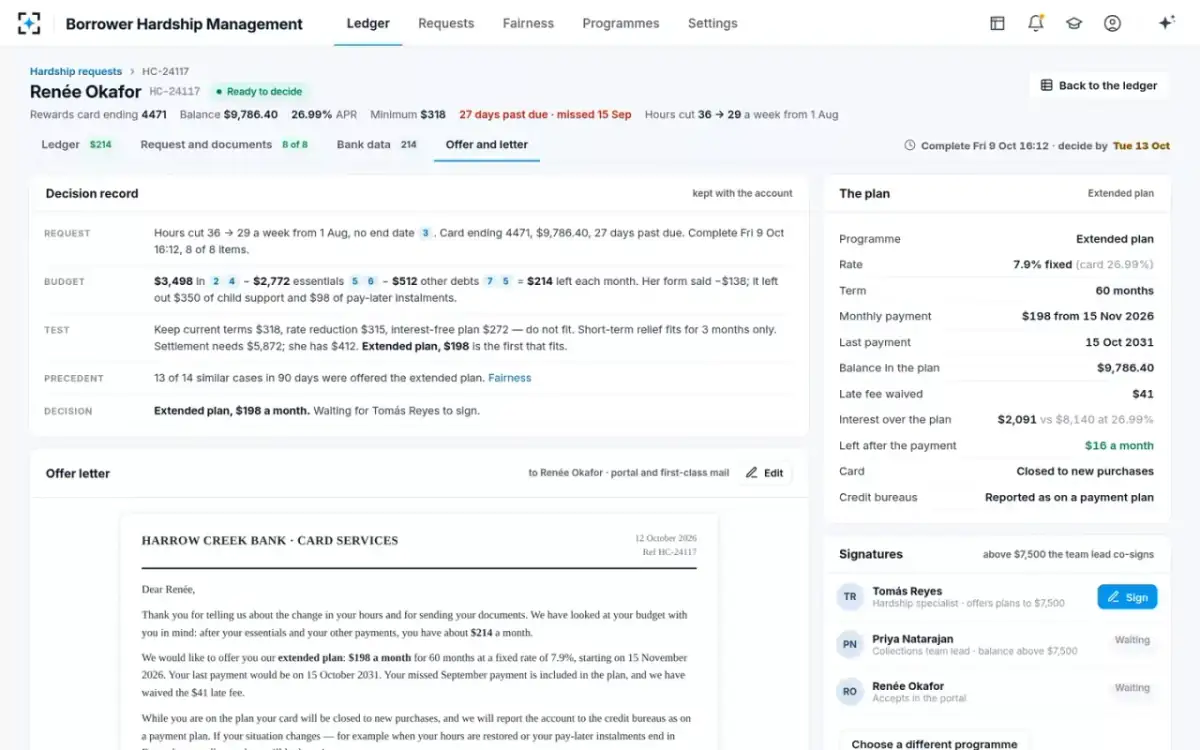
The rate before and after, the term, the first and last payment dates and the balance placed on the schedule are all on the plan panel. The difficulty is on the budget rows. What a lender should add, once, is the classification field itself: which of the four forms this arrangement is, and which indicator established the difficulty. Asked at signature it takes a specialist seconds, because the answer is in front of them. Asked at quarter end it takes the controller a reconstruction.
One arrangement from signature to the call report, and where each fact comes from
A person decides
Hardship specialistDecides the arrangement and signs. At this moment the rate, the term, the dates and the budget behind them are all on the screen.
Agent
Letter writerDrafts the decision file — request, budget, arrangements tested, precedent, decision and reasons — and the offer letter stating the terms in plain words.
Never: Never sends anything; a person signs
A person decides
Collections team leadCo-signs above the specialist’s balance limit, from the same record rather than from a summary of it.
A person decides
ServicingApplies the modified terms to the account on the stated effective date, and keeps the count of prior arrangements the twelve-month cumulative rule needs.
A person decides
Controller or call report preparerEvaluates the modification against the four forms and the six indicators, and classifies it. Every modified loan has to be evaluated, whether or not it was delinquent.
A person decides
Credit riskReflects the arrangement in the allowance, segmenting where a loan no longer shares the risk characteristics of its pool.
Where the allowance and the classification follow the decision
Classification is not the end of it, and the guidance makes one point that a collections lead should understand even though it belongs to credit risk. A modified loan often stops sharing the risk characteristics of the pool it was measured in, and when it does it has to be looked at on its own. The guidance illustrates this with a second-lien example: where another bank has modified the first lien, the second-lien holder has not modified anything and reports nothing, but it "should recognize that the second lien mortgage loan borrower is facing financial difficulty", should consider segmenting the loan into a pool that reflects the increased risk, and "if this loan does not share risk characteristics with other loans in the portfolio, the bank must measure the expected credit loss on this loan individually".
The consumer reading is that relief granted on one product is information about every other exposure to the same borrower. A hardship desk that works card by card, with no view of the same customer's instalment loan, is leaving that information on the floor — and the lender will meet it later as an unexplained deterioration in a pool.
The supervisory expectations around workout programs point in the same direction: accounts in workout programs are to be kept apart from the rest of the book for performance measurement, impairment analysis and monitoring, and where several programs with different performance characteristics exist, each should be tracked separately (OCC Bulletin 2003-1). A ladder with six rungs is six populations, and the classification mapping above is the natural key for reporting them.
Why this belongs in the decision, not in a quarter-end reconciliation
Three arguments, in increasing order of force. The first is cost: the facts are free at signature and expensive afterwards. The second is accuracy: a reconstruction infers the form from a rate field and a term field, and cannot see which indicator of difficulty actually applied or whether a short deferral was the second one in twelve months.
The third is that the alternative does not scale with the honest conduct a lender says it wants. Issuers structure their loss mitigation practices to conform with the federal banking agencies' guidance on these tools, as the CFPB's December 2025 market report records (CFPB, December 2025). A program that makes relief easy to ask for and quick to grant will produce more arrangements, more of them on performing accounts, and more of them to borrowers who have had one before. Every one of those is a classification question. A desk that answers it at the moment of decision gets better at relief and better at reporting at the same time; a desk that defers it finds the reporting burden rising with the thing it was trying to encourage.
Every rung tested at once: the forms are decided here, not later
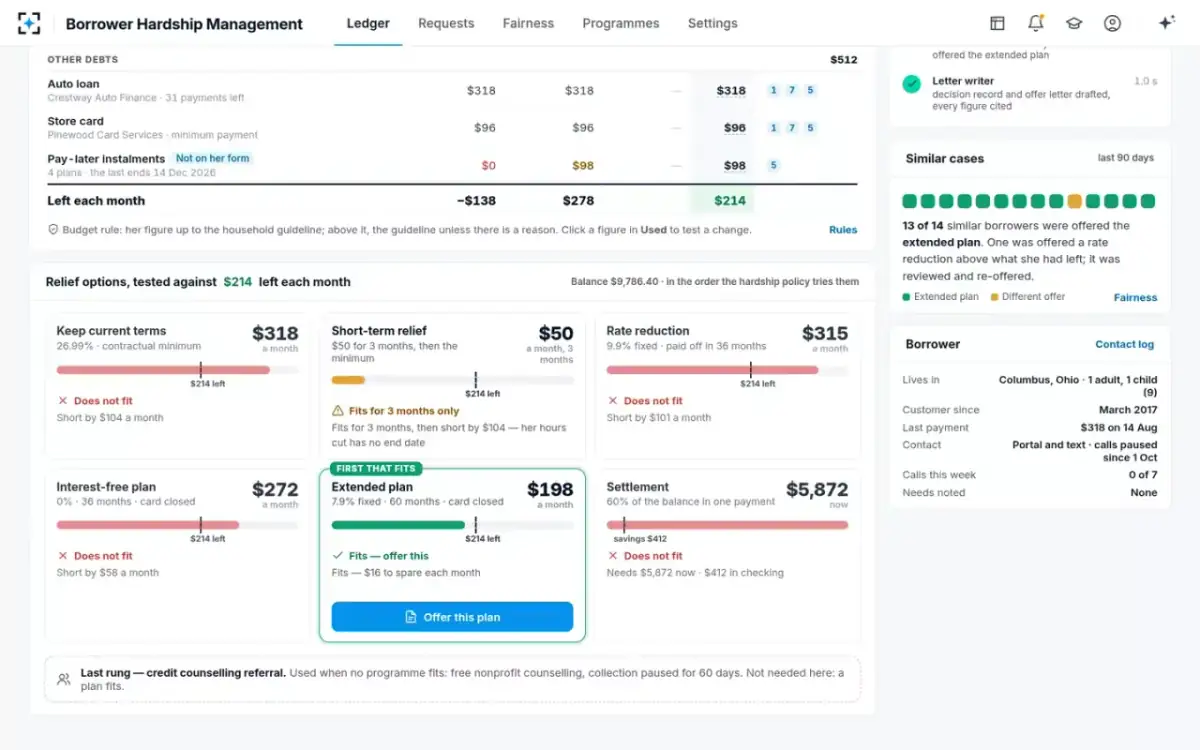
What a borrower sees of all this is nothing, and that is as it should be: the arrangement and its reporting are two readings of one decision. What the borrower does see is the offer letter and what it says about the card and the credit file, which is covered in what a lender must report for a hardship plan.
Questions people ask
Is troubled debt restructuring still used?
Not as a creditor-side accounting designation. The subtopic that carried it is marked superseded following the adoption of ASC Topic 326 by all entities, and readers are directed to the loan modifications subtopic instead. The term survives in conversation and in the title of the standard that replaced it, ASU 2022-02, "Financial Instruments – Credit Losses (Topic 326): Troubled Debt Restructurings and Vintage Disclosures", which is one reason people still search for it.
What counts as a modification to a borrower experiencing financial difficulty?
Two things have to be true together. The borrower is experiencing financial difficulty, judged against a non-exhaustive list of six factors. And the terms of the loan were modified in the form of principal forgiveness, an interest rate reduction, an other-than-insignificant payment delay, or a term extension — or a combination of them. Neither limb is sufficient on its own.
Does a rate reduction have to be reported?
Where the borrower is experiencing financial difficulty, yes. The guidance works it through on a commercial loan whose rate was cut from prime plus two to prime in exchange for stronger guarantees, and answers yes even though the bank improved its position: the borrower could not have obtained similar financing elsewhere at that rate, and a rate reduction is one of the four named forms. What the lender received in return does not change the answer.
Does waiting until maturity avoid the reporting?
No. Simply delaying a modification until the original maturity date or later does not exempt it, because modifications may occur before, at or after the stated maturity, and time may elapse between the original agreement's end date and the effective date of the modified terms. A renewal at maturity on concessionary terms to a borrower who cannot refinance elsewhere is reportable on the same test as a mid-term modification.
What does a payment delay mean in practice?
It means a change that postpones payments, and whether it is reportable turns on the word "other-than-insignificant". A short term is not by itself a reason to call a delay insignificant. The factors to weigh together are whether the delayed amount is insignificant against the unpaid principal or collateral value and produces an insignificant shortfall, and whether the delay in timing is insignificant against the payment frequency, the original maturity or the original expected duration — and modifications in the previous twelve months must be considered cumulatively.
Can a loan that is not past due be reported as a modification?
Yes. A borrower may be contractually current when the bank modifies the loan, and the modification is still reported if it meets the disclosure requirements. This matters for hardship programs that encourage borrowers to come forward early, because a process that only examines delinquent accounts will systematically miss the modifications it most wanted to encourage.