Underwriting leakage is the premium a policy should carry under the insurer's own filed rating plan but does not, because something material was missing or wrong at underwriting and was never caught. In homeowners insurance it comes from four places: liability features left off the application (a pool, a trampoline), insured value nobody recorded (a solar array, a new outbuilding), a roof older than stated, and conditions the manual acts on but no one saw. It recurs at every renewal until someone looks, and it is also a rating error an examiner can cite. The mirror image costs more per file: an aerial image misread as a worn roof or a pool, followed by a surcharge or a nonrenewal the insurer must then defend. Botminds' Aerial Imagery Verification addresses both at the referral: agents set the application against dated captures, the inspection and permits, price every difference from the manual, and refuse to let a single image carry an adverse action.
The figures below come from a fictional sample file in the solution, priced from the manual of an invented carrier, Norland Mutual, and from the solution's own time estimates. None is a market average or a customer's result; no regulator or academic source we found publishes how common undisclosed features are in homeowners books, which is why the measurement method matters more than any benchmark.
One referral, before and after every line is priced
+$488
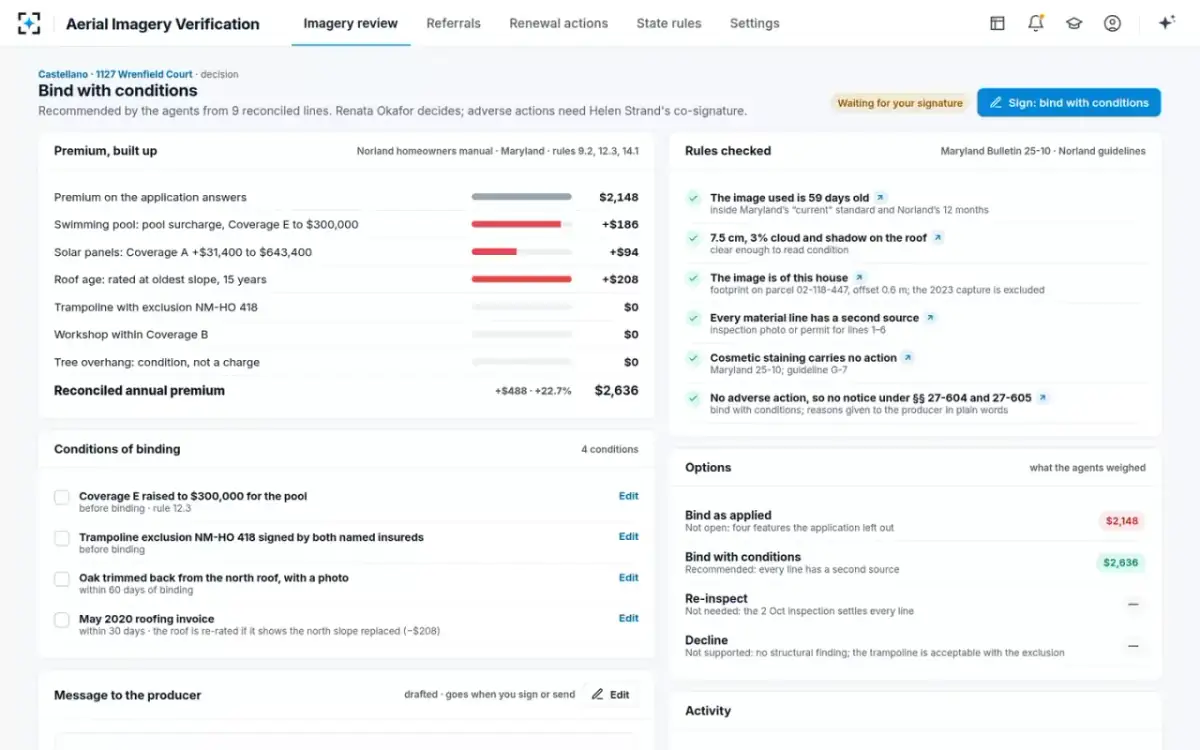
a year short on the application’s answers: $2,148 against $2,636
+22.7%
on the premium the application implied
6of 9
checkable attributes on the application that disagreed with the evidence
0
adverse actions resting on one image: the solution’s design target
What is underwriting leakage in homeowners insurance?
It is the gap between the premium and terms the rating plan prescribes for the risk as it really is, and the premium and terms the policy carries. The gap is invisible in a loss ratio until a claim lands on the undisclosed feature, and invisible in a rate review because the rating plan itself is right; it is the inputs that are wrong.
For a regulated line it is also a compliance finding. Market conduct examiners sample policies and test each one's rating and whether its file supports the decision (NAIC Market Regulation Handbook, Chapter 21; the standards are set out below). A policy rated without its pool is rated on facts its file does not support, which an examiner can cite whichever way the error runs. Whether the omission also lets the carrier deny a claim or rescind is a separate legal test, set out in material misrepresentation in insurance.
Where homeowners leakage comes from: the sample file, line by line
On the sample file four of six mismatches would have changed the premium or the limits, and the largest line was the roof, not a backyard feature. The applicants were not careless: they gave the year half their roof was replaced.
What each mismatch on one application was worth a year
Each priced line leaks for a different reason. The pool adds a liability hazard and, under rule 12.3, a minimum personal liability limit of $300,000 against the $100,000 applied for. The solar array adds $31,400 of rebuilding cost the dwelling limit did not carry, which is an underinsurance problem at the next roof claim as much as a premium problem today. The roof changes the expected loss on the dwelling itself. The roof line is also the one the insured can reverse: a condition asks for the May 2020 invoice within 30 days, and if it shows the north slope replaced, the $208 comes off.
How much does an undisclosed pool cost a homeowners insurer?
In premium, whatever the manual's surcharge and limit rule say: $186 a year on the sample file. In exposure, more, because a pool adds a bodily injury exposure that can run past the policy's liability limit. The CDC states that "more children ages 1–4 die from drowning than any other cause of death," estimates about 4,000 fatal unintentional drownings and 8,000 nonfatal drownings in the United States each year (CDC, Drowning Facts), and notes that "most drownings happen in home swimming pools among children ages 1–4" (CDC, Risk Factors for Drowning).
Some manuals respond by raising the liability limit, not just the premium, when a pool appears: the sample manual's rule 12.3 moves Coverage E from $100,000 to a $300,000 minimum. An undisclosed pool therefore leaves two gaps. The carrier collects $186 less than its filed rate, and the policyholder carries a third of the liability limit the carrier's own rules say the risk needs. The second gap is the one that turns into a dispute, because it surfaces only after a claim larger than the limit.
The pool also brings conditions the manual may act on and an image can only partly show: whether a fence or barrier encloses it (the CDC reports that a fence fully isolating the pool from the house and yard "reduces a child's risk of drowning by 83%" against three-sided property-line fencing), whether a diving board or slide is present, and whether the pool is in use or filled in. A sound rule, and the one the checklist below sets, is that an image raises the question and a second source, an inspection photo or a dated capture from another season, answers it. The filled-in Connecticut pool in the refunds term below was settled that way.
Why a trampoline leaks coverage, not premium
Many manuals do not price trampolines; they exclude them or decline them, so an undisclosed trampoline leaks exposure the carrier never agreed to carry rather than premium. On the sample file the trampoline adds $0 and cannot be bound until both named insureds sign exclusion NM-HO 418 or remove it before the start date.
The reason carriers prefer an exclusion is the injury record. The American Academy of Pediatrics' policy statement found that "Most trampoline injuries occur with multiple simultaneous users on the mat", that safety measures "have not appeared to mitigate risk substantially", and concluded that "the home use of trampolines is strongly discouraged" (AAP policy statement, 2012). A surcharge prices an exposure; an exclusion removes it. An undisclosed trampoline on an unendorsed policy is the carrier carrying a risk its own guidelines refuse, which no premium correction fixes after the injury.
How much underwriting leakage is in a homeowners book?
Nobody can answer that for your book but you: we found no regulator or academic estimate of how often homeowners applications omit rated features, so the figure has to be measured, not borrowed. The arithmetic is simple once three inputs are known, and only one of them is hard.
Annual underwriting leakage is three measured inputs multiplied
Policies in force
N
The homeowners book, by state and form; leakage differs by housing stock.
Policy admin
Share with a priced mismatch
p
Measured on a random sample of in-force policies, reconciled against current imagery, inspection and permits.
Underwriting quality
Average shortfall per mismatched policy
s
Premium short of the filed rate, from the manual, on the same sample. $488 on the sample file.
Pricing
Less refunds owed the other way
− r
Features removed but still charged; on the sample carrier, a pool filled in during 2025 came off at −$164.
Pricing
The share p is the hard input, and a modest sample measures it well enough to act on. A simple random sample of 400 in-force policies estimates a share to within about ±4.9 percentage points at 95% confidence in the worst case (1.96 × √(0.25 ÷ 400)); 1,000 policies narrows that to about ±3.1. Reconciling each sampled policy the way the sample file was reconciled gives p and s together. Replaying last quarter's inspected referrals, the method in testing an aerial imagery underwriting tool, measures the same thing on files whose answers are already known.
The refunds term is not decoration. Features come off houses as well as on: the sample carrier's Connecticut renewal with a pool filled in during 2025 was still carrying the surcharge until the inspection confirmed it. A leakage programme that only ever raises premiums will be read by regulators, and by agents, as a surcharge programme.
What market conduct examiners test in a homeowners underwriting file
Rating accuracy and file support, sampled policy by policy. The property and casualty chapter of the NAIC Market Regulation Handbook includes a standard that "application or enrollment forms are properly, accurately and fully completed, including any required signatures, and file documentation adequately supports decisions made," and tells examiners to "determine that the underwriting file contains necessary information to tell the regulated entity what exposure it has" and to "determine when and under what conditions the regulated entity requires a physical inspection ... or other underwriting information to confirm exposure or premium basis" (NAIC Handbook, Chapter 21, 2021). A separate standard covers "the proper application of rating factors."
The same standard carries a step that leakage programmes often miss. Examiners are to "verify that when a policy is issued on a basis other than applied for, that notice of an adverse underwriting decision is provided in accordance with applicable state statutes and regulations." The sample file is a case in point: it binds at $2,636 instead of the $2,148 the application implied, with a higher liability limit and a trampoline exclusion. Whether that is an adverse underwriting decision needing notice depends on the state's statute, and the referral should answer the question before binding, not after the examiner samples the file.
For a carrier, that means a leakage correction produces three pieces of evidence, not one: the rule in the filed manual that prices the line, the two sources that establish the feature, and the notice, if the state requires it, with the date it went to the applicant and the agent. Files with all three survive a rating sample; files with only the corrected premium invite the question of why the policy changed.
The other leak: adverse actions on misread images
The opposite error, an image read as a condition or feature that is not there, costs more per file because the insurer must defend it. Colorado's 2026 bulletin lists what counts as an adverse action supported by imagery: "underwriting or eligibility determinations, tier placement or rating impacts, coverage limitations or restrictions, nonrenewals, cancellations, and claim denials or reductions" (Colorado Bulletin B-5.57). An August 2026 draft revision proposes to remove rating from that scope; until it is adopted, the March text stands (Colorado request for comment).
The burden sits with the insurer. Pennsylvania reminds insurers that "An insurer must prove not only that the risk has increased but that the increase has been substantial" (Pennsylvania Notice 2024-06). Maryland gives an insured who requests a hearing the right to review the images and other material the insurer relied on, with the insurer bearing the burden of persuasion (Maryland Bulletin 25-10). Maine says that where a change in insurability is the reason for a nonrenewal, "recent evidence will be required to meet this burden of proof. Older imagery will often not be sufficient" (Maine Bulletin 483).
The volume of actions to defend is rising. Insurers reported 2,019,799 company-initiated homeowners nonrenewals nationwide in 2024, 19.6 per 1,000 policies, against 1,255,975 (12.2 per 1,000) in 2023 (NAIC market conduct annual statement data, 2026 report). Not every nonrenewal rests on imagery, but every one that does is a file a regulator can ask for.
Two leaks with one cause: nobody lined the sources up
Feature missed: A pool, trampoline, array or older roof is left off the rating.
Image misread: Streaks, shadows or a neighbour’s roof are read as a condition.
Feature missed: The insurer: premium short of the filed rate, every renewal.
Image misread: The policyholder: a surcharge or a lost policy; then the insurer, at a hearing.
Feature missed: At renewal if someone looks; after a loss if nobody does.
Image misread: When the policyholder disputes, complains or requests a hearing.
Feature missed: Rate not in accordance with the filed plan.
Image misread: Adverse action without adequate support; notice and reason defects.
Feature missed: Four features and a roof slope: +$488 a year on one file.
Image misread: 38 imagery-based actions proposed this quarter; 9 held because one image carried them, 6 changed to renew.
Who finds the mismatch, and what it costs at each stage?
The same mismatch gets more expensive at each stage it survives. Found at the referral it costs one message to the agency; found after a loss it becomes a coverage question while a claim is open.
The same undisclosed feature, priced by who finds it
| Stage | Who finds it | What it costs |
|---|---|---|
| At the referral | Homeowners underwriter | One message to the agency and the right premium from day one: four questions, four conditions, $2,636 instead of $2,148 on the sample file. |
| At the first renewal | Renewal underwriter | A year of premium short ($488 on the sample file), a mid-term conversation with an insured who thought the price was settled, and a rating error already on the books. |
| After a loss | Claims and coverage counsel | The undisclosed feature becomes a materiality question during an open claim, decided against the statutory test of the state. |
| At a hearing | Underwriting manager and counsel | An adverse action on a misread image, defended with the insurer carrying the burden and the policyholder entitled to see the images. |
Leakage closed at the referral: the premium rebuilt from the manual
Is reconciling every referral worth the underwriter's time?
Only if it is fast, which is why it is usually skipped. Botminds estimates an imagery referral takes about 70 minutes by hand and puts the design target with agents doing the reading at about 11, of which 3 are the underwriter deciding and signing. Both figures are Botminds' estimates for the solution's design, not measured results.
Where 70 minutes of a referral go, and the 11 that remain
- Application and file10
- Find, match and measure captures20
- Inspection report and photos15
- Permits and property data8
- Price and write to the agency12
- Decide and sign5
- Application and file1
- Captures2
- Inspection2
- Permits1
- Price and write2
- Decide and sign3
Set that against the leakage formula. If reconciliation finds a shortfall of s on a share p of referrals, each referral reviewed is worth p × s a year for every year the policy renews, against about 11 minutes of underwriter time on the estimate. The break-even depends entirely on p, which is why the sample measurement comes before the business case, not after.
Running a leakage programme without a surcharge reputation
A leakage programme survives regulators and agents when it corrects in both directions, never acts on one source, and lets the insured reverse a finding with a document. The sample carrier's renewal book shows the pattern: of 38 imagery-based actions proposed this quarter, 9 were held because one image carried them, 6 were changed to renew because the finding was cosmetic, and 3 disputes were waiting on an inspection.
Controls for a homeowners leakage programme
- Price only what the filed manual prices
Every correction cites a rule; a feature the manual ignores is not leakage.
- Two sources before any surcharge or adverse action
A second capture, an inspection photo or a permit; one image is a question to the agency.
- Cosmetic stays cosmetic
Streaks and algae on intact shingles carry no charge and no action.
- Give every finding a way back
An invoice, a photo or a re-inspection that reverses the line, with a deadline.
- Refund removed features as readily as you charge added ones
Report the count of downward corrections with the upward ones.
- Measure p and s every quarter, by state
On a random sample of in-force policies, not on referrals already flagged.
- Report reversals as a quality measure
Actions held or changed after review show whether the reading is reliable.
How the inspector documents the features that drive these lines is in what home insurance inspectors look for; Florida's separate legal limits on roof age are in Florida's 15-year roof rule. The full referral is on the Aerial Imagery Verification page.
Questions people ask
What is the difference between underwriting leakage and claims leakage?
Claims leakage is money paid out that should not have been, through overpayment or missed recovery; underwriting leakage is premium never collected because the risk was rated on wrong inputs. On the sample file the underwriting leak was $488 a year in premium short of the filed rate, with no claim involved.
Do homeowners carriers surcharge trampolines?
Some do; many exclude or decline them instead, as the sample carrier does with exclusion NM-HO 418. The carrier's filed manual decides, and an undisclosed trampoline on an unendorsed policy leaks exposure rather than premium.
How large a sample measures leakage reliably?
A simple random sample of 400 in-force policies estimates the share with a priced mismatch to within about ±4.9 percentage points at 95% confidence in the worst case; 1,000 policies narrows it to about ±3.1. Stratify by state if housing stock and rules differ.
Can leakage found mid-term be corrected immediately?
Usually at renewal, with notice; mid-term cancellation is limited by statute in many states once a policy has been in force for a set period. In Florida a residential policy in force more than 60 days may be cancelled only for listed reasons, a material misstatement among them.
Does solar on the roof count as leakage?
If the array is owned and the dwelling limit does not include it, yes: on the sample file it added $31,400 to Coverage A and $94 a year. If it is leased, it may belong to the leasing company, which is why the underwriter asks who owns it before re-rating.
How old can the imagery be for a leakage review?
Colorado expects imagery used for general underwriting and rating to be no more than 12 months old, and Louisiana bars relying solely on images more than 24 months old for the condition behind a cancellation or nonrenewal. The sample carrier lets no capture older than 12 months support an adverse action.