Aerial imagery is up to date enough for an underwriting action when three things hold on the day of the decision: the capture date falls inside the age limit for that use in the state where the house sits, the capture shows the insured parcel rather than the one next door, and it is sharp and unobstructed enough for the finding being made. The limits differ by use. Louisiana's statute bars relying solely on aerial images more than 24 months old to identify the condition behind a homeowners cancellation or nonrenewal; Colorado expects imagery for general underwriting and rating to be no more than 12 months old; Maine, Tennessee, West Virginia and Maryland say older imagery alone will often not carry the insurer's burden. The check is mechanical, which is why it is so often skipped: a capture date read from tile metadata, an address geocoded to the nearest roof. Botminds' Aerial Imagery Verification, built for homeowners underwriters, runs it on every capture before any feature or condition is read from it, and holds any adverse action that rests on one image.
This page is for the people who set and defend imagery rules inside a carrier: the homeowners underwriting manager who writes the guideline, the compliance officer who files it, and the underwriter who signs. The worked example is a fictional sample file in the solution, with invented people and figures. It is not legal advice; the state of the risk decides.
Four numbers that frame image age in homeowners underwriting
24months
Louisiana: oldest image an insurer may rely on alone for the condition behind a cancellation or nonrenewal
12months
Colorado: oldest imagery expected for general underwriting and rating
18+months
age of some images in homeowners’ complaints recorded by Maine
31m
how far off the parcel one sample capture sat: the house next door
How old can aerial imagery be for an underwriting decision?
It depends on the use and the state: no age limit for finding the house in Louisiana, 12 months for general underwriting and rating in Colorado, 24 months by statute in Louisiana for an image relied on alone to show the condition behind a termination, and "recent" or "current" without a number in several other states. Louisiana's text is the only statute among them: an insurer "shall not solely rely upon aerial images of an insured property to identify the specific condition that serves as the insurer's basis for cancellation or nonrenewal of a policy of homeowners' insurance unless the images are taken within twenty-four months of the date of the cancellation or nonrenewal of the policy" (La. R.S. 22:1339).
What the state rules say about image age, by use
| State | Rule | What it says about age |
|---|---|---|
| Louisiana | R.S. 22:1339 (statute, 2024) | 24 months for an image relied on alone to identify the condition behind a cancellation or nonrenewal; no age limit for identifying and locating the property |
| Colorado | Bulletin B-5.57 (March 2026) | No more than 12 months for general underwriting and rating; for claims, recent enough to capture post-loss conditions |
| Colorado, draft | Revised B-5.57 (comment closed 1 Sep 2026) | Proposes 18 months and removing rating from scope; not in force |
| Maine | Bulletin 483 (March 2025) | Complaints of images more than 18 months old; recent evidence required where insurability is the reason |
| Tennessee | Bulletin 25-03 (October 2025) | Older imagery standing alone unreliable for a claim denial, cancellation or nonrenewal |
| West Virginia | Bulletin 25-02 (April 2025) | Older imagery standing alone will often not meet the insurer’s burden |
| Maryland | Bulletin 25-10 (June 2025) | Only a clear, accurate and current view may support cancellation, nonrenewal or claim denial |
The non-numeric rules bite as hard as the numbers. Tennessee: "Older aerial imagery standing alone is unreliable and unlikely to provide a sufficient basis on which to deny a claim or cancel or nonrenew a policy" (Tennessee Bulletin 25-03). Maryland lets imagery support cancellation, nonrenewal or claim denial "only if the image provides a clear, accurate, and current view of the property" (Maryland Bulletin 25-10). A carrier writing in several states needs one internal limit at or below the strictest that applies to each use; the full comparison is in aerial imagery laws by state.
Which date counts: the capture, the delivery or the decision?
The capture date, measured against the date of the decision, and for a termination in Louisiana against the date of the cancellation or nonrenewal itself. The date a vendor delivered a tile, or the date the carrier licensed a library, says nothing about the roof. Colorado asks insurers to weigh "capture date relative to the relevant event or condition" (Colorado Bulletin B-5.57), which is the right frame: a capture taken before a hailstorm says nothing about hail damage, however recent it is.
On the sample file an underwriter decided on 12 October 2026 with three captures on file. Aged on that day, only one was recent enough to carry a finding by itself.
Three captures of one sample address, aged on the day of the decision
- 59 d
- Within 12 months12 mo
- 12 to 24 months+6 mo
- Within 12 months12 mo
- 12 to 24 months12 mo
- Beyond 24 months+16 mo
The newest capture, 59 days old at 7.5 cm, carries the findings. The April 2025 capture, 18 months old, shows the pool and the two roof tones and is used only to corroborate: on the sample carrier no image over 12 months may support an adverse action. The June 2023 capture fails both numeric limits, but its age is the lesser problem.
Up to date is not enough: resolution, cover and the right parcel
A current image can still be unusable. Colorado lists what an insurer should weigh together: "spatial resolution, orthorectification method and quality, elevation modeling, capture date relative to the relevant event or condition, and surface-only limitations of aerial imagery", and warns that imagery "sufficient for parcel-level identification or community risk assessment may not be sufficient to support decisions on property conditions or claims handling" (Colorado Bulletin B-5.57). Delaware names "image distortion, weather interference, and the inability to capture fine details" as inherent limitations (Delaware Bulletin No. 150).
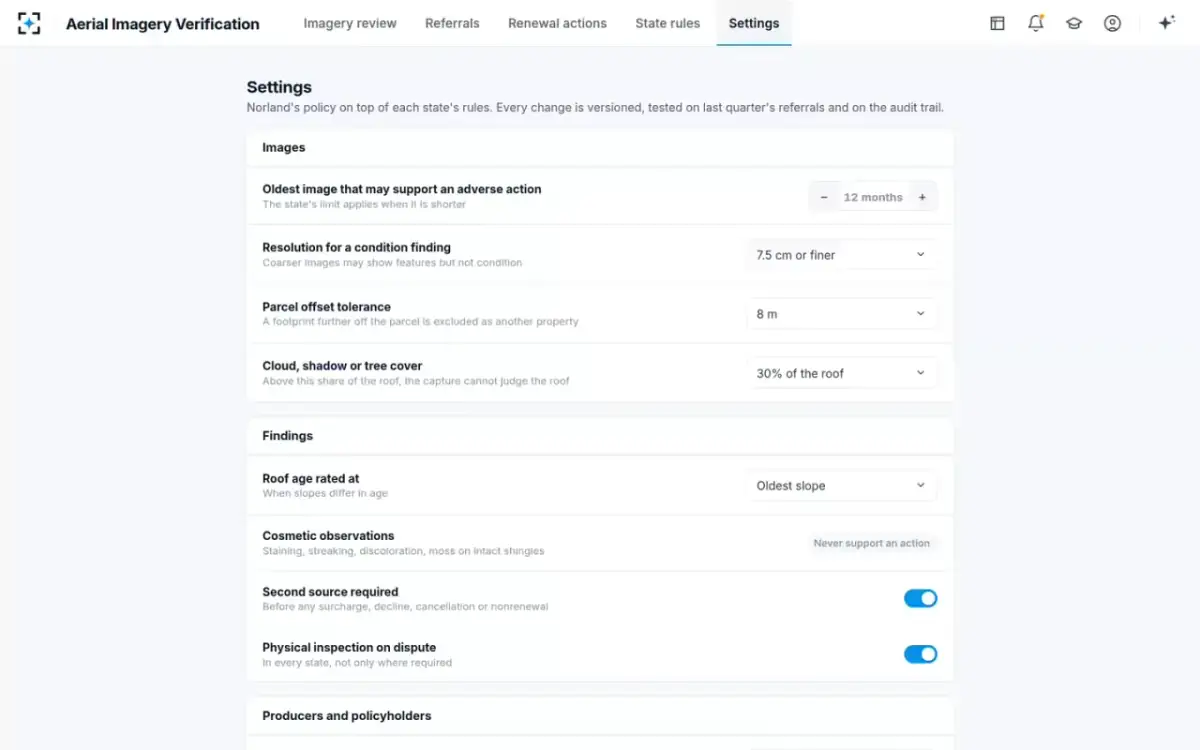
No regulator we read sets a resolution number, so the carrier must, and write it into its guidelines. The sample carrier reads a roof condition only from captures of 7.5 cm or finer, judges nothing about a roof where cloud, shadow or tree cover exceeds 30% of it, and excludes any capture whose footprint sits more than 8 metres from the parcel. Those are settings, chosen by the carrier; on its referral list a Maryland new-business file with cloud over 41% of the roof goes to re-inspection rather than to a reading.
The fitness checks as guideline settings, each with its default
The wrong-house problem is a measurement, not a judgement
A capture of the wrong house usually comes from locating imagery by address rather than by parcel: the geocode lands near the right lot and the nearest roof is read. Maine lists "the image shows the wrong structure or property" among homeowners' complaints (Maine Bulletin 483), and Tennessee and West Virginia both name imagery that shows "the wrong structure or property" as a misuse (Tennessee, West Virginia).
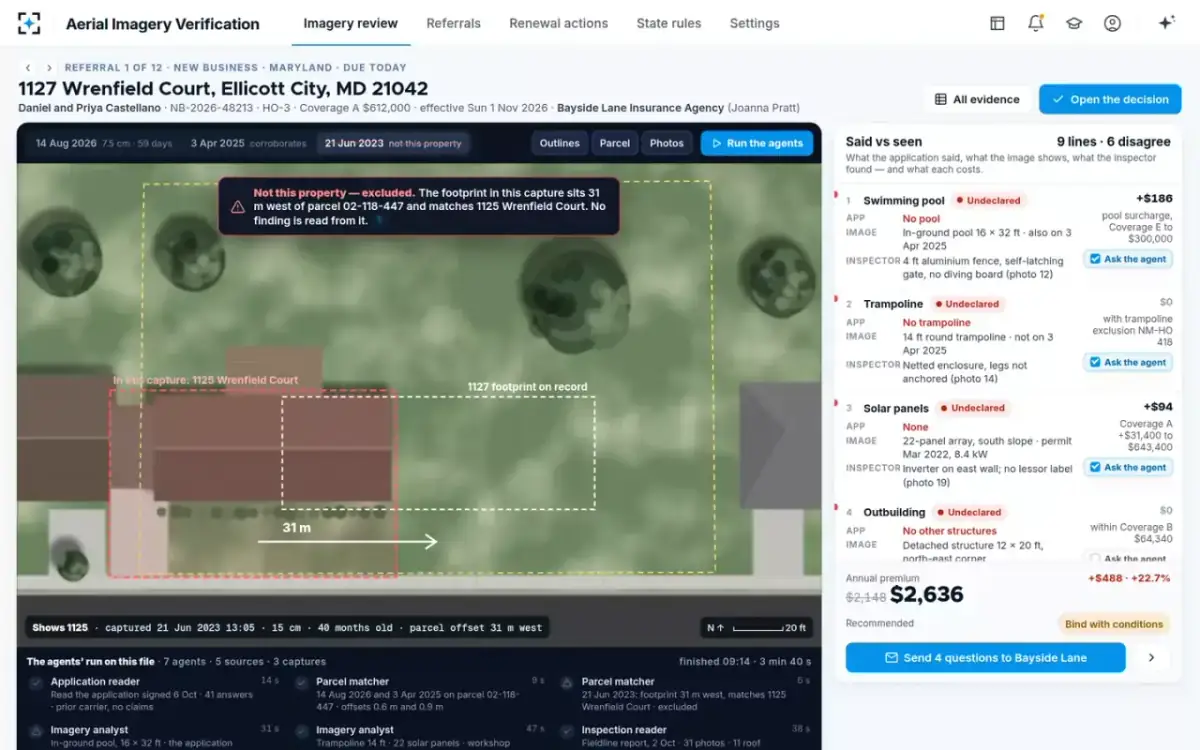
The check is an offset in metres. Place the building footprint seen in the capture on the insured parcel's boundary and measure; past the tolerance, the capture is of somewhere else. On the sample file the June 2023 footprint sits 31 metres west of parcel 02-118-447 and matches 1125 Wrenfield Court. Had it been read, the roof would have been dated from the neighbour's gable roof and the pool would not have existed in 2023, which is the kind of contradiction that ends up in a misrepresentation allegation (the materiality side is in material misrepresentation in insurance).
An old capture of the house next door, excluded before it is read
What can an out-of-date capture still be used for?
Finding the house, dating a change, and corroborating a newer source. Louisiana says so in terms: images "utilized solely for the purpose of identification and location of the immovable property and any improvements to the immovable property may be used without a limitation on the age of the photograph" (La. R.S. 22:1339). An old capture can show where the pool is and roughly when it appeared; it cannot, alone, show what the roof is like today.
The sample carrier's rule follows that split. A capture older than 12 months may back up a finding from a newer source, as the April 2025 capture backs up the pool on the August 2026 one, but it never carries an action alone. Old captures are also how a carrier dates a change: a pool absent in one capture and present in the next narrows when it was built, which matters at renewal when the question is whether a feature was there at the last inspection.
How should a carrier set its image-age limit?
By use, at or below the strictest rule that applies in each state, and in the filed guidelines rather than in an analyst's habits. Connecticut expects imagery guardrails to "be set forth in each insurer's filed underwriting guidelines if aerial imagery is used" (Connecticut notice, 2024), and Colorado expects adverse actions from imagery tools to be "consistent with the insurer's filed underwriting criteria and rate filings" (Colorado Bulletin B-5.57).
One carrier guideline, four uses, four limits
| Use of the image | A defensible internal limit | Why |
|---|---|---|
| Locate the property and its improvements | No age limit | Louisiana exempts identification and location from its age rule |
| Show a feature exists (pool, array, outbuilding) for rating | 12 months, plus a second source before any surcharge | Colorado’s expectation for general underwriting and rating |
| Show a roof or property condition for an adverse action | 12 months, a resolution floor, and a second source | Inside Louisiana’s 24 months and Colorado’s 12; Maine, Tennessee, West Virginia and Maryland expect recent or current imagery |
| Corroborate a newer source | Older captures allowed | The action rests on the newer source; the older one dates or confirms it |
Colorado's August 2026 draft would "extend aerial imagery to eighteen (18) months" and remove rating from scope; comments closed on 1 September 2026, and until a revised bulletin is issued the 12-month expectation stands (Colorado request for comment). A guideline that hard-codes one number across states will be wrong somewhere within a year; one that stores the limit per state and per use changes with a setting.
What should happen when the only imagery is too old?
Get a better source before acting: a new capture, an inspection, or the policyholder's own evidence. Maryland says that where imagery flags a possible problem "without unequivocally establishing the existence of the problem", the insurer should investigate further, for example by "obtaining more reliable images or inspecting the property by alternative means" (Maryland Bulletin 25-10). Pennsylvania calls a physical inspection "prudent" where unequivocal material damage is not shown (Pennsylvania Notice 2024-06), and Delaware recommends one whenever a customer disputes an imagery finding (Delaware Bulletin No. 150).
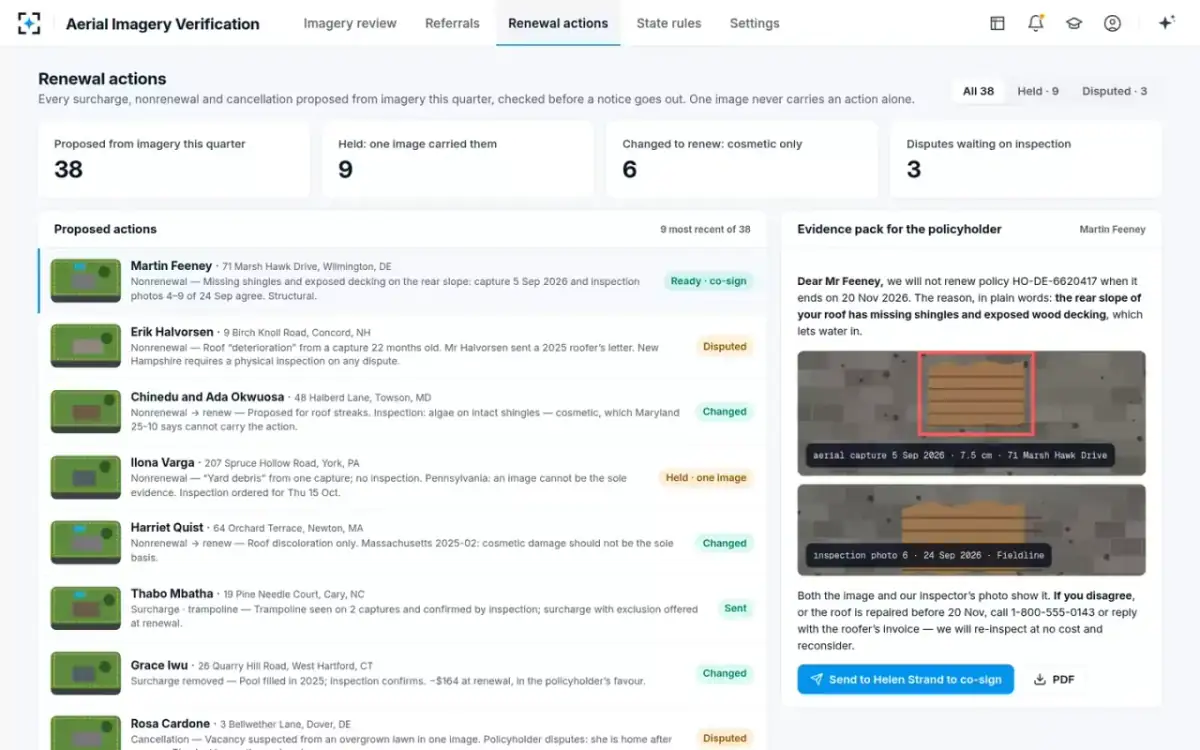
On the sample carrier's renewal list this quarter, a Pennsylvania nonrenewal for yard debris seen on one capture was held and an inspection ordered, and a renewal disputed with a 2025 roofer's letter against a capture 22 months old waits on a physical inspection. Of 38 imagery-based actions proposed, 9 were held because one image carried them.
Every imagery-based action, aged and sourced before a notice goes
What the file must show a regulator or a hearing officer
The capture date and parcel match of every image relied on, the second source, and proof the policyholder was told. Maine explains why the last item matters:
In some instances, insurers have not informed homeowners that a nonrenewal action is being taken based upon aerial imagery, and homeowners do not learn that aerial imagery has been used until shortly before the date of a hearing.
Maine Bureau of Insurance, Bulletin 483, 19 March 2025
Maine, Tennessee and West Virginia describe the same best practice: tell the homeowner before acting that the action rests on aerial imagery, provide copies of the images, and let the homeowner give updated information or dispute them. Tennessee adds that "Many consumer complaints are based on a lack of communication" (Tennessee Bulletin 25-03). An image whose date the carrier cannot state is an image it cannot send.
What an imagery-based action's file should hold
- The capture date of every image relied on
From the capture itself, aged against the decision date and the state’s limit for that use.
- The parcel offset of every capture
Measured, with any capture past tolerance marked excluded and unread.
- Resolution and cover for any condition finding
Against the carrier’s written floor; a finding from a coarser or obscured capture is a question, not a fact.
- A second, independent source
An inspection photo, a newer capture, a permit or a professional report.
- The cosmetic-or-condition call
Streaks and discoloration alone do not support the action in Connecticut, Pennsylvania or Delaware.
- Notice, copies and the way to dispute
What was sent, when, with which images and their dates.
Who decides and signs at each step is set out in insurance companies using drones to cancel coverage. The full referral is on the Aerial Imagery Verification page.
Questions people ask
How old can aerial imagery be for a homeowners nonrenewal in Louisiana?
No more than 24 months, measured to the date of the cancellation or nonrenewal, if the insurer relies on the image alone to identify the condition behind the action. Images used only to identify and locate the property and its improvements have no age limit under R.S. 22:1339.
Does Colorado's 12-month expectation apply to claims?
No; the 12 months is for general underwriting and rating. For claim determinations, Colorado's bulletin says imagery "should be recent enough to capture post-loss conditions", which ties the date to the loss rather than to a fixed age.
Will Colorado extend its imagery limit to 18 months?
A draft revision published on 18 August 2026 proposes 18 months, removing rating from the bulletin's scope and accepting customer-provided photos as additional verification. Comments closed on 1 September 2026; until a revised bulletin is issued, the March 2026 text applies.
What resolution is needed to judge a roof's condition from the air?
No regulator we read sets a number; Colorado says imagery good enough to identify a parcel may not be good enough to judge a condition. The sample carrier's floor is 7.5 cm or finer for any condition finding, a setting a carrier chooses and files with its guidelines.
Can a newer image make an older one usable again?
An older capture can corroborate a finding from a newer source, as an 18-month capture confirms a pool seen on a 59-day one on the sample file. The action then rests on the newer image and the second source; the older capture dates or confirms the change.
How do underwriters know an aerial image shows the right house?
By measuring the offset between the building footprint in the capture and the insured parcel's boundary, not by trusting the address. On the sample file a capture 31 metres off the parcel matched the neighbour's house and was excluded against an 8-metre tolerance.