A material misrepresentation in insurance is a false or incomplete answer that would have changed the insurer's decision had the truth been known: whether to accept the risk, at what premium, for what amount, or with cover for the hazard that caused a loss. Florida writes all four into its statute; New York asks a narrower question, whether the truth would have led the insurer to refuse the contract, and lets the insurer's practice on similar risks prove it. For a homeowners carrier the practical consequence is the same in both states: materiality is proved with the filed rating manual and underwriting guidelines, and with evidence that the undisclosed pool, trampoline, solar array or older roof is really there. That evidence is hardest to assemble after a loss, when the question is whether the policy responds. Botminds' Aerial Imagery Verification assembles it at the referral instead: agents set every application answer against dated aerial captures matched to the parcel, the exterior inspection and permits, price each difference from the manual, and leave the decision to the underwriter.
This page is written for the people who carry the question inside an insurer: the homeowners underwriting manager who owns the guidelines, the compliance officer who answers the examiner, and the counsel who defends a rescission. The worked example is a fictional sample file in the solution, with invented people, carrier and figures; the statutes and bulletins are quoted from the states' own sites. It is not legal advice.
Two statutory tests for the same omitted pool
Florida §627.409: Was the statement fraudulent, or material to acceptance of the risk or the hazard assumed? Or would the insurer in good faith not have issued it, not at that premium, not in that amount, or not covering that hazard?
New York §3105: Would knowledge of the true facts have led the insurer to refuse to make the contract?
Florida §627.409: Not required: fraud is one route, materiality is another.
New York §3105: Not required for property policies; the statute requires it only for hospital, medical, surgical and prescription drug policies.
Florida §627.409: The insurer shows what its own requirements would have done with the truth.
New York §3105: Evidence of the insurer’s practice on similar risks is admissible on materiality.
Florida §627.409: Meets the premium limb on its face: a higher rate or a higher limit.
New York §3105: Turns on how the courts read “refusal to make such contract”; counsel decides.
What makes a misrepresentation material? Two statutory tests
A misrepresentation is material when it touches the insurer's decision, and the states draw that line in different places. Florida treats every application statement as "a representation and not a warranty", and lets a misrepresentation, omission, concealment or incorrect statement prevent recovery only if it is "fraudulent or is material to the acceptance of the risk or to the hazard assumed by the insurer", or if, had the true facts been known, "the insurer in good faith would not have issued the policy or contract, would not have issued it at the same premium rate, would not have issued a policy or contract in as large an amount, or would not have provided coverage with respect to the hazard resulting in the loss" (Fla. Stat. §627.409).
New York's statute is shorter and stricter on the insurer: "No misrepresentation shall be deemed material unless knowledge by the insurer of the facts misrepresented would have led to a refusal by the insurer to make such contract" (N.Y. Ins. Law §3105(b)(1)). The same section defines a representation as a statement of past or present fact made "at or before the making of the insurance contract as an inducement to the making thereof", so a feature added after binding is a renewal question, not a misrepresentation.
The gap between the two matters most for the features a homeowners manual prices rather than declines. A pool that would have cost $186 more a year plainly meets Florida's premium limb. Whether it amounts to a refusal to make "such contract" in New York is a question for counsel in that state, and a carrier writing both should not assume one answer travels.
Which homeowners application answers carry materiality?
The answers that carry materiality are the ones the filed manual acts on: features that add a liability hazard, add insured value, change the expected loss on the dwelling, or make the risk ineligible. An answer the manual ignores cannot change the premium, the limit or the acceptance decision, so it fails both tests however wrong it is. The sample application on this page asked 41 questions; nine attributes on it could be checked against outside evidence, and six of the nine were wrong.
Six wrong answers on one sample application, and what the manual does with each
| Attribute | Application said | Evidence showed | What the manual does | Premium or limit effect |
|---|---|---|---|---|
| Swimming pool | No pool | In-ground pool, 16 × 32 ft, fenced, on two captures, inspection photo 12 and a 2019 permit | Rule 12.3: surcharge and personal liability of at least $300,000 | +$186 a year; Coverage E from $100,000 to $300,000 |
| Trampoline | None | 14 ft trampoline, netted, legs not anchored (photo 14) | Exclusion NM-HO 418 signed by both named insureds, or removal | $0; coverage changes, not price |
| Solar panels | None | 22-panel array, permitted March 2022 | Dwelling limit raised to cover rebuilding the array | +$94; Coverage A +$31,400 |
| Roof age | Replaced 2020 | South slope 2020; north slope from 2011 | Rated at the oldest slope, 15 years | +$208 |
| Outbuilding | No other structures | 12 × 20 ft workshop with its own electric service | Within the other-structures limit | $0 |
| Tree overhang | No trees within 10 ft | Oak canopy over 28% of the north slope | Condition: trim within 60 days | $0 |
Read with Florida's four limbs, three of the six are material on premium (pool, solar, roof), one on the hazard covered (the trampoline, which the carrier will not cover without an exclusion), and two on nothing at all. The workshop sits inside the other-structures limit and the oak is a maintenance condition. An underwriter who alleges misrepresentation on the workshop is alleging something the carrier's own manual says does not matter.
The roof line shows why "wrong" and "false" are different words. The applicants said 2020 because half the roof was replaced in May 2020 after hail; the north slope dates from 2011. The answer was partly true and almost certainly innocent, and the manual's rule (rate at the oldest slope) still moves the premium by $208. How each of these lines prices out across a whole book is worked through in underwriting leakage in homeowners.
How does an insurer prove materiality? With its own manual
An insurer proves materiality by showing what its own written rules would have done with the truth, not by an underwriter's recollection of what they would have done. New York says so directly: "In determining the question of materiality, evidence of the practice of the insurer which made such contract with respect to the acceptance or rejection of similar risks shall be admissible" (N.Y. Ins. Law §3105(c)). Florida's premium limb asks the same thing in arithmetic: would the policy have been issued "at the same premium rate"?
That puts three documents at the centre of every materiality case: the filed rating manual, the underwriting guidelines, and the carrier's own history of similar risks. Connecticut, for one, expects homeowners underwriting guidelines to be filed and expects any aerial imagery guardrail to "be set forth in each insurer's filed underwriting guidelines if aerial imagery is used" (Connecticut notice, 2024). A carrier that priced pools inconsistently, surcharging some and waving others through, has weakened its own evidence before any dispute begins.
Materiality on the premium limb is arithmetic from the filed manual
Premium on the answers given
$2,148
Rated exactly as the application was completed: no pool, no solar, roof from 2020.
Rating engine
Pool, rule 12.3
+$148 surcharge, +$38 limit
Coverage E raised from $100,000 to the $300,000 the rule requires.
Manual rule
Solar array
+$94
Coverage A raised by $31,400 to $643,400.
Manual rule
Roof at the oldest slope
+$208
Rated at 15 years; refundable if the May 2020 invoice shows the north slope replaced too.
Manual rule
The sum is the evidence. A carrier that can show the rule number, the rate it would have charged and the date the rule was filed has answered Florida's premium question before it is asked, and has the "practice on similar risks" New York admits.
Is an innocent mistake still a material misrepresentation?
Yes, in both statutes read here, for a homeowners policy. Florida makes fraud one route and materiality another, so an honest error that would have changed the premium still meets §627.409(1)(b). New York requires intent only for "hospital, medical, surgical, or prescription drug expense insurance" (§3105(b)(2)); a property policy can be affected by an innocent but material misstatement.
That does not make every innocent error a reason for an adverse action. The roof on the sample file is the model: the applicants gave the date they remembered, the evidence showed two dates, and the carrier priced the older one and gave the insureds a document that would reverse it. The materiality analysis decides what the carrier may do; the guidelines decide what it should do, and most innocent errors found before binding end as a corrected premium, not a dispute.
What evidence should exist before an insurer alleges misrepresentation?
More than one source. An allegation of misrepresentation rests on the premise that the feature exists, and a single aerial image can be old, of the wrong house, or a tarpaulin read as a pool. Maine has recorded homeowners' complaints that "the image shows the wrong structure or property" and that images were "more than 18 months old" (Maine Bulletin 483), and Maryland says imagery that is "low-resolution, out-of-focus, blurry, or dated" does not give an accurate and clear representation of the property (Maryland Bulletin 25-10).
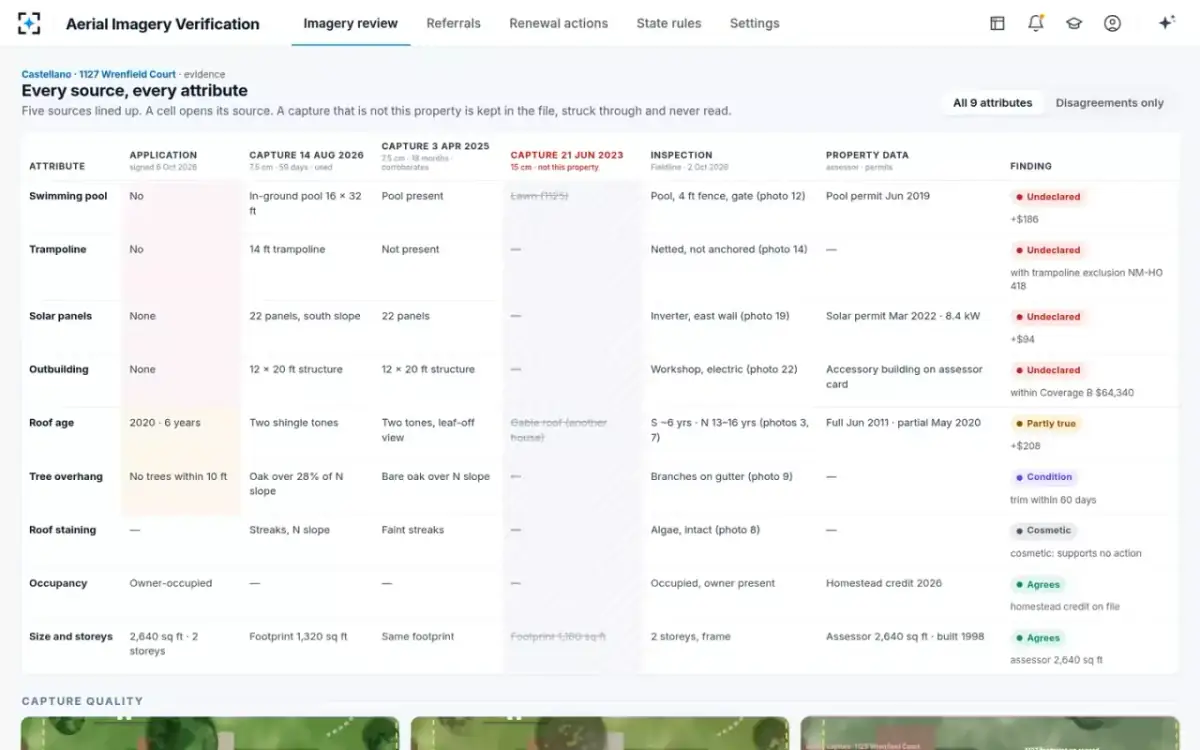
On the sample file the pool appears on an August 2026 capture, an April 2025 capture, inspection photo 12 and county permit P19-00352 from June 2019. A third capture, from June 2023, sits 31 metres off the parcel and shows the neighbour's lawn; read naively, it would say the pool did not exist in 2023. The agents excluded it before reading it, and that exclusion belongs in the file as much as the four confirmations do. How old a capture may be before it is used at all is the subject of whether the aerial imagery is up to date.
The materiality file: one application answer against every source
Rescission, cancellation, nonrenewal or a corrected premium
Which remedy is open depends on when the misrepresentation is found and how far into the term the policy is. Before binding, the carrier prices the truth or declines, and in Florida a denial "must be accompanied by the specific reasons for denial, including the specific underwriting reasons, if applicable" (Fla. Stat. §627.4091). Once the policy is in force, cancellation narrows quickly.
The remedy changes with the calendar
| When the truth surfaces | What the carrier can do | What the rules require |
|---|---|---|
| Before binding | Price the feature, add a condition or exclusion, or decline | Florida: specific reasons, including underwriting reasons, on any denial (§627.4091) |
| First 60 days in force | Cancel, or correct and endorse | Florida residential: 20 days’ notice with the reason, unless there was a material misstatement or misrepresentation (§627.4133) |
| After 60 days in force | Cancel only for listed reasons, material misstatement among them | Florida: no cancellation except for material misstatement, nonpayment, unmet underwriting requirements or a substantial change in the risk; Connecticut lists material misrepresentation among its limited reasons |
| At renewal | Re-rate, add conditions, or nonrenew | Florida residential: at least 120 days’ written notice of nonrenewal, with the reason (§627.4133) |
| After a loss | Deny recovery or rescind, if the statutory test is met | Examination standard: “Rescissions are not made for non-material misrepresentation.” |
Rescission is the remedy examiners test most directly. The market conduct standard reads "Rescissions are not made for non-material misrepresentation", and the neighbouring standard tests that "Cancellation/nonrenewal, discontinuance and declination notices comply with policy and contract provisions, state laws and the regulated entity's guidelines" (NAIC examination standards). An examiner sampling rescinded homeowners files will look for the rule that made each misstatement material, and for the evidence that the misstatement was real.
Connecticut's advisory confirms the same narrowing outside Florida: once a policy has been in effect at least 60 days, or is a renewal, mid-term cancellation "is generally permitted only for reasons such as" nonpayment, "Material misrepresentation" and a physical change that materially increases a hazard (Connecticut advisory). Who must decide and sign an imagery-based termination is set out in insurance companies using drones to cancel coverage.
The cheapest place to settle materiality is the referral
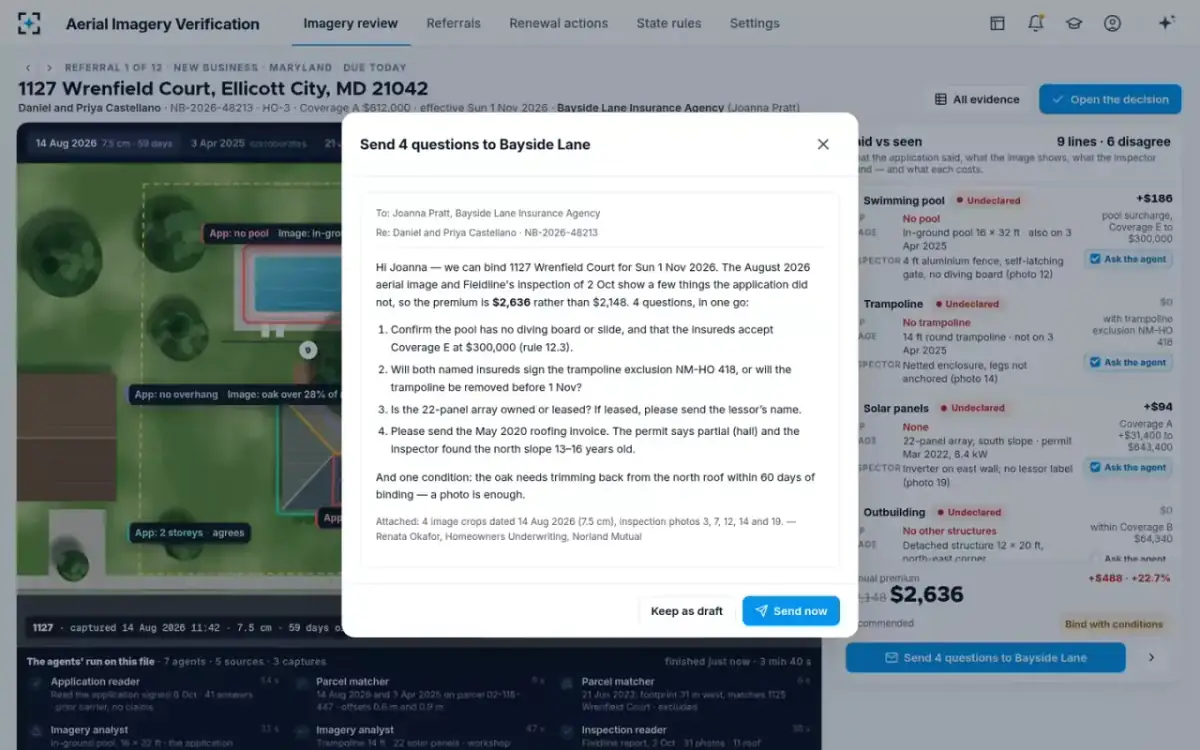
A misrepresentation found before binding costs one message to the agency; the same misrepresentation found after a loss costs a coverage dispute with the insurer carrying the proof. On the sample file the underwriter sent four questions in one message: confirm the pool has no diving board or slide and that the insureds accept Coverage E at $300,000; will both named insureds sign the trampoline exclusion or remove it before 1 November; is the solar array owned or leased; and send the May 2020 roofing invoice. Image crops dated 14 August 2026 and inspection photos 3, 7, 12, 14 and 19 went with it.
How Aerial Imagery Verification builds the materiality file before binding
Agent
Read the applicationExtracts the 41 answers and the nine that outside evidence can test.
Agent
Match each capture to the parcelMeasures each footprint against the parcel boundary; a capture past the tolerance (8 m on the sample carrier) is excluded unread.
Never: reads a feature from a capture of another house
Agent
Read captures, inspection and permitsOutlines and measures each feature, reads the inspector’s photos and margin notes, checks permit and assessor data.
Agent
Price each difference from the manualCites the rule behind every line: surcharge, limit change, exclusion, condition or nothing.
Agent
Draft the questions to the agencyOne message per referral, with the crops and photos attached.
Never: sends it
A person decides
The underwriter decides and signsBinds, binds with conditions, re-inspects or declines; an adverse action also needs the manager’s co-signature.
The file this produces is the same file counsel would need after a loss: what the application said, every source that contradicted it with its date, the rule that made the difference matter, and the underwriter's signed decision. Built at the referral, it usually ends in a corrected premium; the sample file was bound with four conditions, and "decline" was marked not supported because nothing on it was structural.
Four material differences, raised with the agency before binding
Application questions that make materiality provable
Materiality is easiest to prove when the application asked a precise question the manual acts on. "Any pool?" invites argument about above-ground and inflatable pools; "Any swimming pool, in-ground or above-ground, on the premises?" does not. Product and underwriting managers who own the application form control most of the ambiguity a coverage dispute later turns on.
Application wording that holds up when materiality is tested
- Define the feature the way the manual rates it
If rule 12.3 applies to any pool, ask about any pool, and say so on the form.
- Ask the detail the rule turns on
Diving board, slide, fence height, trampoline enclosure and anchoring: an image cannot show them, and the answer moves the rule.
- Ask roof age by section
Partial replacements are common; one date for two slopes produces innocent, material errors.
- Ask who owns solar panels
Owned, leased or financed changes the dwelling limit, and only the insured knows.
- Ask about outbuildings by use
A workshop with its own electric service is a different risk from a garden shed.
- Keep the signed answers with their version of the form
Materiality is judged against the question actually asked on the date it was asked.
The inspection side of the same features, as the inspector photographs them, is in the homeowners insurance inspection checklist. The full referral, screen by screen, is on the Aerial Imagery Verification page.
Questions people ask
What is an example of material misrepresentation in insurance?
A homeowners application that answers "no pool" for a property with a fenced in-ground pool, where the carrier's manual surcharges pools and requires a higher liability limit. On the sample file that answer understated the premium by $186 a year and the liability limit by $200,000, which meets Florida's premium limb on its face.
What is the difference between misrepresentation and concealment?
A misrepresentation is a false statement; concealment is keeping back a fact the insurer asked about or needed. Florida's statute treats them together, covering any "misrepresentation, omission, concealment of fact, or incorrect statement", and applies the same materiality test to all of them.
Can an insurer rescind a homeowners policy after a claim?
Only where the state's statutory test is met, and the examination standard regulators use reads "Rescissions are not made for non-material misrepresentation." In Florida the misstatement must be fraudulent or material, or the insurer must show it would not have issued the policy on the same terms had it known the truth.
Does the insurer have to prove intent?
Not for a homeowners policy under the two statutes read here. Florida makes fraud one route and materiality another, and New York requires intent only for hospital, medical, surgical and prescription drug expense policies.
How long after binding can a carrier cancel for material misrepresentation?
In Florida, a residential policy in force more than 60 days may still be cancelled for a material misstatement, one of a short list of permitted reasons; within the first 60 days the usual 20-day notice does not apply where there was a material misstatement or misrepresentation. Other states set their own windows and notice periods.
What evidence do examiners expect behind a misrepresentation finding?
The rule that made the misstatement material, the rate the carrier would have charged, and proof that the undisclosed feature exists. For imagery-based findings, several state bulletins expect a current, clear image of the right property and, where it is not unequivocal, a further source such as an inspection.