The First Brands bankruptcy and Tricolor Holdings' collapse came in the same month, September 2025, and the charges that followed in 2026 describe the same mechanism in both: receivables pledged as collateral to more than one lender, a practice known as double-pledging. Neither failure required a new kind of fraud or a gap in the law. Both required that nobody recomputed the certificate against the underlying aging, general ledger and collateral pool fast enough to catch what the borrower's own filing left out — the same gap ABL Collateral Monitoring is built to close, by reading those files every day rather than once a quarter.
This guide works from primary sources only: the SEC's and IRS Criminal Investigation's own statements on the two cases, the OCC's Spring 2026 Semiannual Risk Perspective, and the banking agencies' 2025 Shared National Credit review. The sample borrower named near the end is fictional. It does not repeat any figure or quote already used in the companion guide on building a defensible file, which asks what a recomputed borrowing base should pass; this one asks what the two collapses themselves show about the industry's monitoring more broadly.
Two collapses, one blind spot
First Brands Group, an auto-parts manufacturer, and Tricolor Holdings, a subprime auto lender, had little in common as businesses. What they shared was a financing structure built on receivables pledged to asset-based lenders and factoring partners, and a failure mode where those same receivables, or loans, were pledged more than once without any single lender seeing the whole picture. In both cases, the gap between what was certified and what was real widened for months before it surfaced, because the certificate itself was never tested against a second, independent source.
Two collapses, by the numbers government filings give
$1.9B+
raised by Tricolor through asset-backed securities offerings
$5B
in First Brands’ reported annual net sales, against just $12M in cash on hand
$9B+
in First Brands’ liabilities at the time its cash position was disclosed
First Brands: billions in receivables that weren't real
IRS Criminal Investigation, describing the charges brought against First Brands' executives, put the gap between the company's reported scale and its actual cash position bluntly: "First Brands—a company that reported approximately $5 billion in net annual sales worldwide—declared just $12 million in cash in its corporate bank accounts and over $9 billion in liabilities". Behind that gap sat receivables the company had sold to its factoring partners that, per the same filing, did not exist: "First Brands sold its factoring partners billions of dollars of purported customer receivables that did not exist".
A receivable that does not exist cannot be caught by reviewing the certificate alone, because the certificate's own arithmetic is internally consistent — it is the underlying sale that is fictitious, not the subtraction. Catching it requires tying the certificate back to something outside the borrower's own books: the customer's own confirmation, the general ledger entry behind the invoice, or a pattern across customers that does not match ordinary trade behavior. That tie-back is exactly what a field exam samples for a few times a year, and exactly what a daily recompute cannot do either, unless it also reads the register the sale is supposed to appear in.
Tricolor: an $800 million gap between pledged and real collateral
Tricolor's failure ran through asset-backed securities rather than a factoring relationship, but the same double-pledging mechanism sat underneath it. The SEC's own description of the charges is specific about what the company's executives knew and did not disclose: "the loans included in the ABS collateral pools were free and clear of any other liens when the defendants knew that many had been or would soon be double pledged". Tricolor had raised "more than $1.9 billion through ABS offerings" on the strength of collateral pools investors were told were clean, and the complaint puts the resulting hole in its collateral base at "approximately $800 million."
Double-pledging works precisely because no single lender or investor sees every pledge against a given loan or receivable. Each certificate, to each counterparty, looks complete and internally consistent on its own; the fraud is visible only in the overlap between two counterparties' records, which neither one holds by itself. That is also why the fix is not more scrutiny of any one certificate, but a system that can compare a borrower's current filing against its own trend and flag what has moved in a way worth asking about, rather than trusting each new filing on its own terms.
Are more asset-based lenders tightening collateral monitoring?
No public government series counts how many lenders have changed their monitoring, so the honest answer comes from what supervisors are saying and measuring. They are saying monitoring matters more: the OCC's Spring 2026 risk report calls fraud "a key driver of operational losses" and says that "in light of the evolving nature of fraud confronting banks, a dynamic and adaptive approach to risk management is warranted." What they are measuring is not a book in broad decline. In the 2025 Shared National Credit review of large shared loans, the share of commitments rated special mention or classified fell to 8.6% from 9.1% — but the agencies added that "the decline is primarily due to growth in new commitments rather than an underlying improvement in credit quality."
Put together, the picture is a market whose averages look steady while specific, concealed failures surface in it. That is the case for tightening how collateral is watched borrower by borrower: averages do not show a double-pledged receivable, and a lender cannot wait for the average to move.
Large shared loans rated below pass: a lower share, but not better credit
What the OCC's own handbook said about this fraud years earlier
Nothing in either case would have surprised the authors of the OCC's Asset-Based Lending handbook. Its 2017 text describes the mechanism almost word for word: "A fraudulent borrower can submit falsified sales and collection documentation, use the same receivables as collateral to obtain financing from more than one bank, divert cash or collateral proceeds, misrepresent purchase orders, or overstate inventory levels." It calls fraud "a frequent cause of loss in ABL" and names the defence: "regular collateral monitoring and timely field audits are the best deterrents to fraud-related losses."
The same handbook is candid about why the defence fails in practice. "Tracking, monitoring, and reporting ABL collateral can be a manual, time-intensive process prone to human error and fraud," it says. "Many banks find this type of monitoring difficult and have sustained losses as a result." What the 2025 collapses add is not a new risk but a reminder of the price of the one the regulator had already described — and of the handbook's own conclusion, that a bank "should make sure not to advance funds against nonexistent collateral."
What regulators are already flagging across private credit
The OCC's Spring 2026 Semiannual Risk Perspective, published after both collapses were public, draws a narrower but pointed distinction: bank exposure to private credit funds is generally performing as agreed, but "there are signs that credit quality for some vintages, borrower types, and sectors of the private credit markets is weakening", and the use of debt restructurings and paid-in-kind mechanisms "may mask underlying credit deterioration in loan portfolios held by private credit funds." The OCC's own conclusion from that trend is not a call for more paperwork; it ties directly to monitoring practice: "in conjunction with growth in lending to private credit funds and an increase in concentrations at some banks, careful monitoring of borrower performance and refinancing risk is increasingly important" (OCC, Semiannual Risk Perspective, Spring 2026).
"Careful monitoring of borrower performance and refinancing risk is increasingly important."
OCC, Semiannual Risk Perspective, Spring 2026
Why a field audit alone did not catch either collapse in time
A field exam is built to sample, not to see everything: an examiner pulls a representative set of invoices, confirms a portion with customers directly, and reconciles what is found against the certificate, a few times a year. That design works well against ordinary deterioration — slowing collections, rising dilution, a customer concentration creeping up — because a sample taken from a slowly changing population still represents it reasonably well. It works far less well against a deliberate, concealed fraud, because the population being sampled is exactly the part a determined counterparty has an incentive to make look ordinary between exams.
The public record does not say that a routine field exam exposed either structure. In Tricolor's case the SEC's complaint describes conduct running "between at least 2020 and September 2025," and says "certain Tricolor lenders uncovered Defendants' fraud in the summer of 2025" before calling its debt. That is the argument for daily recomputation rather than a better sample: a system that reads the aging, the general ledger and the lockbox every day has more chances to notice a pattern — a customer's receivables rising without matching collections, dilution concentrated in one counterparty, a credit memo register that does not tie to the general ledger — than a sample drawn a few times a year, even a well-chosen one.
What is double-pledging, and how would it show up in daily data?
Double-pledging is using the same receivable, loan or asset as collateral for more than one lender or investor at the same time, without disclosing the overlap to either. It is invisible to any single lender's own certificate review, because the certificate only shows what the borrower reports to that lender; it is the comparison across lenders, or against an independent registry, that would expose it directly. Short of that comparison, daily monitoring cannot prove a receivable is double-pledged. What it can do is flag the symptoms that tend to travel with it: a customer whose balance grows while its payments do not, dilution concentrated in one account rather than spread across many, or a roll-forward that stops explaining the aging within a normal tolerance.
Where double-pledging is invisible, and where it leaves a trace
What a single lender's certificate shows
The borrower's own total for the receivables pledged to that lender, consistent on its own terms.
What a second lender's certificate shows, unseen by the first
The same receivable, pledged again, equally consistent on its own terms.
What neither certificate reveals
The overlap is visible only across the two records, which no single party holds — or in the symptoms that travel with it: receivables rising without matching collections, dilution concentrated in one account.
First Brands and Tricolor: from pledging to public charges
- Receivables pledged to factoring partnersongoing
- Bankruptcy filing exposes the shortfallfiling
- IRS CI charges announced, 29 Jan 2026charged
- ABS offerings sold on pledged collateral poolsongoing
- Collapse exposes the double-pledgingcollapse
- SEC charges announced, 18 Aug 2026charged
The watchlist: every borrower ranked, certified against recomputed
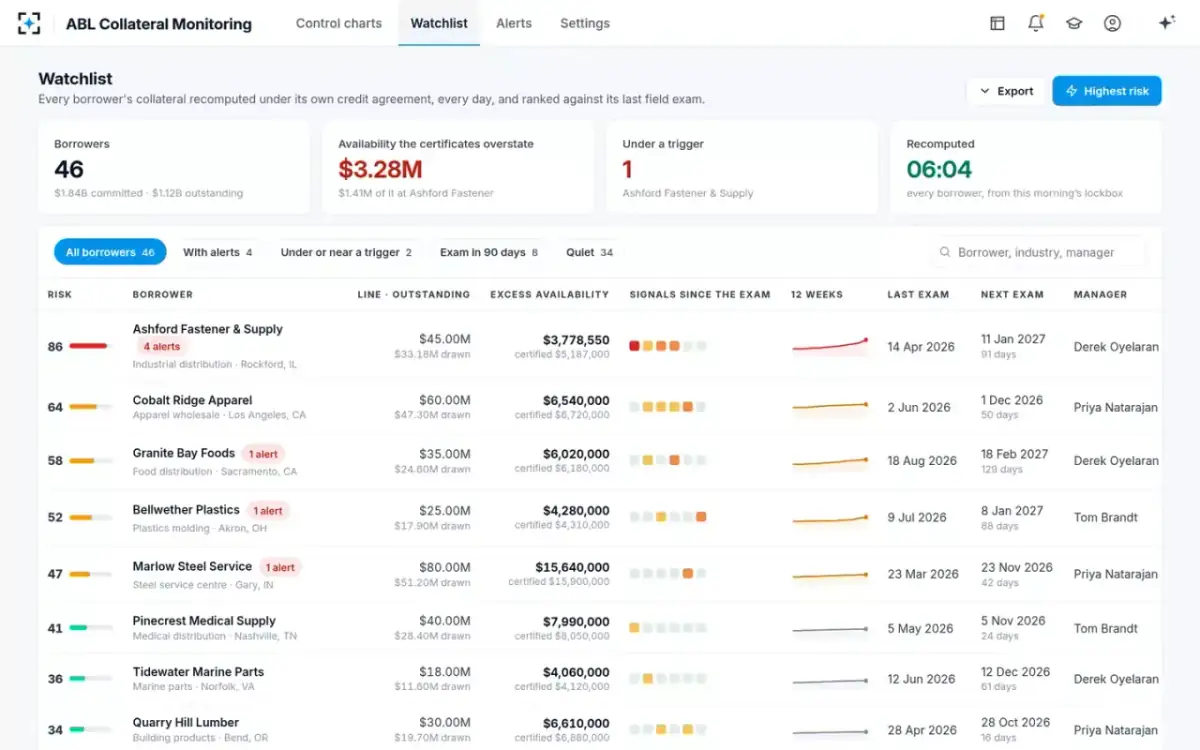
The line is over-advanced long before the next exam finds it
The practical lesson from both collapses is not that fraud is now more common; it is that the gap between a periodic certificate and the underlying files is where it hides, and that gap exists on every ABL book, not only the ones that turn out to be fraudulent. Ordinary deterioration — a slipping customer, rising dilution, a concentration quietly crossing its limit — lives in the same gap and is caught by the same fix. On the fictional sample borrower this guide's companion pieces follow, Ashford Fastener & Supply, a concentration and a dilution issue together moved recomputed excess availability $1,667,354 below what certificate 41 claimed, 91 days before its next scheduled field exam. Nothing about that borrower was fraudulent; the certificate was simply filed before the September numbers were in it. Rescoping the field exam itself picks up from there: what changes once daily alerts, rather than a fixed calendar, decide what an exam tests first.
Questions people ask
What happened in the First Brands bankruptcy?
First Brands, reporting about $5 billion in net annual sales, filed for bankruptcy holding just $12 million in cash against more than $9 billion in liabilities. IRS Criminal Investigation later charged former executives with selling factoring partners billions of dollars of customer receivables that did not exist.
How much money did Tricolor's fraud involve?
Tricolor raised more than $1.9 billion through asset-backed securities offerings. The SEC charged former executives with knowing that loans represented as free of other liens in the ABS collateral pools had been, or would soon be, pledged to more than one party.
Why didn't First Brands' lenders catch the fraud sooner?
A fabricated receivable is internally consistent within the certificate that reports it; the arithmetic does not reveal that the underlying sale never happened. Catching it needs a tie-back to something outside the borrower's own books, which is exactly what a periodic field exam samples for rather than checks exhaustively.
Are asset-based lenders tightening collateral monitoring?
No government series counts it directly. Supervisors are pointing that way: the OCC's Spring 2026 risk report calls fraud a key driver of operational losses and asks for "a dynamic and adaptive approach to risk management," while the 2025 Shared National Credit review warns that a lower share of weak large loans reflects new lending rather than better credit.
What is double-pledging?
Pledging the same receivable, loan or asset as collateral to more than one lender or investor at the same time, without disclosing the overlap. It is invisible to any single lender's own certificate; it surfaces only by comparing records across counterparties, or by noticing the symptoms that travel with it in a borrower's own data.
What do regulators say about private credit monitoring in 2026?
The OCC's Spring 2026 Semiannual Risk Perspective says bank exposure to private credit funds is generally performing as agreed, but flags signs of weakening credit quality in some vintages, borrower types and sectors, and states plainly that careful monitoring of borrower performance and refinancing risk is increasingly important as bank concentrations in the space grow.