A collateral monitoring system is worth pricing against what the work costs today, not against its own subscription fee in isolation, because the manual alternative has a real and fairly stable cost: a collateral manager's time, borrower by borrower, every month. At a lender with 40 or more relationships, that time is the single biggest input into whether continuous monitoring pays for itself, and it is measurable before anyone signs anything — from a lender's own time sheets, or from the hours split below, taken from Botminds' fictional sample bank, Bramwell Business Credit, running ABL Collateral Monitoring.
The figures on this page separate two kinds of numbers carefully: published wage data from the government, and the sample bank's own demo figures for one borrower's monthly review. Scaling the sample to a $1.12 billion book is this guide's own arithmetic, offered as a method rather than a measured industry result.
Where a month of monitoring one borrower goes, in hours
Reviewing one borrower's certificate by hand is not one task; it is six, each pulling from a different file. Reading the certificate and tying it to the aging takes about three hours. Lockbox receipts, DSO and the roll-forward take another two. Concentration and cross-aging, checked against the specific credit agreement rather than a rule of thumb, take two more. Credit memos and dilution take two. Comparing the certificate with the last field exam and writing up what changed takes two more. Deciding what to do, and getting it approved, takes about an hour — roughly twelve hours a month, for one borrower, before anyone has acted on what they found.
One borrower, one month: hours by hand, hours with the agents, and the loaded cost of the hand version
| Task | By hand | With the agents | Monthly cost by hand |
|---|---|---|---|
| Reading the certificate and tying it to the aging | 3.0 h | 0.25 h | ≈ $111 |
| Lockbox receipts, DSO and the roll-forward | 2.0 h | 0.25 h | ≈ $74 |
| Concentration and cross-aging under the agreement | 2.0 h | 0.25 h | ≈ $74 |
| Credit memos and dilution | 2.0 h | 0.5 h | ≈ $74 |
| Comparing with the last exam and writing it up | 2.0 h | 0.5 h | ≈ $74 |
| Deciding and getting approval | 1.0 h | 0.5 h | ≈ $37 |
With the agents reading, tying out and recomputing every file each morning, the same six tasks fall to about 2.25 hours — not because any step disappears, but because the mechanical reconciliation inside each one shrinks to a review of what already ties, leaving the collateral manager's time for the two things that still need a person: reading what credit memos and a slowing lockbox actually mean, and deciding.
What does a collateral manager's time cost?
There is no government wage series for "collateral manager" by that exact title, so the nearest published comparisons are loan officers and financial examiners. The U.S. Bureau of Labor Statistics puts the median annual wage for loan officers at $76,690 as of May 2025, equivalent to $36.87 an hour; financial examiners, whose work is closer to a senior collateral manager's risk and compliance responsibilities, have a median annual wage of $94,160 (BLS, Loan Officers; BLS, Financial Examiners).
The two published wage figures behind every hour in this guide's arithmetic
$36.87/hr
median hourly wage for loan officers, May 2025
$94,160
median annual wage for financial examiners, May 2025
At roughly $37 an hour, the loan-officer figure, unloaded, one borrower's monthly review by hand costs about $444; with the agents, about $83. Loading the rate for benefits raises both numbers together without changing the ratio between them. The BLS's Employer Costs for Employee Compensation gives the size of the load: in June 2026, wages were 70.0% of private-industry compensation, so total cost runs about 1.43 times pay, or about $53 an hour on the loan-officer median, before office and systems overhead.
Scaling from one borrower to a $1.12B book
Bramwell Business Credit's sample book carries 46 borrowers and $1.12 billion outstanding. If the hours above hold roughly steady across the book — larger borrowers take longer to review, smaller ones less, and the two tend to average out — 46 borrowers at twelve hours each is about 552 hours a month by hand, versus about 104 hours with the agents reading and recomputing first. That gap, not the per-borrower hours alone, is what a lender is actually pricing a monitoring system against: either roughly 3.3 full-time collateral managers' worth of monthly reconciliation, or well under one.
The scaling matters because it does not require hiring linearly with the book. A collateral manager's own week, before and after, shows where those hours actually move — not away from the job, but away from reconciliation and toward the decisions only a person can make.
The ROI formula: hours saved × loaded rate × borrowers
The return on a collateral monitoring system is the hours it saves per borrower, times a loaded hourly rate, times the number of borrowers in the book, minus the system's own cost. Each term is a number a lender can pull from its own data rather than take on faith.
The ROI formula, term by term
Hours saved, per borrower per month
≈ 9.75 h
From the sample bank’s own before/after split — 12.0 h by hand, 2.25 h with the agents reading and recomputing first.
Demo figure, Bramwell Business Credit sample
Loaded hourly rate
≈ $53/hr
BLS median loan-officer wage of $36.87, times about 1.43 for benefits (BLS employer-cost data, June 2026); use your own bank’s fully loaded rate for a precise number.
BLS figures, our arithmetic
Borrowers in the book
× your own count
The hours-saved figure is per borrower per month; multiply by the number your desk actually carries.
The system’s own cost
− your own quote
Subscription, implementation and the hours your own team spends on the pilot described below.
On Bramwell's 46 borrowers, roughly 9.75 hours saved per borrower at a loaded rate near $53 an hour comes to about $23,800 a month in reclaimed collateral-manager time, before weighing it against the system's own cost — a number every lender should get from its own vendor conversation, not from this guide.
What does a field exam cost, and what doesn't it replace?
A field exam is priced and billed separately from the monitoring work above, and the two are not substitutes. The OCC's Comptroller's Handbook notes that an ABL unit's "fee structure typically includes customer charges for administrative costs, including field audits, lockbox arrangements, and appraisals" (OCC, Asset-Based Lending), and elsewhere that whoever performs the audit, "the cost is generally passed on to the borrower." A continuous monitoring system does not replace that cost; the Handbook calls for a field audit "often quarterly but more frequently if risk dictates," and nothing about daily control charts changes the requirement for someone to leave the building and verify the collateral in person.
What changes is how that cost is spent. A field exam scoped from the alerts already open on a borrower tests four specific questions instead of a broad sample, which does not necessarily make the visit cheaper but makes the time on site more likely to find what is actually wrong.
What the regulator expects the desk to spend money on anyway
Some of the cost of watching collateral is not optional, and a return calculation should start by setting it aside. The OCC's handbook expects that "an ABL unit should have dedicated field audit staff that includes skilled accountants," that a bank without such staff "should still inspect collateral and review supporting documentation periodically," and that ABL management and lending staff "should have the knowledge and experience to recognize, assess, mitigate, and monitor the risks unique to ABL." Automated monitoring does not remove any of those seats.
Where the handbook does see savings is in the reconciliation itself. It describes manual tracking as "a manual, time-intensive process prone to human error and fraud" and lists, among the benefits of automated monitoring systems "when properly implemented," "reduced administrative costs and more effective time management" alongside "lower losses from credit risk and fraud." That is the same split this page's formula makes: the hours inside each monthly review are the cost a system can reduce; the field audit staff, the expertise and the decisions are costs a lender keeps.
Where the return is weakest: small, simple borrowers
The ROI formula above is kindest to a lender with many borrowers, each costing roughly the same fixed hours to review by hand. It is weakest on a small book of a handful of simple, stable relationships, where the twelve hours a month of manual review were never really the bottleneck and a borrower's own file rarely drifts far between certificates. A lender with eight long-standing borrowers and no history of collateral surprises will save real hours from continuous monitoring, but the dollar total will be a fraction of what a 46-borrower book realizes, and the system's own cost has fewer borrowers to spread across.
The honest reading is that collateral monitoring software earns its keep fastest on a larger or more volatile book — more borrowers, more concentrated receivables, more borrowers with thin headroom — and more slowly, though not necessarily never, on a small and stable one.
What moves the ROI number most, in this formula
What this doesn't price: a reduction caught 115 days early
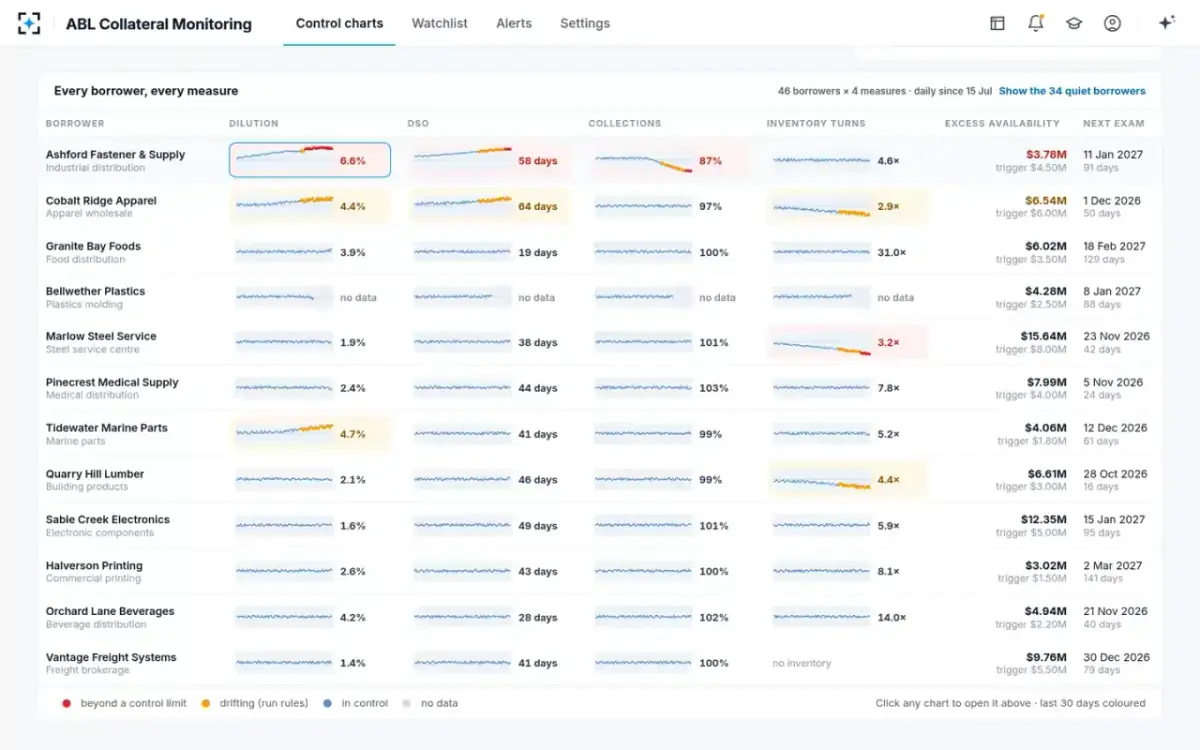
Every number above prices hours, not outcomes, and that understates the case for continuous monitoring on at least one borrower in Bramwell's sample book. Ashford Fastener & Supply's dilution drift was flagged 21 days after its own certificate would have shown it, and 115 days before the next scheduled field exam would have looked at all. The $1,667,354 reduction in availability that followed was caught while Ashford still had room to adjust — not months later, after a borrower's position had already run past what the collateral could support.
Every borrower charted, the measure a 115-day gap would otherwise have hidden
A drift caught at the next field exam, against one caught on a daily chart
At the next scheduled exam: Whenever the exam calendar next reaches this borrower — up to 115 days later in Ashford’s case.
On a daily control chart: The morning the measure crosses its own control limit.
At the next scheduled exam: React to a problem that has already run for months.
On a daily control chart: Ask for a corrected certificate, a reserve, or a targeted visit while the gap is still small.
At the next scheduled exam: The field exam’s own fee, already budgeted for the visit.
On a daily control chart: No incremental cost once the system is running — the daily recompute happens regardless.
How to build your own number from your own portfolio
A lender does not need Bramwell's figures to price this; it needs its own. Time a handful of actual monthly reviews, across borrowers of different sizes, to get a realistic hours-by-hand figure. Use the bank's own loaded hourly rate for the staff who do the work, not a published median. Multiply by the number of borrowers the desk actually carries, and compare the result with a vendor's quote — including the hours a pilot itself will take, since a pilot run on files the team has already closed is the cheapest way to find out whether the hours-saved assumption holds before committing to the system.
To see the hours this guide is built on, screen by screen, start from ABL Collateral Monitoring.
Questions people ask
How much does collateral monitoring software cost?
It varies by lender size and portfolio, and no single public figure covers it. The more useful number to build first is what manual monitoring already costs in hours — roughly twelve hours a month per borrower in Botminds' own sample — so a vendor's quote can be weighed against a real baseline rather than compared in isolation.
What does a collateral manager's time cost?
Collateral manager is not a government-tracked job title, so the nearest published comparisons are loan officers, at a median $76,690 a year ($36.87 an hour) as of May 2025, and financial examiners, at a median $94,160. Benefits add roughly 43% on top, on the BLS's employer-cost figures, so a loaded loan-officer hour is near $53 before overhead.
How many hours does it take to review a borrowing base certificate?
In Botminds' sample bank, a full monthly review of one borrower — reading the certificate, checking the lockbox and concentration, reviewing credit memos, comparing with the last exam and deciding — runs to about twelve hours by hand, falling to roughly 2.25 hours once the certificate, aging and credit-memo data are read and recomputed automatically each morning.
What is the ROI of continuous collateral monitoring?
It is hours saved per borrower, times a loaded hourly rate, times the number of borrowers in the book, minus the system's own cost. Because the hours-saved figure multiplies by every borrower in the portfolio, the size of the book is usually the single biggest driver of the total.
What does a field exam cost, and does software replace it?
A field exam's cost is generally passed through to the borrower as part of an ABL unit's fee structure, per the OCC's Handbook. Continuous monitoring does not replace it — regulators still expect a field audit on a regular schedule — but it can scope the exam more precisely, from the alerts already open rather than a generic sample.
Is collateral monitoring software worth it for a small ABL book?
The return is smaller and slower on a small book of long-standing, stable borrowers, where manual review was never the real bottleneck. It tends to be strongest on a larger book, or one with more concentrated or volatile borrowers, where both the hours saved and the cost of a missed drift scale up together.