Borrowing base fraud is what happens when the number on a certificate and the collateral actually behind it stop matching, and nobody catches the gap before the lender has advanced against it. Two collapses of September 2025, First Brands Group and Tricolor Holdings, are alleged to have turned on a version of that same gap: receivables and loans pledged more than once, or reported as clean when they were not. Both cases are now in federal court, and the government's own filings describe exactly what a defensible file should have shown instead.
This guide works from the primary sources — the SEC's and IRS's own charging announcements — rather than news coverage of either case, and from Botminds' fictional sample borrower, Ashford Fastener & Supply, run through ABL Collateral Monitoring. Ashford's story carries no allegation of forged documents; it shares First Brands' and Tricolor's blind spot — a certificate nobody recomputed fast enough — at a different scale and with no suggestion of the same crime.
What First Brands' lenders missed, in the government's own words
First Brands Group, an automotive-parts supplier, filed for bankruptcy on 28 September 2025 after what the indictment, as the IRS Criminal Investigation announcement describes it, calls "a yearslong fraud." Announcing the charges on 29 January 2026, U.S. Attorney Jay Clayton said that founder Patrick James and his brother Edward James "obtained billions for First Brands—and millions for themselves—by presenting their lenders with the impression of a successful, growing international business" (IRS Criminal Investigation). Specifically: "First Brands sold its factoring partners billions of dollars of purported customer receivables that did not exist."
The scale of the gap, once it surfaced, was stark. First Brands had reported roughly $5 billion in net annual sales worldwide; at bankruptcy it "declared just $12 million in cash" against more than $9 billion in liabilities. A company with billions in reported revenue and purportedly real receivables does not usually run out of cash that fast — the IRS's own description is of receivables that were never collectible because many of them were never real, pledged to factoring partners who had no way to verify them independently.
Tricolor: loans pledged more than once, the SEC says
Tricolor Holdings, a subprime auto lender, filed for Chapter 7 bankruptcy on 10 September 2025. The SEC's civil complaint, filed 18 August 2026 against three former executives, describes a different mechanism reaching a similar result: "the loans included in the ABS collateral pools were free and clear of any other liens when the defendants knew that many had been or would soon be double pledged" (SEC press release 2026-77). The company had raised more than $1.9 billion through asset-backed securities offerings; more than $945 million of that principal was still outstanding and owed to investors when it collapsed.
Two 2025–26 collapses, in the government's own figures
$9B+
in liabilities First Brands owed at bankruptcy, against $12 million of cash on hand
$1.9B
Tricolor raised through loans pledged into ABS pools — some double pledged, the SEC alleges
$945M
of that principal still owed to investors when Tricolor failed
From a bankruptcy filing to federal charges: two collapses on close to the same calendar
- Years of reported growth
- Bankruptcy filed, 28 Sep 2025
- Charges unsealed, 29 Jan 2026
- Years of ABS offerings
- Bankruptcy filed, Sep 2025
- SEC complaint, 18 Aug 2026
What makes a receivable ineligible, and why it matters more than it looks
Neither case required inventing new fraud techniques. Both exploited the same structural fact about a borrowing base: it is only as good as the eligibility rules applied to it, and a receivable that should have been excluded — because it does not exist, because it is pledged elsewhere, because a customer relationship makes it unreliable — looks identical to a good one on a spreadsheet that only totals the aging. The credit agreement's own definitions are supposed to catch this. A certificate that is accepted on its face, without recomputing it against those definitions and the underlying documents, trusts the borrower to apply rules against its own interest.
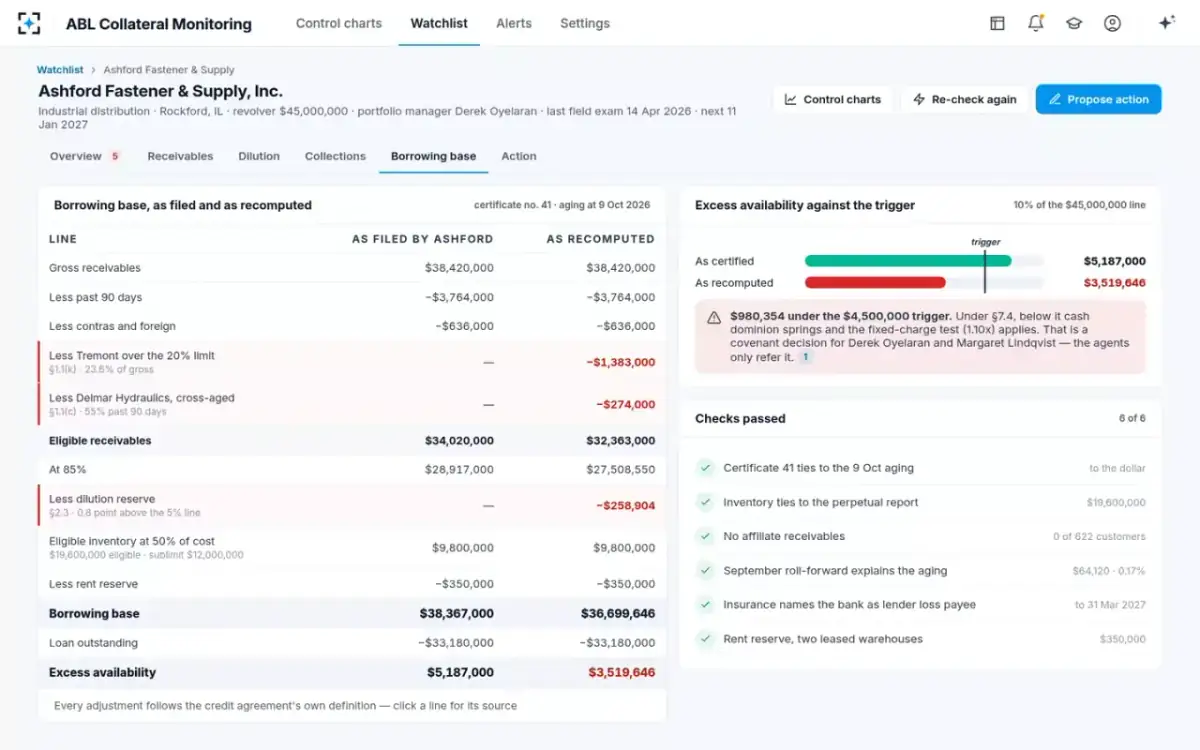
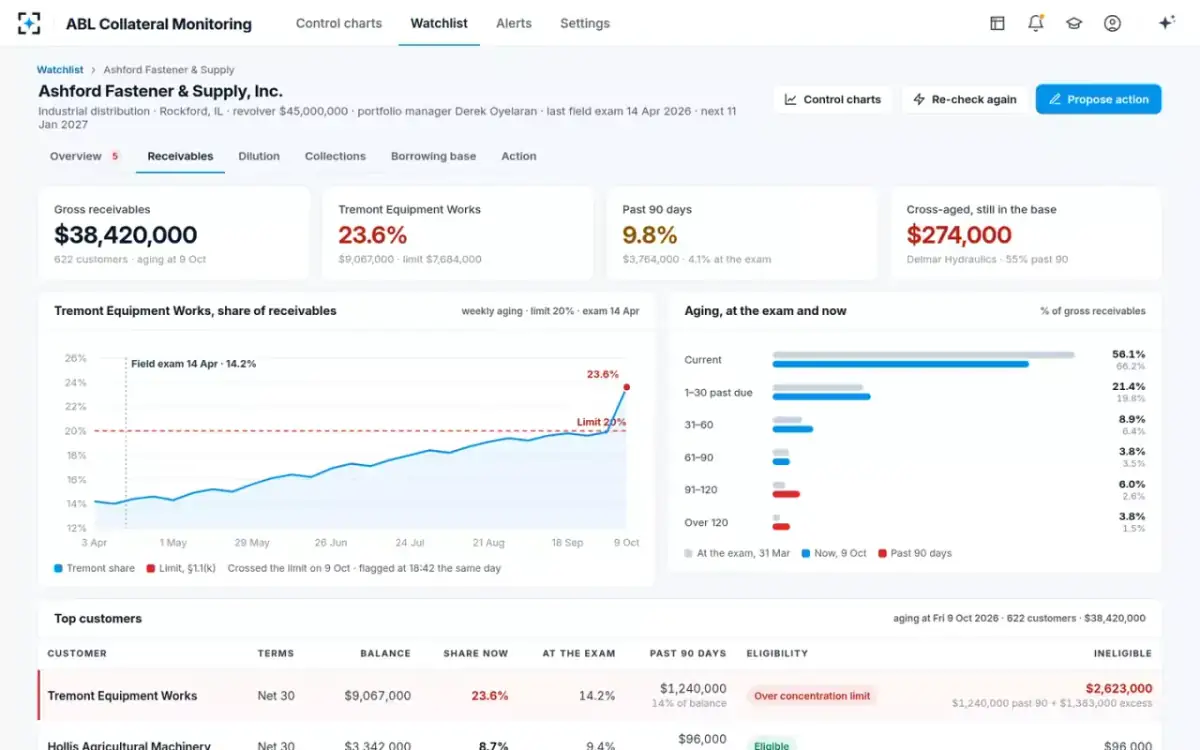
On Ashford Fastener & Supply, the same structural gap showed up at ordinary scale rather than criminal scale: Tremont Equipment Works had grown to 23.6% of receivables against a 20% concentration limit, and Delmar Hydraulics was 55% past 90 days, over the 50% cross-aging line. Neither had been removed from certificate 41. Nobody forged anything; the certificate simply had not been recomputed since the limits were last checked, and a drift that size, left long enough, is the same shape of gap that let First Brands' and Tricolor's numbers run for years before anyone outside the company looked closely.
Does a field exam actually catch fraud?
It can, and it is built to: the OCC's Comptroller's Handbook for Asset-Based Lending states that "a field audit helps detect fraud and financial weakness and is a customary way to confirm the quality of the borrower's financial data, receivables, inventory, and internal controls" (OCC, Asset-Based Lending). But a field exam is a sample taken on a schedule, usually "quarterly but more frequently if risk dictates," and a fraud built to survive a quarterly sample has months between visits to keep the numbers looking consistent. The public record does not credit a routine field audit with exposing either case. First Brands' problems became public with its bankruptcy filing; in Tricolor's, the SEC says certain lenders uncovered the fraud in the summer of 2025, weeks before the company failed, after conduct the complaint dates to at least 2020.
That is the case for recomputing between exams rather than relying on the exam alone. A field exam scoped from what daily data already flags tests exactly the receivables a recompute has raised a question about, instead of a sample chosen before anyone knew where to look.
The checks a recomputed borrowing base should pass
A defensible file is one where every number on the certificate can be traced back to a document and a rule, not merely a total that happens to tie. The checks below are the ones a recompute has to pass before a lender can trust the certificate it has in hand.
Checks a recomputed borrowing base should pass before a lender relies on it
- Does the certificate tie to the current aging?
Not last month’s — the aging dated the same day as the certificate, reconciled to the dollar.
- Is every concentration limit checked against the agreement, not a rule of thumb?
Each credit agreement sets its own percentage; a generic 20% assumption can miss a tighter or looser clause.
- Is cross-aging applied the way the agreement defines it?
A customer past due on one invoice can take its whole balance ineligible, depending on the agreement’s wording.
- Has dilution been measured against the trailing period the agreement specifies?
A spike concealed inside a longer average is exactly what a quarterly review is most likely to miss.
- Are affiliate and related-party receivables flagged, not just totalled?
The OCC’s own Handbook singles these out as a fraud risk, not only a credit risk.
- Does the lockbox roll-forward explain the aging within a stated tolerance?
A roll-forward that does not reconcile is the first sign a receivable may not be what it claims to be.
Affiliate receivables: the concentration the Handbook singles out for fraud risk
Most ineligibility rules exist to manage credit risk — a concentrated or aging receivable is simply less likely to be collected. Affiliate receivables get a sharper warning. The OCC's Handbook lists them among ineligible receivables specifically because "affiliate receivables can also increase the potential for fraud, particularly in times of financial stress" (OCC, Asset-Based Lending) — a related party has less reason to dispute an invoice, which makes a fabricated or inflated one harder to catch through the normal channel of a customer pushing back.
Neither First Brands' nor Tricolor's announced charges turn on affiliate receivables specifically — First Brands' centered on receivables sold to factoring partners that did not exist, and Tricolor's on loans pledged to more than one securitization pool. But the underlying lesson is the same one the Handbook draws about affiliates: a receivable that the usual arm's-length checks do not naturally test — because nobody outside the two related parties is positioned to dispute it — is exactly where a borrowing base needs an independent recompute rather than trust in the borrower's own total.
What changes when dilution is checked daily instead of quarterly
Dilution is one of the quietest ways a borrowing base can drift, because it hides inside a normal-sounding monthly total until the trend is pointed out. Ashford's September credit memos ran to $1,482,120, 6.9% of sales for the month, with 61% of them — $862,000 — landing on one customer, Tremont, under a price-protection clause. On a quarterly review, that single month sits inside a trailing average and barely moves it; checked daily against the trend since the last field exam, it is the signal that flags Tremont's growing share of receivables before the two problems compound into one.
Checked daily, the eligibility and concentration checker recomputed Ashford's borrowing base from $38,367,000 as filed to $36,699,646, and excess availability from $5,187,000 certified to $3,519,646 — under the $4,500,000 covenant trigger. That gap did not require new information; it required recomputing the same information against the agreement's own rules before another certificate cycle passed.
Ashford's certificate, as filed and as recomputed
As filed, certificate 41: $38,367,000
As recomputed, same day: $36,699,646, after Tremont and Delmar are made ineligible
As filed, certificate 41: $5,187,000
As recomputed, same day: $3,519,646 — under the $4,500,000 trigger
As filed, certificate 41: Not separately flagged
As recomputed, same day: 23.6% of receivables, over the 20% limit
As filed, certificate 41: None booked
As recomputed, same day: $258,904, from 5.8% trailing dilution against a 5% line
Can an AI agent change a certificate?
No, and this is the limit that keeps a recompute defensible rather than just another number competing with the borrower's. In ABL Collateral Monitoring, the eligibility and concentration checker recomputes a borrowing base from the aging, inventory and credit-memo data it reads, cited to the page and line it came from — but it never files a certificate, never edits the borrower's own submission, and never changes the credit agreement's definitions on its own. The recompute sits beside the certificate as a second, independently derived number; a person decides which one governs the conversation with the borrower.
What the six agents behind a recompute may and may not do is the fuller account of that boundary — it is also what makes the recompute something a lender, and eventually an examiner, can audit line by line rather than take on faith.
The borrowing base, filed and recomputed, with the checks that passed
Building a file that would survive a second look
A defensible file is not a thicker file; it is one where every number a lender relies on can be traced back to a specific document and a specific clause, recomputed recently enough that the trace is still current. Lenders to both companies received the borrower's own reports, and, the charges allege, those reports carried receivables that were pledged twice or never existed. A file built only from what the borrower sends inherits whatever the borrower chose to put in it; the defence is to recompute its totals against the underlying records, and against the agreement's own rules, between the scheduled reviews.
Receivables, recomputed against the agreement's own concentration and cross-aging rules
"the loans included in the ABS collateral pools were free and clear of any other liens when the defendants knew that many had been or would soon be double pledged"
SEC press release 2026-77, on the Tricolor charges
None of the checks above require new regulation or a new kind of audit — they require recomputing what the credit agreement already specifies, on a schedule shorter than the next field exam, and treating a disagreement between the certificate and the recompute as something to resolve rather than something to average away. To see what that recompute looks like on one borrower, start from ABL Collateral Monitoring; the formula behind every one of these numbers, worked line by line, follows from here.
Questions people ask
What is borrowing base fraud?
Borrowing base fraud is when the collateral a certificate claims to support a loan does not match what actually exists or is actually available — because a receivable was invented, pledged to more than one lender, or should have been excluded under the credit agreement's own rules and was not. First Brands and Tricolor are both now the subject of federal charges and a civil complaint alleging versions of this.
How did First Brands defraud its lenders?
According to the IRS Criminal Investigation's own announcement, First Brands "sold its factoring partners billions of dollars of purported customer receivables that did not exist," while presenting lenders with the appearance of a healthy, growing business. At bankruptcy it held $12 million in cash against more than $9 billion in liabilities.
What is double-pledging of collateral?
Double-pledging is using the same collateral — in Tricolor's case, the same auto loans — to secure more than one financing or securitization pool, so investors in each pool believe they have a claim on collateral that is also claimed elsewhere. The SEC's complaint alleges Tricolor's executives knew loans in its ABS pools had been or would be double pledged.
Can a field exam catch fraud?
Yes — the OCC's own Handbook describes field audits as a customary way to detect fraud and confirm collateral quality. But an exam is a periodic sample, and a fraud built to survive the interval between exams can run for a long time; the public record does not credit a routine audit with exposing either First Brands or Tricolor.
What does a lender do when a certificate doesn't match the aging?
The gap becomes a question to resolve, not a number to average. In ABL Collateral Monitoring, a recomputed borrowing base that disagrees with the filed certificate is shown side by side with it, cited to the aging line, credit-memo entry or agreement clause behind each figure, and a collateral manager decides what the disagreement means before anything changes.
Were First Brands' and Tricolor's executives charged?
Yes. First Brands' founder Patrick James and his brother Edward James were charged in an indictment unsealed 29 January 2026 with conspiracy to commit wire and bank fraud, among other counts. Three former Tricolor executives — Daniel Chu, Jerome Kollar and Ameryn Seibold — were civilly charged by the SEC on 18 August 2026 with securities fraud; in a parallel action, the U.S. Attorney's Office for the Southern District of New York announced criminal charges against the same three in December 2025. All charges are allegations the government must still prove.