A borrowing base calculation answers one question: how much can a lender safely advance against the receivables and inventory a borrower pledges today? The formula is short — eligible collateral multiplied by an advance rate, less reserves — and a borrower or a new analyst can learn it in a sentence. What takes longer to learn is everything the word "eligible" is carrying: which receivables actually count, which ones a single late customer removes, and how a credit-memo register turns into a reserve. ABL Collateral Monitoring recomputes this calculation for every borrower from the underlying aging and the credit agreement itself, and this guide works the formula through on one fictional sample certificate, Ashford Fastener & Supply's certificate no. 41, filed against its 9 October 2026 aging.
The formula: eligible collateral × advance rate − reserves
Every borrowing base, regardless of lender or industry, reduces to three terms. Eligible collateral is the receivables and inventory left once the ineligible categories a credit agreement lists are removed. The advance rate is the percentage of that eligible value a lender is willing to lend against, lower for inventory than for receivables because inventory is harder to convert to cash at full value. Reserves are further deductions the agreement allows the lender to take for a specific risk — dilution, rent owed to a landlord with a lien ahead of the lender's, or anything else the agreement names.
The borrowing base formula, term by term
Eligible collateral
Gross receivables and inventory, less ineligible categories
Past due, cross-aged, contra, foreign, affiliate and over-concentration amounts come out first, under the agreement’s own definitions.
Advance rate
× a percentage, by collateral type
Commonly 70–85% on eligible receivables and markedly lower on inventory.
Reserves
− dollars, by named risk
Dilution above the agreement’s line, landlord or warehouseman liens, and any other reserve the agreement names.
What makes a receivable eligible, and what takes it out
A receivable starts eligible and is removed, line by line, for reasons the credit agreement lists in its own definitions. The Comptroller's Handbook frames the underlying asset simply: "the borrowing base in an ABL is likely to consist primarily of working assets, such as accounts receivable and inventory" — and an account, in the law both parties' agreements are written against, is "a right to payment of a monetary obligation" for goods sold or services performed (UCC § 9-102). Most agreements then carve out: receivables past a due-date threshold, usually 90 days; contra accounts, where the borrower also owes the same customer money; foreign receivables, unless insured; affiliate receivables, because a related party's payment proves little about collectability; and anything over a per-customer concentration limit.
On Ashford's 9 October aging, two of those carve-outs apply at once. Tremont Equipment Works, its largest customer, had grown to $9,067,000 of receivables — 23.6% of the $38,420,000 gross — against the agreement's 20% concentration limit, so $1,383,000 of Tremont's balance is ineligible purely for being over the line. Delmar Hydraulics is 55% past 90 days, over the agreement's 50% cross-aging threshold, which takes out the rest of its balance, $274,000, under the same clause. Neither adjustment appears on certificate 41 as filed; both are the agreement's own rule, not a judgment call.
What is cross-aging, and why one late customer can exclude a whole account?
Cross-aging is the rule that a customer whose unpaid balance is mostly old makes its whole account suspect, not just the old part. If a defined share of what a customer owes — the Comptroller's Handbook's own example uses "any (or some percentage) of that customer's receivables" past due — has aged past the agreement's threshold, the entire balance from that customer drops out of eligible collateral, not just the late portion. The handbook adds that the rule is sometimes called the "10 percent rule" because 10% of a customer's accounts "is a common delinquency threshold"; Ashford's agreement uses 50%, a much looser line. The logic is that a customer paying slowly across the board is more likely to be disputing the goods, in financial trouble, or both, and the part that is not yet 90 days past due is no safer than the part that is.
Delmar Hydraulics shows the mechanism exactly: once 55% of its balance passed 90 days, the cross-aging test removed its entire remaining $274,000, not just the overdue share. A lender reading only "percent past due" by itself would miss that the real exposure is the whole account, once the threshold is crossed.
How is dilution calculated, and when does it cost advance rate?
Dilution is the share of gross sales that never becomes cash because of returns, allowances, discounts, disputed invoices or bad debt write-offs — credits a customer earns rather than an invoice it disputes outright. The Comptroller's Handbook sets the expectation plainly: "dilution varies by industry but is usually expected to be 5 percent or less of receivables". Agreements handle the excess differently; Ashford's takes a point of advance rate for every point dilution runs above a 5% line, which works out as a dollar reserve.
Ashford's trailing three-month dilution was 5.8% against 3.1% at its last field exam, and September's credit memos were unusually concentrated: 61% of them, $862,000, were price-protection adjustments to Tremont under its Q3 pricing program. The agreement takes one point of advance rate for every point above the 5% line, so the dilution analyst proposed a reserve of $258,904 — a reduction the certificate had not yet taken, because the September credit-memo register had not been read into it when the certificate was filed.
Advance rates on inventory: lower, and why
Inventory is harder to collect against than a receivable, because turning it into cash means selling it, often in a hurry and often below book value, rather than simply waiting for a customer to pay an invoice already raised. Advance rates on inventory are correspondingly lower than on receivables. The Comptroller's Handbook describes inventory loans as traditionally structured with "conservative advance rates equivalent to 80 percent of the net orderly liquidation value (NOLV) of the inventory, as determined by a qualified appraiser" — a percentage of what the stock would fetch in an orderly sale, which is usually well below its cost. Agreements that advance on cost instead set a lower percentage of cost, and work-in-process is often excluded. Ashford's agreement advances inventory at 50% of cost, against $19,600,000 of eligible inventory, producing $9,800,000 before its $12,000,000 sublimit and rent reserve are applied.
Most agreements also cap the inventory line with a dollar sublimit, separately from the percentage advance rate, so that inventory can never grow to dominate the borrowing base the way a single large receivable customer might. Ashford's $12,000,000 inventory sublimit sits above its $9,800,000 calculated advance, so the sublimit does not bind this quarter; it would only take effect if eligible inventory grew enough that 50% of its cost exceeded $12,000,000, at which point the base would be capped at the sublimit rather than continuing to rise with inventory. A rent or warehouseman's reserve is deducted after the sublimit, to cover a landlord's or warehouse operator's lien that can sit ahead of the lender's own claim on goods stored on leased premises; Ashford's agreement takes a flat $350,000 reserve against two leased warehouses.
Typical advance rate ranges, by collateral type
| Collateral type | Typical advance rate | Why it differs |
|---|---|---|
| Eligible accounts receivable | 70–85% common | Some banks go up to 90% of eligible business-to-business receivables. |
| Inventory, against appraised value | 80% of NOLV, traditionally | Competition has pushed some lenders to 85–90% of NOLV. |
| Inventory, against cost (sample facility) | 50% of cost | Ashford’s agreement; a cost-based rate sits below an NOLV-based one because NOLV is usually below cost. |
| Work-in-process | Often excluded | Has little resale value until it is finished. |
Concentration limits: why no single customer should be the base
A concentration limit caps how much of eligible receivables any one customer may represent — the Comptroller's Handbook suggests limiting concentrated accounts to "no more than 10 percent to 20 percent of the receivables borrowing base," and Ashford's agreement uses 20% — so that the borrowing base is not, in practice, a loan against one counterparty's ability to pay. Without a limit, a borrower's largest, fastest-growing customer can quietly become the base itself: Tremont rose from 14.2% of Ashford's receivables at the 14 April field exam to 19.9% on 2 October and 23.6% by 9 October, tracking a pricing program that was also, as the dilution figures above show, driving credit memos higher at the same time. A concentration test catches the exposure before the customer's share crosses the line, not after a payment default proves it mattered.
The ineligibility checklist a recomputed borrowing base applies
- Past due
Receivables aged beyond the agreement’s threshold, commonly 90 days.
- Cross-aged
A customer whose balance is mostly past due loses its entire account, not just the late share.
- Contra accounts
Where the borrower also owes the same customer money.
- Foreign receivables
Excluded unless insured, under most agreements.
- Affiliate receivables
Related-party receivables the Comptroller’s Handbook flags for added fraud risk.
- Over-concentration
The share of one customer’s balance above the agreement’s limit.
Excess availability: the number that actually moves
Excess availability is what is left once the borrowing base is compared against what is already drawn: borrowing base minus loan outstanding. It is the number a borrower actually watches day to day, because it is what can still be drawn, and it is the number a covenant trigger is usually written against. Ashford's certificate shows $5,187,000 of excess availability on a $38,367,000 borrowing base against $33,180,000 outstanding. Recomputed, the borrowing base falls to $36,699,646 and excess availability to $3,519,646 — $980,354 under the agreement's $4,500,000 trigger, which springs cash dominion under §7.4 and brings the 1.10x fixed-charge coverage test into play.
Ashford's borrowing base, as filed and as recomputed
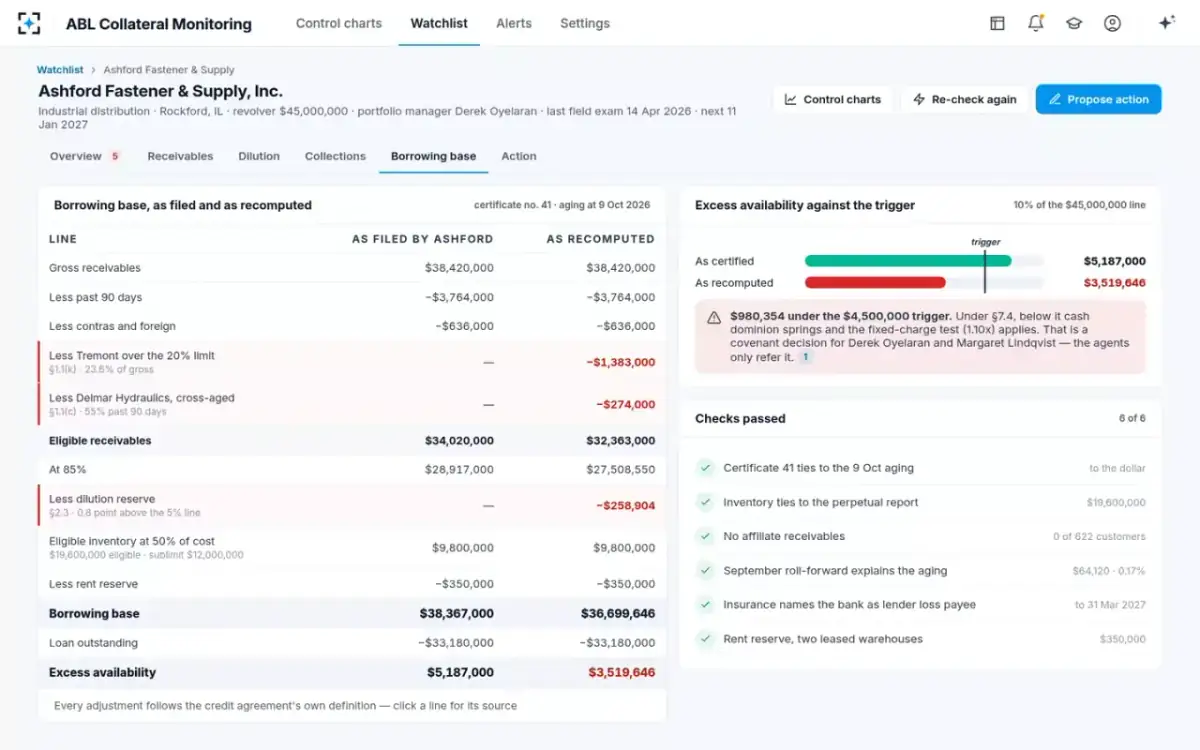
A borrowing base calculation, worked line by line
The table below is Ashford's certificate worked from gross receivables down to excess availability, as filed and as recomputed, matching the screen above. Reading the two columns side by side is the fastest way to see where a certificate and an agreement's own arithmetic can quietly diverge.
Ashford Fastener & Supply, certificate 41: as filed against as recomputed
| Line | As filed | As recomputed |
|---|---|---|
| Gross receivables | $38,420,000 | $38,420,000 |
| Less past 90 days | −$3,764,000 | −$3,764,000 |
| Less contras and foreign | −$636,000 | −$636,000 |
| Less Tremont over the 20% limit | — | −$1,383,000 |
| Less Delmar Hydraulics, cross-aged | — | −$274,000 |
| Eligible receivables | $34,020,000 | $32,363,000 |
| At the 85% advance rate | $28,917,000 | $27,508,550 |
| Less dilution reserve | — | −$258,904 |
| Eligible inventory at 50% of cost | $9,800,000 | $9,800,000 |
| Less rent reserve | −$350,000 | −$350,000 |
| Borrowing base | $38,367,000 | $36,699,646 |
| Loan outstanding | −$33,180,000 | −$33,180,000 |
| Excess availability | $5,187,000 | $3,519,646 |
When the loan is bigger than the base: over-advances
The calculation matters most at the moment it says the loan is too big. The OCC defines an over-advance as "a loan advance that increases the loan balance beyond the amount supported by the borrowing base," and it treats a deliberate one as a credit decision in its own right: over-advances "should be approved in accordance with the bank's loan policies and be supported by an assessment of the adequacy of the company's cash flow to repay the overadvance," and those "in excess of prudent advance rates or that rely on cash flow for repayment weaken the ABL loan structure and should have a defined repayment plan with repayment over a short term." Some facilities pre-approve a seasonal over-advance for the months when inventory builds ahead of sales.
An unchecked certificate can create an over-advance nobody approved. Ashford's recomputed base of $36,699,646 still covers its $33,180,000 loan, so the drift here eats excess availability rather than tipping the loan over the base. But the same arithmetic run on a borrower drawn closer to its limit — or a few more weeks of Tremont's concentration growing — is how a lender ends up with what the handbook calls a "stretch piece" or "airball": a loan balance the collateral no longer supports, discovered only when someone recalculates.
How often is a borrowing base recalculated?
Most agreements set the certificate's filing frequency in the agreement itself: weekly or monthly is typical, and for retailers, the Comptroller's Handbook notes, "most banks require daily or weekly borrowing base certificates to monitor sales and inventory trends." Between certificates, nothing forces a recalculation unless something prompts one — a field exam, a covenant test, or a lender's own periodic review. ABL Collateral Monitoring recomputes every borrower's base every morning from that day's lockbox and sales journal, so the gap between "how often the agreement requires a certificate" and "how often the arithmetic is actually re-tested" closes to a day rather than a month or a quarter. Setting early-warning indicators for a borrower's collateral covers how a daily recompute turns into an alert worth acting on, and ABL Collateral Monitoring shows the full borrower cockpit this calculation feeds.
Questions people ask
How do you calculate a borrowing base?
Take eligible collateral — receivables and inventory, less the categories the credit agreement treats as ineligible — multiply by the agreement's advance rate for each collateral type, and subtract any reserves the agreement names, such as a dilution reserve. The result, less what is already drawn, is excess availability.
What is a typical advance rate for accounts receivable?
Commonly 70–85% of eligible accounts receivable, with some lenders advancing up to 90% against strong business-to-business receivables, per the Comptroller's Handbook. Inventory advance rates run well below receivables, because inventory must be sold, usually at a discount, to become cash.
What makes a receivable ineligible?
The usual categories are past due beyond the agreement's threshold, cross-aged (a customer whose balance is mostly past due), contra accounts, foreign receivables unless insured, affiliate receivables, and any amount above a per-customer concentration limit. Each agreement defines its own list; none of these is universal law.
How is dilution calculated?
As the share of gross sales lost to returns, allowances, discounts and bad debt over a trailing period, commonly three months. The Comptroller's Handbook says it is "usually expected to be 5 percent or less of receivables"; agreements then set their own response, such as Ashford's one point of advance rate for each point above 5%.
What's a good concentration limit?
The Comptroller's Handbook treats any customer at 10% or more of receivables as a concentration and suggests limiting concentrated accounts to no more than 10% to 20% of the receivables borrowing base; within that, a lender tightens for a borrower with few customers. The purpose is to keep the borrowing base from becoming, in substance, a loan against one customer's ability to pay.
What's the difference between the borrowing base and excess availability?
The borrowing base is the maximum a lender will advance against eligible collateral. Excess availability is the borrowing base minus what is already drawn — the amount still available to borrow, and usually the figure a covenant trigger is written against.