Collateral management software is any system a lender uses to track the receivables and inventory behind an asset-based loan — from a shared spreadsheet that copies in each borrowing base certificate, to a borrower-facing portal that collects the certificate online, to an agentic system that re-reads the certificate, the aging and the credit-memo register and recomputes the number itself. The three approaches look similar on a vendor slide: all three store a certificate, all three produce a report, and all three can tell a collateral manager what a borrower said its availability is. What they cannot all do is tell the lender when the borrower's own number is wrong. ABL Collateral Monitoring is Botminds' agentic system for this work, and this guide runs one fictional sample borrower's certificate through a spreadsheet process, a portal and an agentic system to show exactly where each one stops.
The borrower is Ashford Fastener & Supply, a $45,000,000 revolver at a fictional sample lender, Bramwell Business Credit — invented for this guide, not a customer result. Its certificate no. 41, filed against the 9 October 2026 aging, claims $5,187,000 of excess availability. As recomputed under its own credit agreement, excess availability is $3,519,646, a gap of $1,667,354 that none of the three approaches finds the same way.
Three ways to watch one borrower's collateral
A spreadsheet process starts with the certificate the borrower emails or faxes in, and a collateral manager or analyst keys its totals into a tracking sheet: borrowing base, outstanding, excess availability, and whatever ratios the credit file wants watched. A borrower portal moves the same exchange online — the borrower uploads the certificate and its supporting schedules through a web form, the lender downloads them, and the portal may total a few columns automatically. An agentic system does the uploading and the recomputing in one pass: it reads the certificate, the aging, the inventory report and the credit-memo register the moment they arrive, applies the credit agreement's own eligibility definitions to each receivable and inventory line, and produces a second number next to the borrower's own.
The difference is not where the document lives. It is whose arithmetic the lender is reading. A spreadsheet and a portal both display the borrower's own total, however they are formatted. Only a system that goes back to the aging and the agreement, line by line, produces a number the borrower did not supply.
What a spreadsheet process catches, and what it cannot
A well-run spreadsheet catches a lot. It catches a certificate that is late, a total that does not add, a borrowing base that has fallen month over month, and — if someone remembers to check — a concentration that is creeping toward its limit. The OCC's Comptroller's Handbook assumes frequent reporting for the riskiest books — for retailers, it notes, "most banks require daily or weekly borrowing base certificates to monitor sales and inventory trends" — and a spreadsheet is the simplest way to log what arrives.
What a spreadsheet cannot catch is anything the certificate itself does not show. Ashford's certificate 41 does not subtract Tremont Equipment Works, its largest customer, even though Tremont had grown to 23.6% of receivables against a 20% concentration limit by the 9 October aging. The certificate's own total is internally consistent — the borrower added its own numbers correctly — so a spreadsheet that copies that total forward copies the error forward with it. A collateral manager would have to pull the aging herself, compute Tremont's share by hand, and compare it with the agreement's limit, every certificate, every borrower, to catch what the spreadsheet process alone does not.
What a borrower portal adds, and what it still trusts
A portal removes the fax and the email thread. It gives the borrower one place to upload a certificate, an aging and a credit-memo register on a schedule, and it gives the lender one place to find them, usually with a reminder when a borrower is late. Some portals total a few of the certificate's own lines automatically, which is a genuine improvement over a spreadsheet keyed by hand: it removes a class of transcription error.
What a portal does not do, on its own, is read the aging against the agreement. The number a portal displays is still the number the borrower calculated and uploaded. If Ashford's own spreadsheet omitted the Tremont concentration test, uploading that same spreadsheet to a portal does not add the test. A portal is a better filing cabinet for the same documents a spreadsheet process already collects; it is not, by itself, a second opinion on what they say.
What does "good MIS" mean to an examiner?
Bank examiners have a name for the tracking a lender keeps on its own ABL book, management information systems, and the Comptroller's Handbook is specific about what it is for: "good MIS enables an ABL lender to identify over-advances and changes in borrowing patterns or collateral quality. Timely identification allows the bank to take swift action to control risks" The standard is about identification, not storage: a system that stores every certificate a borrower has ever filed, searchably, has not identified anything until a person or a process compares what is filed against what the agreement allows.
That is the test to apply to any of the three approaches. A spreadsheet that is current and complete is good record-keeping. It becomes good MIS, in the examiner's sense, only once something in it is being compared against a rule — a limit, a trend, an aging bucket — rather than merely totalled and filed.
What only a recomputing system catches
ABL Collateral Monitoring's eligibility and concentration checker reads Ashford's 9 October aging and the credit agreement's own definitions every morning, the same aging Ashford used to file certificate 41, and applies the 20% concentration limit itself. Tremont at 23.6% puts $1,383,000 of its receivables over the line; Delmar Hydraulics, 55% past 90 days against the agreement's 50% cross-aging test, takes a further $274,000 out of the base. Neither adjustment appears on certificate 41, because neither is the borrower's to make. The recomputed borrowing base is $36,699,646 against $38,367,000 as filed, and recomputed excess availability of $3,519,646 falls under Ashford's $4,500,000 trigger.
Certificate 41, as filed and as recomputed under the agreement
| Line | Arithmetic | Effect on availability |
|---|---|---|
| Borrowing base as filed | From the certificate | $38,367,000 |
| Tremont Equipment Works over the 20% limit | $9,067,000 against a $7,684,000 limit | $1,383,000 ineligible |
| Delmar Hydraulics cross-aged | 55% past 90 days, over the 50% line | $274,000 ineligible |
| Ineligibles at the advance rate | $1,657,000 × 85% | −$1,408,450 |
| Dilution reserve | 5.8% three-month dilution, 1 point of advance rate per point above 5% | −$258,904 |
| Borrowing base recomputed | $38,367,000 − $1,667,354 | $36,699,646 |
| Excess availability | $5,187,000 as filed, recomputed | $3,519,646, under the $4,500,000 trigger |
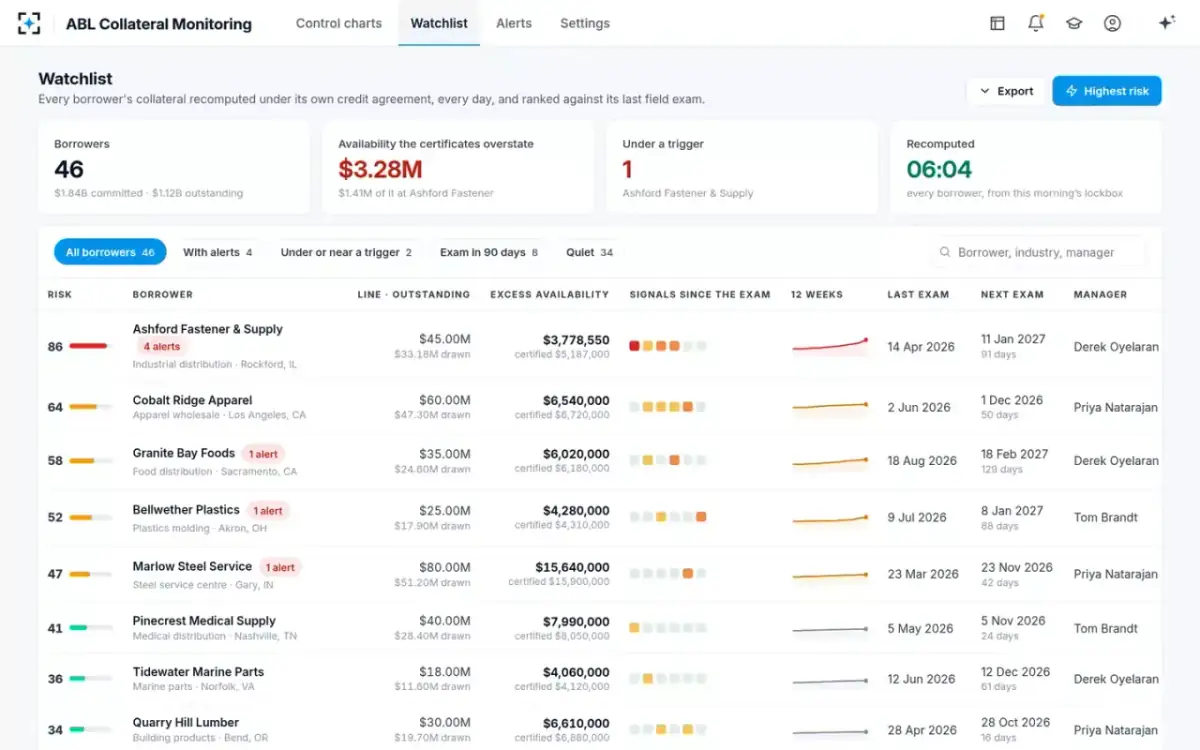
The watchlist screen below is what a recomputing system adds that a spreadsheet or a portal cannot: every borrower's availability, as certified and as recomputed, side by side, ranked by how far apart the two numbers are. Across Bramwell's 46 borrowers, certificates overstate availability by $3.28 million in total — not because any one certificate is dishonest, but because a borrowing base certificate, by its nature, is the number the borrower's own process produced.
The watchlist: every borrower, certified against recomputed
Do I need software to monitor a borrowing base?
Not always, and not at every size. A lender with a handful of simple, well-behaved borrowers, modest concentration, clean agings and a collateral manager with time to re-check the arithmetic by hand can run a disciplined spreadsheet process and catch most of what matters. The case for moving past a spreadsheet grows with the number of borrowers, the complexity of each agreement's eligibility rules, and the volatility of any one customer's receivables: Tremont's 23.6% concentration did not appear overnight, and a monthly review has one chance a month to catch a trend that can clear a limit in weeks.
The honest question is not "software or not" but how much of the eligibility testing a lender wants to repeat by hand every certificate, for every borrower, forever. A spreadsheet answers that question once, for one borrower, on the day someone does the arithmetic. A recomputing system answers it every morning, for every borrower, from that morning's files.
Where spreadsheets and portals still do the job well
Neither approach is obsolete. A spreadsheet remains the fastest way to track a short list of borrowers whose agreements are simple and whose concentration never comes close to a limit; building or buying a recomputing system for three clean borrowers is more process than three clean borrowers need. A portal earns its place wherever the paperwork itself is the friction — chasing a late certificate by phone and email is real cost, and a portal that collects documents on schedule removes it regardless of what reads the documents afterward. A lender can also run a portal for intake and a recomputing system for the arithmetic, which is a reasonable division: let the portal solve delivery, and let the agentic system solve eligibility.
Spreadsheet, portal and agentic system, on the same certificate
Spreadsheet or portal: The borrower's own total, typed or uploaded.
Agentic system: The borrower's total next to a number recomputed from the aging and the agreement.
Spreadsheet or portal: Caught only if someone pulls the aging and checks it by hand.
Agentic system: Tested against the agreement's own limit on every aging, every morning.
Spreadsheet or portal: Reviewed when the credit-memo register is read, often monthly or quarterly.
Agentic system: Measured from the register daily, with the reserve the agreement calls for.
Spreadsheet or portal: A gap in the tracking sheet until someone chases it.
Agentic system: Flagged the morning a file does not arrive.
Spreadsheet or portal: Whatever notes the collateral manager kept alongside the sheet.
Agentic system: Every adjustment cites the certificate page, aging line or agreement clause behind it.
How does collateral monitoring software recompute availability?
A recomputing system needs four inputs it reads itself rather than takes on faith: the aging or inventory detail behind the certificate, the credit agreement's own eligibility definitions, the credit-memo register, and the lockbox or bank file that shows what has actually been collected. From those four it rebuilds the borrowing base the way the agreement defines it — eligible receivables at the agreed advance rate, less reserves — rather than the way the borrower's own spreadsheet happened to calculate it. The difference shows up only when a borrower's number and the agreement's own arithmetic diverge, which is also the only time it matters.
Speed is part of what makes this worth doing daily rather than at the certificate's own cadence. ABL Collateral Monitoring's six agents read Ashford's lockbox and sales journal every morning at 06:00, across all 46 of Bramwell's borrowers, and the watchlist above is rebuilt by 06:04 — well before certificate 41 would next be due. How to calculate a borrowing base, step by step works the Ashford arithmetic all the way through.
Time to see a drift, by approach (estimated)
Choosing between the three for your own portfolio
Size the decision to what a wrong certificate would cost, not to how many borrowers are on the book. A single over-concentrated customer at one mid-sized borrower produced a $1.67 million swing in approved availability at Ashford; multiply that kind of gap across a portfolio and a spreadsheet's monthly cadence is the slower half of the exposure, not the documents it tracks. The checklist below is the question to ask of any of the three, including a recomputing system bought from a vendor rather than built in-house.
Which approach fits which portfolio
- How many borrowers, and how concentrated is each one’s receivables?
A handful of low-concentration borrowers is a spreadsheet’s strength; a book with customers near their limits needs daily eligibility testing.
- How often does the aging actually move between certificates?
A borrower whose top customer can cross a limit in weeks needs more than a monthly look.
- What does late paperwork cost today?
If chasing certificates is most of the collateral manager’s week, a portal alone is worth adding before anything else.
- Can the team re-test every agreement’s own eligibility rules, by hand, every certificate?
If not reliably, that is the gap a recomputing system closes first.
- Does the output cite its source?
An examiner asking why a number changed needs the certificate page, aging line or clause behind it, not a recollection.
Whichever approach a lender runs today, the question certificate 41 answers for Ashford is the one worth asking of its own portfolio: not whether the paperwork is organized, but whether anything is testing it. What a defensible file looks like sets out the checks a recomputed borrowing base should pass, and ABL Collateral Monitoring shows the watchlist, the borrower cockpit and the six agents behind them together.
Questions people ask
What is collateral management software?
Any system a lender uses to track the collateral behind an asset-based loan — from a shared spreadsheet that records each borrowing base certificate, to a borrower portal that collects certificates online, to an agentic system that reads the certificate, aging and credit-memo register and recomputes the borrowing base under the credit agreement and flags changes. The three differ in whether the number shown is the borrower's own or a second, independently calculated one.
Do I need software to monitor a borrowing base?
Not at every size. A short list of simple, low-concentration borrowers can be tracked on a disciplined spreadsheet. The case for more grows with the number of borrowers, how close any customer sits to a concentration or cross-aging limit, and how often those limits actually move between certificates.
What's the difference between a borrower portal and collateral monitoring software?
A portal mainly solves delivery: it gives a borrower one place to upload a certificate and its schedules, on a schedule, instead of email or fax. Collateral monitoring software of the agentic kind solves arithmetic: it re-reads the aging and the agreement and produces a second, recomputed number next to the borrower's own. A portal can be the intake layer in front of either a spreadsheet or a recomputing system.
Can a spreadsheet track a borrowing base?
Yes, and for a simple book it can do the job well: it catches a late or falling certificate and, with discipline, a concentration creeping toward its limit. What it cannot do is independently test the borrower's own arithmetic against the agreement's eligibility definitions unless someone repeats that work by hand every certificate.
How does collateral monitoring software recompute availability?
It reads the aging or inventory detail behind the certificate, the credit agreement's own eligibility definitions, the credit-memo register and the lockbox file, then rebuilds the borrowing base the way the agreement defines it rather than the way the borrower's own process calculated it — eligible receivables at the agreed advance rate, less the reserves the agreement calls for.
What does good MIS look like for an ABL lender?
The OCC's Comptroller's Handbook ties good management information systems to identification, not storage: systems that let a lender spot over-advances and changes in collateral quality in time to act on them. A filing system that stores every certificate searchably is good record-keeping; it becomes good MIS once something in it is actually tested against a rule.