Asset-based lending software is easiest to evaluate the way a credit team already evaluates anything consequential: against files it has already judged, not against a live borrower where nobody yet knows the right answer. The strongest pilot for ABL Collateral Monitoring replays several months of borrowers a lender's own collateral managers and field examiners have already reviewed and closed, so every figure the system produces can be checked against a conclusion the team already reached by hand. A disagreement becomes something to investigate, not a reason to doubt either side blindly.
What follows is a method, not a sales process: what data a pilot needs, the checks it should pass before anyone relies on it for a live decision, and a week-by-week shape for a 30–60-day run. The regulatory language is quoted from the agencies' own guidance on model validation, read carefully for where it does and does not cover a system like this one.
Why the pilot starts on files you have already closed
A system tested only on new, live borrowers has no answer key: if it flags something a collateral manager did not catch, nobody yet knows whether the system found something real or made a mistake. A system tested on files the team already closed has an answer key built in — the certificate the collateral manager approved, the dilution reserve a credit committee already set, the concentration limit a field exam already confirmed. Every output the pilot produces on those files can be compared against a conclusion the lender's own people already reached and stand behind.
This is also how a lender finds the system's honest limits before they matter. If the eligibility and concentration checker misreads a specific agreement's unusual affiliate definition, that shows up as a disagreement with a file the team has already resolved — not as a live number nobody has time to double-check during a real month-end close.
What data a pilot needs: certificates, agings, credit memos, lockbox
The pilot needs the same documents the system reads in production, for a set of borrowers the team already knows well: borrowing base certificates as filed, the receivable aging and inventory detail behind them, the monthly credit-memo register, lockbox and bank files for the same period, the credit agreements and any amendments, and the prior field exam report the team compared against at the time.
What to hand over for a pilot, borrower by borrower
- Three to six months of borrowing base certificates
As filed, with whatever corrections your team already made by hand.
- The receivable aging and inventory detail behind each certificate
Matching the certificate dates, not a more recent snapshot.
- The monthly credit-memo register
By customer and reason, for the same months.
- Lockbox and bank files for the same period
Daily if your own review already uses daily receipts.
- The credit agreement and every amendment in force
Including any side letter that changes a standard eligibility definition.
- The last field exam report for each pilot borrower
What the exam found, and whether anything in the certificate changed afterward.
How does validation work for a system that isn't a "model"?
The Federal Reserve, OCC and FDIC's 2026 model risk guidance states plainly that "generative AI and agentic AI models are novel and rapidly evolving. As such, they are not within the scope of this guidance" (SR Letter 26-2 / OCC Bulletin 2026-13) — but the same letter is explicit that a bank's own governance still applies: "a banking organization's risk management and governance practices should guide the determination of appropriate governance and controls for any tools, processes, or systems not covered in this document." In practice, that means borrowing the validation discipline the guidance describes for traditional models, even though the letter of it does not name agentic AI.
Two pieces of that discipline translate directly to a pilot. First, timing: "validation generally occurs prior to a model's first use" — the pilot is that validation, run before the system touches a live decision. Second, method: "outcomes analysis compares model outputs to corresponding real-world outcomes to assess model performance relative to model objectives and business use" — which is exactly what replaying closed files does, comparing the system's recompute against the real outcome a collateral manager already reached.
What the OCC already says about automated monitoring systems
The OCC's Asset-Based Lending handbook has a section on exactly this kind of tool, and it is the most direct statement of what a pilot should prove. It starts from the problem: "tracking, monitoring, and reporting ABL collateral can be a manual, time-intensive process prone to human error and fraud. Many banks find this type of monitoring difficult and have sustained losses as a result." It then lists the benefits automated systems can provide "when properly implemented": lower losses from credit risk and fraud, "because the systems enhance the bank's ability to detect problems early and minimize the risk of borrower fraud"; reduced administrative costs; "a standardized approach to ABL risk management"; and a better relationship with the borrower through faster feedback.
Two phrases in that passage set the pilot's agenda. "When properly implemented" is the condition a replay on closed files tests: whether the system reads this lender's agreements and documents correctly. And the handbook adds that "the OCC expects banks and their boards of directors to properly oversee and manage third-party relationships" — a reference, in the 2017 text, to guidance since replaced by the agencies' 2023 interagency guidance on third-party relationships, which applies to a monitoring vendor like any other.
The handbook's claimed benefits, and the pilot evidence for each
| Benefit the OCC lists | What a pilot should show | Where it shows up |
|---|---|---|
| Detecting problems early | Alerts on closed files that arrive before the team’s own review found the issue | Dates of first alert against dates of the original finding |
| Minimising the risk of borrower fraud | Recomputed bases that flag what certificates left out | Disagreements traced to aging lines and agreement clauses |
| Reduced administrative cost | Hours per borrower before and during the parallel run | The team’s own time records |
| A standardized approach | The same tests applied to every borrower, every day | The pilot’s test log, borrower by borrower |
The checks a pilot should pass before go-live
A pilot is not a demonstration that the system runs; it is a specific set of checks against the lender's own closed files, each with a stated pass condition.
Pilot checks, what each one tests, and what a pass looks like
| Check | What it tests | A pass means |
|---|---|---|
| Does it tie to the aging and inventory you already closed? | Whether the reader extracts figures correctly from your own certificates and supporting reports | Every figure matches, to the dollar, what your team already verified by hand |
| Does it recompute under your own agreement’s definitions? | Whether concentration, cross-aging and affiliate rules are read correctly from your specific credit agreements | The recomputed base matches what a collateral manager would calculate by hand from the same agreement |
| Does its dilution reserve match what your team would propose? | Whether the dilution analyst’s reserve calculation follows your agreement’s own formula | Within a small, explainable tolerance of your team’s own number, with the difference traceable to a specific line |
| Does every figure cite a page and a line? | Whether a result can be checked against the document it came from | A reviewer can open the cited document and find the figure, every time |
| Does a disagreement with your file get flagged, not hidden? | Whether the system surfaces a mismatch rather than quietly favoring one number | Every disagreement is visible, with both figures shown side by side |
None of these checks requires trusting the system's own account of itself. Every recompute is cited to the certificate line, aging entry or agreement clause it rests on, so a reviewer checks the citation, not a claim.
What to do when the system disagrees with your own file
A disagreement during a pilot is the most useful thing it can produce, and it needs a fixed process rather than an ad hoc call. The first question is always which side is wrong: did the system misread a document, misapply a clause, or did the team's original review miss something, which is possible, since a certificate accepted without a full recompute is exactly the gap continuous monitoring is built to close. The second question, once the cause is known, is whether it is a configuration problem (an agreement clause read incorrectly) or a genuine limit of the approach (a document format the reader cannot extract reliably).
How a pilot resolves a disagreement, step by step
Agent
The system’s recomputeProduces a figure — a borrowing base, a dilution reserve, a concentration percentage — cited to its source document and line.
A person decides
The pilot teamCompares it against the file’s already-closed conclusion for the same period.
A person decides
The pilot teamWhere the two disagree, traces both back to the same underlying document to find which one is right.
A person decides
The pilot teamClassifies the cause: a misread document, a misapplied clause, or a genuine extraction limit — and records it before the next test file.
Running beside the team for a cycle before handing anything over
After the closed-file replay, the next stage is running the system beside the live team for one full certificate cycle — reading the same new certificates the collateral manager is reading, in parallel, without anyone acting on its output yet. This catches what a historical replay cannot: how the system handles the ordinary friction of a live month, a late certificate, an amended agreement arriving mid-cycle, a format the borrower changed without notice.
Re-checking a live borrower with the morning's new files, before anyone acts on it
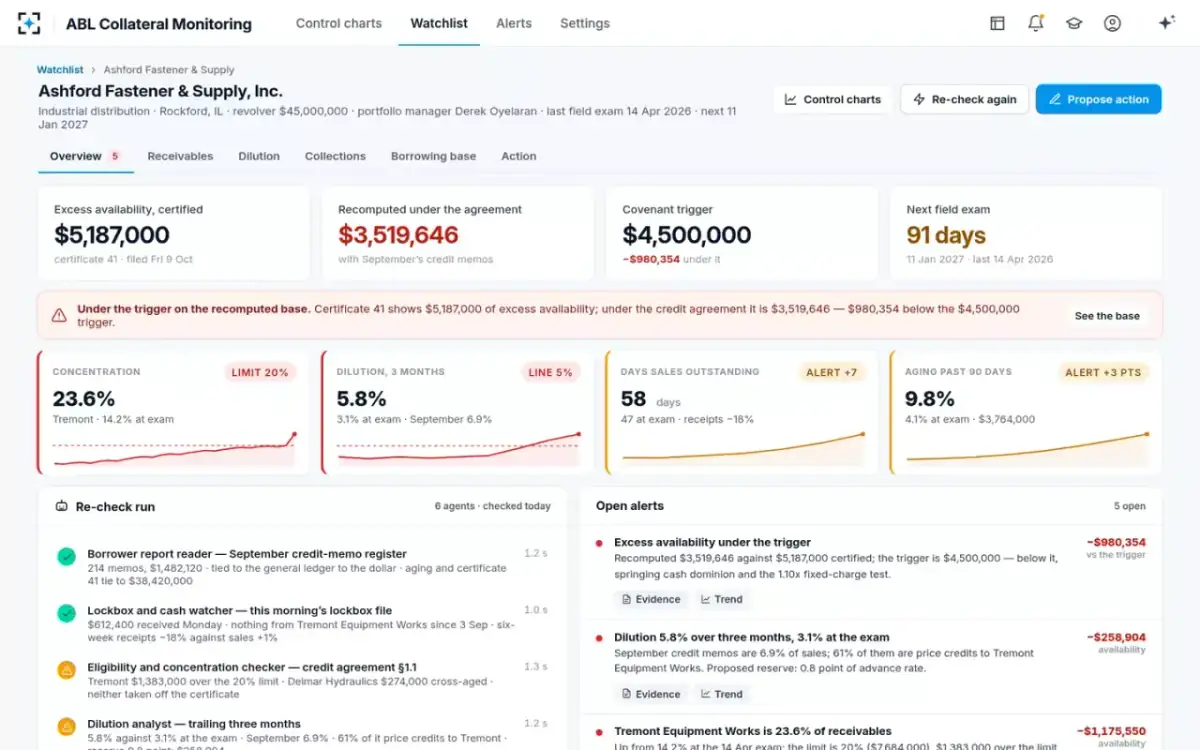
Only once a full cycle has run beside the team, with disagreements understood and resolved, does the system's output move from a second opinion to the number the desk acts on first.
What a 30–60-day pilot plan looks like, week by week
A pilot that starts on closed files and ends running beside the team might take the shape below, though the exact length depends on how many borrowers and how varied the credit agreements are.
A 30–60-day pilot, from replay to running beside the team
- Gather documents for 5–10 closed borrowers4 d
- System recomputes; team compares to its own closed conclusions6 d
- Resolve disagreements, classify each one4 d
- System reads new certificates in parallel, unused≈2 cycles
- Compare each cycle’s output to the team’s own reviewongoing
- System’s output used for a subset of borrowers firstphased
What should a collateral monitoring pilot test?
Beyond the accuracy checks above, a pilot should test three things that only show up once the system meets a lender's actual documents: whether it reads the specific certificate and aging formats the lender's own borrowers use, without a lengthy setup for every new format; whether its citations are specific enough that a collateral manager or an examiner can verify a figure without extra work; and whether disagreements surface clearly enough that nobody is tempted to just trust the system's number without checking it, especially once it has been right several times in a row.
The watchlist a pilot's outcomes-analysis step compares against the team's own ranking
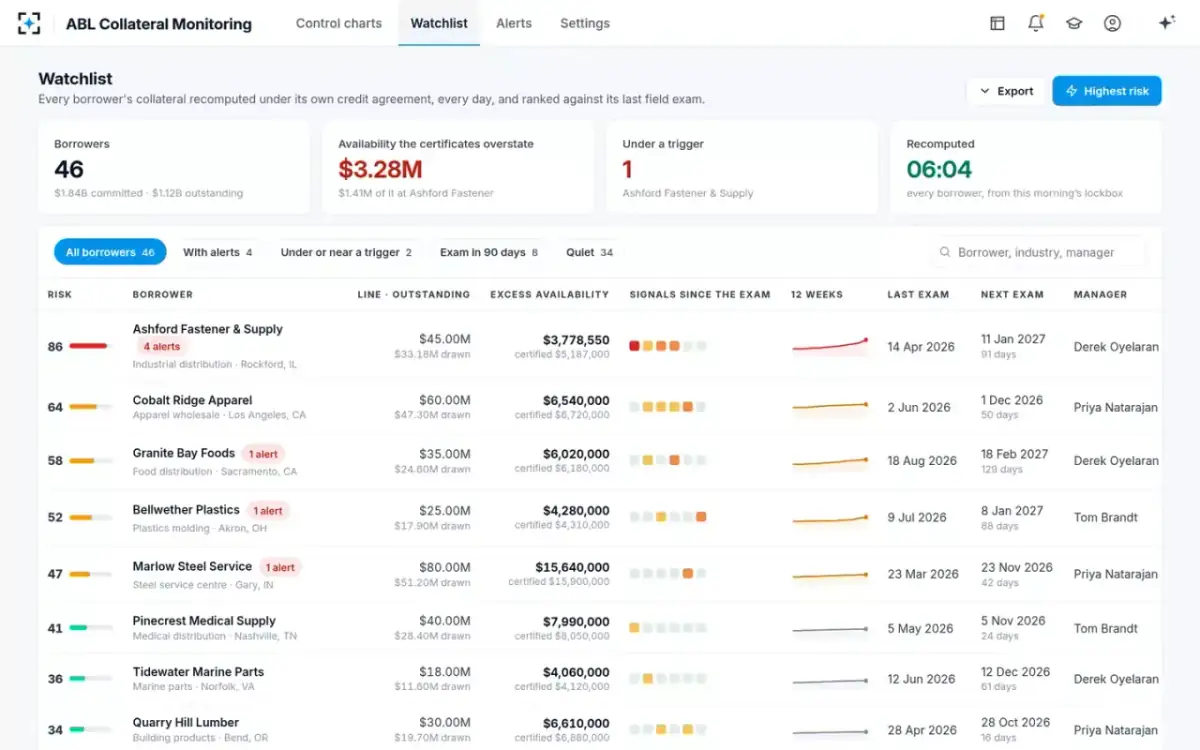
A pilot, against a full go-live
Pilot: Is compared against a conclusion the team already reached, or runs beside a live review unused.
Full go-live: Becomes the number the collateral manager starts from each morning.
Pilot: The pilot team, deliberately looking for one.
Full go-live: The collateral manager, as part of the normal morning review.
Pilot: Nothing — the team’s own closed file or live review is still the record of truth.
Full go-live: A decision made on a figure the team should have questioned.
Pilot: About 30–60 days, in the plan above.
Full go-live: Ongoing, with every alert still ending in a person’s decision.
A pilot built this way answers the only question that actually matters before go-live: not whether the system is impressive on a demonstration borrower, but whether it agrees with the lender's own team on the files that team has already judged. To walk through a borrower the way a pilot would, start from ABL Collateral Monitoring.
Questions people ask
How do I test asset-based lending software before buying it?
Replay several months of borrowers your own team has already reviewed and closed, and compare the software's output against the conclusions your team already reached. A pilot built this way gives every result an answer key, rather than asking a credit team to trust a live number nobody has independently checked yet.
What data do I need to pilot collateral monitoring software?
Borrowing base certificates as filed, the receivable aging and inventory detail behind them, the credit-memo register, lockbox and bank files for the same period, the credit agreement and its amendments, and the last field exam report for each pilot borrower.
How long does an ABL software pilot take?
We plan a closed-file replay at one to two weeks and running the system beside a live team for a certificate cycle or two at another four to six weeks, so a full pilot, from replay to a decision on go-live, runs about 30 to 60 days.
How do you validate an AI model before relying on it?
Bank regulators describe two relevant practices: validating before first use, and outcomes analysis — comparing the system's outputs against real-world results it should match. A pilot that replays closed files and compares the system's recompute against the team's own already-reached conclusion is a direct application of both, even for a system the guidance does not yet formally name.
What happens if the pilot disagrees with my own team?
Trace both the system's figure and the team's original conclusion back to the same underlying document to see which one is right, then classify the cause — a misread document, a misapplied agreement clause, or a genuine limit of the approach — before moving to the next test file. A disagreement caught in a pilot costs nothing; the same disagreement after go-live is a decision made on a number nobody questioned.
Is agentic AI exempt from model validation?
It is outside the scope of the Federal Reserve, OCC and FDIC's current model risk guidance by name, but the same guidance expects a bank's own risk management and governance practices to cover any tool it does not name. In practice, that means applying the same validate-before-use and outcomes-analysis discipline the guidance describes for traditional models, rather than treating the absence of a specific rule as an absence of any requirement.