A field exam in asset-based lending is an on-site review, typically by the lender's own field examiners, that tests a borrower's reported collateral against its actual books and records: confirming receivables directly with customers, counting or sampling inventory, and reconciling the credit-memo register against the general ledger. It exists because a borrowing base certificate is the borrower's own number, and an exam is how a lender periodically checks it against something the borrower does not control. The question this guide answers is not whether field exams matter — they do, and nothing below argues otherwise — but how their scope and timing get decided, and what changes once daily collateral data, rather than a calendar and a general sample, is available to help decide it. ABL Collateral Monitoring's action recommender proposes exactly this kind of rescoping, for a named person to approve.
What a field exam actually tests, and how often
A field exam's core work is independent verification: confirming a sample of receivables directly with the customers who owe them, observing or testing inventory counts, and tracing the credit-memo register and the cash receipts journal back to the general ledger and bank statements. The Comptroller's Handbook sets the baseline cadence examiners expect a bank to apply to its own borrowers: "a field audit should be conducted before a new account is booked and regularly thereafter—often quarterly but more frequently if risk dictates. In a high-risk relationship or workout situation, weekly or daily audits may be appropriate". The cadence is already meant to flex with risk; what is harder, in practice, is knowing which borrower's risk has changed enough to justify moving its exam up, and which specific parts of the file deserve attention when it does.
How is a field exam's scope decided today?
A field exam schedule is usually set by the credit agreement and the lender's own policy, with the interval tied to the credit's risk, and the sample is built when the exam is planned. The OCC asks its own examiners to check that process at the bank, not just its results: the examiner "should review how the bank determines the frequency and scope of field audits." Without a systematic record of which transactions, customers or months looked unusual since the last visit, a lender's examiner can only build that sample from the file as a whole and the certificates themselves, read after the fact.
What the OCC asks a field audit to test
The handbook's own instructions describe what a field exam is for in specific terms. The field auditor "should obtain written account verifications and perform sufficient reconciliations and testing to ensure that the borrower's financial records are accurate." On dilution, it is more pointed still: "the bank should carefully analyze trends or significant changes in dilution rates, and a field auditor should review and test selected credit memos." And on fraud, the reason to look at all: "because fraud can significantly reduce collateral values, a bank should make sure not to advance funds against nonexistent collateral."
Read against Ashford's open alerts, those instructions already name the tests. A dilution alert built from September's credit memos is the handbook's "review and test selected credit memos." A concentration alert on Tremont is a case for written account verifications from Tremont itself. A collections slowdown is a reconciliation of the lockbox to the cash receipts journal and the bank. The handbook does not say how to choose which credit memos or which accounts; daily data answers that by pointing at the ones that moved.
What changes when two or more alerts are open on one borrower
ABL Collateral Monitoring's rule is specific: when two or more alerts are open on one borrower at once, the action recommender proposes a targeted exam, with its sample drawn directly from what the alerts already show rather than built from scratch. On Ashford Fastener & Supply, four things were true at once on 12 October 2026: a concentration alert on Tremont Equipment Works, a cross-aging alert on Delmar Hydraulics, a dilution alert tied to September's credit memos, and a collections-slowdown alert on Tremont's own payments. Each alert already names a customer, a time window and a document trail; scoping the exam from them means the examiner starts with a hypothesis to test rather than a blank sample to build.
From open alerts to a rescoped exam
Agent
Trend and risk scorerRaises alerts with their evidence once two or more are open on one borrower.
Agent
Action recommenderDrafts a targeted exam scope, with each test tied to a specific open alert.
A person decides
Portfolio manager and field examinerReview the proposed scope and the earlier date, and approve or adjust it.
Never: The exam date and scope are never applied without a person's approval.
A person decides
Field examiner on siteRuns the targeted tests, confirming each alert directly with the evidence it names.
Four tests instead of the whole file: a worked example
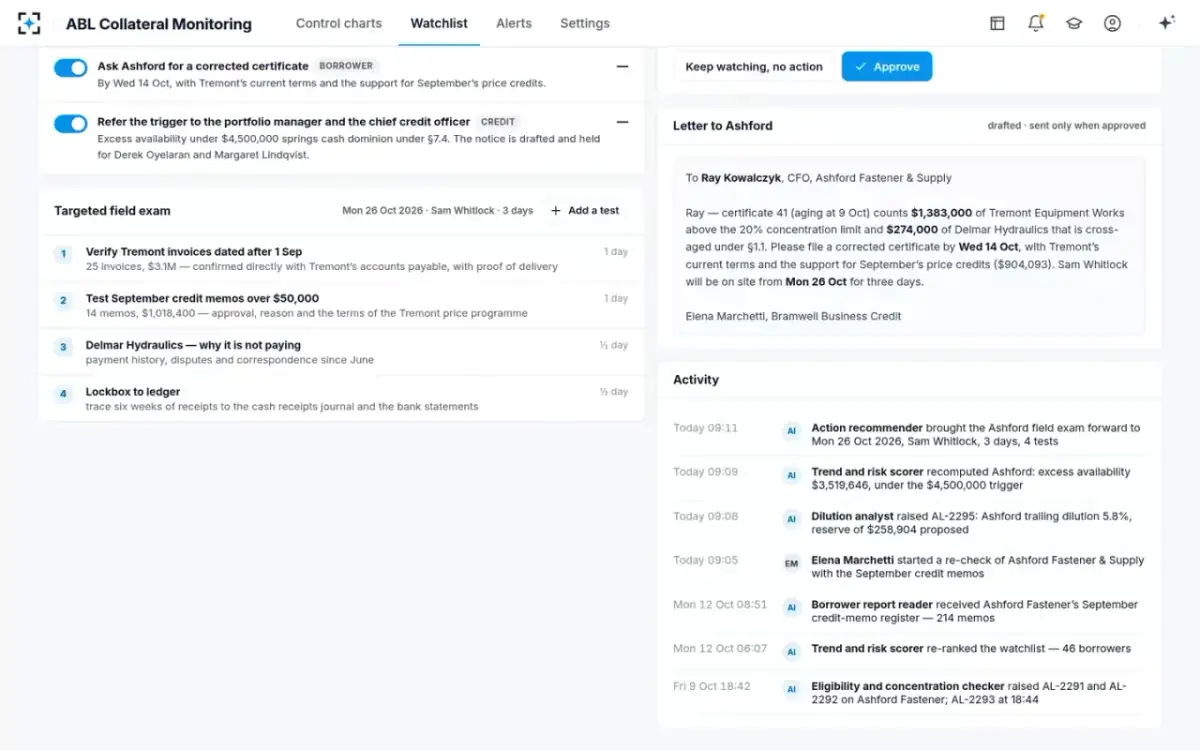
Ashford's proposed scope on 12 October was four tests, each tied to one of its open alerts rather than drawn from a general sample: confirming 25 Tremont invoices dated after 1 September directly with Tremont's own accounts payable department, testing September's credit memos over $50,000 against the agreement's dilution definition, investigating why Delmar Hydraulics had stopped paying, and tracing six weeks of lockbox receipts to the cash receipts journal and bank statements. Every test answers a question the daily data had already raised; none of them is a general confirmation sample chosen because the file was due for one.
Ashford's four-test scope, each tied to its alert
| Test | What it confirms | Which alert it answers |
|---|---|---|
| Verify 25 Tremont invoices dated after 1 Sep | Confirmed directly with Tremont’s accounts payable, with proof of delivery | Concentration: Tremont at 23.6%, over the 20% limit |
| Test September credit memos over $50,000 | 14 memos, $1,018,400, against the agreement’s dilution definition | Dilution: 5.8% against the 5% line |
| Delmar Hydraulics — why it is not paying | Payment history, disputes and correspondence since June | Cross-aging: 55% past 90 days |
| Lockbox to general ledger | Six weeks of receipts traced to the cash receipts journal and bank statements | Collections: receipts down 18% while sales held |
What a "targeted examination" already means to a bank regulator
Scoping an exam to a specific question, rather than running a full-file review every time, is not a new idea; it already describes how the largest bank examiners allocate their own time. A GAO review of how the OCC supervises the largest banks found that its own large-bank examination teams "conduct multiple targeted examinations throughout the year. These examinations focus on a particular bank product, function, or risk" (GAO-19-69, Large Bank Supervision), alongside the full-scope annual examination federal statute requires. The analogy here is to the method — narrowing an examination's scope to the risk that is actually live — not a claim that the OCC's own rules for examining banks govern how a lender runs its internal ABL field exams; those are a bank's own credit-policy decision.
Bringing a field exam forward: what has to be true first
Moving an exam date up is a scheduling decision with a real cost: it pulls a field examiner off another borrower's planned work, and it should be justified by something more specific than a single borderline reading. ABL Collateral Monitoring's rule ties the recommendation to two or more open alerts on the same borrower, which is a higher bar than any single alert alone, and the recommendation always goes to a named person — on Ashford, the portfolio manager and the field examiner's own schedule — rather than moving automatically. Ashford's exam moved from 11 January 2027 to Monday 26 October 2026, with Sam Whitlock booked for three days, once Elena Marchetti and Derek Oyelaran reviewed the proposed scope and approved it alongside the rest of the day's actions.
The scope and the date are not independent decisions, either. A four-test scope that confirms a narrow set of alerts can usually be fit into whatever gap a field examiner's calendar has in the next week or two, where a full-sample exam brought forward would need the same days a general review normally takes, crowding out whichever other borrower was next in line. That is part of why tying the recommendation to specific, evidenced alerts matters beyond simply justifying the decision: it also keeps the exam itself short enough that bringing it forward does not quietly cost the rest of the examiner's book its own scheduled attention.
Field audit frequency: quarterly, to weekly or daily in a high-risk relationship
- Scheduled field exam interval~90 days
- Weekly audit7 days
- Daily audit, where warranted1 day
What a field exam still does that daily data cannot
Daily data recomputes the borrowing base from documents the borrower itself has already supplied: the aging, the credit-memo register, the lockbox file. None of that independently confirms the documents are accurate in the first place. Only an examiner on site, calling a customer directly to confirm a receivable is real and the amount is correct, or physically counting inventory, produces evidence the borrower's own reporting cannot manufacture on its own. The charges in the First Brands and Tricolor cases describe a gap of exactly this kind: receivables and pledges that, the authorities allege, looked complete and consistent in the documents lenders were given. What those two collapses changed in how lenders watch collateral follows that argument from the regulators' own filings. A field exam and daily recomputation answer different questions, and a targeted exam scoped by alerts still needs the independent confirmation only a person on site can get.
A full-sample exam against an alert-scoped exam
Full-sample exam: General sampling guidance, applied to the file as a whole.
Alert-scoped exam: The specific alerts open on this borrower since the last exam.
Full-sample exam: A blank sample to build from the file.
Alert-scoped exam: A hypothesis to confirm: a named customer, time window and document trail.
Full-sample exam: The next scheduled date, regardless of what has changed since the last exam.
Alert-scoped exam: Brought forward when two or more alerts are open at once, on approval.
Full-sample exam: Independent confirmation with customers and physical inventory checks.
Alert-scoped exam: The same independent confirmation — scoping changes what is tested, not whether it is tested independently.
Can a field exam be brought forward?
Yes, and the Comptroller's Handbook already expects it in a higher-risk relationship, recommending weekly or even daily audits where risk dictates rather than holding every borrower to the same quarterly or annual interval. What daily collateral data adds is a specific, documented reason to bring a particular exam forward, rather than relying on a portfolio manager noticing informally that a borrower looks worse than usual. The OCC's own Spring 2026 Semiannual Risk Perspective makes the same point about the broader private credit market it oversees: growth in lending to private credit funds and rising concentrations at some banks make "careful monitoring of borrower performance and refinancing risk... increasingly important" — a statement about the whole market, not asset-based lending specifically, but the same logic applies at the level of one borrower's file.
The targeted exam and the letter, drafted and held
Questions people ask
What is a field exam in asset-based lending?
An on-site review of a borrower's collateral records, typically performed by a lender's own field examiners, that independently verifies what a borrowing base certificate reports: confirming receivables directly with customers, testing inventory, and tracing the credit-memo register and cash receipts to the general ledger and bank statements.
How often are ABL field exams conducted?
The Comptroller's Handbook describes a field audit before a new account is booked and regularly thereafter, often quarterly, more often as risk dictates, and weekly or daily audits where a relationship is high-risk or in workout. The actual interval is set in the credit agreement and a lender's own credit policy.
What's the difference between a field exam and an audit?
In asset-based lending the terms are often used interchangeably for the same on-site, independent verification of collateral; some lenders reserve "audit" for a formal, documented procedure and "exam" more loosely, but both describe testing the borrower's reported collateral against evidence the borrower does not control, such as direct customer confirmations.
Can a field exam be brought forward?
Yes. Nothing requires a lender to wait for a scheduled date if risk changes; the Comptroller's Handbook itself expects more frequent audits, down to weekly or daily, for a higher-risk relationship. Daily collateral monitoring gives a specific, documented reason — such as two or more open alerts on one borrower — to move a particular exam up rather than relying on informal judgment alone.
What does a field examiner actually test?
Direct confirmation of a sample of receivables with the customers who owe them, observation or testing of inventory, and tracing the credit-memo register and cash receipts journal back to the general ledger and bank statements — independent evidence a borrower's own certificate or reporting cannot substitute for.
How is a field exam's scope decided?
Traditionally, from general sampling guidance applied to the file as a whole, without a systematic record of what has changed on that specific borrower since the last exam. Where daily alerts are available, a scope can instead be drawn directly from what the alerts already show — a named customer, time window and document trail for each open alert.