Asset-based lending AI, in the form most lenders are actually trying, is not one model that decides things. In Botminds' ABL Collateral Monitoring, it is six specialist agents, each with one job and a written limit on what it may never do: a reader that extracts figures, a watcher that reads cash, a checker that recomputes a borrowing base, an analyst that measures dilution, a scorer that ranks risk, and a recommender that drafts a proposal. The collateral manager is the seventh step, and the only one that decides.
That division is not an accident of software design. It mirrors, almost line for line, the separation of duties an asset-based lending unit already has to keep under its own examiners, and it sits inside the boundary regulators have so far drawn around AI in banking: propose and recompute, never decide. The figures and screens below come from a working, fictional sample at Bramwell Business Credit; the regulatory language is quoted from the agencies' own guidance, linked where it appears.
The six agents, and what each one touches
Borrower report reader opens first, reading certificates, agings, inventory reports and credit-memo registers the moment they arrive, and ties every figure to the page and line it came from. Lockbox and cash watcher reads each day's bank and lockbox files at 06:00, watching receipts, DSO and the roll-forward for a customer that has stopped paying. Eligibility and concentration checker takes what the first two found and recomputes the borrowing base under the specific credit agreement's own definitions — concentration, cross-aging, past-due, affiliates. Dilution analyst works the credit-memo register into a dilution rate and the reserve the agreement calls for. Trend and risk scorer plots every measure against control limits built from that borrower's own history and ranks the whole portfolio. Action recommender turns whatever is still open into one proposal: ineligibles, a reserve, a targeted exam, a letter.
Six agents, one collateral manager: who touches a drift from first read to final decision
Agent
Borrower report readerReads certificates, agings, inventory reports and credit-memo registers as they arrive, extracting each figure with its page and line.
Never: corrects the borrower’s own numbers
Agent
Lockbox and cash watcherReads each day’s lockbox and bank files at 06:00: receipts by customer, collections against sales, DSO and the roll-forward.
Never: moves or applies cash
Agent
Eligibility and concentration checkerApplies the credit agreement’s own definitions — concentration, cross-aging, past due, affiliates — and recomputes the borrowing base.
Never: changes an agreement’s definitions, or files a certificate
Agent
Dilution analystMeasures dilution by month, reason and customer, and works out the reserve the agreement calls for.
Never: sets the reserve
Agent
Trend and risk scorerPlots every borrower’s daily measures against limits from its own history, ranks the portfolio and raises alerts with their evidence.
Never: closes an alert
Agent
Action recommenderTurns open alerts into a proposal: ineligibles, a reserve, a targeted exam and a borrower letter.
Never: sends a letter before approval, or triggers a covenant
A person decides
Elena Marchetti, collateral managerReads every proposal, decides what is a reserve, an ineligible or a referral, and approves up to $500,000.
What none of the six agents may ever do
Each agent's job description is really two lists: what it does, and what it may never do. The borrower report reader never corrects a figure it disagrees with — if a certificate's number looks wrong, the discrepancy becomes a flag, not a silent fix. The lockbox watcher never moves or applies cash. The eligibility checker recomputes the base but never files a certificate or rewrites an agreement's definitions. The dilution analyst proposes a reserve and stops there. The scorer raises an alert and cannot close one. The action recommender drafts a borrower letter and a covenant referral, and neither goes out until a person approves it.
What each agent may do, and what it may never do
| Agent | Does | Never |
|---|---|---|
| Borrower report reader | Extracts figures with their page and line | Correct a borrower’s reported number |
| Lockbox and cash watcher | Flags a customer that stops paying | Move or apply cash |
| Eligibility and concentration checker | Recomputes the borrowing base and availability | Change the agreement’s own definitions, or file a certificate |
| Dilution analyst | Proposes a dilution reserve, with the credit memos behind it | Set the reserve |
| Trend and risk scorer | Ranks every borrower and raises an alert with its evidence | Close an alert, or decide it needs no action |
| Action recommender | Drafts a letter, an exam scope and a referral | Send the letter, or trigger a covenant or cash dominion |
Is agentic AI a "model" under bank examiners' own guidance?
Not yet, by the regulators' own words, and that absence is worth reading carefully rather than taking as reassurance. The Federal Reserve, OCC and FDIC's 2026 revision to model risk management guidance says plainly: "Generative AI and agentic AI models are novel and rapidly evolving. As such, they are not within the scope of this guidance" (SR Letter 26-2 / OCC Bulletin 2026-13). That is not the same as agentic AI being unregulated. The same letter adds that "a banking organization's risk management and governance practices should guide the determination of appropriate governance and controls for any tools, processes, or systems not covered in this document" — in plain terms, a bank is still expected to govern an agentic tool with the same rigor, even though no single rulebook yet tells it exactly how.
The OCC's own supervisory read of the industry, published the same year, describes banks moving carefully: "Banks are taking a measured approach to the adoption of generative AI (genAI) and agentic AI, with usage generally limited to specific use cases with guardrails and human-in-the-loop accountability to manage risk" (OCC, Semiannual Risk Perspective, Spring 2026). Guardrails and human-in-the-loop accountability are exactly the two things the six-agent design is built around: a limit on what each agent may touch, and a person at the end of every path that leads to money moving or a covenant firing.
Why reading is not the same as deciding
The useful distinction inside "AI in asset-based lending" is between reading and deciding, and it is easy to blur the two once a system starts producing numbers that look like answers. Reading is extraction and arithmetic: pulling a figure off a scanned certificate, tying it to an aging line, recomputing a formula the credit agreement already defines. None of that is new judgment — it is work a collateral manager already does, done faster and on every borrower every day instead of once a month on a sample.
Deciding is different in kind, not degree: choosing that a drift is a real problem rather than noise, that a reserve of this size is the right response, that a borrower's explanation is credible. The six agents in ABL Collateral Monitoring sit entirely on the reading side of that line, however sophisticated the reading gets — recomputing a borrowing base under a 40-page credit agreement is still reading, just reading done thoroughly. The four human seats that carry a borrower's collateral keep every decision the six agents are built never to make.
The eligibility and concentration checker: recomputes, never files
This agent does the single most consequential piece of reading in the chain: applying a specific credit agreement's own eligibility rules — which receivables count, which are excluded for concentration or age, which customer relationships are affiliates — to the latest aging and inventory data, and producing a recomputed borrowing base and excess availability. On Ashford Fastener & Supply, that recompute found $1,383,000 of Tremont Equipment Works' receivables over the 20% concentration limit and $274,000 of Delmar Hydraulics excluded for being more than 50% past 90 days, neither of which the filed certificate had removed.
What the agent never does is treat that recompute as final. It does not file a corrected certificate with anyone, and it does not change the agreement's definitions if a result looks inconvenient. The recompute is an input to a person's decision, cited back to the specific aging line and agreement clause it came from, so the collateral manager can check the agent's work rather than simply trust it.
The dilution analyst: proposes a reserve, never sets one
Dilution — credit memos, discounts and write-offs that shrink what a receivable actually collects — is one of the harder numbers to catch early, because a single month's credit memos rarely look alarming on their own. The dilution analyst reads the credit-memo register by month, reason and customer, compares the trailing rate with what the last field exam found, and calculates what reserve the credit agreement's own formula calls for once dilution crosses its threshold. On Ashford, three-month dilution of 5.8% against a 5% line, and $512,600 of credit memos to one customer in 30 days against $168,400 a month the year before, produced a proposed reserve of $258,904.
The agent proposes that number and stops. Setting a reserve — making it real, reducing the availability a borrower can draw against — is the collateral manager's decision, recorded with a name and a time, because a reserve has an immediate dollar effect on a client relationship and belongs with the person accountable for that relationship, not with the agent that spotted the pattern.
The action recommender: drafts a letter that is never sent unapproved
Once the other agents have read, watched, checked and scored, the action recommender turns whatever is still open into one proposal: which ineligibles and reserves to take, what a targeted exam should test and when, and a draft letter to the borrower. On Ashford it proposed six actions at once — removing Tremont's excess and Delmar's cross-aged balance, taking the dilution reserve, moving Sam Whitlock's field exam from 11 January to 26 October, requesting a corrected certificate, and referring the covenant trigger.
"A banking organization's risk management and governance practices should guide the determination of appropriate governance and controls for any tools, processes, or systems not covered in this document."
Federal Reserve, OCC and FDIC, SR Letter 26-2 / OCC Bulletin 2026-13 (2026-04-17)
Every one of those six actions waited. The letter to the borrower does not leave until a person approves it; the referral does not trigger cash dominion on its own. The agent's draft is the labor of assembling a coherent response; the decision to send it is never the agent's to make.
What happens when an agent's recompute disagrees with the certificate?
This is the moment the whole design is built for, and it is worth walking through concretely. Ashford's certificate 41 claimed $5,187,000 of excess availability. The eligibility checker, recomputing under the agreement's own definitions with the morning's data, found $3,519,646 — under the $4,500,000 covenant trigger. The two numbers disagree by $1,667,354, and nothing in the system resolves that disagreement automatically.
Every borrower's measures, the morning a disagreement surfaces
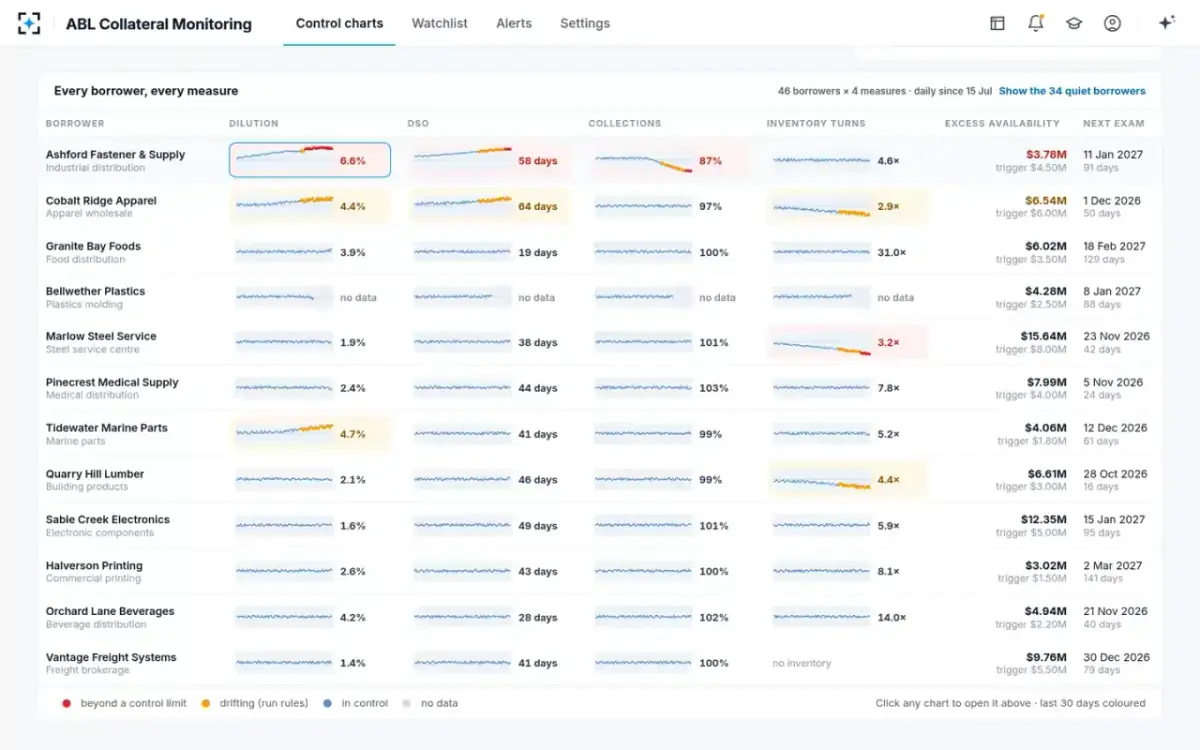
What happens next is a person's review, not an override. Elena Marchetti opens the borrower, sees the certified and recomputed figures side by side, and re-runs the agents on the morning's new files — the September credit-memo register and the latest lockbox receipts — before deciding anything. The recompute held at $3,519,646, now confirmed against the new files, and the borrower's risk score rose from 86 to 91. Only then does the proposal go to the two approvals it needs.
What an agent produces, against what a person decides
The agents: Recomputes excess availability under the agreement’s own definitions, cited to the aging line and clause.
The collateral manager and chief credit officer: Reads the recompute against the trend and the last exam before acting on it.
The agents: Proposes a dilution reserve from the credit-memo register.
The collateral manager and chief credit officer: Approves it, up to $500,000; above that, a second signature.
The agents: Scopes a targeted exam from the open alerts and a date from the schedule.
The collateral manager and chief credit officer: Books the examiner, and owns what the exam finds.
The agents: Drafts the borrower letter and the covenant referral.
The collateral manager and chief credit officer: Approves it before it is sent, or sends it back.
Can agentic AI do this safely under today's rules?
The honest answer is: safely enough to pilot, under the governance a bank already owes any tool that touches credit decisions, and not yet under a rulebook written specifically for it. NIST's own AI Risk Management Framework exists because, as the agency puts it, there is a general need "to better manage risks to individuals, organizations, and society associated with artificial intelligence" (NIST AI RMF) — a voluntary framework, not a banking rule, but a useful checklist for the governance questions a bank's own risk committee should be asking regardless of whether a specific regulation names agentic AI yet.
What keeps the six-agent design on the safer side of that uncertainty is structural, not promised: every agent's limits are written down, every figure is cited to its source, and every action with money or covenant consequences waits for a named person. A pilot that replays a lender's own closed borrower files first is how that structure gets tested before it touches a live decision.
To see the six agents and the collateral manager's seat working on one borrower, start from ABL Collateral Monitoring.
Questions people ask
How does AI work in asset-based lending?
In ABL Collateral Monitoring, it works as six specialist agents, each limited to one task — reading documents, watching cash, recomputing a borrowing base, measuring dilution, scoring risk, and drafting a proposal — feeding a collateral manager who makes every decision. None of the six agents acts on a borrower's account or sends anything to a borrower without approval.
Can AI approve a loan reserve?
No. The dilution analyst proposes a reserve, with the credit memos and the agreement clause behind it, but the collateral manager decides whether to take it, and above $500,000 of availability effect a chief credit officer co-approves. The proposal is never final until a named person signs it.
What can't AI do in collateral monitoring?
It cannot correct a borrower's reported figures, move or apply cash, change a credit agreement's own definitions, file a certificate, close an alert, set a reserve, or send a letter or trigger a covenant without approval. Every one of the six agents in ABL Collateral Monitoring has a written "never" alongside its job.
Is agentic AI regulated like a model?
Not specifically, yet. The Federal Reserve, OCC and FDIC's own 2026 model risk guidance states that "generative AI and agentic AI models are novel and rapidly evolving" and are "not within the scope of this guidance," while still expecting a bank's existing risk management and governance practices to cover any tool the guidance does not name.
Does AI replace the field examiner?
No. The agents recompute a borrowing base from documents a borrower has already sent; a field examiner independently verifies those documents against the underlying business — calling customers, counting inventory, testing controls on site. Daily data changes when and how narrowly an exam is scoped, not whether one happens.
What does human-in-the-loop mean for asset-based lending?
It means a named person reviews and approves every action with a financial or covenant consequence before it takes effect: a reserve, an ineligible, a targeted exam, a borrower letter, a covenant referral. The OCC's own 2026 risk report describes exactly this pattern — agentic AI used "with guardrails and human-in-the-loop accountability to manage risk" — as the shape banks are actually adopting it in.