The collateral monitoring process at an asset-based lender is often written up as one job: monitor borrowing base certificates, track covenant compliance, liaise with credit. At a bank that runs asset-based lending the way examiners expect, it is four seats, and the four seats exist because the regulator already requires the split: nobody who controls a borrower's collateral should also be the one who approved the loan. Botminds' ABL Collateral Monitoring sits across all four seats — the collateral manager who watches daily, the portfolio manager who owns the relationship, the field examiner who tests it on site a few times a year, and the chief credit officer who signs off above a limit. What changes with continuous monitoring is not how many seats there are; it is what each one spends the week doing.
The people below — Elena Marchetti, Derek Oyelaran, Sam Whitlock and Margaret Lindqvist — are characters in a working, fictional sample bank, Bramwell Business Credit, with 46 borrowers and $1.12 billion outstanding. The regulatory figures are sourced where they appear; the rest is the sample bank's own data, labelled as such.
Four duties the regulator keeps apart, on one sample book
4
duties the OCC’s own Handbook says an ABL unit must keep separated: credit approval, collateral and cash control, field audits and portfolio management
46
borrowers on the fictional sample bank’s book
$1.12bn
outstanding across those borrowers, sample data
The four seats that carry one borrower's collateral
One borrower's file passes through four pairs of hands before a problem either gets fixed or gets missed. The collateral manager reads what the borrower sends, every week or month. The portfolio manager owns the relationship and the covenant conversation that follows a bad number. The field examiner leaves the building, a few times a year, to test what the borrower says against the underlying records. The chief credit officer signs the decisions too large for anyone else to make alone. None of the four can do another's job and still keep the separation a regulator expects — the OCC's Comptroller's Handbook for Asset-Based Lending is explicit that "ABL departments should be structured with a distinct separation of administrative duties between employees responsible for credit approval, collateral/cash proceeds control, field audits, and portfolio management," and warns that "lending units that allow employees to perform conflicting roles can increase the bank's operational risk" (OCC, Asset-Based Lending).
That separation is not a chart on a wall; it is why a drift in Ashford Fastener & Supply's receivables has to travel through four different judgments before anyone acts on it. The collateral manager notices it first, on a control chart. The portfolio manager hears about it in terms of the relationship. The chief credit officer is the one person who can authorize a reduction large enough to matter. The field examiner is the one who eventually walks the warehouse floor and counts what is actually there. Six agents now do the reading and the recomputing between those four people, but none of the four seats disappears.
The same borrower, four seats — before and with the agents reading and recomputing
Today
Sees each of 46 borrowers once a month in a spreadsheet; the trouble starts in the weeks between.
With agents
Starts every morning on control charts for every borrower, with the transactions behind any point past a limit.
Still theirs: Deciding which alert becomes a reserve, an ineligible or a referral.
Today
Hears about a collateral problem from the borrower, or from the next exam.
With agents
Hears first, with what it costs in availability and the covenant referral already written up.
Still theirs: Owning the relationship, and the conversation about the covenant.
Today
Arrives on site to test a sample of the whole file, on a date set months ago.
With agents
Gets the date brought forward and a scope of four tests drawn from the open alerts.
Still theirs: Testing on site — what no daily measure replaces.
Today
Is asked to approve a reserve without the trend since the exam behind it.
With agents
Co-approves above $500,000 with the trend, the recomputed base and the proposal on one screen.
Still theirs: The second signature above the collateral manager’s limit.
What does a collateral manager do?
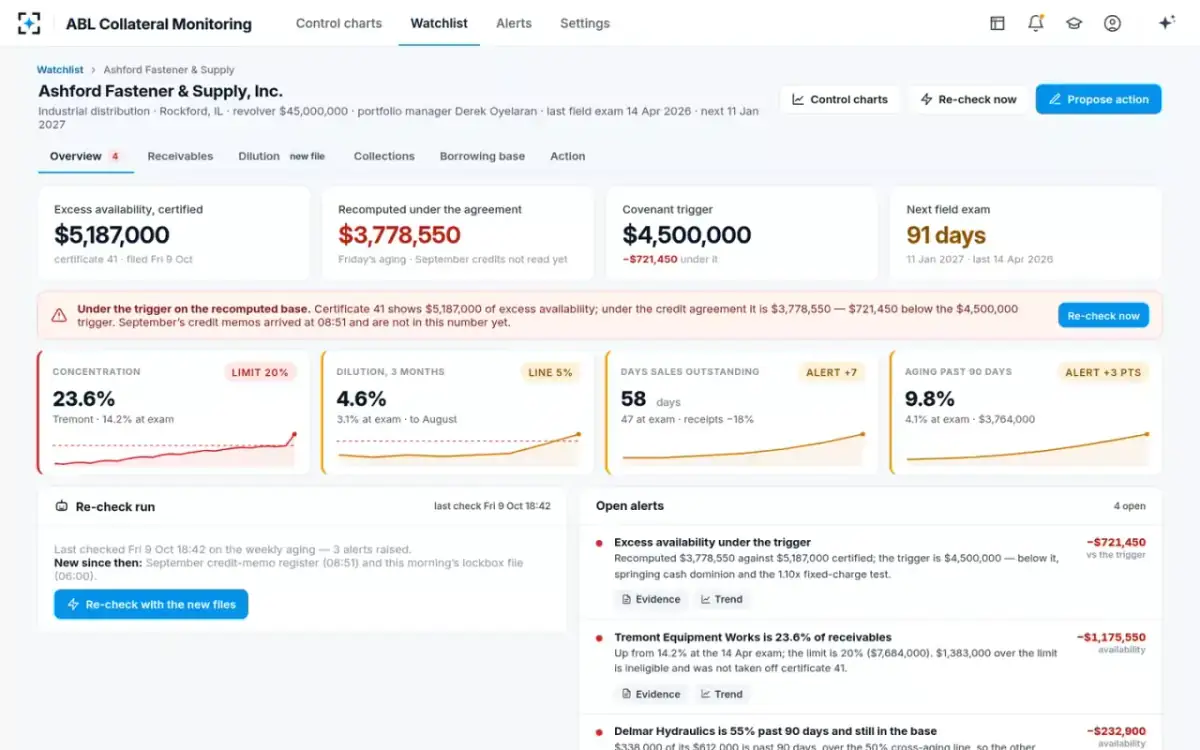
A collateral manager's actual job is reconciliation under time pressure: tie the borrowing base certificate the borrower filed to the receivable aging and inventory reports behind it, check that nothing in the credit agreement's own definitions has been missed, and decide whether what changed since last month is noise or a problem. At Bramwell, Elena Marchetti carries 46 of those borrowers. On paper that is a monthly review; in practice it means catching a customer concentration that crept from 14.2% to 23.6% of receivables somewhere between two certificates, or a $512,600 jump in credit memos to one customer that the certificate itself never flags, because the certificate only shows the total.
What makes the job hard is not the arithmetic. A borrowing base is eligible collateral times an advance rate minus reserves, and the formula itself is not complicated. What is hard is noticing, inside one certificate among dozens, that a number which still passes every covenant has been drifting for three months. Reading every aging line by hand, every month, for every borrower, is the job a collateral manager actually has — and it is also the part of the job most likely to miss a slow-moving problem, because a human reviewer's attention is not evenly spread across 46 borrowers that all look fine on the surface.
The field examiner's seat: a sample, not the whole file
A field examiner does not read certificates; a field examiner leaves the office. "Field audits are integral to monitoring and controlling ABL," the OCC's Handbook says. "A field audit helps detect fraud and financial weakness and is a customary way to confirm the quality of the borrower's financial data, receivables, inventory, and internal controls" (OCC, Asset-Based Lending). Sam Whitlock, the lead field examiner at Bramwell, tests a sample: he pulls invoices, calls customers to confirm balances, counts inventory, and checks that the borrower's internal controls are what the certificate assumes they are. The Handbook calls for "dedicated field audit staff that includes skilled accountants," and for the exam itself to happen "before a new account is booked and regularly thereafter — often quarterly but more frequently if risk dictates," with weekly or daily audits reserved for "a high-risk relationship or workout situation."
The limit of the seat is sampling. A field exam tests what it has time to test, on the day it happens, and the schedule for most borrowers is set months in advance regardless of what the collateral is doing between visits. That is the seat continuous monitoring changes most directly: when Ashford's daily data already shows two or more alerts open at once, the exam stops being a routine sample and becomes a scope built from exactly what the alerts found, on a date that can move up rather than wait for the calendar.
The portfolio manager: hearing about trouble first, or last
A portfolio manager's job is the relationship: Derek Oyelaran at Bramwell carries twelve of them, and his job is to know each borrower's business well enough that a certificate's numbers make sense in context — a seasonal dip, a customer that paid late for a good reason, a plan to refinance. What a portfolio manager cannot do, under the same separation of duties the OCC's Handbook requires, is also be the one who tests or approves the collateral behind the number. His seat is built on being told, promptly, when something in the collateral has moved.
The difference continuous monitoring makes to this seat is the order information arrives in. Today, a portfolio manager often hears about a collateral problem from the borrower itself, framed the way the borrower wants it framed, or from the next field exam, months after the fact. With daily control charts already running, Derek sees Ashford ranked at the top of a recomputed watchlist, with the covenant-trigger referral already drafted, before he has a conversation with anyone at the company. Hearing first, with the number already recomputed under the agreement, changes what that conversation is about — a plan, not a surprise.
What the portfolio manager and the collateral manager open on the same borrower
What does a chief credit officer check before a second approval?
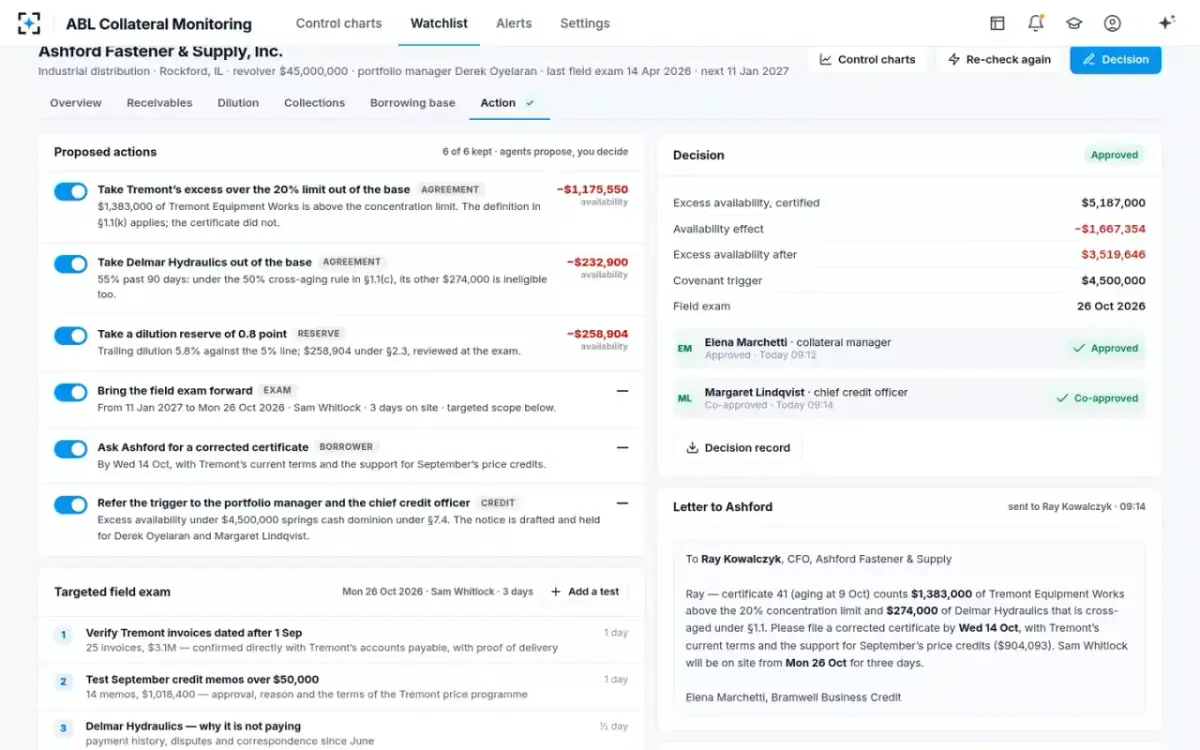
A chief credit officer's seat exists for one reason: some decisions are too large, or touch the bank's own exposure too directly, for one person to make alone. At Bramwell, Margaret Lindqvist co-approves any availability reduction above $500,000 and is the one the agents' covenant-trigger referrals go to. What she checks before signing is not the arithmetic a collateral manager already ran; it is the trend behind it — whether this is a single bad certificate or the third quarter of a pattern, whether the exam that already happened agrees with what the certificate now shows, and whether the proposed action (a reserve, an ineligible, a targeted exam, a letter to the borrower) actually matches the size of the problem.
On Ashford, that meant reviewing a $1,667,354 reduction in availability: Tremont Equipment Works over its concentration limit, Delmar Hydraulics cross-aged past the 50% line, and a dilution reserve the certificate had not booked. Each of the three pieces has its own agreement clause behind it, and Margaret's approval is recorded with her name and the time, on top of Elena's — the second signature the OCC's separation of duties is written to require once the first approver's limit is reached.
Why the handoffs cost more than the reviews
Every one of the four reviews above is fast on its own. What is slow is the handoff between them: concentration lives in the aging, dilution lives in the credit-memo register, collections live in the lockbox file, and the comparison with the last exam lives in a field examiner's own workpapers, filed somewhere else entirely. A collateral manager reviewing a certificate by hand is really reconciling four separate files that were never built to talk to each other, once a month, for 46 borrowers.
How one drift alert moves from a control chart to an approved decision
Agent
Trend and risk scorerFlags a measure past its control limit, every morning, with the transactions behind it.
Never: closes an alert
A person decides
Elena Marchetti, collateral managerOpens the alert, recomputes the base and decides whether it is a reserve, an ineligible or a referral.
Agent
Action recommenderDrafts the proposal: ineligibles, a reserve, a targeted exam date and scope, a borrower letter.
Never: sends the letter before approval
A person decides
Elena MarchettiApproves up to $500,000 of availability effect.
A person decides
Margaret Lindqvist, chief credit officerCo-approves above $500,000, on one screen with the trend and the recomputed base.
A person decides
Sam Whitlock, field examinerRuns the targeted exam, scoped to the open alerts, on the date brought forward.
The handoffs are also where separation of duties earns its cost. Because a collateral manager cannot also run the field exam, and a portfolio manager cannot also approve an ineligible, every finding has to cross a seat boundary before it becomes a decision. That crossing is valuable — it is the actual control — but it is also where a drift sits unnoticed the longest, because nobody owns the gap between two people's files. What a month of that reconciliation costs, in hours, across a whole portfolio is close to a fixed number per borrower regardless of how large the book is.
A separation of duties the regulator already expects
None of this four-seat structure is a Botminds idea. It is what examiners already look for when they review an ABL unit, and a bank that collapses the seats into fewer people is the one an examiner flags. The OCC's Handbook flags the same risk of closeness in the collateral itself: it lists affiliate receivables as commonly ineligible because they "can also increase the potential for fraud, particularly in times of financial stress." The logic — keep the check away from the party who benefits from the number — is the same logic that keeps a collateral manager's review separate from a portfolio manager's relationship and a chief credit officer's sign-off.
What continuous monitoring adds to an already-required structure is evidence for each seat to act on sooner. The separation does not get cheaper to maintain; it gets faster to feed. A collateral manager still owns the decision, a portfolio manager still owns the relationship, a field examiner still has to leave the building, and a chief credit officer still signs above the limit — the four-seat structure a regulator already expects is exactly what stays in place.
What each seat's week looks like with daily control charts
The clearest way to see what changes is to watch one month of a collateral manager's time move. By hand, reading the certificate and tying it to the aging alone takes about a quarter of the month's hours on one borrower; concentration, cross-aging, credit memos, dilution and the comparison with the last exam fill most of the rest, and deciding what to do about any of it is a small fraction of the time spent. With the agents reading, tying out and recomputing every borrower each morning, the mechanical reconciliation shrinks, and the hours shift toward the two things only a person's judgment can do: reading what the dilution and the collections trend actually mean, and deciding.
One borrower, one collateral manager's month: where the hours go, before and after
By hand, before
- Reading the certificate · 25%
- Lockbox & DSO · 17%
- Concentration & cross-aging · 17%
- Credit memos & dilution · 17%
- Comparing with the exam · 17%
- Deciding & approval · 7%
With the agents, after
- Reading the certificate · 11%
- Lockbox & DSO · 11%
- Concentration & cross-aging · 11%
- Credit memos & dilution · 22%
- Comparing with the exam · 22%
- Deciding & approval · 23%
The same shift shows up in every seat, not only the collateral manager's. A portfolio manager's week moves from reacting to a borrower's own account of a problem toward reviewing a referral that already states the number. A field examiner's year moves from a fixed sampling calendar toward a scope built from what the alerts actually found. None of the four seats gets smaller; each one spends less of its week on reconciliation and more of it on the decision the seat exists to make.
Where the desk's judgment still has to be a person's
What none of the agents behind these charts may do is as deliberate as what they do. The trend and risk scorer never closes an alert; the action recommender never sends a borrower letter before someone approves it; nothing proposes a reserve as final. Every one of the four seats above keeps the part of the job that is a judgment call: whether a drift is a pattern or a one-off, whether a customer's slow payment is a sign of real trouble, whether the file in front of a chief credit officer justifies the number being asked for. What the six agents behind these screens may never do is the other half of this seat-by-seat story.
The decision the two senior seats make together, recorded with both names
Staffing an ABL desk, in other words, is not a question of how many people a bank can afford to put on collateral. It is a question of whether the four seats the OCC already expects have what they need to act on a drift in days rather than at the next scheduled exam. To see what the collateral manager's own morning looks like on this borrower, start from ABL Collateral Monitoring.
Questions people ask
What does a collateral manager do?
A collateral manager ties each borrower's borrowing base certificate to the receivable aging and inventory reports behind it, checks the credit agreement's own eligibility rules — concentration, cross-aging, past-due, affiliates — and decides whether a change from the prior period is noise or a problem. At a lender with 40 or more borrowers, that review usually happens once a month per file, by hand, unless the certificates are being recomputed and charted daily instead.
What does a field examiner do in asset-based lending?
A field examiner leaves the office to test what a borrower's certificate claims: pulling invoices, confirming balances with customers, counting inventory, and reviewing the borrower's own internal controls. The OCC's Handbook calls for this on a new account and then "often quarterly but more frequently if risk dictates," with weekly or daily audits reserved for a high-risk relationship.
What does a portfolio manager do in ABL?
A portfolio manager owns the borrower relationship: understanding the business behind the numbers, managing the covenant conversation, and bringing in the chief credit officer when a decision needs a second signature. Under the separation of duties the OCC's Handbook describes, the portfolio manager does not also test or approve the collateral — that is kept with the collateral manager and the field examiner.
What does a chief credit officer check before a second approval?
Above a collateral manager's own approval limit — $500,000 of availability effect in Bramwell's settings — a chief credit officer reviews the trend behind the number, not just the number itself: whether the certificate's problem is new or has been building for several quarters, what the last field exam already found, and whether the proposed reserve or ineligible actually matches the size of what changed.
How is collateral monitoring staffed at a bank?
In four seats the OCC expects to keep apart: credit approval, collateral and cash control, field audits and portfolio management. The collateral manager reads the borrower's certificates and reports, the field examiner tests them on site a few times a year, the portfolio manager owns the relationship, and the chief credit officer approves decisions above a limit. Continuous monitoring changes what each seat does in a week, not how many seats there are.
What's the difference between a collateral manager and a field examiner?
A collateral manager works from what the borrower sends — certificates, agings, credit-memo registers — on a recurring schedule, usually monthly. A field examiner leaves the building to independently verify a sample of what the borrower reported, on a schedule set by risk — often quarterly, by the OCC's description, and more often when the relationship is troubled. The two seats are kept separate so that the person reconciling the paperwork is never the only one who has seen the collateral itself.