A toxicology study monitor is the sponsor scientist who owns a contract laboratory's study on the sponsor's side: the person who agrees the protocol, follows the study in life, reads the draft report inside the laboratory's comment window, decides which of its findings are adverse, confirms the no-observed-adverse-effect level, and signs to say the sponsor has reviewed it. The job is awkward by design, because the monitor controls none of the work being judged. Under United States Good Laboratory Practice the contract laboratory's study director is the single point of study control, and the sponsor's duty runs to telling that laboratory the work is part of a regulated study — not to directing its conclusions. Botminds' Toxicology Report Review is built for that seat: six agents read each draft as it arrives, pull every finding, exposure value and page citation out of it, compare the summary against the tables, and hand the study monitor a list of what does not agree, for her to decide and sign.
Everything on this page describing one study — the drug, the contract laboratory, the people and the findings — is fictional sample data from the solution, not a customer's result. The rules, the duties and the inspection interval come from the regulations and FDA documents linked where they appear.
What does a toxicology study monitor do?
A toxicology study monitor does five things, in a loop that repeats per study: agrees the design, watches the study in life, reviews the draft report, sends numbered comments to the contract laboratory, and signs the sponsor's review of the final. Four of the five are reading and writing. Only one of them — the review of the draft — happens on someone else's clock, and that is the one that sets the rhythm of the week.
The title varies. Sponsors call the seat study monitor, study director (confusingly, since that word already belongs to the laboratory), nonclinical study manager, or simply the responsible toxicologist. The duties do not vary much. One person is named against each study, that person reads the draft and that person's comments go back to the laboratory. On a mid-size programme the same person may carry a dozen studies a year across two or three laboratories, and three drafts can land in one month.
Where the 22.4 hours of one draft review go, and where 6.4 hours go instead
Reviewing one 13-week draft by hand · 22.4 hours
- Reading the draft and finding each section · 18%
- Summary against the tables and the individual listings · 31%
- Exposure values and the margins · 13%
- Protocol, amendments and dose formulation · 11%
- Comparing with the rest of the programme · 11%
- Deciding each issue, the comment letter, signing · 16%
Reviewing the same draft already read and checked · 6.4 hours
- Reading the draft and finding each section · 8%
- Summary against the tables and the individual listings · 23%
- Exposure values and the margins · 8%
- Protocol, amendments and dose formulation · 8%
- Comparing with the rest of the programme · 8%
- Deciding each issue, the comment letter, signing · 45%
The shape matters more than the total. By hand, about 85% of the week goes on finding what is wrong and about 15% on deciding it; with the finding already done, deciding takes 45% of a much shorter week. Nothing in the first band is judgement: it is a person holding page 6 against page 188 and page 389 to see whether three numbers agree. The second band — is this finding adverse, does this move the no-observed-adverse-effect level, is this worth a comment — is the part only the named toxicologist can do, and by hand it gets the smaller share of the week.
The split that defines the job: the CRO owns the study, the sponsor owns the conclusion
Good Laboratory Practice puts control of a study in exactly one place. For a study run at a contract laboratory, that place is the laboratory.
Part 58 gives the study director overall responsibility for how the study is technically run and for interpreting, analysing, documenting and reporting its results, and makes that person the single point of study control (21 CFR 58.33).
Read that rule as a study monitor and the shape of the job appears. Interpretation, analysis and reporting all sit at the laboratory. The monitor cannot rewrite a pathology narrative, cannot change a table, cannot decide what the report says. What the monitor can do is read, compare, ask and refuse: ask the study director to correct an error, ask for a value to be traced to its raw data, ask why the discussion and the summary disagree — and, failing that, say in the sponsor's own review that the sponsor does not accept the report's reading.
The sponsor's own duty under the regulations is short and specific. When a sponsor uses a contract laboratory, it must tell that laboratory what the work is: 21 CFR 58.10 requires the sponsor to tell the consulting laboratory, contractor or grantee that the work is part of a nonclinical laboratory study that has to be run in compliance with Part 58. That requirement is the sponsor's central written duty toward a contract laboratory in Part 58, and it is a notification, not a supervision right. Everything else a sponsor does with a draft report — the comparisons, the comment letter, the internal sign-off — is the sponsor's own quality work, and a sponsor that does none of it still has the submission to defend.
FDA is explicit that the two sides are meant to talk. In its guidance on pathology peer review, the agency writes that it "acknowledges the need for interactions between the sponsor or applicant and study personnel during the conduct of a nonclinical toxicology study under GLP" (FDA, Pathology Peer Review in Nonclinical Toxicology Studies, December 2021). The same guidance draws the line on the other side: the independence of the study pathologist and the peer-review pathologist "should be ensured by both the management of the nonclinical testing facility and the sponsor or the applicant." The sponsor is expected to be in the conversation and expected to keep its hands off the diagnosis.
Day one of the window: 412 pages, ten working days
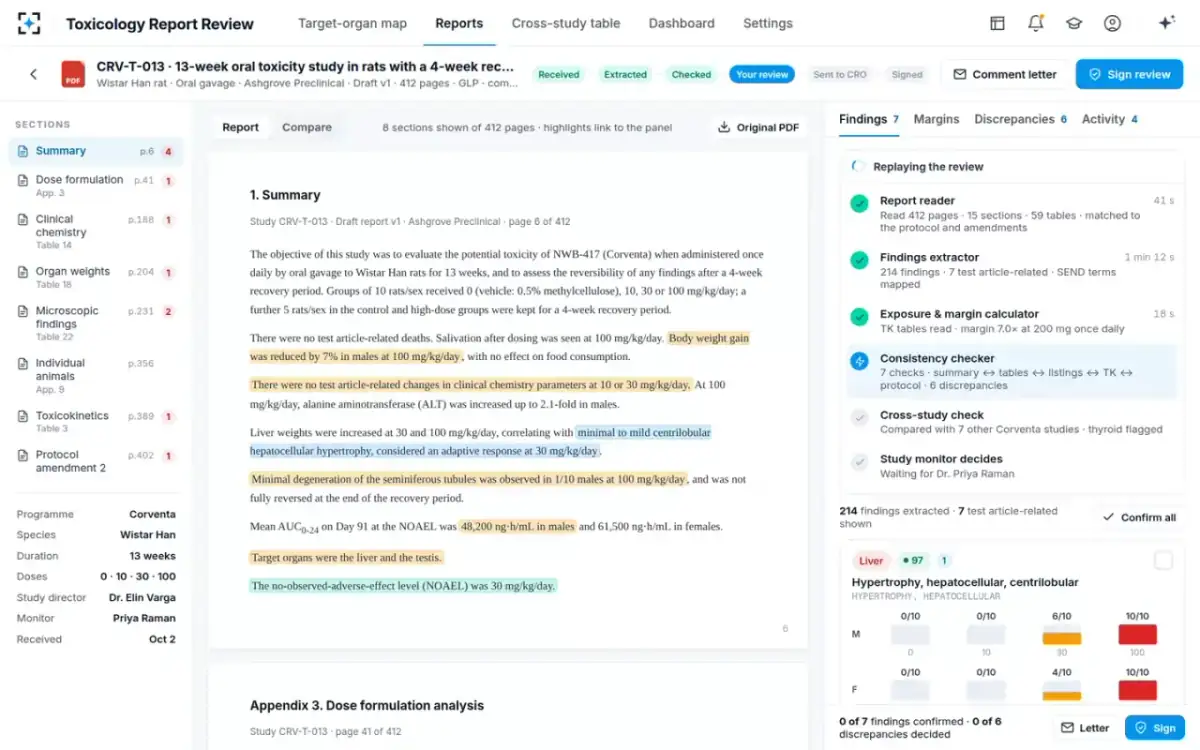
A draft report arrives as a single file, and the clock on it is contractual, not regulatory. Ten working days is a common comment window; fifteen and twenty are also written into statements of work, and the window is usually per laboratory rather than per study. In the sample programme the window with one laboratory is ten working days and the draft is 412 pages: a summary, methods, clinical pathology, organ weights, microscopic findings, individual animal listings, the toxicokinetic report, the protocol and two amendments.
One ten-working-day comment window, by hand and in Toxicology Report Review
- Reading and locating each section2 days
- Summary against the tables and listings3 days
- Exposure values and the margins1 day
- Protocol, amendments and formulation1 day
- Comparing with the programme1 day
- Deciding, the letter and the signature2 days
- Review, decide, comment letter, signature1 day
The second lane is not a shorter week; it is a week with the finding taken out of it. The reading, the cross-checking and the recomputing happen before the monitor opens the file, and what reaches her is a list of pairs: this sentence on page 6, that table on page 188, and the difference between them. Her 2.9 hours of deciding and writing barely move, because that part was never the problem.
Every draft, amendment and final across three programmes
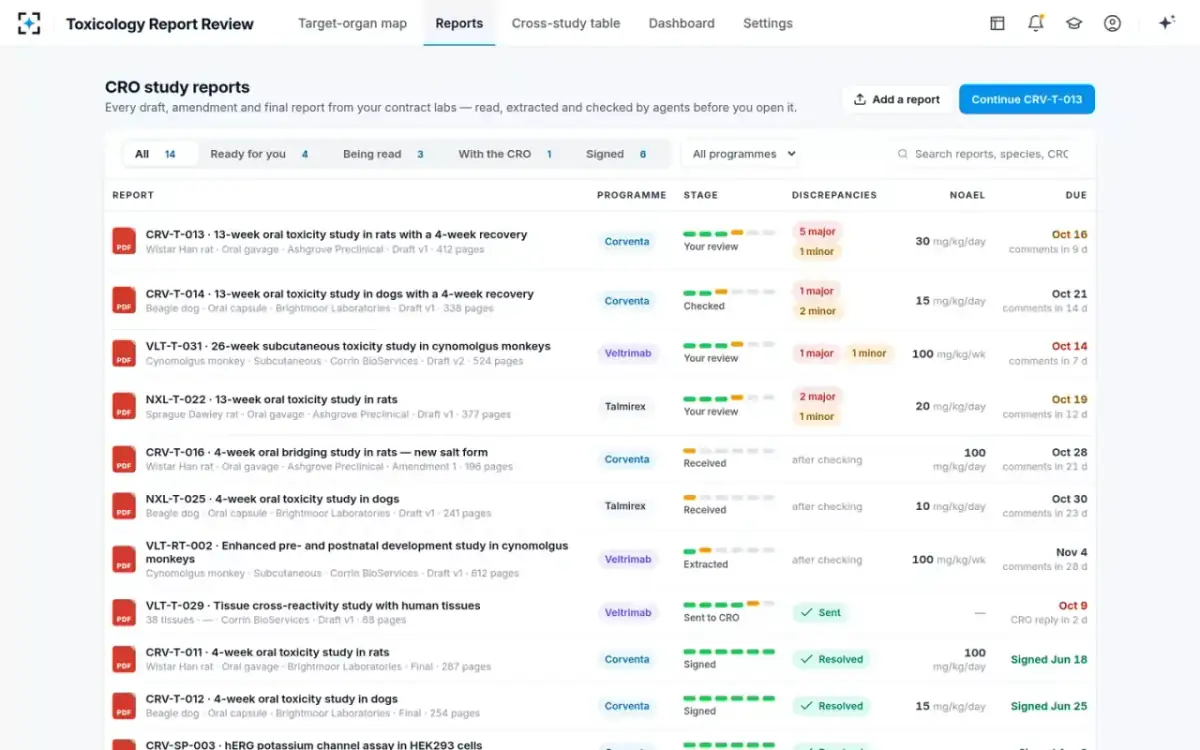
Four drafts ready at once is the ordinary case, not a bad month. Each has a different laboratory, a different species and a different due date, and the monitor's first decision of the week is which one to open, which is why the queue shows the window and not just the arrival date.
What a sponsor may ask a CRO to change — and what it may not
The useful distinction is between the report as a description and the report as a judgement. A sponsor may always ask for a correction to the first: a count that does not match the individual animal listing, an exposure value taken from the wrong sampling day, a table header in the wrong unit, a protocol deviation that happened and was not written down. These are errors of fact, the study director is responsible for the accuracy of the reporting, and correcting them before signature costs nothing.
The second is different. Whether a liver change at the mid dose is adaptive or adverse, whether a finding is test-article related, where the no-observed-adverse-effect level falls — these are the study director's and the study pathologist's interpretations. A sponsor may argue with them, in writing, with reasons; it may not instruct them. FDA's peer review guidance is written largely to protect this boundary, and the mechanism it recommends when the sponsor disagrees is a documented, transparent process, not a quiet redraft: diverging interpretations "should be addressed using a transparent and unbiased process that is clearly described in written procedures."
In practice the line is easy to hold if every comment is written as a question about the evidence. "Please correct the incidence in the summary and the pathology narrative; the individual animal listing names two animals" is a factual request. "Please reconsider calling this adverse" is not — and the honest version of it is a comment that sets out why, records the sponsor's position, and leaves the call where the regulation puts it. Where the disagreement survives the window, the sponsor states its own reading in its own review, which is what determining a no-observed-adverse-effect level actually comes down to.
Who else signs: the study director, the quality assurance unit, two pathologists
A draft report on a study monitor's desk already carries, or will carry, four other signatures, and knowing what each one certifies tells the monitor what is left for her to check.
The five signatures on one GLP study, and what each one covers
- The study director signs the final report
Under 21 CFR 58.185(b), and under 58.33 that signature carries overall responsibility for the technical conduct, interpretation, analysis, documentation and reporting of the study.
- The quality assurance unit signs a statement in the report
Under 21 CFR 58.35(b)(7) it specifies the dates inspections were made and findings reported to management and to the study director. It is a record of inspections, not a warranty that every number is right.
- The study pathologist signs the pathology report
FDA: "The pathology report is the sole responsibility of the study pathologist." The diagnoses and their interpretation are that person's, not the sponsor's and not the laboratory management's.
- The peer-review pathologist signs a separate peer-review statement
Included in the final study report — and FDA is explicit that this person should not sign the pathology report itself.
- The sponsor signs its own review
Nothing in Part 58 requires it. It is the sponsor saying what it has checked, what it asked for, and what it accepts — the record that answers "did anyone at the sponsor read this?" years later.
The quality assurance line is the one most often misread. The quality assurance unit does review the final report, and 21 CFR 58.35(b)(6) requires it to check that the report accurately describes the methods and standard operating procedures and that the reported results accurately reflect the study's raw data. But its statement in the report says when it inspected, not that it re-derived every figure, and it is the laboratory's own unit, not the sponsor's. A sponsor that treats the quality assurance statement as its own check has outsourced the question to the party whose work it is checking.
The four comparisons that find most of what is wrong
Most of what a study monitor catches comes out of four comparisons, run in the same order every time. They are mechanical, which is both why they take so long and why they can be done before she opens the file.
The four comparisons, and the kind of error each one catches
- The summary against the tables
Every number and statement in the summary found in the table behind it. Catches the mid-dose change left out of the summary, and the statement that there were no test-article-related changes over a table that shows one.
- The tables against the individual animal listings
Counts by dose and sex recounted from the individual animal data. Catches an incidence of 1/10 in the summary against 2/10 in the pathology table, with the listing naming both animals.
- The exposure values against the toxicokinetic report
The day, sex and dose group behind every exposure figure. Catches the summary that quotes Day 1 where it means the last sampling day — the single error most likely to move a margin.
- The report against the protocol and its amendments
Design, schedule and acceptance criteria against the signed protocol. Catches a dose formulation result outside the protocol's own range with no deviation recorded, and a schedule the report describes differently from the amendment that changed it.
In the sample draft these four turned up six differences, five of them classed major: an alanine aminotransferase change at the mid dose missing from the summary, a seminiferous tubule finding reported as 1/10 males where the pathology table says 2/10 and the listing names animals 4107 and 4112, a Day 1 exposure value quoted as the Day 91 value, a Week 6 formulation at 87.0% of nominal against a protocol range of 90–110% with no deviation recorded, a target organ present in the programme's other study and absent from this one's target organ list, and a table header reading "% body weight" over values in grams.
Only one of the six is interesting science. The third is the one that moves a number: with the correct Day 91 value, the exposure multiple at the planned clinical dose falls from 7.9× to 7.0×, and which row of a toxicokinetic table sets the margin is a decision worth making deliberately rather than by transcription.
Six agents read the 412 pages before the study monitor opens them
How many drafts can one study monitor carry?
There is no published ratio, and anyone quoting one is quoting a staffing model, not a standard. The arithmetic a safety assessment lead can do is the honest version. Take the review hours per draft, add the protocol work and the in-life contact that precedes it, and divide the year by the result. At roughly 22 hours of review per 13-week draft, plus protocol review, study start-up and in-life queries, a monitor who does nothing else might carry twenty to thirty studies a year; a monitor who also writes investigator's brochure sections, answers the programme team's dose questions and sits on the governance meeting carries far fewer.
What breaks the model is not the average, it is the overlap. Comment windows are set by contract and do not negotiate with each other, so three drafts arriving in the same fortnight is three fixed deadlines, not a queue. That is the argument for taking the mechanical band out of the week: it does not raise the number of studies one person can think about, but it stops two windows closing on the same unread file.
The five people who carry one draft, and what Toxicology Report Review moves
Today
Spends two days finding the problems in a draft and an hour deciding them, with three contract laboratory drafts open at once.
With agents
Opens a draft already read and checked, with each discrepancy shown against both of its pages; spends the time deciding, and signs in hours.
Still theirs: Accepting or dismissing every discrepancy, and the signature on the sponsor review.
Today
Answers the programme team's "what dose can we go to?" with a margin spreadsheet rebuilt by hand for every dose.
With agents
Switches the clinical dose on the programme map and reads every organ's margin, and the highest dose that keeps them all above the floor.
Still theirs: Setting the floor, and the recommendation to the governance meeting.
Today
Decides whether hypertrophy at the mid dose is adaptive, or adverse with an enzyme change at the top dose, from tables spread across hundreds of pages.
With agents
Sees each finding with its incidence by dose and sex, severity, recovery and cited page, and confirms the call before the review is signed.
Still theirs: Adverse against adaptive — the call itself.
Today
Needs a cross-study table with every cell sourced, and needs to know which values are still draft.
With agents
Works from one cited table per programme, draft values labelled as liable to change, ready to export.
Still theirs: What the brochure and the summary documents say.
Today
If a value is not cited to a page of the signed report, it is not in the submission — and checking that is slow.
With agents
Reads the activity trail and checks every exported value against its source page in the signed report.
Still theirs: The quality check on everything that leaves for a submission.
The comment letter, and what the signature means
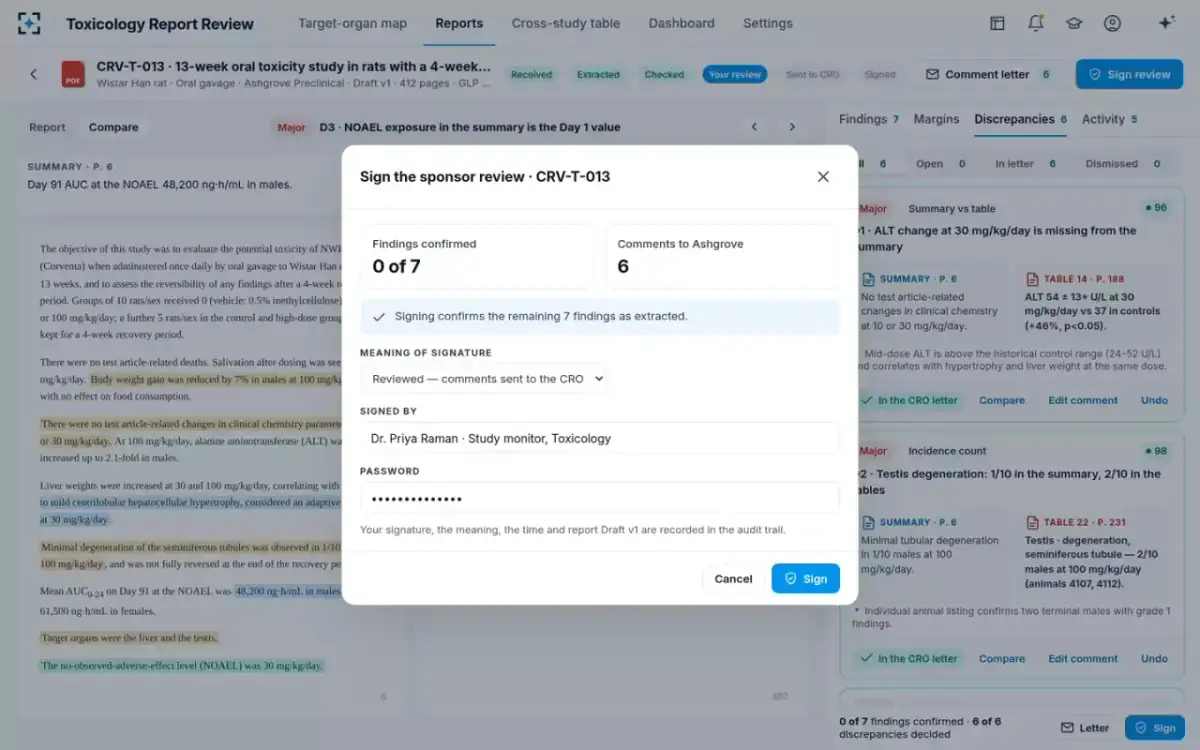
The output of the window is a numbered comment letter to the study director: one comment per issue, each with its location, what is wrong, and what the sponsor asks for. The sample letter runs to six, addressed to the study director at the contract laboratory, with a class against each — five major, one minor — and a reply date ten working days out. Numbered comments are not a formality. The next draft gets checked against the list, item by item, and an item the laboratory declines has to be visible as declined rather than lost.
What the sponsor's signature means should be written down, because "approved" covers several different claims. In the solution the signer picks the meaning from a short list, and the default on a draft review is the narrow one: reviewed, comments sent to the contract laboratory. That is a far smaller statement than accepting the report, and on a draft it is the only true one — the report is not final, the laboratory has not replied, and the findings behind the sponsor's own reading are still marked as draft wherever they appear in the programme's tables.
Signing the sponsor review: the meaning, the count and the version
The inspection that reads the same pages two years later
The last reason to do the work in the window is that someone else will do a version of it later, without the window's deadline and without the sponsor in the room. FDA's compliance programme for nonclinical laboratories sets the interval plainly: its objective is "to inspect (approximately every two years) nonclinical laboratories conducting safety studies that are intended to support applications for research or marketing of regulated products" (FDA Compliance Program 7348.808, implementation date 6 October 2026).
What that inspection does to a chosen study is the same four comparisons, run harder: the protocol and its amendments, the raw data, the records and the specimens, all held against the final report. A sponsor's study monitor and an FDA investigator are looking for the same class of thing — a report that says something the data behind it does not. The difference is the cost of finding it. In the comment window a correction is an edit to a draft. After the study director signs, it is a formal amendment to a final report, identifying what is being corrected and why, signed and dated. The full inspection order, and how to run it on a draft, is set out in a GLP audit checklist for a CRO draft report.
That is the whole argument for the seat. The study monitor cannot control the study and cannot write the report, so the only leverage the role has is time — the ten days between a draft and a signature, spent on the comparisons that a later reader will make anyway. To see the queue, the comparisons and the signature on one sample programme, start from Toxicology Report Review.
Questions people ask
What is the difference between a study monitor and a study director?
They sit on opposite sides of the contract. The study director is named by the testing facility and, under 21 CFR 58.33, is the single point of study control, responsible for the technical conduct, interpretation, analysis and reporting of the study. The study monitor is the sponsor's scientist for that study: agreeing the design, following it in life, reviewing the draft report and sending the sponsor's comments. Only the study director signs the final report.
Does a sponsor study monitor have to be a toxicologist?
No regulation requires any particular qualification for the sponsor's side; Part 58 sets personnel requirements for the testing facility, not for the sponsor's reviewer. In practice the seat is filled by a toxicologist or a scientist with repeat-dose study experience, because the review turns on judgements about adversity, dose response and reversibility. The adverse-against-adaptive call on histopathology belongs to the study pathologist in any case.
What happens during the CRO comment window?
The sponsor reads the draft and sends back numbered comments. The window is a commercial term, commonly ten, fifteen or twenty working days, set in the statement of work rather than by regulation. The sponsor checks the summary against the tables, the tables against the individual animal listings, the exposure values against the toxicokinetic report and the whole against the protocol and its amendments, then writes one comment per issue with its location and what is asked.
Who signs off on a CRO toxicology report at the sponsor?
Nothing in Part 58 requires a sponsor signature at all — the regulation's signatures belong to the study director, the quality assurance unit and the pathologists. Sponsors add their own because the submission is theirs to defend. Typically the named study monitor signs the review of the draft, the toxicologic pathologist confirms the adverse-against-adaptive calls, and the safety assessment lead signs where the study sets a programme-level conclusion.
How often does FDA inspect a nonclinical laboratory?
Approximately every two years, under FDA Compliance Program 7348.808, for laboratories running safety studies intended to support research or marketing applications. An inspection audits at least one completed study, comparing the protocol and its amendments, the raw data, the records and the specimens against the final report. FDA also runs directed inspections — to verify critical safety studies behind a pending application, or to look into unreliable data brought to its attention — so a given study can be audited sooner.
Can a sponsor ask a CRO to change a study report?
Yes for errors of fact, and with care for matters of interpretation. Corrections to counts, exposure values, units, missing deviations and inconsistencies between the summary and the tables are ordinary comments, and the study director is responsible for accurate reporting. Diagnoses and the adverse-against-adaptive judgement belong to the study pathologist and the study director; FDA expects divergences to be resolved through a transparent, documented process, and a sponsor that still disagrees records its own position in its own review.