The SEND implementation guide — the SENDIG, from CDISC — is the specification that says how an animal toxicology study's subject-level data is laid out so that every study arrives in the same shape. CDISC describes SEND as the nonclinical implementation of its tabulation model for study data, a consistent way to collect and present nonclinical results, and one of the standards FDA requires for data submissions (CDISC, SEND). What matters on a sponsor's desk is a timing detail rather than a data model: the datasets are filed at the same moment as the PDF study report, which means the sponsor's reviewer has two independent descriptions of one study before anybody signs anything. Botminds' Toxicology Report Review reads the report side — every finding, incidence, exposure and stated no-adverse-effect level with the page it came from — and maps what it extracts to SEND controlled terminology, so the prose can be held against the vocabulary the datasets use.
This page is written for the person who receives both files, not for the person who builds them. Everything about the requirement is quoted from FDA's Study Data Technical Conformance Guide and from CDISC, and linked. The worked example is sample data on a fictional molecule.
Four facts about SEND that change how a draft is reviewed
Same day
the datasets are due with the nonclinical PDF study report for a commercial IND or NDA/BLA
Draft too
report status — draft, interim or final — does not change whether SEND applies
Not only GLP
non-GLP toxicity studies submitted to support clinical safety must include SEND
v3.1.1
the latest general SENDIG release CDISC lists, dated 30 March 2021
What is the SEND implementation guide, and what does it cover?
The SENDIG describes the datasets, their variables and the terminology a nonclinical study submits. Its scope is narrower than "toxicology": CDISC lists single-dose and repeat-dose general toxicology, carcinogenicity studies, and the respiratory and cardiovascular testing done in safety pharmacology (CDISC, SEND). Other study types have guides of their own — CDISC lists SENDIG-DART for embryo-fetal development and juvenile studies, for example — and FDA is plain about anything no supported guide covers: a study type missing from every FDA-supported SENDIG, primary pharmacology for example, does not need SEND even if some of its endpoints could be modelled in it.
The reviewer's reading of that scope is a useful one. The studies the SENDIG covers are precisely the studies whose reports carry a no-adverse-effect level, an exposure table and an incidence table — the three things a sponsor review turns on. For those studies, a second machine-readable copy exists.
Which studies require SEND, and when the datasets are due
The requirement is stated by study purpose rather than by study name. "SEND is required for single-dose and repeat-dose general toxicology studies that are submitted by the sponsor to support the safety of a proposed clinical trial under commercial IND development or for the support of marketing authorization and/or labeling," FDA's conformance guide says (Study Data Technical Conformance Guide v6.3). Carcinogenicity studies and the repeat-dose studies supporting a carcinogenicity special protocol assessment are covered too, when initiated after the relevant requirement date.
The timing sentence is the one worth pinning to the wall: "Additionally, SEND datasets are required to be submitted at the same time as the nonclinical PDF study report for a commercial IND or NDA/BLA." And for the stage where a sponsor review actually happens, the guide is explicit that draft reports are in scope — "SEND datasets are required when submitting a draft study report as these data form the basis of regulatory decisions regarding nonclinical support for clinical development in accordance with the dates specified in the Catalog". Where datasets later change, the new ones replace the old with the final report; where they do not, FDA recommends an updated reviewer's guide noting that nothing changed.
Two scope rules catch programmes out. The requirement does not depend on good laboratory practice status — FDA says whether SEND is included has nothing to do with whether the study was run under GLP — and it does not depend on report status: "the study report status or the finalization of the study report (i.e., draft, interim or final) does not impact whether the SEND requirement applies". A non-GLP tolerability study used to argue clinical safety carries datasets like everything else.
What the datasets carry, and what they leave out
SEND carries the animals. Each dataset holds subject-level results — the individual laboratory values, the individual microscopic findings, the individual exposures — in named variables with coded terms. That is a complete description of what was measured and a very incomplete description of what the study concluded.
The gap has been described precisely in the peer-reviewed literature. SEND "provides structured formats for recording subject-level data" but "is insufficient for robust predictive modeling and comprehensive database searching: SEND data primarily captures individual animal measurements, lacking the crucial context of overall study interpretation", write Doktorova and colleagues in Archives of Toxicology (Doktorova et al., 2026). The interpretation — which findings were called adverse, which were called adaptive, where the no-adverse-effect level was set and why — lives in prose.
This valuable information, however, is locked within these unstructured free-text toxicology reports, often available only as PDF documents.
Doktorova et al., Archives of Toxicology, 2026
That sentence is the whole argument for reading the report as well as the data, and for reading it with something better than a highlighter. The datasets will tell you that twelve animals had a finding. Only the report will tell you whether the study director thought it mattered.
The same finding, asked of the datasets and of the report Toxicology Report Review reads
The SEND datasets: Exactly, animal by animal, with the terms the pathologist coded.
The study report: As an incidence count in a table, and again, usually rounded or grouped, in the summary.
The SEND datasets: A graded value per animal on the study’s own scale.
The study report: A sentence describing the distribution, which is where a grade can quietly become "minimal to mild".
The SEND datasets: Not carried. Adversity is an interpretation, not a measurement.
The study report: Stated, and the basis for the no-adverse-effect level.
The SEND datasets: The recovery-phase results, animal by animal.
The study report: The judgement about reversibility, which can rest on one animal.
The SEND datasets: Concentrations and derived parameters by subject and timepoint.
The study report: A table of group means by day, sex and dose — and a summary that quotes one of them.
The SEND datasets: Not carried as such; it is a conclusion drawn over the findings.
The study report: A list, which has to agree with the tables behind it.
Reading the datasets against the prose: three checks that cost nothing
If both files are in the building, three comparisons are available before anybody opens a spreadsheet, and each tests a different kind of error.
The first is counts. Take an incidence from the summary and count the animals in the data that carry the coded finding at that dose and sex. A mismatch is either a transcription error in the report or a mapping decision in the datasets, and both are worth a comment. FDA expects the second case to be declared rather than left to be discovered: where differences in how clinical observations are presented in the report mean that terms or counts in incidence tables built from the data cannot easily be reconciled to the report, the conformance guide says they "should be mentioned in the nSDRG".
The second is exposure. Take the figure the summary quotes for the no-adverse-effect level and find the same group, day and sex in the exposure data. Quoting the first sampling day instead of the last is the classic error, because the two values sit in the same table and differ by enough to move a margin. Which row sets your margin works through why that matters.
The third is vocabulary. Take the terms the report uses for its findings and hold them against the controlled terminology release in force for the study. Drift here does not change a number; it changes whether a cross-study comparison will ever line the finding up with its counterpart in another study.
The handful of domains a sponsor reviewer actually opens, and what each one tests in the report
| Dataset | What it holds | The report section it tests |
|---|---|---|
| Laboratory test results | Individual clinical pathology values, with categorical results held as text rather than numbers. | The clinical pathology narrative, and every percentage change quoted in the summary. |
| Microscopic findings | Each animal’s findings, standardised to a base pathological process with the severity grade beside it. | The pathology narrative and the incidence tables, including the ones repeated in the summary. |
| Clinical observations | In-life observations only — no events, no interventions, no numeric results. | The in-life section, and any incidence table built from observations. |
| Pharmacokinetic concentrations | One result per analyte, per subject, per sample. | The toxicokinetic tables the exposure margin is computed from. |
| Pharmacokinetic parameters | Derived parameters, named consistently with the concentrations they come from. | The exposure figures quoted in the summary and the discussion. |
| Trial summary | The study’s own parameters, including the start date the submission is validated against. | The design section: species, route, duration, group sizes. |
The nSDRG: the document that explains your own data
Every submission of nonclinical data carries a reviewer's guide, and its naming is fixed: "An SDRG for nonclinical data should be named nsdrg (the prefix 'n' designates 'nonclinical') and the document should be named 'nsdrg' and provided as a PDF file upon submission (nsdrg.pdf)" (Study Data Technical Conformance Guide v6.3, section 2.1.2). FDA does not require a particular template, though it prefers the published one.
For a sponsor reviewer the nSDRG is the most useful short document in the package, because it is where every awkward decision is supposed to be written down: an extended severity list, a mapping that cannot be reconciled with the report's own tables, a conformance finding that was accepted rather than fixed. Reading it first tells you which of the three checks above will throw differences that are already known and explained, and which will throw differences nobody has looked at. Where multiple studies are reported in one document, each study carries its own package — datasets, nSDRG and definition file — so that each can be reviewed independently.
Versions, the Data Standards Catalog and the study start date
Which version of the standard applies is not a sponsor choice, and it is not decided by the submission date. It is decided by the study's own start date against the dates published in FDA's Data Standards Catalog. The conformance guide's footnote to the SEND requirement points straight there — "see the Data Standards Catalog for the latest version of SEND required and the relevant requirement dates for specific submission types" — and the validation machinery works the same way: "the expectation is that when the SSD is after the established required deadlines, the study data must comply with the standards in the FDA Data Standards Catalog".
The start date itself is read from the trial summary dataset, and FDA's automated checks reject submissions where it cannot be found. The practical consequence for a long programme is that two studies in the same package can legitimately sit on two different versions of the standard, because they started in different years. A reviewer comparing them needs to know that before concluding that one of them is wrong.
Toxicology Report Review keeps the contract laboratory's own words beside the standard term
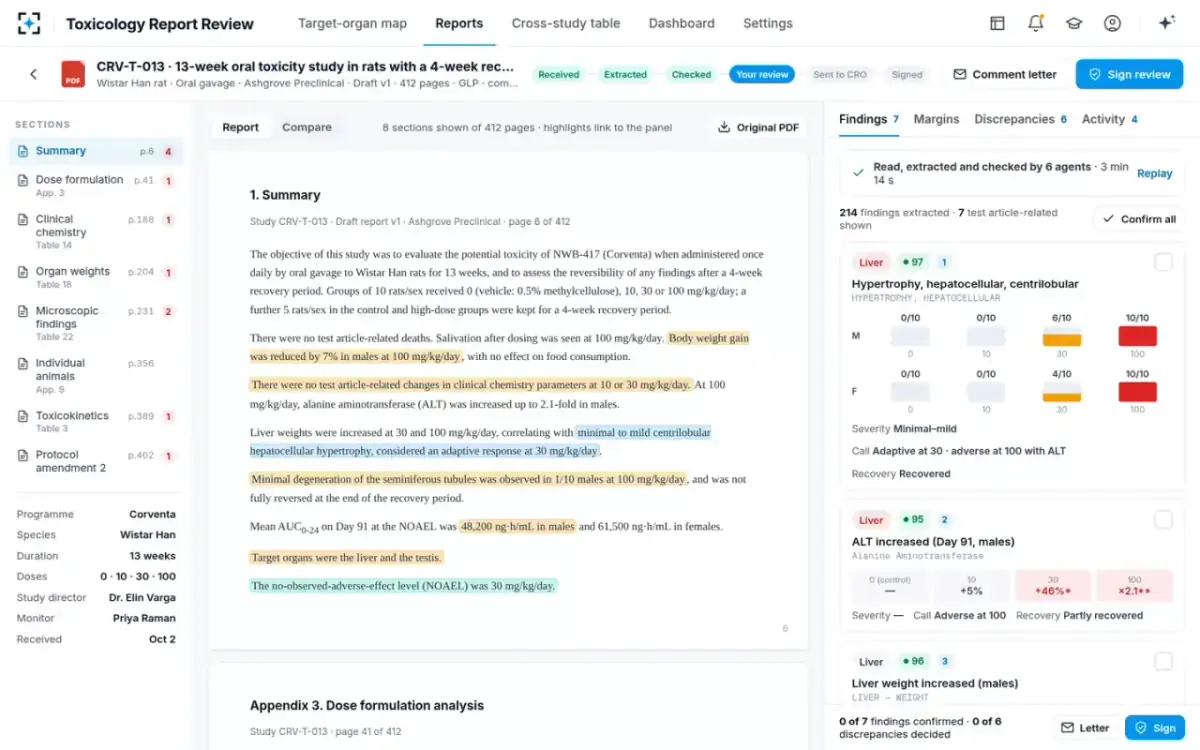
Can SEND data be used to check a study report?
Yes, for anything that is a count, a value or an exposure, and no for anything that is a judgement. That boundary is firm and it is the useful part of the answer. The datasets are an independent transcription of the measurements, so they can confirm that an incidence in the summary matches the animals, that an exposure quoted at the no-adverse-effect level is the one in the table, and that a severity distribution described in a sentence matches the grades recorded. They cannot tell you whether a finding should have been called adverse, whether a target organ list is complete, or whether a second no-adverse-effect level has appeared in the discussion — because none of those is in the data.
There is also a caution in the other direction. A difference between the datasets and the report is not automatically a report error. Mapping to a standard vocabulary groups findings, and grouping changes counts. That is why FDA asks for such differences to be declared in the reviewer's guide, and why a sponsor reviewer should read any difference as a question for the study director rather than as a finding against them. The wider checklist for a draft report puts this check among the others that pay off first.
The regulation behind all of this is short. For each toxicology study intended primarily to support the safety of the proposed clinical investigation, an investigational new drug application must contain a full tabulation of its data, in a form a reviewer can examine in detail (21 CFR 312.23(a)(8)). SEND is how that tabulation is now delivered; the report is how it is explained.
The reviewer's checks, in the order they pay off
- Read the nSDRG first
It should name every mapping decision that will not reconcile with the report, every extended terminology list and every accepted conformance finding.
- Confirm the version applying to this study
From the study start date against the Data Standards Catalog, not from the submission date — two studies in one package can sit on different versions.
- Count one incidence per target organ
Take the figure the summary quotes, count the animals carrying the coded finding at that dose and sex, and ask about any difference.
- Trace the exposure at the no-adverse-effect level
Match the group, the day and the sex. Quoting the first sampling day instead of the last is the error that moves a margin without looking wrong.
- Hold the vocabulary against the release in force
Terms that do not match the controlled terminology release will not line up with the same finding in another study later.
- Take everything that is a judgement to a person
Adverse against adaptive, the target organ list, reversibility. The datasets have no opinion about any of them, and neither should a machine.
Controlled terminology, and the summary that drifts from it
Controlled terminology is the part of the standard that decides whether a finding in one study can ever be matched to the same finding in another. FDA's description is worth reading as a statement of purpose rather than a technical rule: controlled terminology standards "specify the key concepts that are represented as definitions, preferred terms, synonyms, codes, and code system", and analysis "is greatly facilitated by the use of controlled terms for clinical or scientific concepts that have standard, predefined meanings and representations" (Study Data Technical Conformance Guide v6.3, section 6.1.1).
There is a second instruction beside it that sponsors forget, and it is the one that protects the report: sponsors "should provide the actual verbatim terms that were collected … as well as the coded term". Both, not one. The same rule should govern a sponsor's own review: a mapped term is for comparison, the reported wording is for the comment letter, and a system that discards one of them has made the other unverifiable.
In Toxicology Report Review the terminology check is one of seven the reviewer can run, each switched on or off, and the controlled terminology release in force is itself a setting — the current release or the previous one — so a study that belongs to an older release is checked against the vocabulary it was built on rather than against today's.
Seven checks before the study monitor opens the draft
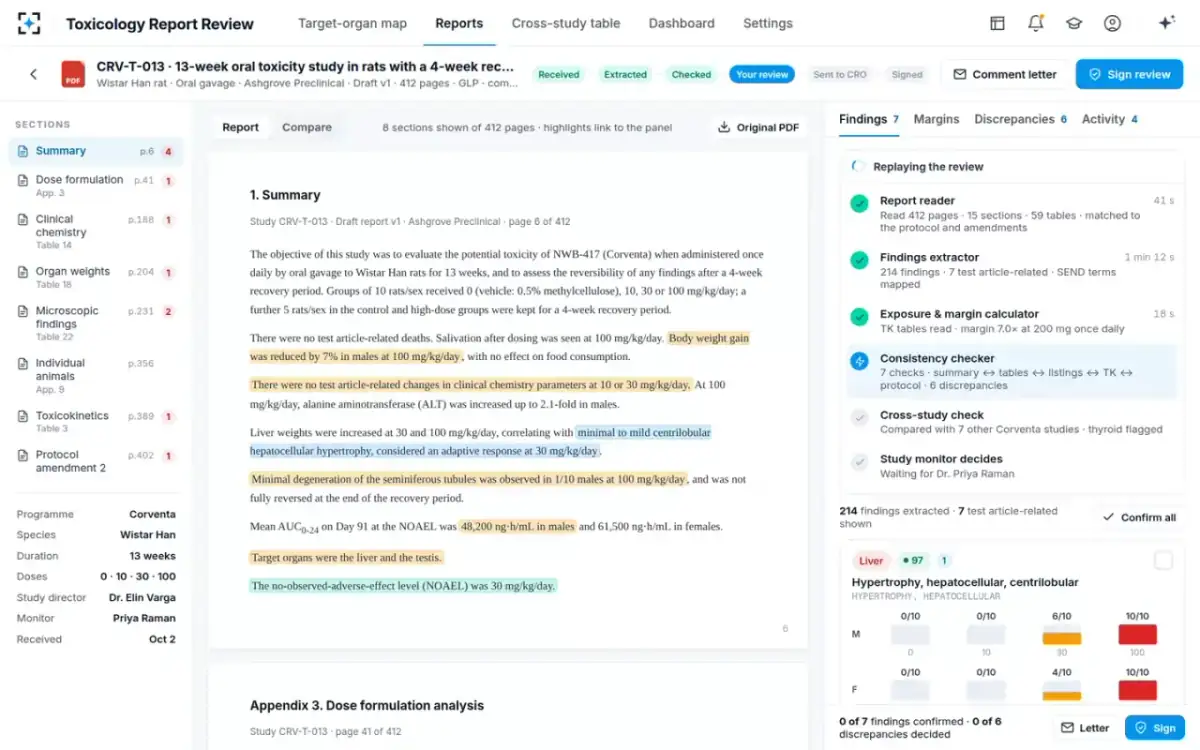
What a cross-study table needs that one study's datasets cannot give
The table a programme actually runs on — species, doses, target organs, the no-adverse-effect level, the exposure at it, the margin at the clinical dose and the human-equivalent dose, for every study — is built from exactly the material SEND does not carry. Every cell in it is an interpretation of one study, and the value of the table comes from the cells being comparable across studies.
Controlled terminology is what makes that comparison possible at all. FDA notes that controlled terminology "is also useful when consistently applied across studies to facilitate integrated analyses … and cross-study comparative analyses", and that such comparisons "occasionally provide critical information for regulatory decisions". A sponsor building a cross-study table is doing the same work on its own account, one programme at a time, and it inherits the same dependency: findings described in different words in two reports will not meet in the table unless something maps them.
That is the division of labour the solution is built on. It reads the study report, the toxicokinetic report, the pathology report and the individual animal listings — the documents that carry the interpretation — extracts each value with its page, maps the extracted terms to SEND controlled terminology and flags terms that do not match, and keeps the resulting table current with draft values labelled as draft. The datasets stay what they are: the independent copy a reviewer can check a count against.
One draft arriving, and where a person is required
Agent
Report readerSplits the report into summary, methods, results, tables, listings, pathology, toxicokinetics and appendices, keeps each section’s page range and matches the report to its protocol and amendments.
Never: alters the source PDF
Agent
Findings extractorPulls findings by organ with incidence by sex and dose, severity, reversibility and the stated no-adverse-effect level, mapping each to the standard term while keeping the reported wording beside it.
Never: marks a finding adverse or adaptive except as the report states it
Agent
Consistency checkerRuns the seven checks, including terminology, and shows both sources for every difference it raises.
Never: decides — it proposes to the study monitor
A person decides
Toxicologic pathologistConfirms the adverse-against-adaptive calls before the review is signed.
A person decides
Study monitorAccepts or dismisses each difference with a reason, signs the sponsor review, and only then does the comment letter leave for the study director.
The programme in one table, every value carrying its source
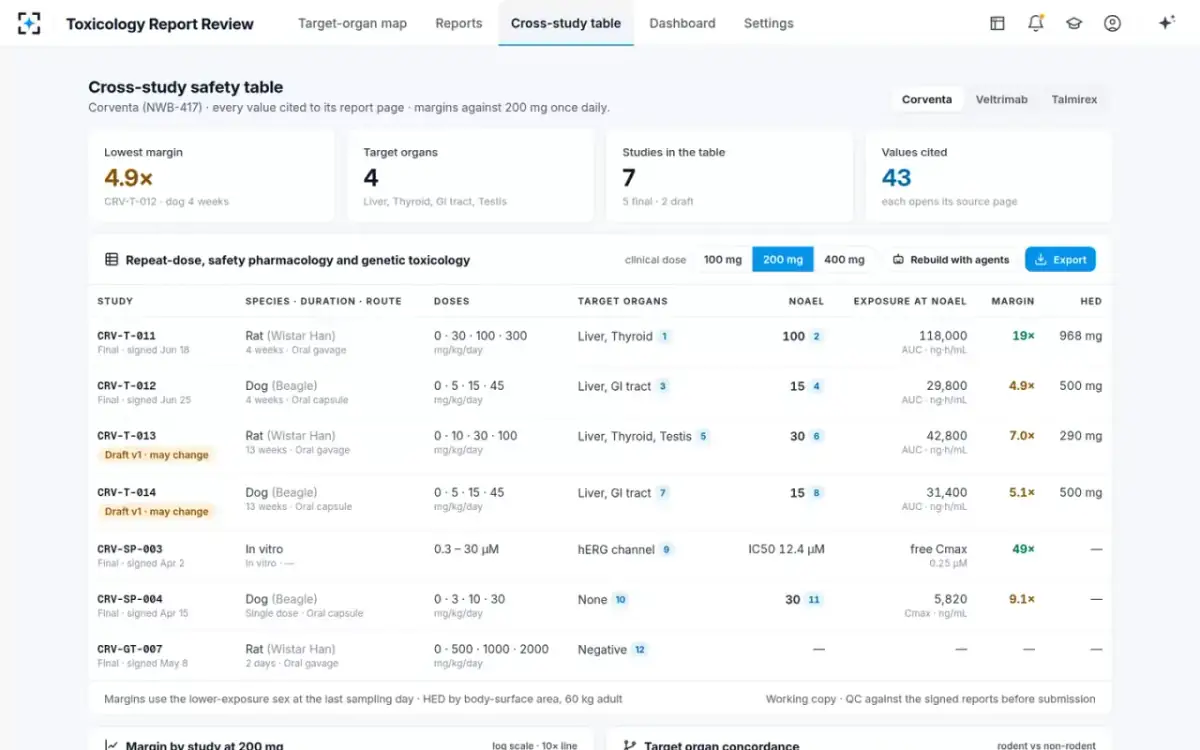
To see the extraction, the terminology check and the comment letter on one of your own drafts, start from Toxicology Report Review.
Questions people ask
What is an nSDRG, and who writes it?
It is the nonclinical study data reviewer's guide, filed as nsdrg.pdf alongside the datasets, and it explains the data to the person reading it: mapping decisions, extended terminology lists, conformance findings and anything that will not reconcile with the study report. FDA does not mandate a template but prefers the published one. It is normally written by whoever prepared the datasets, and it is the first thing a sponsor reviewer should read.
Are SEND datasets required for a draft study report?
Yes. FDA states that datasets are required when a draft study report is submitted, because those data inform decisions about nonclinical support for clinical development, and that report status — draft, interim or final — does not change whether the requirement applies. If the datasets change before the final report, the new ones replace them; if they do not, FDA recommends an updated reviewer's guide saying so.
Does SEND include the study's conclusions?
No. The datasets carry subject-level measurements. The published evaluation of automated extraction from study reports makes the point directly: SEND data primarily captures individual animal measurements and lacks the context of the overall study interpretation. Which findings were adverse, where the no-adverse-effect level sits and why, and the list of target organs all live in the report's prose.
Which SENDIG version applies to my study?
The one tied to the study's start date in FDA's Data Standards Catalog, not the version current when you submit. The start date is read from the trial summary dataset and checked automatically; a submission whose start date falls after a requirement date must comply with the standards the Catalog names. Two studies in one package can therefore sit on different versions.
Do non-GLP studies need SEND datasets?
If they are submitted to support a determination of clinical safety, yes. FDA states that the requirement is not limited to good laboratory practice studies and that the decision to include SEND is independent of that status. Study types not modelled in an FDA-supported SENDIG, such as primary pharmacology, are outside the requirement even when some of their endpoints could be represented.
Can a difference between the datasets and the report be ignored?
Not ignored, but not assumed to be a report error either. Mapping findings to a standard vocabulary groups them, and grouping changes counts, which is why FDA asks that differences of that kind be described in the reviewer's guide. Treat each one as a question for the study director, with both sources shown, and let the answer decide whether it becomes a comment.