A GLP audit checklist is usually written for the facility being inspected. This one is written for the sponsor reading a draft study report, and it is borrowed rather than invented: FDA's own compliance programme for nonclinical laboratories sets out exactly what an inspection compares with what, and a sponsor can run the same comparisons on a draft while corrections are still an edit rather than a formal amendment. The checks are the inspection's — protocol and amendments against the report, raw data against the report, specimens against the report, and the fourteen things a final report must contain. Botminds' Toxicology Report Review runs seven of them on every contract laboratory report as it arrives, shows both sources for each difference, and leaves the decision on every one of them to the sponsor's study monitor.
The draft on this page is fictional sample data from the solution: a 13-week oral toxicity study in rats, 412 pages, Draft v1, with six differences found and five of them classed major. The regulations and the FDA compliance programme are linked where they appear.
What does FDA actually audit in a GLP study?
An inspection of a nonclinical laboratory has two halves: a look at the facility's systems, and a data audit of at least one completed study. The second half is the one a sponsor can rehearse, and the compliance programme states its scope in a single sentence.
"The audit will include a comparison of the protocol (including amendments to the protocol), raw data, records, and specimens against the final report to substantiate that protocol requirements were met and that findings were fully and accurately reported" (FDA Compliance Program 7348.808, Good Laboratory Practice (Nonclinical Laboratories), implementation date 6 October 2026).
Four sources on one side, the report on the other, and two questions: were the protocol's requirements met, and were the findings fully and accurately reported. A sponsor sitting in a comment window has the protocol, its amendments and the report. It usually does not have the raw data or the specimens — but it has the individual animal listings and the appendices, which are the closest thing to raw data that travels with a report, and most of what an audit finds is findable there.
The comparisons, in the inspection's own order
Translated into a sponsor's checklist, the audit becomes seven comparisons. The first five follow the compliance programme's own headings; the last two are additions a sponsor can make that an inspector cannot, because only the sponsor has the rest of the programme in front of it.
Seven checks on a draft report, each naming the two documents it compares
- The summary against the tables
Every number and statement in the summary found in the table behind it. The source of most major findings, because the summary is what everyone downstream quotes.
- The incidence counts against the individual animal listings
Counts by dose and sex recounted from the individual animal data — the inspection's "original" record, and the only place a count can be settled.
- The toxicokinetic report against the summary
Day, sex and dose group behind every exposure value. The error most likely to move a margin without changing a word of the science.
- The report against the protocol and its amendments
Design, schedule and acceptance criteria against the signed protocol, amendment by amendment. FDA: study methods in the report "should be compared against the protocol and the SOPs to confirm those requirements were met."
- Dose formulation results against the protocol's own acceptance criteria
An analytical result outside the protocol range is a deviation whether or not anyone wrote one. 21 CFR 58.113 requires periodic analysis for uniformity and concentration.
- Target organs against the rest of the programme
A finding in another study of the same drug and absent here is either a species difference worth stating or an omission worth a comment. An inspector auditing one study cannot see this; a sponsor can.
- Terminology against the submission standard
The names in the report's tables against the controlled terms in the datasets that will accompany it, so the narrative and the data do not disagree at submission.
Run in that order, the list is cumulative: the summary is checked against the tables, the tables against the listings, and the listings are where an argument ends. Starting at the other end — reading the appendices first — is thorough and almost never finishes inside a ten-working-day window.
What a final report must contain: the fourteen items
Before any comparison, there is a completeness check, and it has a published list. 21 CFR 58.185(a) sets out fourteen things a final report must include, and the useful sponsor-side exercise is to find each one in the draft and note its page — because an item that cannot be found in a 400-page draft will not be easier to find in a submission three years later.
The fourteen items 21 CFR 58.185(a) requires, and where each sits in a 400-page draft
| The regulation's item | Where it usually sits | What a sponsor checks |
|---|---|---|
| 1. Facility name and address; study initiation and completion dates | Title page and the GLP compliance statement | The dates are consistent with the protocol and the in-life records |
| 2. Objectives and procedures from the approved protocol, including any changes | Methods section | Every amendment is reflected, not just listed |
| 3. Statistical methods used | Methods section | The tests named are the tests the tables report |
| 4. Test and control articles: name, code, strength, purity, composition | Methods, with a certificate of analysis in an appendix | The batch in the report is the batch in the formulation analysis |
| 5. Stability of the test and control articles under the conditions of administration | Appendix | Covers the whole dosing period, not just its start |
| 6. A description of the methods used | Methods section | Matches the protocol, and the deviations are written down |
| 7. The test system: number of animals, sex, body weight range, source, species, strain, age, identification | Methods section | Group sizes match the tables; the identification scheme matches the listings |
| 8. Dosage, dosage regimen, route and duration | Methods section | The doses in the methods are the doses in every table header |
| 9. All circumstances that may have affected the quality or integrity of the data | A deviations section, or scattered footnotes | The hardest item to check, and the one a formulation result out of range belongs to |
| 10. Names of the study director, the other scientists and all supervisory personnel | Title page and signature pages | The study director named is the one who signs |
| 11. Transformations and calculations, a summary and analysis, and a statement of the conclusions | Results and discussion | The conclusions stated consistently — not a NOAEL in the summary and another in the discussion |
| 12. Signed and dated reports of each individual scientist or professional involved | Appendices, including the pathology report | Present and signed, including any peer-review statement |
| 13. Locations where specimens, raw data and the final report are to be stored | Archive statement | Named, so the material can be found at an inspection |
| 14. The quality assurance unit's signed statement | Front matter | Present, with the inspection dates on it |
Items 9 and 11 do most of the work. Item 11 requires a statement of the conclusions drawn from the analysis, which a summary and a discussion that disagree cannot both be — the question behind how a NOAEL is determined in the first place. Item 9 is the home of everything unplanned that happened, and a report whose deviations section is empty on a 13-week study is a report whose deviations are somewhere else.
Protocol against report: the amendments nobody re-reads
The protocol is read carefully once, before the study starts. The amendments are read once each, when they are signed. By the time the draft report arrives, months later, the document the report must match is the protocol as amended, and almost nobody reconstructs it.
FDA's audit does: its comparison is against "the protocol (including amendments to the protocol)", and its protocol-against-report heading names more than a dozen things to check — the selection and acquisition of the test system, housing and assignment, clinical observations and treatments, sampling and analysis for contaminants in feed and water, preparation and administration of the test article, analysis of the test article mixtures, handling of dead or moribund animals, necropsy and histopathology.
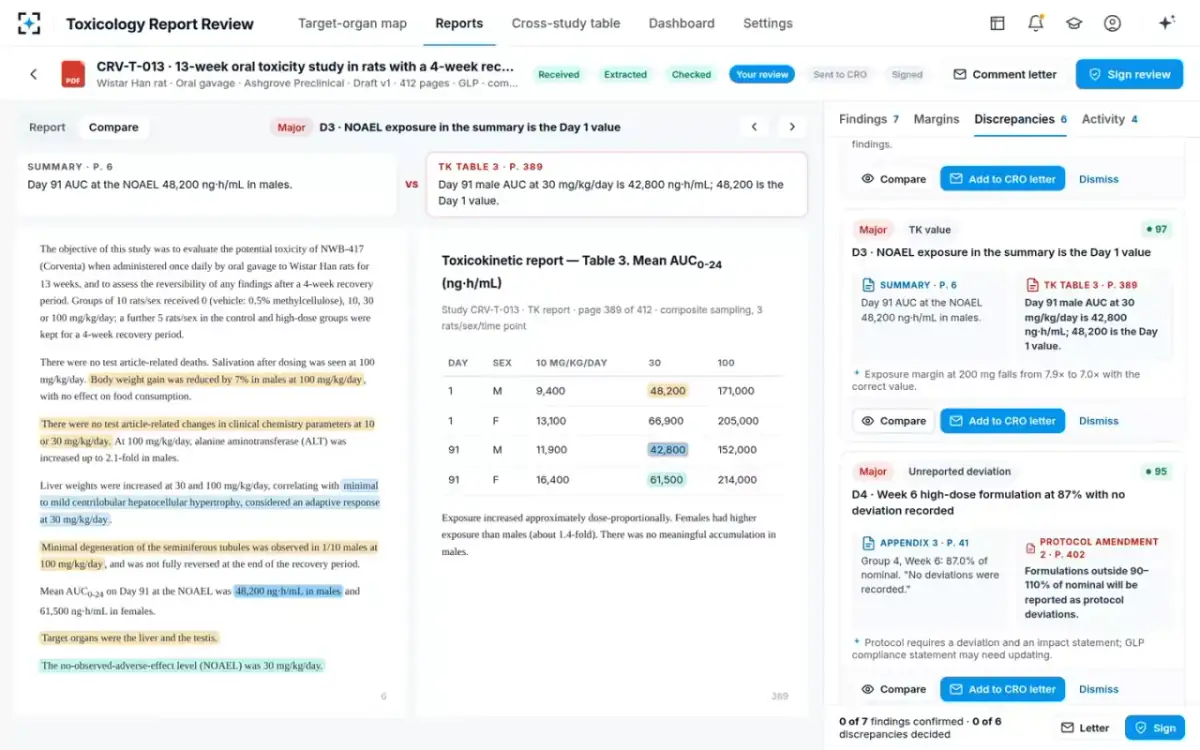
In the sample draft the amendment that matters is the second one, on page 402, which sets the acceptance criterion for dose formulations at 90 to 110% of nominal and requires anything outside it to be reported as a protocol deviation. The appendix on page 41 reports a Week 6 formulation at 87.0% of nominal for the top-dose group, and states "no deviations were recorded." Neither page is wrong on its own. Together they are a finding.
Report against raw data: counts, listings and individual animals
The second comparison is the one that takes the time. The compliance programme asks for "a detailed review of records, memorandum, and other raw data to confirm that the findings in the final report completely and accurately reflect the raw data", with representative samples audited against the report — body weights, food and water consumption, dosing records, formulation analyses, protocol-required analyses, necropsy and gross pathology, histopathology.
It also asks for something a sponsor can imitate exactly: "A representative number of animals from selected dose groups (initially the control and high) should be traced from receipt through final histopathologic examination." Pick two or three top-dose animals, follow them through every table and appendix in the report, and see whether the same animal has the same story everywhere. It is often the most productive hour in a draft review.
One finding, traced from the summary to the animals it is made of
What the summary says, page 6: Minimal degeneration of the seminiferous tubules was observed in 1/10 males at the top dose, and was not fully reversed at the end of the recovery period.
What the tables and listings say: Table 22, page 231: 2/10 males at the top dose, seminiferous tubule degeneration, minimal.
What the summary says, page 6: Not named.
What the tables and listings say: Individual animal listing, Appendix 9: animal 4107 unilateral, animal 4112 bilateral, both grade 1. Two terminal males with grade 1 findings.
What the summary says, page 6: —
What the tables and listings say: The incidence in a summary is what the brochure and the submission summaries quote; a count that the pathology table contradicts is a reporting error, not a difference of opinion.
What the summary says, page 6: —
What the tables and listings say: "The summary reports seminiferous tubule degeneration in 1/10 high-dose males; Table 22 and Appendix 9 list 2/10 (animals 4107 and 4112). Please correct the incidence in the summary and the pathology narrative."
Both sources on screen, with the values highlighted
Dose formulation, deviations, and the record that explains them
Dose formulation analysis is where a study's arithmetic meets its chemistry, and it has its own section of the regulation. 21 CFR 58.113 requires that mixtures of a test article with a carrier be analysed "to determine the uniformity of the mixture and to determine, periodically, the concentration of the test or control article in the mixture" (21 CFR 58.113). A result outside the protocol's acceptance range means the animals in that group did not receive the dose the report says they received, for whatever period the result covers.
What makes it a finding is not the number but the silence. An out-of-range result with a recorded deviation and an impact statement is a study being run properly: someone noticed, wrote it down, and said what it meant for the data. The same result with "no deviations were recorded" on an adjacent page is an unexplained gap between the protocol's requirement and the report, and it is exactly what an inspection's protocol-against-report comparison is for.
The related habit is in the records themselves. Under 21 CFR 58.130, "any change in entries shall be made so as not to obscure the original entry, shall indicate the reason for such change, and shall be dated and signed or identified at the time of the change." A sponsor rarely sees raw data sheets, but it sees the consequence: values that changed between a draft and the next draft, with no note saying why. Asking why is free in the window.
What does 'accurate' mean to an inspector?
The compliance programme sets out five qualities the study records must have, and defines each in a short sentence. They are the familiar data-integrity words, and reading them as questions about a draft report is the quickest way to turn them from a slogan into a check.
The inspection's five words, and what each one asks of a draft report
Attributable
"The raw data can be traced, by signature or initials and date to the individual observing and recording the data."
In a draft report: does every table say who produced it, and does the report name the scientists and supervisory personnel involved?
Legible
"The raw data are readable and recorded in a permanent medium."
A change to an entry must not obscure the original, must give the reason, and must be dated and signed at the time.
Contemporaneous
"The raw data are recorded at the time of the observation."
Dates that run backwards, or a deviation written up after the report, are the signal here.
Original
"The first recording of the data."
The individual animal listing, not the summary table built from it — which is why counts are checked against the listing and not against each other.
Accurate
"The raw data are true and complete observations."
The whole of the sponsor's review is a proxy for this one: does the report say what the data behind it say?
The fifth is the one that matters most and is defined most simply: "Accurate – the raw data are true and complete observations." Complete is doing as much work as true. A summary that states there were no test-article-related changes in clinical chemistry at the mid dose, over a table that shows a 46% rise in a liver enzyme at that dose, contains no false number anywhere. It is incomplete, and incompleteness is the failure mode a summary-against-tables check exists to catch.
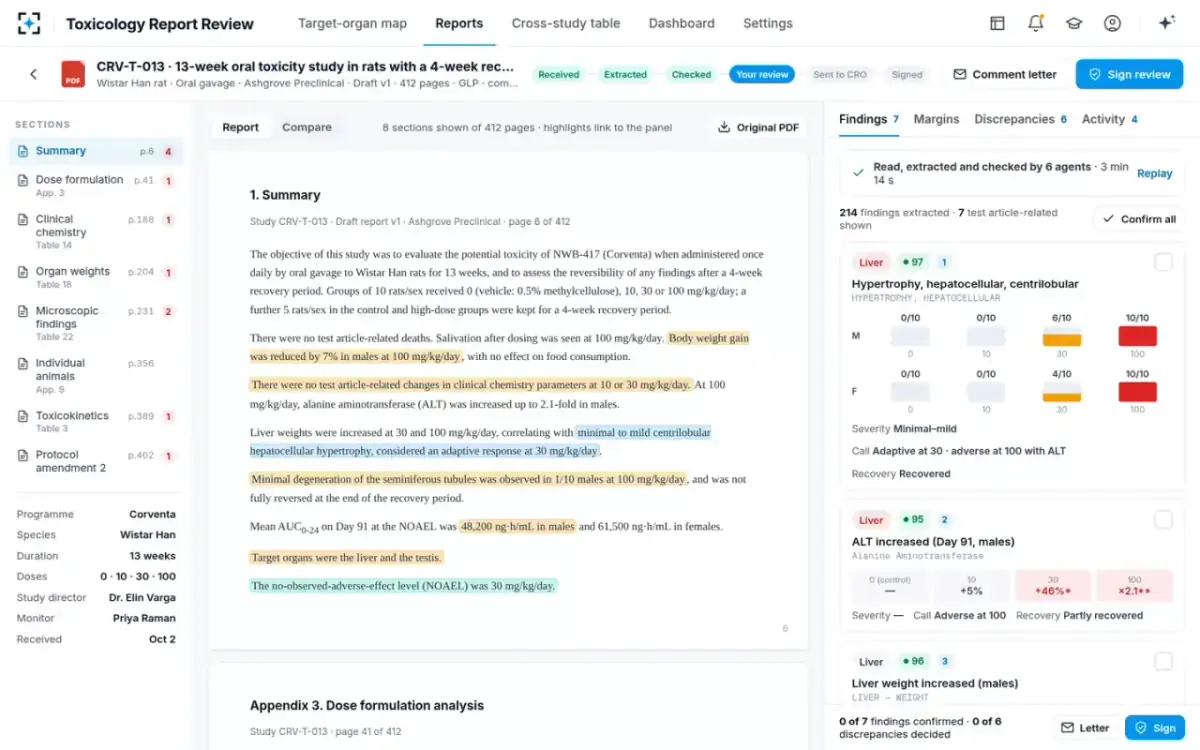
Each finding, with the page it was read from
The quality assurance statement, and what it does not promise
Every GLP final report carries a statement from the testing facility's quality assurance unit, and it is routinely over-read. The regulation says what it must contain: a signed statement, included with the final report, giving the dates the unit inspected the study and the dates its findings went to management and to the study director (21 CFR 58.35(b)(7)).
Dates, and that findings were reported. Not a warranty that every number in the report is right, not an audit of the sponsor's interests, and not an independent body — the unit belongs to the testing facility, is required to be independent of the people running the study, and reports to that facility's management. A sponsor that treats the statement as its own check has delegated the question to the organisation whose work is in question.
What the statement is genuinely useful for is as a date check. If the inspection dates on it do not span the phases of the study the protocol said would be inspected, or if there is no quality assurance statement in the draft at all, that is a question for the window, and it is the kind of question that is awkward to raise for the first time after the study director has signed.
Why the draft is the cheap place to find all of this
Everything above can be found later. The difference is what it costs to fix. Inside the comment window a correction is an edit to an unsigned document: the contract laboratory changes the sentence and issues the next draft. After the study director signs, the regulation requires a formal amendment by the study director, identifying the part being corrected and the reason for it, signed and dated — a separate document that must then travel with the report to everyone who has already read it.
The same correction, found in the window and found after the signature
- Draft arrives, sponsor reviews2 wks
- Comment letter to the study director1 wk
- Contract laboratory corrects, issues Draft v23 wks
- Sponsor confirms, final report signed2 wks
- Error found in the signed final report4 wks
- Amendment drafted, agreed, signed and dated4 wks
- Amended report re-issued to everyone who has it3 wks
- Summary documents and tables re-checked and re-issued5 wks
There is a second clock behind both lanes, and it is long. FDA inspects nonclinical laboratories approximately every two years, and when it audits a study it runs the comparisons at the top of this page against the final report — by which time the people who wrote it may have moved on and the window is years closed. A sponsor that ran the same comparisons on the draft has nothing new to learn from that inspection, which is the whole argument for doing it when it is cheap. The seat that does it, and the ten days it has, are described in what a toxicology study monitor does, week by week.
Six findings, six numbered comments, one signature
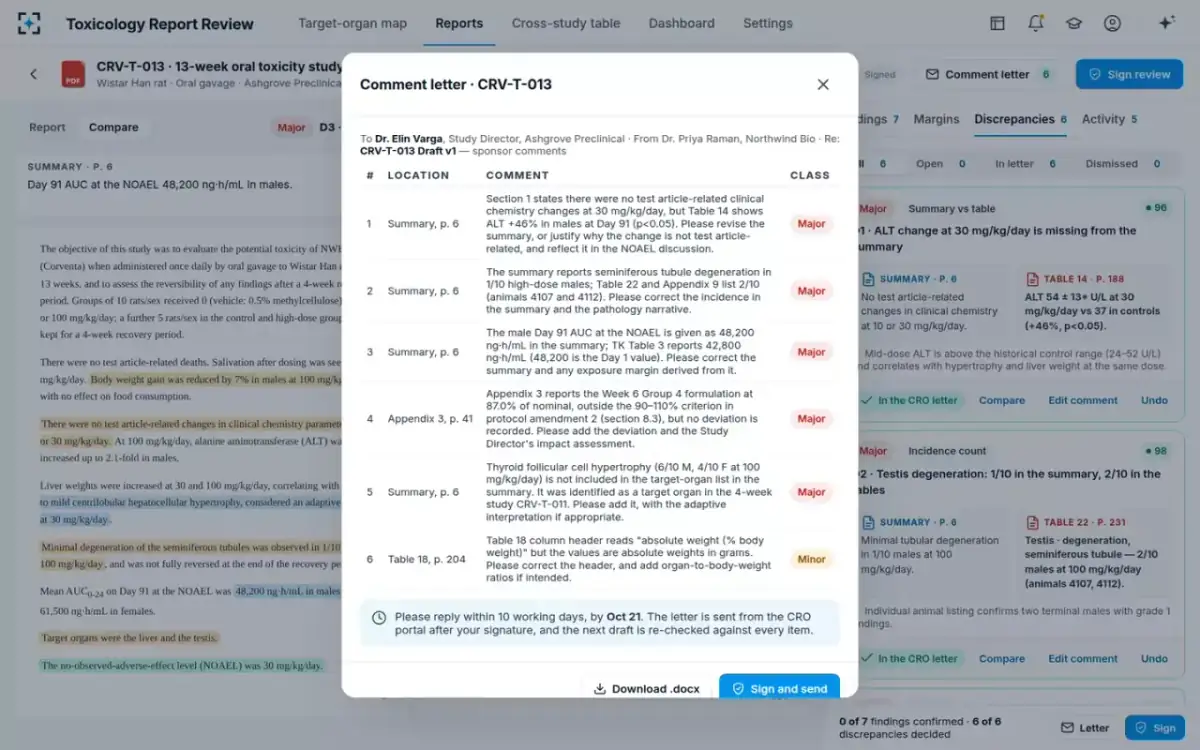
One closing note on what this checklist is not. It does not make the sponsor the study director, and none of the seven checks produces a conclusion: each one produces a pair of pages that disagree, for a named person to decide. The arithmetic that depends on getting those pages right — the exposure values, the days, the sexes — is worked through in which row sets the margin. To see the seven checks running on one sample draft, start from Toxicology Report Review.
Questions people ask
What does 21 CFR 58.185 require a final report to contain?
Fourteen items under 21 CFR 58.185(a), from the facility's name and the study dates through the test article's identity and stability, the methods, the test system, the dosage, anything that may have affected data quality, the people involved, the calculations and a statement of the conclusions, the signed individual reports, the storage locations and the quality assurance unit's statement. The report must then be signed and dated by the study director.
What are the ALCOA data integrity principles?
Attributable, legible, contemporaneous, original and accurate — the five qualities FDA's compliance programme requires of study records when it audits them. Its own definitions are short: traceable by signature or initials and date to the person who observed and recorded the data; readable and in a permanent medium; recorded at the time of the observation; the first recording; and true and complete observations.
What happens if the final report does not match the raw data?
Corrections to a signed final report are made by amendment by the study director, identifying the part corrected and the reason, signed and dated — and the amended report has to reach everyone who already has it, including any submission built on it. At an inspection, a report that does not reflect the raw data is the central finding of a data audit, because substantiating that findings were fully and accurately reported is what the audit is for.
Who writes the quality assurance statement in a study report?
The testing facility's own quality assurance unit, which must be independent of the people running the study. Its statement specifies the dates inspections were made and when findings were reported to management and to the study director. It is a record of inspection activity, not a certification that every value in the report is correct, and it is not the sponsor's check.
How do you document a protocol deviation in a GLP study?
In writing, at the time, with its reason and an assessment of its effect on the study, and in a form the final report can reflect — the report must describe all circumstances that may have affected the quality or integrity of the data. An analytical result outside the protocol's own acceptance criterion is a deviation whether or not anyone wrote one up, so "no deviations were recorded" on a page next to an out-of-range result is a question, not an answer.
How do you check a draft study report?
In the inspection's order, and from the top down. Confirm the fourteen required items are present and note their pages; compare the summary with the tables; recount incidences from the individual animal listings; check exposure values against the toxicokinetic report by day, sex and dose; compare the report with the protocol as amended, including the dose formulation results; then compare the target organs with the rest of the programme. Write one comment per issue, with its location.