ICH M3(R2) is the guideline that says which nonclinical safety studies a human clinical trial needs, and its most-used answer is a duration: a repeated-dose toxicity study must generally be at least as long as the dosing in the trial it supports, in a rodent and in a non-rodent. That sounds like a planning fact, and it is treated as one. It is also a check on paperwork, because the duration is claimed from study reports, and the reports a programme holds are often 300-to-500-page contract-laboratory drafts with comments still open. Botminds' Toxicology Report Review reads each draft as it arrives, extracts the design, the findings and the exposures with the page each value came from, and puts the duration the study supports next to the margin it gives — so the programme's duration line is read off the reports the sponsor actually holds.
Everything below about the guideline is quoted from the ICH text and linked. The worked programme is sample data on a fictional molecule and two fictional contract laboratories, used once to show what the check looks like on a real desk.
What does ICH M3(R2) require, and what it leaves to the regions
M3(R2) is a framework, not a list of studies to buy. It sets out what should be done before each stage of human testing — safety pharmacology, repeated-dose toxicity, genotoxicity, local tolerance, reproduction toxicity, carcinogenicity where relevant — and for each it gives a timing relative to clinical development rather than a fixed menu. The parts a sponsor consults weekly are three: the table of repeated-dose durations, the rules for choosing the high dose, and the section on estimating the first dose in human.
Two things it deliberately does not settle. The first is the arithmetic of the first human dose: M3(R2) says what information should be weighed, and leaves the algorithm and the safety factor to the regions. The second is a short list of regional alternatives written into the footnotes of its own tables — the United States accepts an extended single-dose study in place of two-week studies for a single-dose trial, the EU accepts six months rather than nine in the non-rodent, and both Japan and the United States accept up to six months in named circumstances. Read the table without the footnotes and you will plan a study you did not need, or miss one you did.
ICH M3(R2) in Toxicology Report Review's duration check: the common rule, and what a region still decides
The same for everyone: Two-week repeated-dose studies in a rodent and a non-rodent.
Still regional: In the United States an extended single-dose study is an accepted alternative for a single-dose trial, and a trial shorter than 14 days can be matched by studies of its own duration.
The same for everyone: Nine months, to support dosing longer than six months.
Still regional: Six months is accepted in the EU; where a longer study has already been run, a six-month study is not added. Japan and the United States accept up to six months in listed cases.
The same for everyone: Three-month studies in both species, plus complete chronic data before the extension.
Still regional: The extension runs "consistent with local clinical trial regulatory procedures", so when the chronic data must be filed is a regional question.
The same for everyone: All relevant nonclinical data — pharmacological dose response, pharmacology, pharmacokinetics — weighed before the dose is set.
Still regional: The calculation itself, and the safety factor applied to it, follow the region’s own guidance.
Do you need both a rodent and a non-rodent study?
Yes, for general repeated-dose toxicity, and missing this is a frequent misreading of the table. The guideline's rows are not "a study of at least this length"; they are two columns, rodent and non-rodent, and the duration applies to each. For trials beyond two weeks, M3(R2) asks for repeated-dose toxicity studies at least as long as the trial (ICH M3(R2), section 5.1), and the table beside that sentence sets the same requirement in both species.
The practical consequence is that a programme's duration is set by whichever species is behind. A sponsor with a finished 13-week rat study and a 4-week dog study does not have 13 weeks of support; it has four. Conversely a 26-week rat study does not buy anything extra while the non-rodent is at 13 weeks. The pair is the unit, and the weaker half governs.
There are places the pair gives way — a second species adds nothing for some biotechnology-derived products, and the guideline addresses those separately — but for a conventional small molecule in general toxicity testing the two-species rule is the one a protocol amendment will be read against.
The duration table in plain words
The table below is M3(R2)'s Table 1 with its footnotes moved up beside the rows they change, which is how a reviewer needs to read it. Nothing has been added to the guideline's numbers.
Recommended minimum duration of repeated-dose toxicity studies, with the footnotes folded in
| Maximum duration of the clinical trial | Rodent | Non-rodent | What the footnotes change |
|---|---|---|---|
| Up to 2 weeks | 2 weeks | 2 weeks | In the United States, extended single-dose toxicity studies can support single-dose human trials. Clinical studies of less than 14 days can be supported by toxicity studies of the same duration as the proposed study. |
| Between 2 weeks and 6 months | Same as the clinical trial | Same as the clinical trial | A trial can run past 3 months on 3-month studies in both species, provided complete chronic rodent and non-rodent data arrive before dosing is extended beyond 3 months. |
| Over 6 months | 6 months | 9 months | In the EU, 6 months in the non-rodent is acceptable, and a longer study already run is not supplemented by one. Up to 6 months can also be appropriate in Japan and the United States for intermittent dosing, confounded tolerability, recurrence prevention in cancer, or short life expectancy. |
One row trips people up for a different reason. "Same as clinical trial" is a floor, not a target: a 13-week study supports 13 weeks of dosing, not 13 weeks plus a safety buffer, and a trial designed for twelve weeks of dosing that slips to fourteen has outrun its studies. Where a trial's dosing duration is still moving, the sensible design question is whether the studies should be run one step longer than the plan rather than exactly at it.
A second table in the guideline, for marketing authorisation rather than trials, is stricter and is the one to look at before the first study is commissioned: clinical dosing of up to two weeks wants one-month studies in both species, two weeks to one month wants three months, one to three months wants six months, and anything longer wants six months in the rodent and nine in the non-rodent. Teams that plan only against the trial table end up repeating work at filing.
Does a 13-week study support a three-month trial?
A 13-week study in one species does not. A 13-week rodent study and a 13-week non-rodent study, both reported, do support clinical dosing up to three months — that is the "same as clinical trial" row read correctly. The distinction matters because the shorthand "our 13-week rat covers the Phase 2" turns up in planning documents, and it is only true when the non-rodent study exists beside it.
It also matters which version of the report the support rests on. For a first application to test a drug in people, FDA has long accepted an integrated summary built on unaudited draft reports of completed animal studies, expecting that those drafts "might undergo minor modifications during final review and quality assurance auditing", with the final, fully quality-assured reports available within 120 days of the start of the human study and the summary updated for any differences (FDA, Content and Format of INDs for Phase 1 Studies, November 1995). A draft with six open discrepancies is exactly what that expectation rests on: whatever the review changes has to be carried into the final report and declared. This is the join between the guideline and the desk: the duration question and the draft-review question are the same question, asked by two different people.
One programme's pair against its clinical plan, as Toxicology Report Review lays it out
- Clinical dosing12 weeks
- Dosing duration covered13 weeks
- Dosing duration covered13 weeks
- Covered by the 13-week pair13 weeks
- Not covered13 weeks short
Dosing past three months: the footnote, and what must be in hand when
The most valuable sentence in M3(R2) for a programme in Phase 2 is a footnote, and it is worth reading in full rather than in summary.
In some circumstances clinical trials of longer duration than 3 months can be initiated, provided that the data are available from a 3-month rodent and a 3-month non-rodent study, and that complete data from the chronic rodent and non-rodent study are made available, consistent with local clinical trial regulatory procedures, before extending dosing beyond 3 months in the clinical trial.
ICH M3(R2), Table 1, footnote b
Three things are being said at once. A longer trial can start on the three-month pair. The chronic studies must be complete before dosing in that trial passes three months — not before the trial opens, and not at the next annual report. And "complete data" is the standard, with a documented relaxation for serious or life-threatening indications, where the extension can rest on complete chronic rodent data plus in-life and necropsy data from the non-rodent, with the non-rodent histopathology following within a further three months.
Read as a schedule, the footnote converts into a date: the day the first subject in the trial reaches week thirteen is the deadline for the chronic reports. A programme that treats the chronic studies as a filing activity rather than a dosing prerequisite discovers the deadline from the clinical team.
What has to be in hand before a trial of each length starts
- A trial of two weeks or less
Two-week repeated-dose studies in a rodent and a non-rodent, or, in the United States and for a single-dose trial, an extended single-dose study in their place.
- A trial of twelve weeks
Repeated-dose studies of the same duration in both species — a 13-week rodent and a 13-week non-rodent — each reported, not just a table of top-line results; in the United States a first summary may rest on unaudited drafts, with final reports within 120 days of the start of dosing.
- Dosing that will pass three months
Three-month studies in both species to start, and complete chronic rodent and non-rodent data before dosing is extended, following the local trial procedures.
- Every study you cite
An integrated summary of its toxicological effects, and for each study subject to the Good Laboratory Practice regulations, a statement of compliance or a brief statement of the reason for the noncompliance.
- The people behind the conclusion
The identification and qualifications of the individuals who evaluated the results and concluded that it is reasonably safe to begin the proposed investigations.
- Before the duration line is written
The pair checked against the reports you actually hold, each with its status — draft, amendment or final — and its open comments beside it.
How is the high dose chosen in a toxicity study?
The high dose is chosen to characterise toxicity, not to manufacture a margin, and M3(R2) gives several acceptable ceilings rather than one. Doses up to the maximum tolerated dose will characterise clinically relevant effects, but demonstrating that dose in every study is not essential; equally acceptable are doses that reach large exposure multiples, that saturate exposure, or that use the maximum feasible dose. Above all of them sits a flat number: "Limit doses for acute, subchronic, and chronic toxicity studies of 1000 mg/kg/day for rodents and non-rodents are considered appropriate in all cases except those discussed below" (ICH M3(R2), section 4.3).
The exceptions are narrow and arithmetical. Where 1000 mg/kg/day does not reach a mean ten-fold exposure margin and the clinical dose exceeds one gram a day, the limit becomes a ten-fold margin, or 2000 mg/kg/day, or the maximum feasible dose, whichever is lowest; and in the rare case where 2000 mg/kg/day still gives less exposure than the clinic, a higher dose up to the maximum feasible dose can be considered.
For a reviewer, the point of knowing these ceilings is that the report has to say which one it used. A study whose high dose is 1000 mg/kg/day with no toxicity is a different document from one whose high dose was limited by tolerability at 100, and the second is the one whose findings set the programme's target organs. A draft that reports the high dose without naming its basis is a draft with a comment coming.
Why the animal high dose is not a safety margin
The high dose and the margin are routinely confused in programme discussions, and they measure different things. The high dose is a design decision about how far the study pushed the animal. The margin is a comparison between the exposure at the dose where nothing adverse happened and the exposure a patient will actually see. A study can have a very high top dose and a thin margin, because the margin is set at the no-adverse-effect level, not at the ceiling.
Dose escalation in the clinic works off the same foundation. M3(R2)'s question-and-answer document is explicit that where study doses were chosen by the 50-fold exposure route and adverse findings that were not dose-limiting appeared in at least one study, "Doses might be escalated in the clinical studies based on the NOAEL for the adverse findings identified in the toxicity studies" (ICH M3(R2) Questions and Answers). The level where adversity began is the reference point, so an error in the report about where adversity began is an error in the clinical ceiling. Which study row actually sets your margin works through the comparison itself; here it is enough to say that the duration check and the margin check are two readings of the same table and belong on one screen.
Toxicology Report Review puts the duration the study supports beside the margin it gives
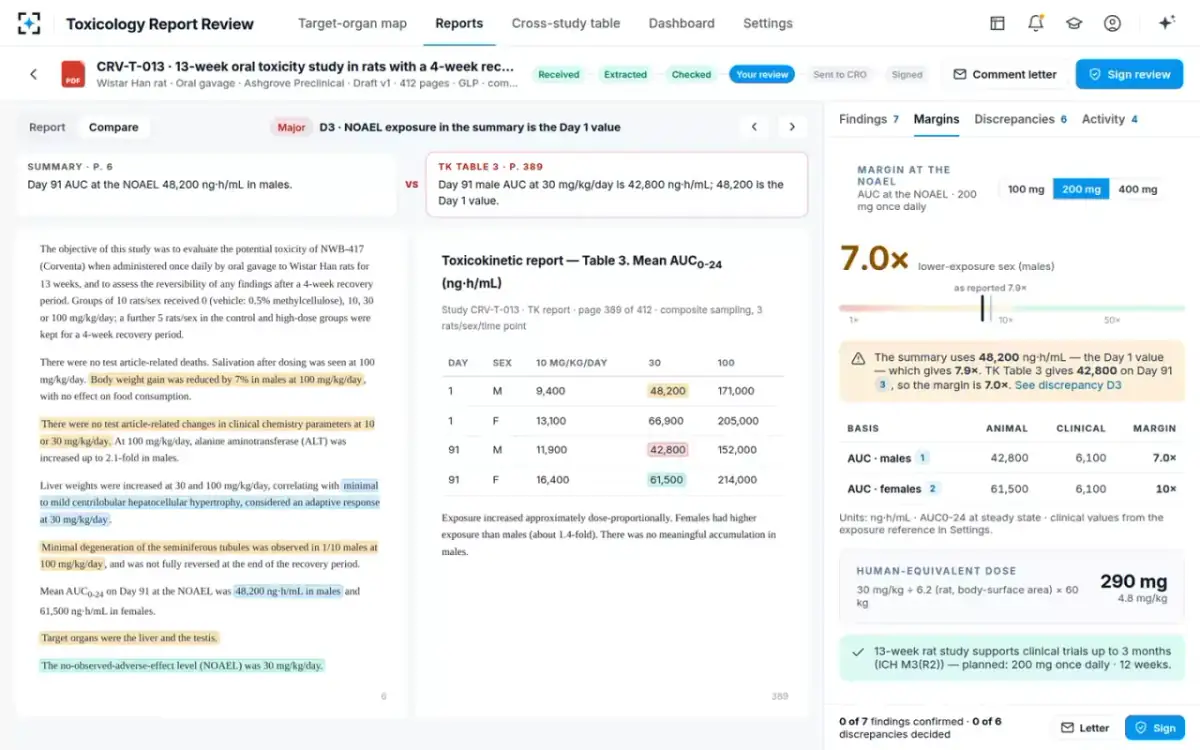
The first dose in human: where M3(R2) stops and the regional algorithm starts
"The estimation of the first dose in humans is an important element to safeguard subjects participating in first-in-human studies," M3(R2) says, and then lists what should be weighed: the pharmacological dose response, the pharmacology and the pharmacokinetics, alongside the toxicology (ICH M3(R2), section 6). What it does not do is give the formula. The conversion from an animal dose to a human-equivalent dose, and the safety factor applied to it, come from regional guidance, which is why two groups can read the same study and propose different starting doses without either misreading the guideline.
That division of labour is useful to a reviewer. The number M3(R2) makes you responsible for is the one from the study — the level at which no adverse effect was seen, and the exposure at it, on the right day and in the right sex. The arithmetic downstream is well specified and easy to audit; the input is the part that comes out of a 400-page draft and can be wrong. The conversion itself, and the ten-fold factor, is a separate piece of work with its own pitfalls.
Running the duration check against the report you were sent
A duration check is four questions, and all four are answerable from the drafts in front of you: which species, how many weeks of dosing, is the report final or still a draft with open comments, and what does the clinical plan now say. Done by hand it means opening two reports, reading the design section of each, and remembering which plan version is current. Done against extracted data it is a line on a screen that changes when the plan changes.
How Toxicology Report Review gets from a contract laboratory's draft to a duration a programme can rely on
Agent
Report readerSplits the report into summary, methods, results, tables, listings, pathology, toxicokinetics and appendices, keeps the page range of each, and matches the report to its protocol, amendments and earlier versions.
Never: alters the source PDF
Agent
Findings extractorPulls the design — species, strain, route, weeks of dosing, dose groups — and the findings by organ with incidence by sex and dose, each value carrying its page.
Never: states a value without a page citation
Agent
Exposure and margin calculatorReads the toxicokinetic tables, picks the right day, sex and dose, and computes the margin at the planned clinical dose next to the duration the study supports.
Never: leaves the basis of a margin unstated
Agent
Consistency checkerTests the summary against the tables, the tables against the individual animal listings, the report against its protocol and amendments, and the study against the rest of the programme.
Never: decides — it proposes to the study monitor
Agent
Target-organ map builderHolds every study in the programme in one table so the pair covering the clinical plan can be read at a glance, with draft values labelled as draft.
Never: promotes a draft value to a confirmed one
A person decides
Study monitorDecides what the pair supports, accepts or dismisses each discrepancy with a reason, and signs the sponsor review with the meaning of the signature recorded.
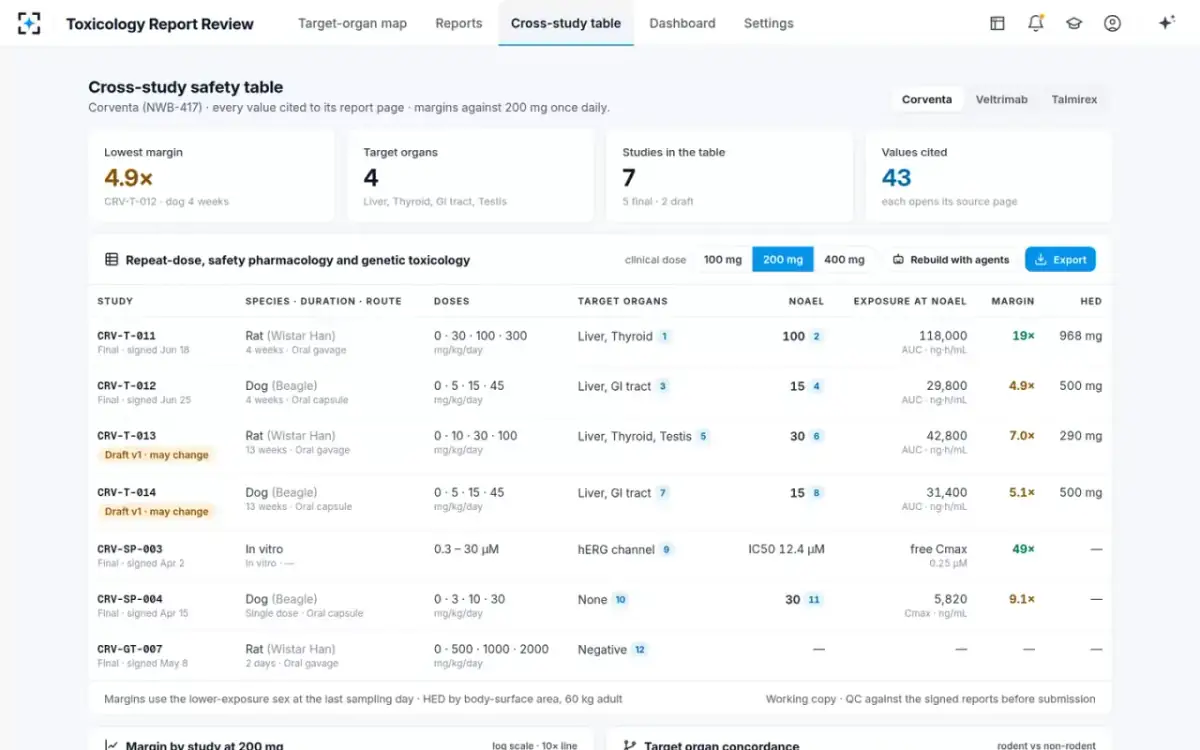
Two settings decide what the duration check means in practice. The first is which studies may set an organ's margin: by default only repeated-dose studies at least as long as the clinical plan, with all repeated-dose studies as the alternative. That default is the guideline's logic turned into arithmetic — a four-week study is not allowed to supply the margin for a twelve-week plan. The second is the comment window agreed with each contract laboratory, ten, fifteen or twenty days, which is the real deadline for noticing that the pair is short.
Every study in one table, so the shorter half of the pair is visible
What the IND needs for each study
The guideline tells you which studies to run; the regulation tells you what to file about them. For an investigational new drug application the pharmacology and toxicology section asks for enough information about the animal and in vitro studies to show why the sponsor concluded the proposed investigations are reasonably safe — and then names three specific deliverables (21 CFR 312.23(a)(8)).
The first is "an integrated summary of the toxicological effects of the drug in animals and in vitro". The second applies study by study: for each toxicology study intended primarily to support the safety of the proposed clinical investigation, a full tabulation of data suitable for detailed review. The third is a compliance statement — "for each nonclinical laboratory study subject to the good laboratory practice regulations under part 58, a statement that the study was conducted in compliance with the good laboratory practice regulations in part 58, or, if the study was not conducted in compliance with those regulations, a brief statement of the reason for the noncompliance".
The regulation also asks who stood behind the conclusion: the identification and qualifications of the individuals who evaluated the results and concluded that beginning the investigation is reasonably safe. That sentence is the reason a duration line is not an administrative detail. Somebody's name is attached to it, and a report reader that flags a missing compliance statement before the summary is written is doing that person's work early.
The programme on one map, with each organ's margin at the clinical dose
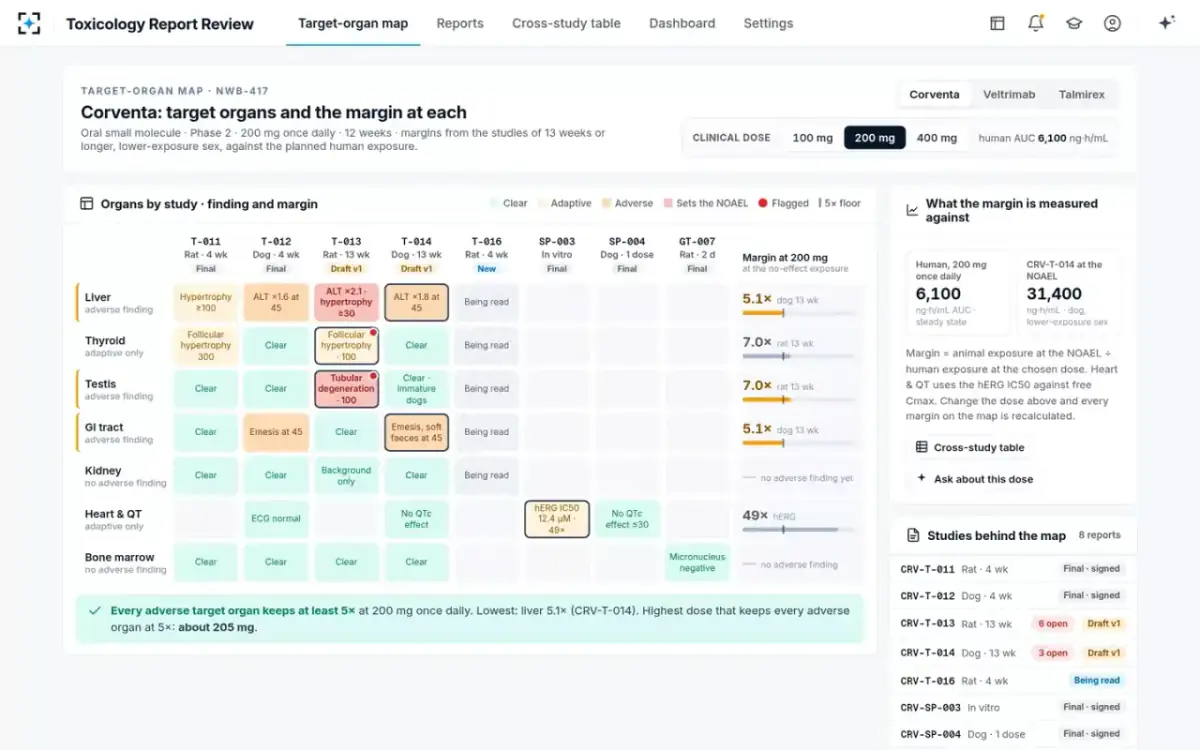
To see the duration check, the margins and the comment letter on one of your own drafts, start from Toxicology Report Review, or read the audit checklist for a draft report for the rest of what a first read should cover.
Questions people ask
What does ICH M3(R2) actually require before first-in-human dosing?
Enough nonclinical work to judge that dosing is reasonably safe, with repeated-dose toxicity studies in a rodent and a non-rodent at least as long as the planned dosing — two weeks in both species for a trial of two weeks or less. Safety pharmacology, genotoxicity and local tolerance work sit alongside it. M3(R2) weighs the information behind the first dose but leaves the calculation of that dose to regional guidance.
Does a 13-week rat study support a three-month clinical trial on its own?
No. The row that covers a three-month trial asks for repeated-dose studies of the same duration as the trial in a rodent and in a non-rodent, so a 13-week rat study needs a 13-week non-rodent study beside it, both reported. A programme's supported duration is set by the shorter of the two.
When do you need a 6-month rodent or 9-month non-rodent study?
To support clinical dosing longer than six months. In the EU six months in the non-rodent is accepted instead of nine, and where a longer study has already been run it is not supplemented with a six-month one. Japan and the United States also accept up to six months in named cases, such as intermittent dosing or a short life expectancy.
What is the limit dose in a repeated-dose toxicity study?
1000 mg/kg/day for rodents and non-rodents is considered appropriate in acute, subchronic and chronic studies in all cases except a short list. Where that dose does not give a ten-fold mean exposure margin and the clinical dose is above a gram a day, the ceiling becomes whichever is lowest of a ten-fold margin, 2000 mg/kg/day, or the maximum feasible dose.
Can a clinical trial start before the chronic studies are reported?
A trial longer than three months can begin on three-month studies in both species, but complete chronic rodent and non-rodent data must be available before dosing in that trial goes past three months, consistent with local procedures. For serious or life-threatening indications the extension can rest on complete chronic rodent data plus in-life and necropsy data from the non-rodent, with its histopathology within a further three months.
What has to be filed about each toxicology study?
An integrated summary of the drug's toxicological effects in animals and in vitro; for each study primarily supporting the proposed investigation, a full tabulation of data suitable for detailed review; and for each study subject to the Good Laboratory Practice regulations, a compliance statement or a brief statement of why it does not comply. The names and qualifications of the people who judged the drug reasonably safe to test are required too.