AI data extraction from a PDF toxicology study report works, and the question worth asking is not whether but how accurately, over which fields, and with what evidence. Published work on 200 study reports puts sensitivity typically above 95% and precision frequently above 97% for the histopathology, organ weight and no-adverse-effect-level fields, and materially lower for fields that are reported inconsistently. That is an extraction story, not a prediction story: nothing here forecasts whether a molecule is toxic, and nothing here decides whether a finding is adverse. Botminds' Toxicology Report Review is built on that distinction. Six narrow agents read each contract laboratory draft, pull every value with the page it came from, check the summary against the tables, compute the exposure margins and draft the comment letter, and a named toxicologist decides every call and signs.
This page is for the buyer who has to say yes or no to AI near a good laboratory practice study report. The accuracy figures below belong to another organisation's published evaluation of its own pipeline, and are attributed as such. The screens are sample data on a fictional molecule.
Can AI extract data from a PDF study report?
It can, and the reason it now can is specific to language models: a toxicology report is not a form. The same finding appears as a sentence in the summary, a row in an incidence table, a grade in a pathology narrative and a line in an individual animal listing, in wording that varies by laboratory and by pathologist. Rule-based extraction has always managed the tables and failed on the prose. The interpretation lives in the prose.
The published description of the problem is blunt about where the value sits: the interpretation a reviewer needs is held in free-text reports, often only as PDF files, rather than in any structured dataset (Doktorova et al., Archives of Toxicology, 2026). Getting at it means reading the document the way a reviewer reads it (section by section, holding each claim against the table behind it) rather than pattern-matching a layout.
The answer is therefore conditional. A machine can extract the values; whether you can use them depends on whether each one arrives with the page it came from, whether the reported wording survives beside any standardised term, and whether anything that is a judgement has been left to a person. Those three conditions do most of the work of making extraction safe.
Predicting toxicity against reading the report that measured it
Two quite different things are sold as "AI in toxicology", and conflating them is an easy error to make in an evaluation. Predictive toxicology estimates a property (mutagenicity, hepatotoxicity, a binding liability) from a structure or from prior data, before an animal is dosed. Report reading extracts what a completed study measured, after the fact, from the document that reports it.
They differ in every way that matters to a buyer. Prediction produces a number nobody observed, so its credibility rests on how well the model generalises, and a regulator's interest in it is high. Extraction produces a number somebody already wrote down, so its credibility rests on whether the extraction matches the source, which can be checked, page by page, by the person who signs. A prediction that is wrong changes what a programme believes about a molecule. An extraction that is wrong changes what a programme believes about a document, and the document is right there to check it against.
Where the hours of one draft review go, by hand and at Toxicology Report Review's target
By hand: 22.4 hours per draft
- Finding, reading and checking · 85%
- Deciding, the letter and signing · 15%
The design target: 6.4 hours per draft
- Finding, reading and checking · 55%
- Deciding, the letter and signing · 45%
That shape is the argument. The deciding hour barely moves, because deciding is not what a machine is being asked to do.
How accurate is AI at reading a toxicology report?
There is a published answer, on a real corpus, and it belongs to somebody else's system. Doktorova and colleagues evaluated an extraction pipeline across 200 study reports: "we evaluated the system performance using 200 Roche toxicology study reports, encompassing clinical pathology, histopathology, organ weights, exposure data, and study-level conclusions". The headline result is field-dependent: "histopathology, organ weight, and NOAEL-related endpoints demonstrated the greatest robustness, with sensitivity typically above 95% and precision frequently exceeding 97%".
A published evaluation of report extraction: another organisation's pipeline, on its own reports
200
toxicology study reports in the evaluation, covering clinical pathology, histopathology, organ weights, exposure data and study-level conclusions
>95%
sensitivity, typically, for histopathology, organ weight and no-adverse-effect-level endpoints
>97%
precision, frequently, on those same endpoints
Lower
for route of administration and substance identifiers; the authors attribute this to heterogeneous reporting, not to the method
The weak fields are as informative as the strong ones. "Lower performance for parameters such as route of administration and substance identifiers reflected heterogeneous reporting practices rather than LLM-based method limitations," the authors write. In other words the machine struggled exactly where laboratories write the same thing six different ways, which is also where a human reviewer skims, because the route of administration is rarely the interesting part.
What those numbers do not cover
Four things, and a buyer should ask about each of them separately.
They do not cover your reports. The corpus was one organisation's, in that organisation's house style, from its own contract laboratories. Accuracy on heterogeneous reporting was the paper's own weak point, so a figure measured on one house style is a reason to run your own test, not a reason to skip it.
They do not cover consistency checking. Extracting a value correctly and noticing that two parts of a report disagree are different tasks with different failure modes. A system can be excellent at the first and useless at the second.
They do not cover interpretation, because nobody is claiming it. Whether a finding is adverse, whether the target organ list is complete, whether a second no-adverse-effect level has appeared in the discussion: none of these is an extraction result.
And they do not cover the thing a reviewer most wants to know, which is the false negative that matters: not the average miss rate across thousands of fields, but whether the one discrepancy that would have moved the margin was found. How to pilot this on your own reports is built around measuring exactly that.
Scanned pages, two-column tables and the appendix nobody paginates
The practical failure modes of PDF reading are mundane and worth listing, because they are what a pilot will hit in week one. A scanned page carries no text layer, so it has to be read optically, and an optical misread of a digit in an incidence table is a silent error rather than a loud one. Rotated landscape tables, tables split across a page break with the header on the first page only, and footnotes that qualify a column from two pages away all produce values that are individually plausible and collectively wrong.
Appendices are the hardest part of a tox report, and the individual animal listings are the hardest part of the appendices: hundreds of pages of dense rows whose own numbering often restarts. A system that quotes page numbers from a report-wide sequence while the reader is looking at an appendix with its own numbering is unusable in a comment letter, because the study director will not find the page.
This is why the page citation, not the extraction, is the feature that makes the rest safe. A value that opens its own page can be checked in two seconds. A value that cannot has to be re-derived by hand, and a reviewer who has to re-derive values is doing the work twice.
One 412-page draft, by hand: where the hours actually go
Does FDA's AI guidance apply to a tool that reads your CRO drafts?
Often not, and the scope sentence is worth reading closely because people assume the opposite. FDA's draft guidance on artificial intelligence for regulatory decision-making leaves out two uses: AI in drug discovery, and AI used for operational efficiencies (internal workflows, resource allocation, drafting a submission) that do not affect patient safety, drug quality or the reliability of results from a nonclinical or clinical study (FDA draft guidance, January 2025).
Read the exclusion carefully, because it has a hinge in it. An internal workflow is out of scope only where it does not affect the reliability of results from a nonclinical study. A system that extracts values a submission will later quote is close to that hinge, and a system that proposes changes to a study report's conclusions has crossed it. The safe reading is that the framework is the right lens whether or not it formally applies, and that the sponsor's own risk assessment should say which side of the line it believes it is on, and why.
The framework itself is not onerous. It "consists of the following 7-step process to establish and assess the credibility of an AI model output for a specific COU based on model risk": define the question of interest, define the context of use, assess model risk, plan the credibility evidence, execute the plan, document the results, and determine adequacy. Credibility, in its terms, is trust in how a model performs for one particular context of use, earned by collecting evidence about that performance.
Context of use: the sentence the framework makes you write down
The single most useful thing an evaluation can borrow from the guidance is the discipline of writing the context of use down. "The COU defines the specific role and scope of the AI model used to address a question of interest," FDA says, and the description "should describe in detail what will be modeled and how model outputs will be used".
For report review that sentence is short and it is a commitment. Something like: the model extracts stated values from a contract laboratory study report and flags internal inconsistencies for a named sponsor toxicologist, who decides every item; no model output reaches a submission or a contract laboratory without that person's signature. Written down, it settles most of the argument about risk, because FDA's own risk test combines two things: model influence, meaning how much the model's output weighs against the other evidence behind a decision, and decision consequence, meaning how serious the harm would be if that decision were wrong. When a person reads both sources for every flagged item before deciding, model influence is low by construction.
The guidance adds the proportionality rule that follows: the activities used to establish credibility "should be commensurate with the AI model risk and tailored to the specific COU". Low influence and a reversible consequence do not need the evidence package a dose-setting model would need. They do need the context of use written down, and they do need the measurement a pilot produces.
Six agents, each step with what it found and how long it took
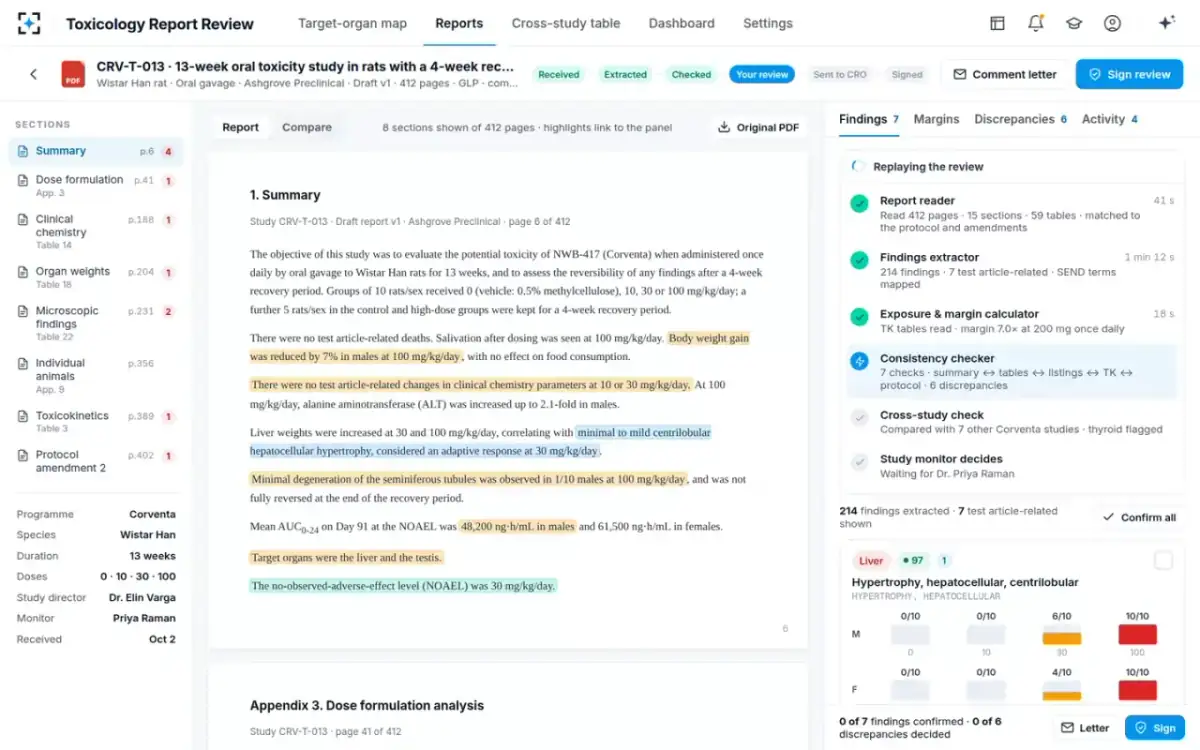
What an AI reviewer must never decide
Three things, and they are not a matter of taste. The first is adversity. The call that a finding is adverse rather than adaptive sets the no-adverse-effect level, and the no-adverse-effect level sets the clinical ceiling; it is a pathologist's and a toxicologist's judgement about biology. An extractor's correct behaviour is to report the call the study made, with its page, and to flag it when the report makes two different calls in two places.
The second is the content of the study report itself. The final report is signed and dated by the study director (21 CFR 58.185(b)), and that signature is the contract laboratory's, not the sponsor's. A sponsor's reviewer comments; it does not edit. Where a change is needed after signature the route is formal: FDA's pathology peer review guidance notes that "when pathology peer review occurs after the final study report is signed, the study director should amend the final study report as necessary to reflect changes in histopathology diagnoses and interpretations" (FDA, Pathology Peer Review in Nonclinical Toxicology Studies, December 2021).
The third is what leaves the building. A comment letter is a communication with a study director about a good laboratory practice study, and it carries the sponsor's name. Nothing should reach a contract laboratory that a named person has not signed.
What each of Toxicology Report Review's agents may do, and what it is barred from
Report reader
MaySplit 412 pages into summary, methods, results, tables, listings, pathology, toxicokinetics and appendices, keep each section’s page range, and match the report to its protocol, amendments and earlier versions.
NeverAlter the source PDF. Leave a section without its page range. Pass over a missing good laboratory practice or quality assurance statement without flagging it.
Findings extractor
MayPull dose groups, findings by organ, incidence by sex and dose, severity, reversibility and the stated no-adverse-effect level.
NeverState a value without the page it came from. Replace the report’s own wording with the mapped standard term. Call a finding adverse or adaptive except as the report states it.
Exposure and margin calculator
MayRead the toxicokinetic tables, pick the day, sex and dose group, and compute margins and human-equivalent doses against the clinical exposure reference.
NeverLeave the basis of a margin unstated. Silently switch sex or sampling day. Hold an old margin after the clinical reference changes.
Consistency checker
MayTest the summary against the tables, the tables against the individual animal listings, the report against its protocol and amendments, and the study against the rest of the programme.
NeverDecide. Raise a difference without showing both sources. Set its own severity rules; those belong to the sponsor’s toxicology function.
Letter drafter
MayTurn accepted differences into a numbered comment table with the location, what is wrong and what the sponsor asks, one request per comment.
NeverSend anything before the study monitor has signed.
Target-organ map builder
MayKeep the programme’s cross-study table current and recompute margins when the clinical dose changes.
NeverUse an unconfirmed finding. Present a value read from a draft report without labelling it as draft.
Six narrow agents instead of one model
The shape of the system matters as much as its accuracy, and it is the part a buyer can inspect without a benchmark. One general model asked to "review this report" produces an answer that cannot be traced back to a page and whose failure cannot be localised. Six narrow agents, each with a stated job and stated limits, produce six outputs that can each be checked against the document.
Narrowness buys three things. Every value carries a page, because the extractor's limit says it must. Every difference shows both sources, because the checker's limit says it must. And nothing leaves before a signature, because the letter drafter's limit says so. None of those is a model capability; all three are design constraints, and constraints are what an inspection can examine.
One draft, six agents, one signature
Agent
Report readerSplits the report into its sections and tables, keeps the page range of each, and matches it to the protocol, the amendments and the earlier versions.
Never: alters the source PDF
Agent
Findings extractorPulls findings by organ with incidence by sex and dose, severity, reversibility and the stated no-adverse-effect level, keeping the report’s own wording beside every mapped term.
Never: marks a finding adverse or adaptive except as the report states it
Agent
Exposure and margin calculatorReads the toxicokinetic tables, uses the lower-exposure sex unless told otherwise, and states the basis of every margin.
Never: leaves a margin without its basis
Agent
Consistency checkerRuns the seven checks and shows both sources for every difference it raises; the severity rules are the sponsor’s.
Never: decides
A person decides
Toxicologic pathologistConfirms the adverse-against-adaptive calls before the review is signed.
A person decides
Study monitorAccepts or dismisses each difference with a reason, signs the sponsor review with its meaning, and releases the letter.
Agent
Letter drafter and map builderDelivers the numbered comment letter after the signature, then refreshes the programme’s cross-study table from confirmed findings.
Never: sends before the signature
What is being signed, and what the signature means
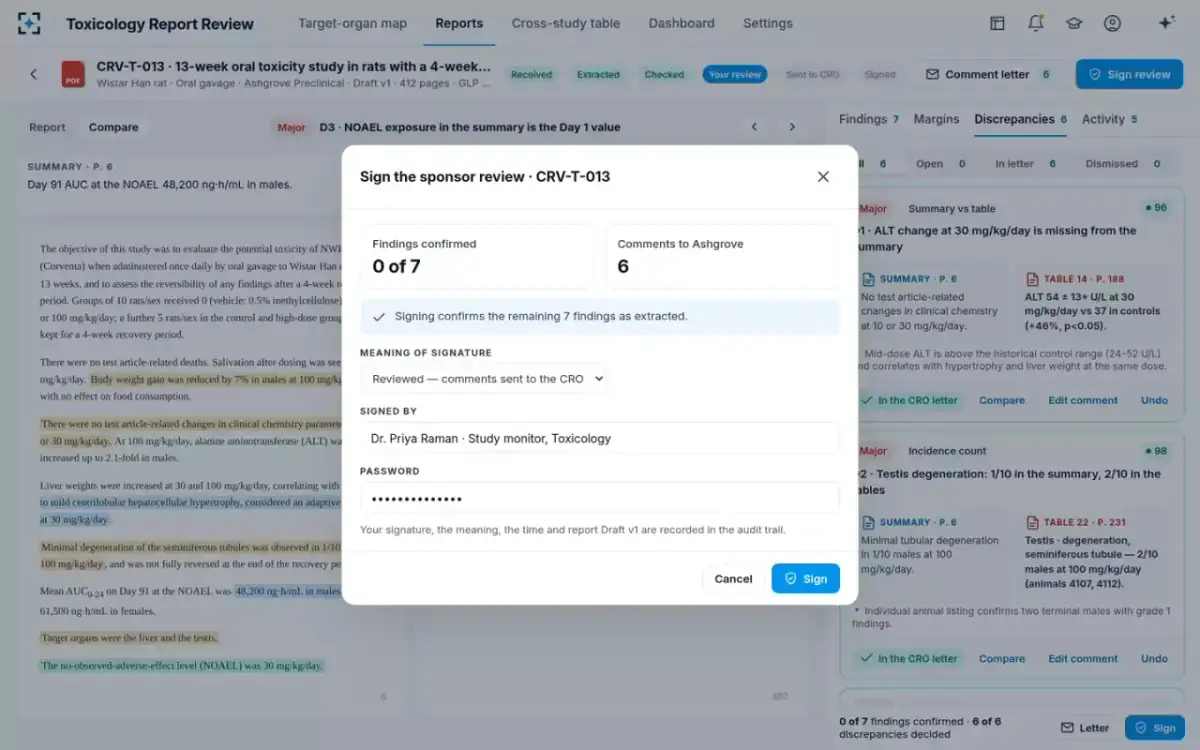
What to ask before AI touches a GLP report
Ten questions that separate an extraction tool from a liability
- Does every extracted value carry the page it came from?
And does the page number work in the appendix, where the listings often restart their own numbering?
- Is the report’s own wording kept beside any standardised term?
A comment letter has to quote the report, not a vocabulary.
- What does the system do with a judgement?
Adverse against adaptive, target organ lists, reversibility: the correct behaviour is to report what the study said and flag a contradiction, not to decide.
- Does a difference always show both sources?
A flag with one source behind it cannot be adjudicated, only believed.
- Who sets the severity rules?
They should be yours, written into settings and visible on the activity trail, not a vendor default.
- What is the context of use, in one sentence?
Write it down as FDA’s framework asks: what is modelled, how outputs are used, and who decides. It settles most of the risk argument.
- Can anything leave without a signature?
Letters to a contract laboratory, exports to a submission document. The answer should be no, demonstrably.
- Is the source document ever modified?
It should be read-only. The signed study report remains the official document.
- What was measured, on whose reports?
A published accuracy figure on somebody else’s corpus is evidence that the task is measurable. Your pilot is evidence about your reports.
- What does the activity trail hold?
Each agent step, each decision and dismissal with its reason, each signature and letter, and every change to a setting such as the margin floor.
One more question belongs on that list and is often skipped: who signs. An investigational new drug application must identify the people who evaluated the animal study results and concluded it was reasonably safe to begin, and state their qualifications (21 CFR 312.23(a)(8)). That requirement is indifferent to how the reading was done. Somebody's name and somebody's qualifications stand behind the conclusion, which is the strongest practical argument for a system that makes a person's decisions easy, visible and fast rather than one that tries to replace them.
To see the extraction, the differences with both sources and the signature on one of your own drafts, start from Toxicology Report Review, or read what a study costs and what an error costs for the business case behind it.
Questions people ask
Can AI read a scanned PDF toxicology report?
It can, through optical character recognition, but with a different risk profile: a misread digit in an incidence or exposure table is a silent error, not a visible one. Treat scanned reports as a separate category in any evaluation, seed a few into a pilot deliberately, and insist on a page citation for every value so a reviewer can confirm the number in seconds.
How accurate is AI at extracting data from a study report?
In one published evaluation, across 200 study reports, sensitivity was typically above 95% and precision frequently above 97% for histopathology, organ weight and no-adverse-effect-level endpoints, with lower performance where reporting practice varied, such as route of administration and substance identifiers. Those are another organisation's measurements of its own pipeline, so they show the task is measurable rather than settling what any tool will do on your reports.
Does FDA allow AI in drug development?
There is no prohibition. FDA's draft guidance sets a risk-based credibility framework for AI whose output supports a regulatory decision, and expressly does not address drug discovery or operational uses that do not affect patient safety, drug quality or the reliability of a study's results. The practical answer is to write down the context of use and size the evidence to the risk.
Can AI decide whether a finding is adverse?
It should not. Adversity is a biological judgement that sets the no-adverse-effect level and therefore the clinical ceiling. The right behaviour for an extraction system is to report the call the study report makes, cite the page, and raise a flag when the report makes different calls in different places. A toxicologic pathologist confirms the call before a review is signed.
Who signs when a machine did the reading?
The same person as before. The contract laboratory's study director signs the final study report; the sponsor's named toxicologist signs the sponsor review and the comment letter, with the meaning of that signature recorded alongside the time and the report version. An investigational new drug application also names the individuals who concluded the drug is reasonably safe to test, which no tool changes.
What should an AI toxicology tool never do?
Alter a source report, state a value without the page it came from, decide adversity, raise a difference without showing both sources, send anything to a contract laboratory before a signature, or present a value read from a draft report without labelling it as draft. Each of those is a design constraint an inspection can check, not a model capability.